Hemant Taneja is the CEO and Managing Partner of General Catalyst. He anchors a study of innovation and technology, with attention to how technological change becomes an operating and strategic concern. His framing invites scrutiny of what meaningful, responsible innovation requires from leaders.
Responsible Innovation and AI
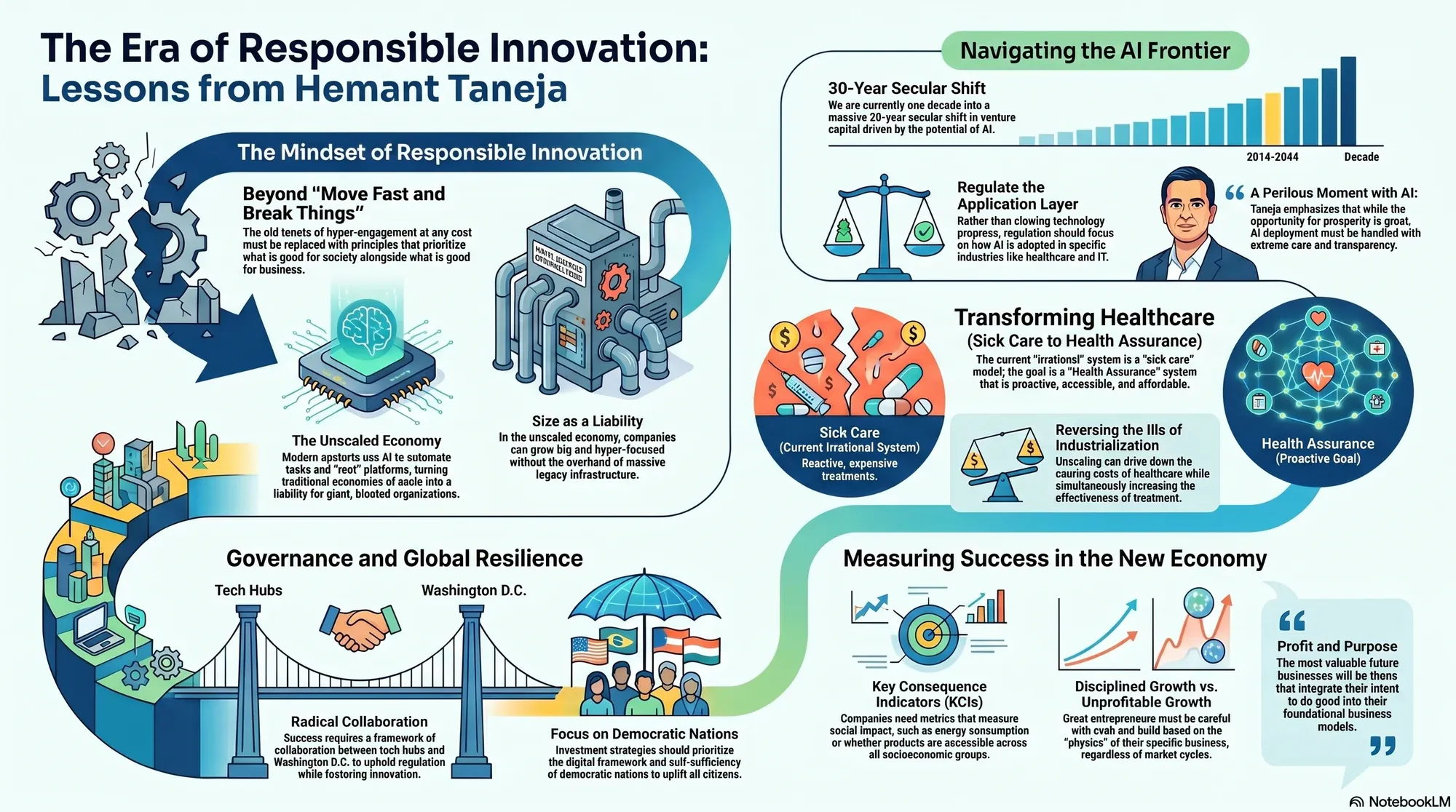
- On Replacing Move Fast and Break Things: The “move fast and break things” mindset is inadequate when technology companies shape essential services; founders should consider stakeholders and unintended harm while designing products. — General Catalyst — Responsible Innovation.
- On Responsible Innovation: Taneja’s responsible-innovation framework asks founders to align business returns with benefits for society from the outset. — General Catalyst — Responsible Innovation.
- On Fighting Inertia: Transforming healthcare requires overcoming institutional inertia and giving existing providers a credible path into the new model. — Stanford GSB — Profit and Purpose.
- On AI’s Perilous Moment: Taneja and Darren Walker warned that rapid AI deployment creates risks that call for deliberate guardrails, not passive adoption. — Washington Post — AI Guardrails.
- On Enhancing Human Potential: Taneja argues that AI should augment human capabilities rather than simply automate work away, with careful attention to social consequences. — Washington Post Live — AI Interview.
- On Regulating AI Applications: He favors regulating how AI is applied in sensitive industries such as healthcare rather than broadly constraining development of the underlying technology. — Washington Post Live — AI Interview.
- On Balancing AI Regulation: His position is a balance: establish trust and some legal guardrails, but avoid premature or excessive rules while AI and its uses are changing quickly. — Washington Post Live — AI Interview.
- On AI for Low-Margin Businesses: Taneja sees an opportunity for founders to use AI to help low-margin businesses become more productive and profitable; he presents this as potential, not a proven result for every industry. — Stanford GSB — Profit and Purpose.
- On AI for Hyper-Focused Markets: In Unscaled, Taneja and Kevin Maney argued that AI and rentable technology platforms could let focused upstarts serve narrower markets without building giant organizations. — PublicAffairs — Unscaled.
- On Transparency and Values: Responsible deployment of powerful technology requires clear values, transparency, and attention to the people affected by its products. — General Catalyst — Responsible Innovation.
- On AI-Native Rollups: General Catalyst’s applied-AI strategy includes acquiring service businesses and improving their operations with AI, rather than only selling them software. — General Catalyst — Applied AI.
- On Radical Collaboration: Taneja argues that large-scale change depends on collaboration with people inside entrenched institutions, not disruption from outside alone. — Thrive Global — Navigating Ambiguity.
- On Trust as AI’s Constraint: For AI companies entering regulated, high-stakes sectors, Taneja argues that earning trust and becoming embedded in real workflows may matter more than raw technical capability. — Hemant Taneja — Q1 2026 Review.
- On AI-Native Operations: Taneja and Hirsh Jain advocate redesigning enterprise work around people and AI systems together, instead of adding AI to unchanged legacy processes. — General Catalyst — Unveiling Percepta.
Healthcare and System Transformation
- On Transforming Healthcare: Taneja’s health-assurance effort aims to make care more proactive, accessible, and affordable by working with health systems and technology partners. — General Catalyst — The Future of Health.
- On Health Assurance: In UnHealthcare, written with Stephen Klasko, Taneja advances a shift from reactive sick care toward proactive, accessible, affordable health assurance; this is a proposed direction, not a demonstrated system-wide outcome. — General Catalyst — Health Assurance 2030.
- On Misaligned Healthcare Incentives: He identifies a structural healthcare problem: the people who decide, pay for, and benefit from care are often different, leaving incentives misaligned. — General Catalyst — Health Assurance.
- On Living the Transformation: General Catalyst created HATCo to work with health systems and operate one itself, testing its transformation thesis rather than remaining solely an outside investor. — General Catalyst — The Future of Health.
- On Remaking Entrenched Industries: Taneja and Maney present unscaling as a possible way for focused firms to challenge entrenched sectors and address problems such as healthcare costs; the book describes potential, not proven broad effects. — PublicAffairs — Unscaled.
- On Lowering Healthcare Costs: Lowering healthcare spending while improving access and outcomes is a stated aim of Taneja’s health-assurance strategy, not a measured consequence of unscaling in general. — General Catalyst — Health Assurance 2030.
- On Changing Systems with Incumbents: After Livongo, Taneja concluded that changing healthcare at scale required partnering with incumbents and operating within the system, not relying on outside disruption alone. — Thrive Global — Navigating Ambiguity.
- On Healthcare Outcomes: The HATCo framework calls for judging healthcare transformation by patient access, outcomes, and aligned incentives—not merely by expanding revenue. — General Catalyst — The Future of Health.
Investment, Company Building and Growth
- On Venture’s Secular Shift: Taneja described the shift toward technology companies redesigning essential services as a long innovation cycle; his 30-year horizon was a forecast, not an established timetable. — Stanford eCorner — Build, Don’t Break.
- On Building without Bloat: Taneja and Maney’s unscaling thesis holds that AI and rented capabilities can help small, focused companies compete without the fixed infrastructure of mass-market incumbents. — strategy+business — Unscaling.
- On the Unscaled Mindset: The unscaled mindset asks leaders to question whether traditional advantages of sheer size still matter when focused firms can rent capabilities and personalize offerings. — strategy+business — Unscaling.
- On Profit and Purpose: Taneja hopes the most valuable future companies will be recognized for both financial success and positive societal purpose. — Stanford GSB — Profit and Purpose.
- On Unprofitable Growth: Taneja criticizes growth-at-any-cost and inflated pricing as undisciplined venture behavior; the lesson is his investment judgment, not a universal financial law. — General Catalyst — Year-End Letter.
- On Disciplined Company Building: In a tougher market, he argues for cash discipline and growth rates grounded in a company’s actual economics rather than momentum alone. — General Catalyst — Year-End Letter.
- On Embedding Intent in Process: He says responsible innovation matters only if it changes concrete firm processes, including hiring and investment review, rather than remaining a slogan. — Stanford GSB — Profit and Purpose.
- On General Catalyst’s Mandate: Taneja positions General Catalyst as an investment and transformation company focused on applied AI and global resilience. — General Catalyst — Hemant Taneja.
- On Serving Entrepreneurs: After founding and selling a mobile-software company, he joined General Catalyst as an entrepreneur-in-residence and built a career helping founders. — General Catalyst — Hemant Taneja.
- On Starting Companies: General Catalyst’s Creation strategy pairs founders with resources to start companies around important problems, extending its role beyond investing in existing startups. — General Catalyst — Fund XII.
- On Investing Beyond Venture: Taneja describes General Catalyst as more than a conventional venture-capital firm, combining early-stage investing with company creation and broader transformation efforts. — General Catalyst — Fund XII.
- On Building Global Leaders: He argues that democratic-market AI companies should move quickly and compete globally while building public trust and respecting social responsibilities. — Washington Post Live — AI Interview.
- On Software Buyout Discipline: Taneja argues that software buyouts should be underwritten on operating cash flows rather than assuming an exit multiple will hold through AI-driven repricing. — Hemant Taneja — Q1 2026 Review.
Leadership, Judgment and Society
- On Learning and Risk: Taneja identifies learning and willingness to take risk as foundational to his own path from student to founder and investor. — Stanford GSB — Profit and Purpose.
- On Technology and Government: He calls for sustained cooperation between technology builders and policymakers so AI deployment respects the purpose of rules in sensitive sectors. — Washington Post Live — AI Interview.
- On Self-Governance and Trust: For early AI deployment, he emphasizes governance, self-regulation, transparency, and trust while acknowledging a role for legal oversight. — Washington Post Live — AI Interview.
- On Inclusive Digital Infrastructure: He warns that technology designed only for high-budget users can leave others behind; builders should test who benefits and who is excluded. — Stanford eCorner — Build, Don’t Break.
- On Strategic Self-Sufficiency: Taneja expects countries to seek more self-sufficiency in critical areas such as AI, vaccines, semiconductors, and energy while continuing trade in other goods. — Washington Post Live — AI Interview.
- On Technology and Democracy: He warns that the earlier social-media era amplified bias and strained democratic trust, making responsible AI development a civic as well as commercial concern. — Washington Post Live — AI Interview.
- On Learning Venture Capital: Taneja left a doctoral path to build a mobile-infrastructure company with friends; after selling it, he joined General Catalyst as an entrepreneur-in-residence and learned to invest alongside founders. — Stanford eCorner — Build, Don’t Break.
- On Founder Potential: He looks for founders with long-term ambition, capacity for radical collaboration, and the drive to grow into leaders of consequential companies. — Stanford GSB — Profit and Purpose.
- On Personal Intensity: Taneja describes pairing urgent, intentional action in the short term with patience for complex long-term goals. — TIME — Hemant Taneja Interview.
- On Shaping the Future: In Taneja’s account, the choices and experiments made along the way help create the future rather than merely follow a predetermined forecast. — Thrive Global — Navigating Ambiguity.
- On Navigating Ambiguity: He values the ability to navigate ambiguity and adapt around a major problem more than confidently predicting a specific route to the future. — Thrive Global — Navigating Ambiguity.
- On the Beginner’s Mind: Taneja seeks founders who care deeply about a significant problem and keep a beginner’s mind as they test unexpected paths toward a solution. — Thrive Global — Navigating Ambiguity.
- On Deliberate Reflection: When public formats reward instant certainty and controversy, Taneja favors slower, more candid reflection on events still unfolding. — Hemant Taneja — Q1 2026 Review.
- On Toxic Brilliance: He rejects the idea that cruelty causes exceptional performance, arguing that talented people succeed despite toxic behavior, not because of it. — Hemant Taneja — Q1 2026 Review.
Learn more:
- Stanford Graduate School of Business — Hemant Taneja on Balancing Profit and Purpose
- The Washington Post — AI Changes Everything. We Need New Guardrails
- The Washington Post Live — The Path Forward: Artificial Intelligence with Hemant Taneja
- General Catalyst — An Open Invitation to Embrace Responsible Innovation
- PublicAffairs/Hachette — Unscaled: How AI and a New Generation of Upstarts Are Creating the Economy of the Future
- strategy+business — Bigger Is No Longer Better When It Comes to Consumer Brands
- Stanford eCorner — Build, Don’t Break (Entire Talk)
- General Catalyst — Announcing Fund XII: Let’s Venture Beyond
- TIME — General Catalyst CEO Hemant Taneja on Aligning Profit With Purpose
- General Catalyst — Hemant Taneja
- General Catalyst — Business Transformation with Applied AI
- General Catalyst — The Future of Health
- General Catalyst — Introducing the Health Assurance Acquisition Corp.
- Thrive Global — Navigating Ambiguity Is More Valuable Than Predicting the Future
- Hemant Taneja — Q1 2026 Review (PDF)
- General Catalyst — Hemant’s Year-End Letter to LPs
- General Catalyst — Health Assurance 2030
- General Catalyst — Unveiling Percepta
- Harvard Business Review — The Era of ‘Move Fast and Break Things’ Is Over