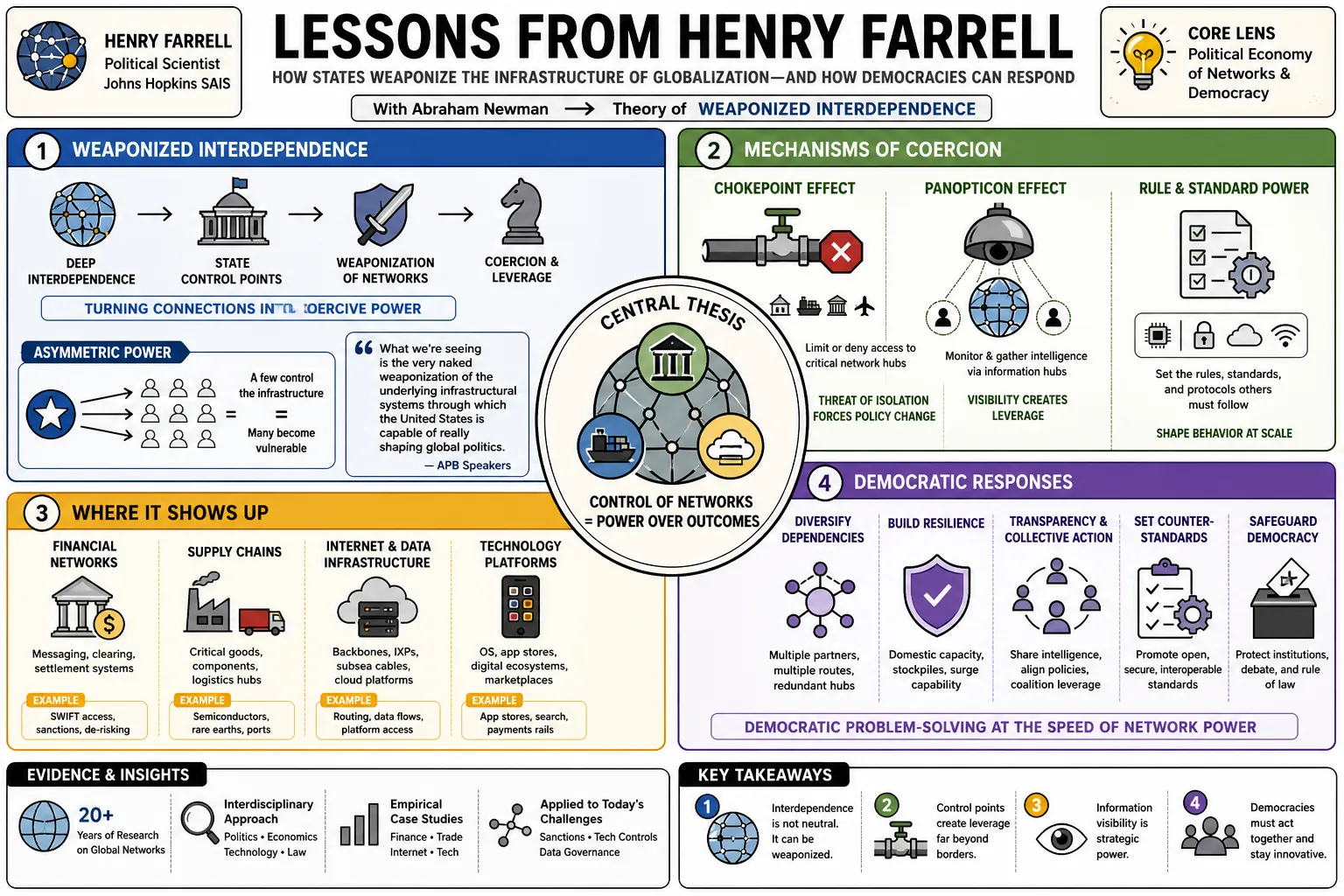
Lessons from Henry Farrell
Henry Farrell is a political scientist at the Johns Hopkins School of Advanced International Studies who examines how states exploit the underlying infrastructure of globalization. He and Abraham Newman developed the theory of weaponized interdependence to explain how governments turn financial networks, supply chains, and internet traffic into tools of coercion. This profile gathers his insights on these economic networks, the political economy of technology, and democratic problem-solving.
Part 1: Weaponized Interdependence
- On Asymmetric Power: "What we're seeing is the very naked weaponization of the underlying infrastructural systems through which the United States is capable of really shaping global politics." — Source: APB Speakers
- On the Chokepoint Effect: "States with political authority over critical network hubs can limit or completely deny other actors access to essential systems, effectively forcing policy changes through the threat of isolation." — Source: Brookings
- On the Panopticon Effect: "Control over information hubs, such as global internet data traffic or financial messaging networks, allows dominant states to monitor and gather critical intelligence on adversaries." — Source: Wikipedia
- On the End of the Liberal Order: "The liberal international order always had hypocrisies... But what we're seeing now is something more naked—an assertion that power can simply be monetized." — Source: APB Speakers
- On the Myth of Peaceful Globalization: "The traditional view that global economic networks naturally foster peace and cooperation ignores how these networks are structured around centralized, exploitable hubs." — Source: Oxford University
- On Global Leverage: "In this globalized, woven-together world, there are a lot of ways in which being on American technologies and in American financial markets gave the United States leverage. This system was fine for our allies and for the world, as long as we didn't use that leverage too much." — Source: Henry Farrell's Blog
- On Retaliation: Farrell and Abraham Newman argue in Foreign Affairs that the United States now has to defend itself in a world where other powers can also weaponize economic and technological chokepoints. — Reference: Foreign Affairs essay by Henry Farrell and Abraham Newman on retaliation in a weaponized world economy
- On Network Topography: "Global networks are not flat webs of equal exchange; they are hierarchical structures where influence is concentrated in specific nodes like server farms or clearinghouses." — Source: Bruegel
- On Economic Coercion: "Weaponized interdependence shifts the battlefield from traditional military engagements to the restriction of supply chains and financial messaging systems." — Source: Belfer Center
- On Strategic Vulnerability: "Interdependence is a double-edged sword that provides both immense economic benefits and profound national security vulnerabilities for states reliant on foreign-controlled hubs." — Source: Henry Farrell's Publications
Part 2: The Underground Empire
- On the Hidden Infrastructure: "The hidden infrastructure of global commerce, such as finance, data, and technology, is not a neutral playing field but a series of strategic choke points." — Source: Engelsberg Ideas
- On U.S. Domination: "The U.S. acts like a spider at the heart of an international web of surveillance and control, repurposing vital economic pathways into mechanisms of geopolitical power." — Source: Book Grocer
- On the Sanctions Machine: "The expansive U.S. sanctions regime operates as a kind of sanctions doomsday machine that could not be turned back off." — Source: The Washington Post
- On Untethering: "Economic ties have become a battle zone as nations like China and Russia attempt to untether themselves from the U.S.-led financial and technological system." — Source: UCLA
- On the Repurposing of Globalization: "The networks built to facilitate free trade and open communication were quietly retrofitted by Washington to serve national security and intelligence objectives." — Source: European Council on Foreign Relations
- On Economic Warfare: "The mechanisms of the global economy are now the primary weapons of statecraft, replacing traditional diplomacy with the threat of financial ruin." — Source: Foreign Affairs
- On the Swift System: "The SWIFT financial messaging network, initially designed as a neutral utility, became a prime example of a centralized hub vulnerable to weaponization by the state." — Source: Substack
- On Supply Chain Weaponization: "Control over the manufacturing and distribution of semiconductors demonstrates how supply chains are exploited to stifle the technological advancement of rival nations." — Source: SoBrief
- On the Cost of Empire: "Sustaining this underground empire risks alienating allies who fear their own economic dependence on the United States could be turned against them." — Source: Engelsberg Ideas
- On the Illusion of the Free Market: "The concept of a truly global free market is a facade obscuring a deeply politicized infrastructure governed by national interests." — Source: Substack
Part 3: Democracy as a Problem-Solving Mechanism
- On Collective Cognition: "Democracy should be understood as an efficient, experimental process for generating solutions to complex social problems, rather than a simple system for political justice." — Source: Preposterous Universe
- On Diversity of Perspective: "Democracy possesses unique cognitive benefits because it enables individuals with diverse viewpoints to interact, facilitating a level of collective learning unattainable in rigid hierarchies." — Source: Crooked Timber
- On Democratic Experimentalism: "By bringing contrasting viewpoints into direct contact, democratic systems can continuously test solutions, troubleshoot failures, and reprioritize values." — Source: Schneier on Security
- On Democratic Incompetence: "The structure of democracy, by aggregating diverse information, routinely outperforms systems that rely exclusively on a small group of insulated experts." — Source: Cambridge University Press
- On the Messiness of Politics: On Mindscape, Farrell frames democracy as a problem-solving system whose value comes from forcing people with different goals and perspectives to work together and turn disagreement into useful information. — Reference: Mindscape interview with Henry Farrell on democracy as a problem-solving mechanism
- On the Limits of Markets: "While markets rely on price signals to coordinate behavior, they often fail to solve complex, multi-dimensional social problems that require deliberative cognitive processes." — Source: Semantic Scholar
- On Authoritarian Brittleness: "Authoritarian systems may appear decisive, but they lack the feedback mechanisms and distributed problem-solving capabilities that make democracies resilient over the long term." — Source: Henry Farrell's Blog
- On Group Composition: "Understanding the specific conditions of group diversity and interaction is critical to improving the actual performance of democratic institutions." — Source: Cambridge University Press
- On Cognitive Democracy: "The true strength of democratic voting lies in its ability to pool dispersed knowledge, turning collective decision-making into an engine of discovery." — Source: Crooked Timber
- On Problem Creation: "Many of the problems that we are going to face over the next many years will stem from publics that have been deranged and distorted by social media in ways that lower the odds that democracy will be a problem solving system, and increase the likelihood that it will be a problem creating one." — Source: Henry Farrell's Blog
Part 4: Silicon Valley Ideology
- On the Aristocratic Mindset: "Silicon Valley is an aristocratic culture." — Source: Wikiquote
- On the Desire for Exit: "First, how Silicon Valley used to be a place where exit was possible and a good thing... if you buy into the notion of exit as a fundamental basis for political organization, then you shouldn't be blackpilled against a protocol that is built precisely around making that possible." — Source: Crooked Timber
- On the Religion of the Engineers: "The cult of progress and the technocapital singularity are Hayek’s ‘religion of the engineers’ with the valences reversed—so that markets and AI rather than the state become the objects of worship." — Source: Programmable Mutter
- On Willful Ignorance: "It is difficult for a man to understand something when his business model depends on his not understanding it." — Source: Programmable Mutter
- On Algorithmic Optimization: "Many other Silicon Valley innovations have replaced purportedly messily inefficient social systems with optimization of a function that weights the leadership's goals and objectives, and algorithmic feedback loops that implement it." — Source: Knight First Amendment Institute
- On Bypassing Friction: "The tech industry frequently views democratic deliberation and political friction as inefficiencies to be engineered away, instead of necessary safeguards." — Source: Programmable Mutter
- On Libertarian Hubris: "The ideology pervasive in tech circles assumes that complex political and social problems can be definitively solved through pure engineering and market forces." — Source: Programmable Mutter
- On the Misunderstanding of the State: "Silicon Valley leaders routinely underestimate the necessity of the state in maintaining the foundational stability that allows their markets and platforms to function." — Source: Paul Krugman Substack
- On Elitism: "The cultural ethos of the tech elite dismisses the value of public institutions in favor of privately managed, technocratic solutions." — Source: Crooked Timber
Part 5: Artificial Intelligence as Social Technology
- On the Nature of AI: "We need to stop imagining AI as super-powered individual intelligences and start seeing it for what it is, a system that reorganizes information and power." — Source: Johns Hopkins University
- On LLM Consciousness: "We can blame the English language for a lot of things. But it is never going to become conscious and decide to turn us into paperclips." — Source: Wikiquote
- On the Illusion of Personality: "LLMs don't have personalities, but compressions of genre that can support a mixture of 'choose your own adventure' with role-playing game. It is very important not to confuse the latter for the former." — Source: Wikiquote
- On AI as a Bureaucracy: "AI should be evaluated as a social technology, akin to markets or bureaucracies, that fundamentally alters how human beings process data and interact with one another." — Source: Henry Farrell's Blog
- On the Threat of Automation: "The primary danger of AI is the automated centralization of power and the erosion of human agency in institutional decision-making, ignoring sci-fi tropes of robot uprisings." — Source: Programmable Mutter
- On the Governance of Algorithms: "Treating political and social governance as an algorithmic optimization problem ignores the vital, qualitative nuances of human deliberation." — Source: Knight First Amendment Institute
- On Data as Power: "The massive datasets required to train modern AI systems represent a new frontier of concentrated infrastructural power, mirroring the chokepoints of global finance." — Source: Henry Farrell's Publications
- On the Singularity Myth: "The narrative of an impending technocapital singularity serves to distract from the immediate regulatory and ethical challenges of deploying AI in existing social structures." — Source: Programmable Mutter
- On Human-AI Interaction: "The most profound impacts of AI will arise from how it shapes human-to-human communication and reorganizes the public sphere, rather than its independent cognitive abilities." — Source: Johns Hopkins University
Part 6: The Dark Web and Cryptopolitics
- On the Anarchist Illusion: "The Silk Road and similar dark web markets were driven by an anarchist-libertarian fantasy of completely exiting ordinary politics and state control." — Source: American Affairs
- On Recreating the State: "Paradoxically, stateless dark web markets inevitably recreate the very bureaucratic and coercive structures they explicitly seek to escape." — Source: Signs Magazine
- On the Bureaucratization of Vice: "Projects born outside the law, like the Silk Road, quickly become heavily bureaucratized, relying on rigid rules and internal hierarchies to manage complex illicit trade." — Source: American Affairs
- On Trust in Anonymity: "Because participants operate anonymously and outside legal protections, they face extreme, often insurmountable challenges in establishing basic trust." — Source: The Washington Post
- On the Instability of Illicit Markets: "The absence of a formal legal system makes dark web marketplaces highly prone to internal scams, sudden implosions, and chronic instability." — Source: The Washington Post
- On Cryptopolitics: "The political philosophy underlying cryptocurrency and dark web ventures assumes that cryptography can entirely replace human institutions, a demonstrably false premise." — Source: Boston University
- On the Dread Pirate Roberts: "The evolution of the Silk Road’s leadership demonstrated how a libertarian experiment quickly descended into paranoia and the violent enforcement of contracts." — Source: American Affairs
- On Digital Hobbesianism: "Without the overarching authority of a state to enforce norms, dark web environments frequently devolve into low-trust arenas where participants constantly fear betrayal." — Source: Transatlantic Relations
- On the Failure of Exit: "The attempt to use decentralized technology to permanently exit society reveals the inescapable necessity of governance and institutional trust in any sustained human enterprise." — Source: Social Science Research Council
Part 7: Public Scholarship and Intellectual Engagement
- On the Purpose of Critique: "What I’ve tried to do over time is embody more and more of my main advisor’s approach to critiquing the work of his students and colleagues... he generally tried to help people make their work better." — Source: Swarthmore College
- On Academic Debate: "Intellectual debate should be about constructive refinement, sidestepping the impulse to break someone on the wheel or capture them for a specific ideological tribe." — Source: Swarthmore College
- On the Necessity of Ideology: "Joseph Schumpeter has a quote somewhere that I keep meaning to try to find again, to the effect that our ideologies blind us to much of reality, but without our ideologies we would not see at all." — Source: Cato Unbound
- On the Crooked Timber of Humanity: "The name of his co-founded blog reflects the Kantian observation that human nature is inherently flawed and complex, and that political theory must account for this imperfection." — Source: Wikipedia
- On Blogging as Scholarship: "Platforms like Crooked Timber and The Monkey Cage proved that rigorous political science could be effectively translated into accessible, public-facing commentary." — Source: University of Toronto
- On Interdisciplinary Thought: "Real understanding of modern political crises requires bridging the gap between political science, economics, sociology, and computer science." — Source: Henry Farrell's Blog
- On Navigating Disagreement: "Engaging with fundamentally different worldviews is an absolute requirement for testing the strength of one's own arguments." — Source: Crooked Timber
- On the Role of the Public Intellectual: "The goal of public scholarship is to elevate the baseline of public discourse on institutional issues, avoiding the temptation to simplify complex ideas into soundbites." — Source: University of Toronto
- On Epistemic Humility: "Acknowledging the limits of one's own theoretical frameworks is essential when analyzing rapidly evolving, unprecedented technological shifts." — Source: Cato Unbound
Part 8: Information, Platforms, and Global Order
- On the Weaponization of Information: "The internet, originally envisioned as a decentralized utopia of free information, has been consolidated into a handful of controllable, exploitable corporate and state nodes." — Source: Good Authority
- On Platform Power: "Major tech platforms exert a form of quasi-sovereign authority, making decisions that shape the political realities of nation-states absent democratic accountability." — Source: Henry Farrell's Publications
- On Digital Derangement: "Social media algorithms are designed in ways that actively distort public perception, undermining the very foundation of democratic problem-solving." — Source: Henry Farrell's Blog
- On the Commodification of Privacy: "The modern data economy is built on a fundamental asymmetry, where individual privacy is routinely sacrificed to build the databases that fuel state and corporate power." — Source: Knowledge at Wharton
- On Transatlantic Tensions: "Differing approaches to data privacy and security between the US and Europe reflect profound underlying disagreements about the role of the state and the protection of the individual." — Source: Knowledge at Wharton
- On the Security State: "The rise of the economic security state means that foreign policy is increasingly dictated by regulatory agencies and financial bureaucrats rather than traditional diplomats." — Source: Foreign Affairs
- On Network Resilience: "Building truly resilient global systems requires decentralizing power and reducing the world's reliance on a few easily weaponized chokepoints." — Source: Bruegel
- On Global Trust: "The active weaponization of interdependence by powerful states systematically erodes the baseline trust required to maintain open, cooperative international networks." — Source: Oxford University
- On the Future of Connectivity: "We are moving away from an era of unchecked global integration toward a fractured landscape where connectivity is viewed primarily as a vector of vulnerability." — Source: Engelsberg Ideas