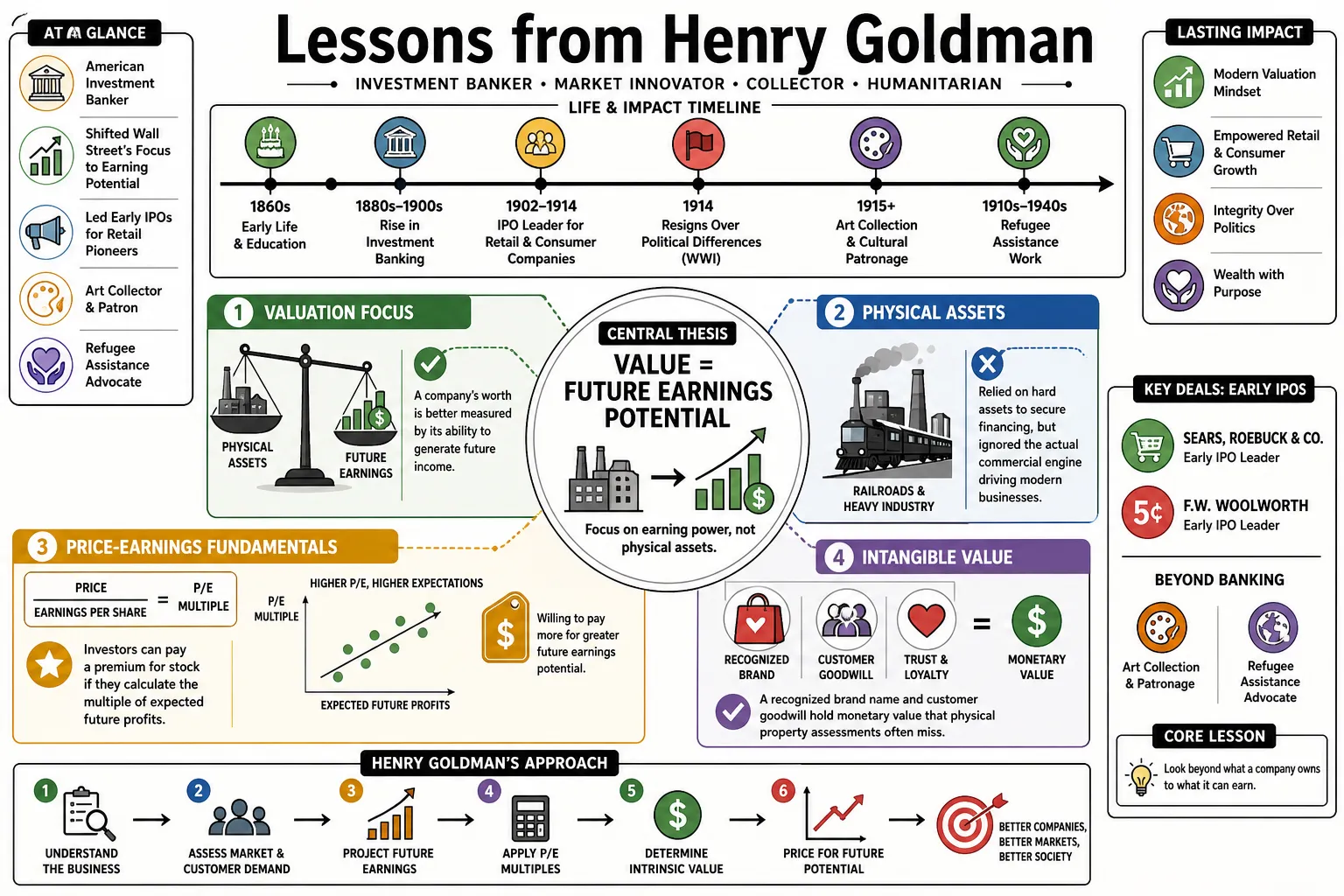
Lessons from Henry Goldman
Henry Goldman was an American investment banker who shifted Wall Street's focus from physical assets to the earning potential of retail and consumer companies. During his tenure as a senior partner at Goldman Sachs, he led early public offerings for businesses like Sears, Roebuck & Co. and F.W. Woolworth. This profile outlines his approach to corporate valuation, his resignation over political disagreements during World War I, and his later focus on art collection and refugee assistance.
Part 1: Valuation and the Earning Power Principle
- On Valuation Focus: "A company's worth is better measured by its ability to generate future income than by the liquidation value of its physical equipment." — Source: [Goldman Sachs History]
- On Physical Assets: "Railroads and heavy industry relied on hard assets to secure financing, but this model ignored the actual commercial engine driving modern businesses." — Source: [American Aristocracy]
- On Price-Earnings Fundamentals: "Investors can pay a premium for stock if they calculate the multiple of expected future profits." — Source: [Immigrant Entrepreneurship]
- On Intangible Value: "A recognized brand name and customer goodwill hold monetary value that physical property assessments often miss." — Source: [Harvard Business School]
- On Income Generation: "The capacity to secure reliable cash flow is the strongest indicator of a firm's ability to service its debts." — Source: [Museum of American Finance]
- On Traditional Underwriting: "Relying exclusively on steel and rail for investment banking limits capital markets from participating in the broader economy." — Source: [Goldman Sachs History]
- On Inventory Turnover: "For a mercantile business, the speed at which inventory converts to cash is the true measure of its underlying health." — Source: [Immigrant Entrepreneurship]
- On Cash Flow Analysis: "Evaluating the rate at which cash moves through a retail operation provides a clearer picture of solvency than appraising its warehouses." — Source: [Grokipedia]
- On Commercial Potential: "Funding a company based on its trajectory allows capital to reach sectors previously deemed too risky for public markets." — Source: [American Aristocracy]
- On The Shift from Hard Assets: "The transition to earnings-based valuation opened Wall Street to industries that lacked large real estate holdings." — Source: [Wikipedia]
Part 2: The Consumer Economy and Retail Financing
- On Retail Expansion: "Taking retail companies public provides them with the capital required to scale operations nationally." — Source: [Goldman Sachs History]
- On Mass Market Appeal: "Businesses that serve the everyday consumer represent a stable and growing segment of the American economy." — Source: [Museum of American Finance]
- On United Cigar Manufacturers: "The 1906 IPO of United Cigar proved that public investors would buy shares in a company based entirely on its retail profitability." — Source: [American Aristocracy]
- On Sears Roebuck: "Providing public financing for Sears required convincing investors that mail-order consumer goods were as reliable as industrial output." — Source: [Immigrant Entrepreneurship]
- On F.W. Woolworth: "The successful underwriting of Woolworth demonstrated that low-margin, high-volume retail could deliver consistent dividend returns." — Source: [Goldman Sachs History]
- On Consumer Spending: "Tracking middle-class purchasing power offers a direct gauge of national economic health." — Source: [Harvard Business School]
- On Blue-Chip Evolution: "Consumer goods manufacturers eventually became the reliable blue-chip stocks that investors previously only found in utilities." — Source: [Grokipedia]
- On Capital for Growth: "Public capital allows merchants to bypass expensive short-term bank loans to fund their seasonal inventory." — Source: [Wikipedia]
- On B.F. Goodrich: "Financing tire and rubber production tied investment banking directly to the emerging consumer automobile market." — Source: [Goldman Sachs History]
- On The Service Economy: "The financial sector must adapt its tools to support the merchants and distributors who connect goods to citizens." — Source: [Museum of American Finance]
Part 3: Underwriting, Risk, and Syndication
- On Collaborative Underwriting: "Partnering with other firms on large stock offerings distributes the financial exposure and ensures a wider market for the shares." — Source: [Immigrant Entrepreneurship]
- On Managing Risk: "No single banking house should absorb the entirety of a novel retail stock issuance." — Source: [Grokipedia]
- On The Lehman Partnership: "Working closely with Philip Lehman allowed both firms to punch above their weight in securing major industrial deals." — Source: [Harvard Business School]
- On Novel Offerings: "Introducing untested business models to the stock exchange requires a slow process of investor education." — Source: [American Aristocracy]
- On Syndicate Management: "Organizing a syndicate of regional brokers ensures that stock distribution reaches beyond the immediate confines of New York." — Source: [Wikipedia]
- On Market Making: "An investment bank must be willing to support the price of newly issued shares to maintain public confidence." — Source: [Goldman Sachs History]
- On Personal Trust: "Major financing deals like the Sears IPO often stem from direct personal friendships between the banker and the company founder." — Source: [Immigrant Entrepreneurship]
- On Distribution Networks: "A successful stock offering relies on a reliable network of regional salesmen who understand the local appetite for risk." — Source: [Harvard Business School]
- On Midwestern Expansion: "Establishing banking relationships in Chicago and the Midwest opened access to the fastest-growing industrial centers in the country." — Source: [Goldman Sachs History]
- On Industry Evolution: "The transition from commercial paper discounting to equity underwriting changed the fundamental purpose of the firm." — Source: [Museum of American Finance]
Part 4: Capital, Debt, and Corporate Growth
- On Debt Obligations: "Relying strictly on debt limits a company's ability to survive unexpected economic downturns." — Source: [Grokipedia]
- On Equity Financing: "Selling common stock transfers risk to the public while providing the company with permanent capital." — Source: [American Aristocracy]
- On Working Capital: "An influx of equity allows management to direct operating revenue toward expansion rather than debt service." — Source: [Goldman Sachs History]
- On Going Public: "The transition from a privately held partnership to a public corporation requires a fundamental shift in how accounting is reported." — Source: [Immigrant Entrepreneurship]
- On Founder Liquidity: "Public offerings allow the original architects of a business to monetize their life's work without dismantling the company." — Source: [Wikipedia]
- On Long-Term Horizons: "Public markets demand quarterly results, but sensible capitalization gives a company the breathing room to plan for decades." — Source: [Harvard Business School]
- On Market Access: "Connecting regional manufacturers to Wall Street capital accelerates the industrialization of the entire country." — Source: [Grokipedia]
- On Balance Sheets: "A clean balance sheet with manageable liabilities is the easiest product to sell to a skeptical investor." — Source: [Museum of American Finance]
- On Industrial Expansion: "Investment banking serves as the necessary plumbing that directs dormant capital into active corporate growth." — Source: [American Aristocracy]
Part 5: Principles, Independence, and Dissent
- On Conviction: "Maintaining a deeply unpopular political stance within a partnership eventually forces a choice between personal belief and professional duty." — Source: [Wikipedia]
- On The WWI Conflict: "Refusing to participate in Allied financing during the war isolated him from both his partners and the broader Wall Street consensus." — Source: [American Aristocracy]
- On Resisting Pressure: "A partner cannot veto the fundamental business strategy of a firm if the rest of the leadership views that strategy as essential for survival." — Source: [Goldman Sachs History]
- On Ancestral Loyalty: "His early vocal support for his German heritage proved incompatible with the public mood and business realities of wartime America." — Source: [Grokipedia]
- On Partnership Rifts: "When personal politics threaten a firm's reputation and client relationships, the partnership structure usually ejects the dissenting voice." — Source: [Immigrant Entrepreneurship]
- On Retiring: "Resigning in 1917 allowed the firm to proceed with Liberty Bond sales while he preserved his individual autonomy." — Source: [Goldman Sachs History]
- On Political Engagement: "Bankers have a responsibility to engage with federal policy to ensure financial systems remain stable." — Source: [Museum of American Finance]
- On Electoral Support: "Switching support to Woodrow Wilson reflected a belief that progressive economic reforms were necessary for market stability." — Source: [Harvard Business School]
- On The Federal Reserve: "Lobbying for a central bank was an acknowledgment that private firms alone could not prevent systemic panics." — Source: [American Aristocracy]
Part 6: Art, Patronage, and Cultural Preservation
- On Renaissance Art: "Collecting works from the Italian Renaissance offers a permanent connection to an era defined by humanism." — Source: [National Gallery of Art]
- On Curation: "A serious private collection focuses on historical significance and provenance rather than mere decoration." — Source: [Detroit Institute of Arts]
- On Masterpieces: "Securing works by Donatello and Rubens requires the same rigorous evaluation used in assessing corporate assets." — Source: [Grokipedia]
- On Wealth and Beauty: "Financial success finds its highest expression when directed toward preserving the enduring achievements of human culture." — Source: [American Aristocracy]
- On European History: "Bringing Baroque paintings to the United States ensures that American institutions can participate in global art scholarship." — Source: [National Gallery of Art]
- On Public Access: "Private art collections eventually serve their best purpose when placed in public museums for general education." — Source: [Wikipedia]
- On Documentation: "Cataloging a collection with academic rigor ensures its place in the permanent historical record." — Source: [Detroit Institute of Arts]
- On Academic Funding: "Endowing a university chair in German Art and Culture serves as an attempt to preserve academic study independent of geopolitical conflict." — Source: [American Aristocracy]
- On Cultural Bridges: "Art and scholarship remain the few reliable methods for maintaining connections between hostile nations." — Source: [Grokipedia]
Part 7: Philanthropy and Humanitarianism
- On Shifting Worldviews: "Direct observation of authoritarianism can completely reverse decades of ingrained cultural loyalty." — Source: [American Aristocracy]
- On the 1933 Berlin Trip: "Witnessing the reality of the Nazi regime firsthand dissolved his previous defenses of the German state." — Source: [Grokipedia]
- On Aiding Refugees: "Financial resources must be deployed rapidly to extract individuals targeted by state persecution." — Source: [Immigrant Entrepreneurship]
- On Repudiating Nazism: "A public reversal of a deeply held stance is necessary when the moral facts on the ground change." — Source: [Wikipedia]
- On Supporting Einstein: "Providing aid to exiled intellectuals ensures that scientific progress is not extinguished by political violence." — Source: [American Aristocracy]
- On Aiding Thomas Mann: "Assisting writers and thinkers forced to flee their homeland preserves the cultural voice of a nation in exile." — Source: [Grokipedia]
- On Local Charity: "Support for institutions like Mount Sinai Hospital addresses immediate domestic needs alongside international crises." — Source: [Immigrant Entrepreneurship]
- On Civic Duty: "Retired bankers retain a civic obligation to direct their accumulated capital toward humanitarian intervention." — Source: [Museum of American Finance]
- On Wealth as Rescue: "In times of geopolitical emergency, a private fortune becomes a tool for physical rescue." — Source: [American Aristocracy]
Part 8: Legacy, Markets, and The Business of Banking
- On The Enduring Nature of Capital: "Money will always be in fashion." — Source: [GetAbstract]
- On Financial Products: "Whenever an account manager mentions 'Products,' my advice is to put your track shoes on, turn around and run as fast as you can for the exit." — Source: [Business Insider]
- On Generational Wealth: "A banking dynasty requires careful succession planning to ensure the founding principles survive the founders." — Source: [Harvard Business School]
- On The Family Firm: "Working alongside family members creates intense loyalty but also complicates necessary business disagreements." — Source: [Immigrant Entrepreneurship]
- On Building Trust: "A bank's most valuable asset is the absolute confidence of its depositors and underwriting clients." — Source: [Goldman Sachs History]
- On Economic Shifts: "Firms that fail to recognize the transition from heavy industry to consumer goods will be left behind." — Source: [Museum of American Finance]
- On Market Permanence: "The mechanics of buying and selling risk will remain consistent regardless of which industries currently dominate the exchange." — Source: [Grokipedia]
- On Institutional Growth: "A successful partnership eventually outgrows the individuals who built it." — Source: [Wikipedia]
- On Modern Finance: "Applying mathematical valuation to abstract concepts like earnings potential laid the groundwork for modern equity markets." — Source: [American Aristocracy]