Hetty Green was a Gilded Age financier who built an estimated $100 million fortune through real estate, railroads, and lending, becoming one of the wealthiest people in American history. She is remembered for her strict contrarian approach to value investing and her insistence on holding large cash reserves to capitalize on financial panics. This profile catalogs her disciplined rules for capital preservation, self-reliance, and independent thought in a male-dominated era.
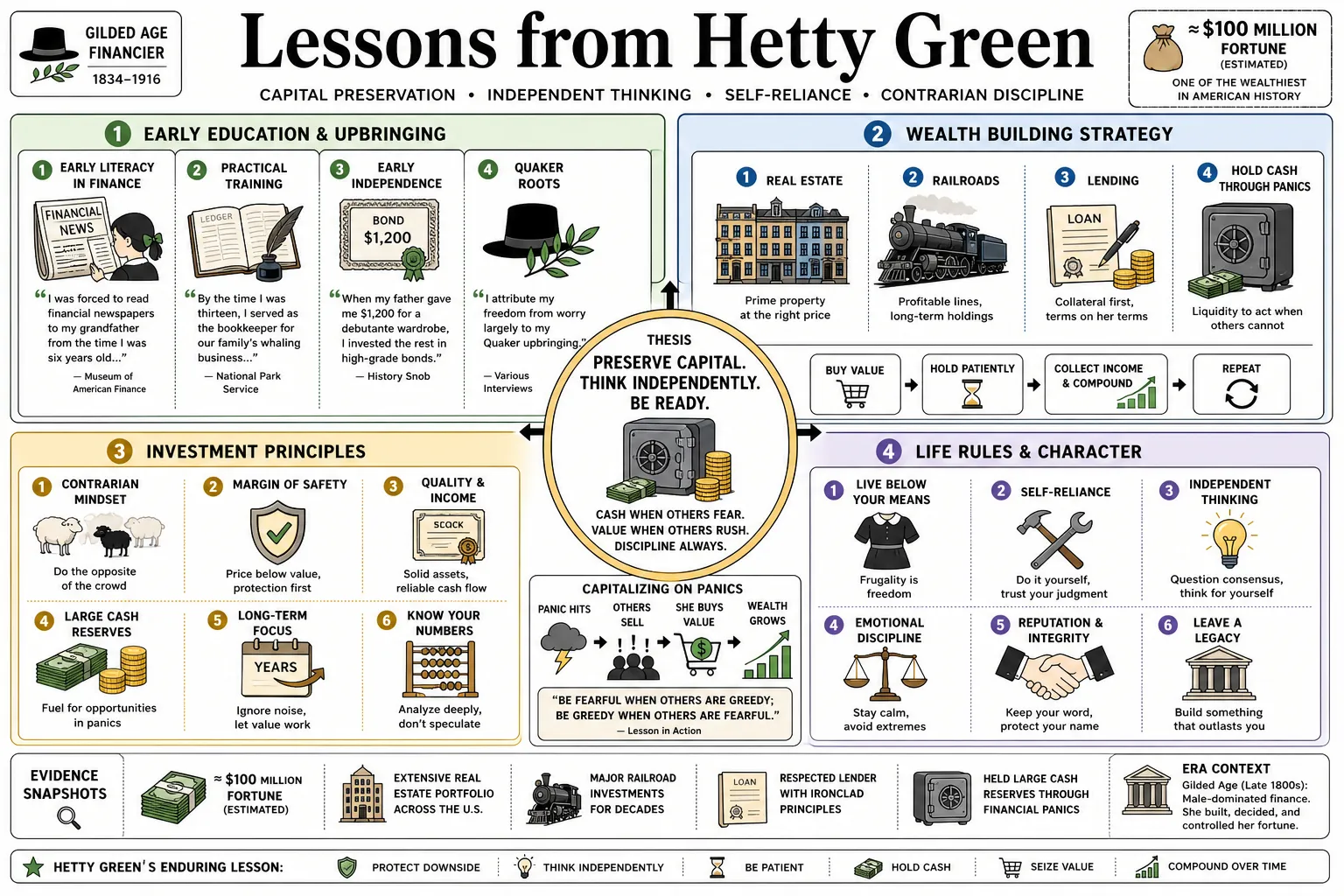
Part 1: Early Education and Upbringing
- On early literacy in finance: "I was forced to read financial newspapers to my grandfather from the time I was six years old, learning the language of money before most children learn to read." — Source: Museum of American Finance
- On practical training: "By the time I was thirteen, I served as the bookkeeper for our family’s whaling business, balancing the accounts and communicating with stockbrokers." — Source: National Park Service
- On early independence: "When my father gave me $1,200 for a debutante wardrobe, I spent only a fraction on clothes and invested the rest in high-grade bonds." — Source: History Snob
- On Quaker roots: "I attribute my freedom from worry largely to the fact that I am a Quaker, and that my father brought me up teaching me to keep myself well in hand." — Source: Quoteswise
- On family legacy: "I was taught from youth that protecting the family capital was a moral obligation." — Source: Texas State Historical Association
- On learning from observation: "Watching my father deal with competitors taught me that emotion has no place in the ledger." — Source: EBSCO
- On self-discipline: "My Quaker upbringing taught me that plain living and strict accounts are the foundation of any lasting enterprise." — Source: Wikipedia
- On isolation and focus: "Growing up among adults discussing maritime trade gave me a singular focus on the mechanics of profit and loss." — Source: Museum of American Finance
- On early capital allocation: "The best education I received was being handed real money and told to make it grow without risking the principal." — Source: Novel Investor
Part 2: Value Investing and Contrarianism
- On the core formula: "There is no great secret in fortune making. All you do is buy cheap and sell dear, act with thrift and shrewdness, and be persistent." — Source: Forbes
- On contrarian timing: "I buy when things are low and nobody wants them. I keep them until they go up, and people are crazy about getting them." — Source: Novel Investor
- On market cycles: "When good things are so low that no one wants them, I buy them and lay them away in the safe." — Source: Farnam Street
- On exiting positions: "When, owing to some new development, my shares go up and are so needed that men will pay well for them, I am ready to sell." — Source: Goodreads
- On crowd psychology: "I am always buying when everyone wants to sell, and selling when everyone wants to buy." — Source: Farnam Street
- On simplicity: "The secret of all successful business is simply recognizing when an asset is priced below its fundamental worth." — Source: Bullish Bears
- On patience: "You must be willing to hold onto an investment for years, waiting for the market to realize the value you saw initially." — Source: LGT
- On avoiding trends: "Never buy into a company just because it is popular; popularity usually means the price is already too high." — Source: Morningstar
- On objective valuation: "A stock is only worth what the underlying business can reliably produce, not what the public currently feels about it." — Source: Hanson Doremus
- On long-term holds: "Lay away good assets and let time do the heavy lifting for your portfolio." — Source: Novel Investor
Part 3: Prudence and Risk Management
- On extreme caution: "More money is made in the end by an over-supply of caution than by indiscriminate recklessness." — Source: Quoteswise
- On reflection: "In business, generally, don't close a bargain until you have reflected on it overnight." — Source: Farnam Street
- On due diligence: "Before deciding on an investment, I seek out every kind of information about it." — Source: Quoteswise
- On leverage: "Never borrow money to invest; relying on margin puts you at the mercy of the lender when the market inevitably turns." — Source: Morningstar
- On complexity: "Avoid speculative or exotic ventures; if you cannot understand the business model on a single sheet of paper, do not invest." — Source: Hanson Doremus
- On corporate bloat: "More companies die from indigestion than starvation; rapid, unchecked expansion is a warning sign." — Source: Substack
- On common sense: "Common sense is the most valuable possession anyone can have, and it is the secret to keeping the money you make." — Source: Farnam Street
- On avoiding debt: "Operating strictly with your own capital ensures you never have to sell a good asset at a bad price." — Source: Novel Investor
- On preserving principal: "Your first job as an investor is to ensure you do not lose the money you started with." — Source: Forbes
Part 4: Managing Panics and Liquidity
- On the Panic of 1907: "I saw this situation developing three years ago. I said the rich were approaching the brink, and that a panic was inevitable." — Source: Substack
- On observing the market: "I saw the handwriting on the wall long before the crash arrived." — Source: Morningstar
- On cash reserves: "Cash combined with courage in a crisis is priceless." — Source: Museum of American Finance
- On lending to the desperate: "During a panic, those who hoarded cash become the lenders of last resort, setting their own terms." — Source: Wikipedia
- On bailing out cities: "When New York City faced default, I wrote them a check for $1.1 million because short-term municipal revenue bonds were the safest yield available." — Source: Strong Valley
- On surviving crashes: "Those who survive financial panics are the ones who refused to participate in the euphoria that caused them." — Source: Firstlinks
- On market corrections: "A panic is simply the market forcing the reckless to hand over their assets to the cautious." — Source: LGT
- On liquidity: "Having dry powder when capital is scarce allows you to dictate the terms of any transaction." — Source: Hanson Doremus
- On recognizing bubbles: "When men begin to brag about how easy it is to make money in the stock market, it is time to build up cash." — Source: Novel Investor
- On holding firm: "During a crisis, you must have the fortitude to ignore the panic of others and stick to your own valuation of assets." — Source: Morningstar
Part 5: Real Estate and Tangible Assets
- On prime collateral: "I advise women to invest in real estate. It is the collateral to be preferred above all others." — Source: AZ Quotes
- On preferred sectors: "Railroads and real estate are the things I like." — Source: Farnam Street
- On tangibility: "The safest means of investing money is putting it into physical property that generates a reliable yield." — Source: The Money Principle
- On railroad solvency: "Only invest in railroads that have manageable debt and a clear path to consistent freight revenue." — Source: Hanson Doremus
- On mortgages: "Holding a well-underwritten mortgage is often safer than holding the deed, provided the borrower has equity." — Source: Novel Investor
- On land value: "Land in a growing city will always appreciate, provided you have the cash flow to hold it through downturns." — Source: Wikipedia
- On infrastructure: "The arteries of commerce are reliable investments because the economy cannot function without them." — Source: Substack
- On thorough property checks: "I would never buy a parcel of real estate without personally inspecting the title and the condition of the surrounding neighborhood." — Source: History Snob
- On long-term physical assets: "Stocks can go to zero overnight, but a prime piece of commercial real estate will always have some intrinsic worth." — Source: LGT
Part 6: Frugality and Everyday Finances
- On basic math: "Watch your pennies and the dollars will take care of themselves." — Source: Farnam Street
- On plain living: "I am trying to live up to the tenets of my faith. That is why I dress plainly and live quietly. No other kind of life would please me." — Source: Substack
- On societal expectations: "Let them wear ostrich feathers on their heads if they want to; that's their responsibility, not mine." — Source: Substack
- On minimizing waste: "Frugality is not about hoarding; it is about ensuring that capital is not squandered on things that have no lasting value." — Source: Forbes
- On the miser reputation: "They call me a miser because I refuse to pay inflated prices for ordinary goods, but I consider it simply good business." — Source: Wikipedia
- On conspicuous consumption: "Spending money just to prove to others that you have it is a fool's errand." — Source: Morningstar
- On negotiation: "I will argue over a few cents on a bill because the principle of paying fair value applies equally to pennies and millions." — Source: Novel Investor
- On avoiding luxury: "Luxury breeds softness, and softness clouds the judgment required to maintain a fortune." — Source: History Snob
- On personal expenses: "Keep your personal overhead as low as possible, so that your capital can be deployed where it generates a return." — Source: LGT
Part 7: Independence and Self-Reliance
- On managing one's own affairs: "If I had let other people do my business for me, I most likely wouldn't have had any business to do now." — Source: Novel Investor
- On trusting others: "The moment you hand control of your money to a third party, you are operating at a severe disadvantage." — Source: Farnam Street
- On secrecy: "Operating quietly and sometimes under assumed names prevents the market from reacting to your trades before they are finished." — Source: Podcast Notes
- On solitary decision making: "The best investment decisions are made alone in a quiet room, far from the noise of the financial district." — Source: Hanson Doremus
- On marriage and money: "A girl ought to be careful about the man she marries, especially if she has money." — Source: Farnam Street
- On the gendered double standard: Novel Investor notes that Green's nicknames, "The Queen of Wall Street" and "The Witch of Wall Street," captured the split way the era judged her: the same hard-nosed financial behavior could be framed as shrewd when admired and as eccentric or monstrous when filtered through gendered expectations, supporting a cleaner lesson that women in finance are often judged through a harsher double standard than equally aggressive men. — Reference: Novel Investor profile on Hetty Green
- On self-defense: "When dealing with brokers and bankers, you must assume they are looking out for their commission first, not your principal." — Source: EBSCO
- On ignoring criticism: "The press will mock you for being frugal and independent, but the ledger at the end of the year is the only judge that matters." — Source: Substack
- On ultimate authority: "I sign my own checks, review my own contracts, and take the blame for my own mistakes." — Source: Museum of American Finance
Part 8: Women in Business and Finance
- On female capability: "What man has done, women can do." — Source: Farnam Street
- On management skills: "I am able to manage my affairs better than any man could manage them." — Source: Novel Investor
- On financial duty: "It is the duty of every woman to learn to take care of her own business affairs." — Source: Farnam Street
- On raising girls: "Every girl should be taught the ordinary lines of business investment." — Source: Farnam Street
- On financial education for women: "A woman should understand bank accounts, mortgages, bonds, and how interest works before she is ever married." — Source: Historic Women of the South Coast
- On independence from husbands: "A wife who understands finance is a partner; a wife who does not is a dependent." — Source: Big Bend Sentinel
- On entering the workforce: "Every girl should be raised with the practical skills necessary to make her own living if the situation requires it." — Source: Historic Women of the South Coast
- On trusting male advisors: "Women are too often taught to blindly trust male relatives with their inheritance, a practice that usually ends in ruin." — Source: History Snob
- On real estate for women: "Real estate is the ideal vehicle for a woman's capital because it is tangible, verifiable, and cannot be easily embezzled by an agent." — Source: AZ Quotes
- On proving oneself: "A woman in finance must be twice as rigorous and twice as cautious to earn half the respect of her male peers." — Source: Novel Investor