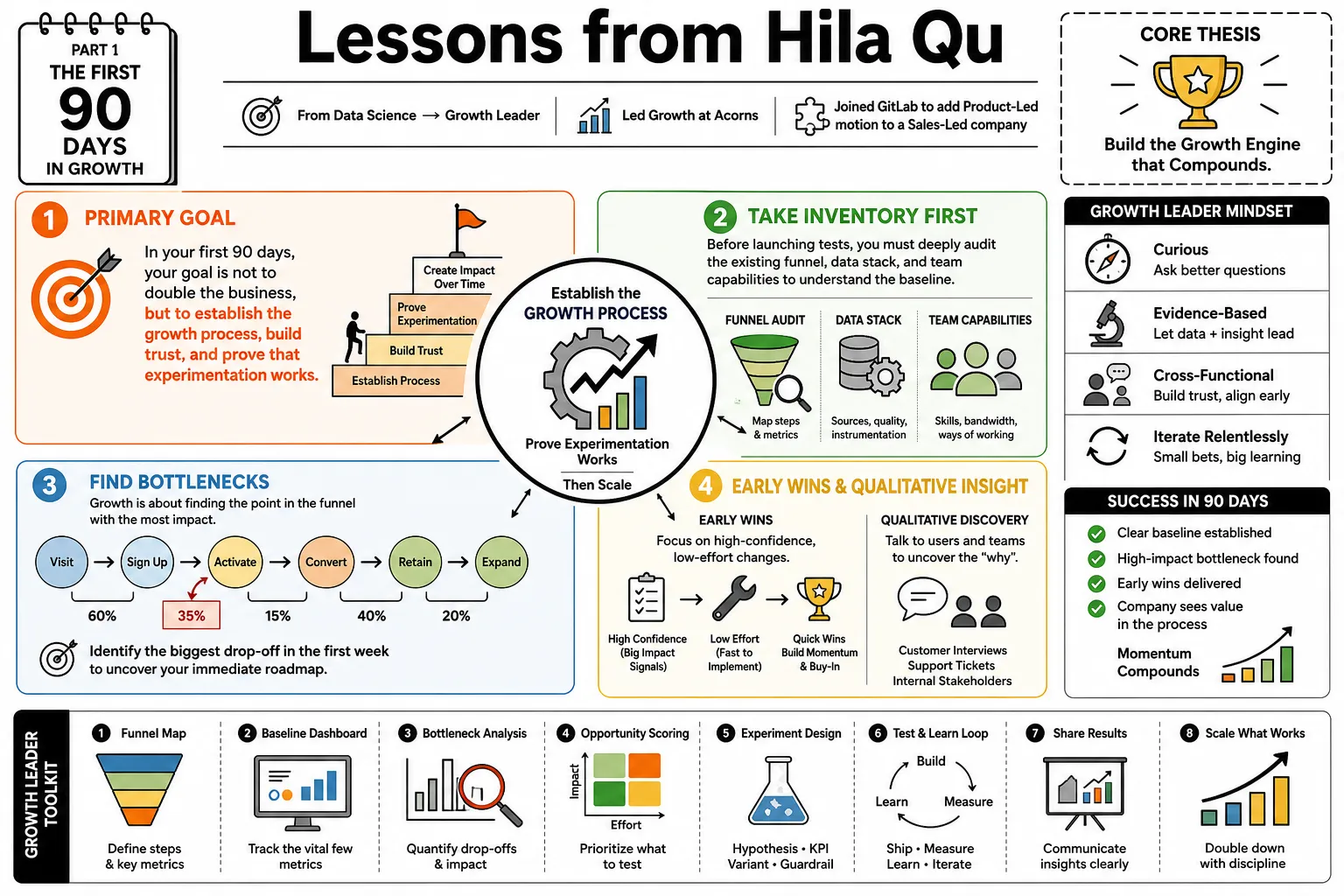
Lessons from Hila Qu
Hila Qu moved from data science to growth, leading the function at Acorns before joining GitLab to layer a product-led motion onto a sales-led company. She built a reputation on practical growth models and tactical 90-day guides for new growth leaders. This profile breaks down her exact methods for standing up teams, running experiments, and designing product-led funnels.
Part 1: The First 90 Days in Growth
- On the primary goal: "In your first 90 days, your goal is not to double the business, but to establish the growth process, build trust, and prove that experimentation works." — Source: [Medium: Your First 90 Day Startup Growth Plan]
- On taking inventory: "Before launching tests, you must deeply audit the existing funnel, data stack, and team capabilities to understand the baseline you are working from." — Source: [Medium: Your First 90 Day Startup Growth Plan]
- On early wins: "Focus your initial experiments on high-confidence, low-effort changes to secure quick wins that build momentum and buy-in from the rest of the company." — Source: [Medium: Your First 90 Day Startup Growth Plan]
- On finding bottlenecks: "Growth is about finding the point in the funnel with the most impact; usually, identifying the biggest drop-off point in the first week uncovers your immediate roadmap." — Source: [Medium: Your First 90 Day Startup Growth Plan]
- On qualitative data: "Don't just look at dashboards. Spend your first month talking to customers and listening to sales calls to understand the friction points that data won't explain." — Source: [Lenny's Podcast]
- On stakeholder alignment: "Growth crosses all departments. Spend time mapping out how your goals align with product, marketing, and sales so you don't become an isolated island." — Source: [Medium: Your First 90 Day Startup Growth Plan]
- On setting expectations: "Be transparent with founders that the initial phase is about building the engine and establishing a testing cadence, not guaranteeing a specific revenue target immediately." — Source: [20VC]
- On instrumentation: "If you can't measure it, you can't grow it. Prioritize fixing broken tracking and defining core metrics before you try to optimize them." — Source: [Medium: Your First 90 Day Startup Growth Plan]
- On avoiding shiny objects: "It is easy to get distracted by new channels or competitor features. Stick to your initial hypothesis and the highest-impact areas of your core funnel." — Source: [Medium: Your First 90 Day Startup Growth Plan]
- On documenting everything: "Keep a log of all experiments, including failures. A failed test that teaches you something about user behavior is a successful part of the 90-day learning curve." — Source: [Medium: Your First 90 Day Startup Growth Plan]
Part 2: Building and Scaling Growth Teams
- On team structure: "A modern growth team needs dedicated engineering and design resources, rather than relying on borrowing capacity from core product teams." — Source: [Lenny's Podcast]
- On hiring data scientists: "Look for data people who are commercial and curious about user behavior, not just those who want to build complex machine learning models." — Source: [20VC]
- On the first growth hire: "The first growth hire should be a generalist who can think analytically, write copy, and operate across the entire funnel before specializing." — Source: [20VC]
- On cross-functional collaboration: "Growth cannot dictate to product. You have to influence by showing data that proves a specific change will improve the user experience and the bottom line." — Source: [Lenny's Podcast]
- On reporting lines: "Whether growth reports to Product, Marketing, or the CEO matters less than whether the team has the mandate and resources to execute independently." — Source: [Lenny's Podcast]
- On engineering mindset: "Growth engineers need a different mindset than core engineers. They must be comfortable with shipping fast, throwing away code, and optimizing for speed of learning over perfect architecture." — Source: [BUILD Podcast]
- On performance metrics: "Evaluate the growth team not just on the metrics they move, but on the velocity of their experimentation and the quality of their insights." — Source: [Lenny's Podcast]
- On scaling: "As the team grows, split responsibilities by funnel stages, such as acquisition, activation, and retention, so that each pod has a clear, non-overlapping metric to own." — Source: [Lenny's Podcast]
- On culture: "Cultivate a culture where no one is punished for a failed experiment, as long as the hypothesis was sound and the learning is shared." — Source: [Lenny's Podcast]
Part 3: Growth Models and Architecture
- On defining the model: "A growth model is simply an equation that shows how your business grows, breaking down top-level metrics into the specific inputs you can actually influence." — Source: [Medium: How To Build A Growth Model]
- On qualitative inputs: "The math of a growth model only works if it is grounded in how real users actually discover, adopt, and pay for your product." — Source: [Medium: How To Build A Growth Model]
- On finding the North Star: "Your core metric should reflect the value the user gets from the product, not just a vanity number that looks good to investors." — Source: [Medium: How To Build A Growth Model]
- On mapping the loops: "Shift from thinking about linear funnels to compounding loops, where one cohort of users directly leads to the acquisition or engagement of the next." — Source: [Medium: How To Build A Growth Model]
- On simplicity: "Start with a simple spreadsheet. If your growth model is too complex for the broader team to understand, it will not be useful for making decisions." — Source: [Medium: How To Build A Growth Model]
- On forecasting: "Use the growth model to run scenarios. By adjusting conversion rates at different steps, you can see mathematically where an experiment will yield the highest return." — Source: [Medium: How To Build A Growth Model]
- On structural constraints: "Identify the natural limits of your model, such as market size or channel saturation, so you know when it's time to build a new loop rather than optimize an old one." — Source: [Medium: How To Build A Growth Model]
- On continuous iteration: "A growth model is never finished. As the product evolves and you add new channels, you must continuously update the assumptions and inputs." — Source: [Medium: How To Build A Growth Model]
- On avoiding local maxima: "A good model helps you step back and realize that a 5% bump in activation might be worth more than a 20% bump in top-of-funnel traffic." — Source: [Medium: How To Build A Growth Model]
- On the purpose of modeling: "The value of building the model is the alignment it creates among the executive team on exactly what drives the business forward." — Source: [Medium: How To Build A Growth Model]
Part 4: Product-Led Growth (PLG) Strategies
- On the core of PLG: "In a PLG motion, the product itself is your best marketing and sales tool, bearing the primary responsibility for acquiring, activating, and retaining users." — Source: [Hila's Substack]
- On time-to-value: "The absolute most important metric in PLG is how quickly a new user can experience the core value of the product after signing up." — Source: [Hila's Substack]
- On removing friction: "Every required field, email verification, or unnecessary step in onboarding reduces the probability that a user will reach the aha moment." — Source: [Hila's Substack]
- On self-serve support: "PLG requires treating in-app guidance, tooltips, and documentation as first-class product features, because users must be able to unblock themselves." — Source: [Hila's Substack]
- On virality: "True virality in PLG happens when a user naturally invites others simply by using the product as intended, rather than through forced referral programs." — Source: [Hila's Substack]
- On free plans: "A freemium or free trial model is not just a pricing strategy; it is a customer acquisition cost, allowing users to build a habit before they are asked to pay." — Source: [Hila's Substack]
- On product analytics: "You cannot run a PLG strategy without deep, event-level product analytics that tell you exactly where users get stuck." — Source: [Hila's Substack]
- On the aha moment: "Define the exact action that correlates with long-term retention, and orient the entire onboarding experience around getting users to take that action." — Source: [Hila's Substack]
- On continuous onboarding: "Onboarding doesn't stop after the first day. PLG means continually introducing users to deeper features as their usage matures." — Source: [Hila's Substack]
Part 5: Adding PLG to Sales-Led Motions
- On the hybrid approach: "Adding PLG to an existing enterprise sales motion is incredibly difficult because it requires changing the mindset from top-down selling to bottom-up adoption." — Source: [Lenny's Podcast]
- On sales conflict: "You must align incentives so that the sales team sees self-serve users as high-quality leads, not as a threat to their pipeline." — Source: [Lenny's Podcast]
- On Product-Qualified Leads (PQLs): "A PQL is much more valuable than a Marketing-Qualified Lead because it is based on actual product usage, indicating the user already understands the value." — Source: [Lenny's Podcast]
- On defining PQL criteria: "Work directly with sales to define what actions a free user must take to be flagged for outreach, so that reps only talk to accounts ready to expand." — Source: [Lenny's Podcast]
- On initial resistance: "Expect resistance from leadership when transitioning to PLG, as initial self-serve revenue will look small compared to enterprise deals, even though the volume is higher." — Source: [Lenny's Podcast]
- On pricing changes: "Adding PLG often requires transparent pricing tiers that allow individuals or small teams to swipe a credit card without talking to sales." — Source: [Lenny's Podcast]
- On dual tracking: "You have to maintain the enterprise sales engine while building the self-serve engine; you cannot afford to drop the ball on current revenue while building for the future." — Source: [Lenny's Podcast]
- On user segmentation: "Clearly segment the market so that individuals are directed into the self-serve funnel while large enterprise accounts are routed to sales reps." — Source: [Lenny's Podcast]
- On the long game: "Successfully layering PLG into a sales-led company is a multi-year transformation that alters the company's DNA, not just a marketing tactic." — Source: [Lenny's Podcast]
Part 6: Retention, Activation, and User Habits
- On retention as the foundation: "If your retention curve doesn't flatten out, any money spent on acquisition is essentially pouring water into a leaky bucket." — Source: [20VC]
- On early activation: "The first few sessions dictate the user's long-term behavior. If they don't form a habit early, it is very hard to bring them back later." — Source: [20VC]
- On defining habits: "Look at your most successful users to determine the natural frequency of the product, whether it's daily, weekly, or monthly, and build triggers around that cadence." — Source: [20VC]
- On notification strategy: "Push notifications and emails should be tied to the user's actual behavior and context, not just broadcast messages hoping for engagement." — Source: [20VC]
- On lifecycle emails: "Map out a lifecycle messaging strategy that recognizes where a user is in their journey, sending different content to a day-one user versus a year-one user." — Source: [20VC]
- On resurrecting churned users: "Win-back campaigns are rarely successful if the product hasn't changed; you need to communicate a specific new value proposition to get them to return." — Source: [20VC]
- On qualitative feedback: "When users churn, don't just rely on exit surveys. Get them on the phone to understand the specific point where the product failed to meet their expectations." — Source: [20VC]
- On habit loops: "A strong habit loop requires a clear trigger, an easy action, and a variable reward that makes the user want to complete the cycle again." — Source: [20VC]
- On measuring activation: "Activation is not just logging in; it is completing the specific set of steps that correlate highly with long-term retention." — Source: [20VC]
- On prioritizing activation: "For most startups, improving activation by 10% will have a much larger impact on the overall business than increasing top-of-funnel traffic by the same amount." — Source: [20VC]
Part 7: B2B vs. B2C Growth Dynamics
- On the B2C approach: "In B2C, the data volumes are huge, so you can run statistical experiments very quickly and optimize micro-interactions for massive gains." — Source: [BUILD Podcast]
- On the B2B approach: "In B2B, traffic is much lower, so experiments take longer. You have to rely more on qualitative feedback and focus on larger, structural changes." — Source: [BUILD Podcast]
- On buyer vs. user: "A key challenge in B2B growth is that the person using the software daily is often not the person who holds the credit card, requiring two distinct value propositions." — Source: [BUILD Podcast]
- On emotional vs. rational: "B2C growth often relies on psychology, emotion, and FOMO, whereas B2B growth must focus on rational ROI, time savings, and team efficiency." — Source: [BUILD Podcast]
- On sales cycles: "In B2C, activation happens in minutes. In B2B, you have to design growth loops that sustain engagement over a multi-month sales cycle." — Source: [BUILD Podcast]
- On feature complexity: "Consumer apps benefit from extreme simplicity, while B2B tools must balance ease of use with the necessary complexity of enterprise workflows." — Source: [BUILD Podcast]
- On expansion: "Growth in B2B relies heavily on expanding within an account, turning a 5-person team into a 50-person deployment, which requires specialized product mechanics." — Source: [BUILD Podcast]
- On network effects: "Consumer network effects often rely on social proof, while B2B network effects rely on data integration and organizational lock-in." — Source: [BUILD Podcast]
- On transferring skills: "The analytical rigor and testing mindset from B2C are highly effective when applied to B2B, provided you adapt your expectations for sample sizes." — Source: [BUILD Podcast]
Part 8: Career Transition and Mindset
- On following curiosity: "Making a major career pivot, like moving from data science to growth, requires being willing to follow your curiosity even when the path isn't perfectly mapped out." — Source: [The How Things Grow Podcast]
- On the value of data skills: "A background in data is a superpower in growth because you can write your own queries and find insights without waiting for an analyst." — Source: [The How Things Grow Podcast]
- On dealing with ambiguity: "Growth is inherently ambiguous. You have to be comfortable running experiments where you don't know the outcome and knowing that most will fail." — Source: [The How Things Grow Podcast]
- On continuous learning: "The tactics that worked two years ago often degrade. To survive in growth, you have to constantly read, network, and study how new platforms operate." — Source: [The How Things Grow Podcast]
- On imposter syndrome: "Everyone in growth feels like they are figuring it out as they go, because every company's product and audience are slightly different." — Source: [The How Things Grow Podcast]
- On building a brand: "Publishing your frameworks and what you learn from experiments is one of the best ways to clarify your own thinking and build your professional network." — Source: [The How Things Grow Podcast]
- On taking risks: "Don't just optimize the edges. The biggest career wins come from proposing and executing bold, structural changes that alter the trajectory of the business." — Source: [The How Things Grow Podcast]
- On the role of a leader: "As a growth leader, your job shifts from running tests yourself to unblocking your team, securing resources, and managing executive expectations." — Source: [The How Things Grow Podcast]
- On the long-term view: "Growth is not about quick hacks. It is about building a sustainable, compound-interest machine that serves the customer and the company over the long haul." — Source: [The How Things Grow Podcast]