Lessons from Hiten Shah
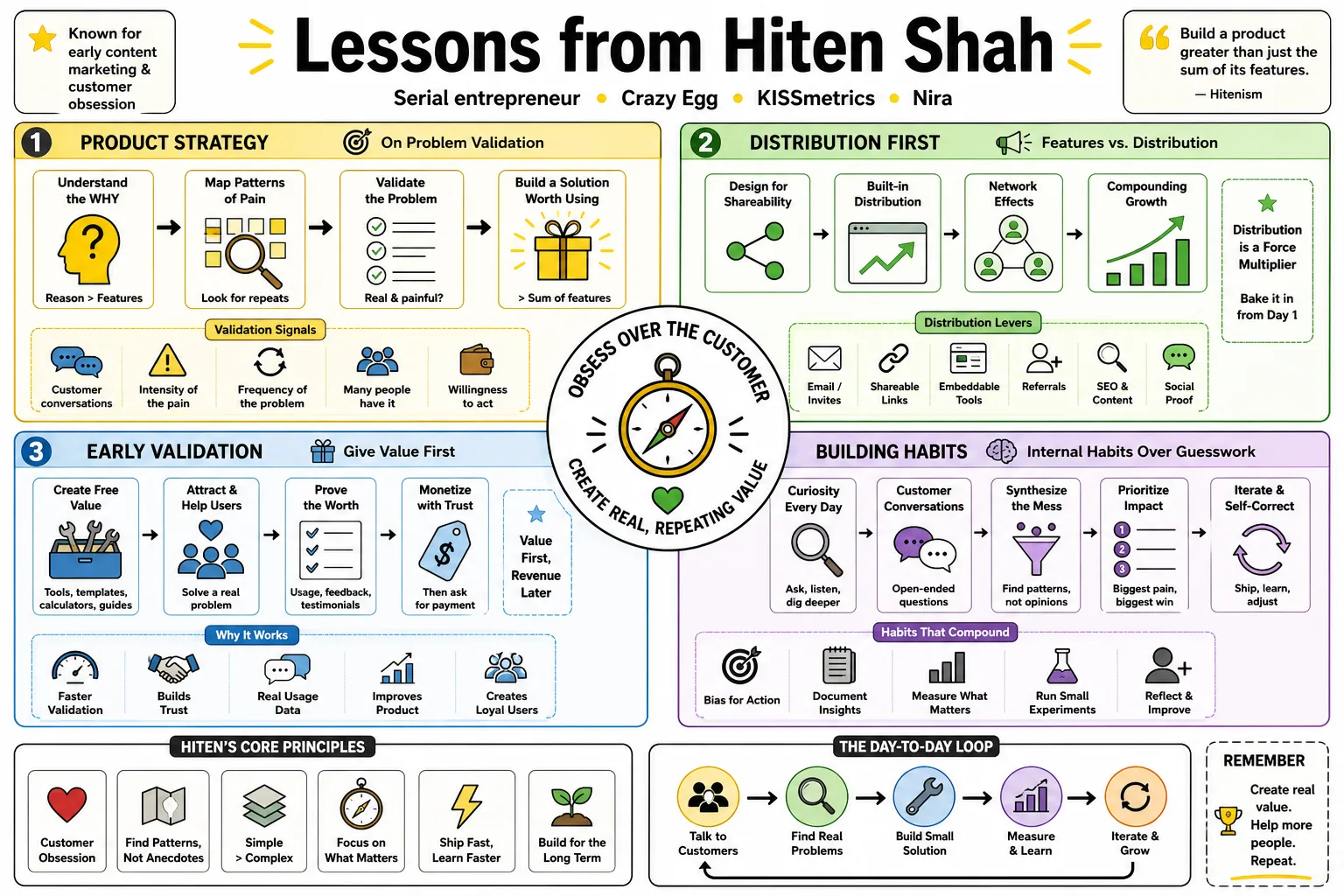
Serial entrepreneur Hiten Shah co-founded software companies including Crazy Egg, KISSmetrics, and Nira. He built his reputation on early content marketing and by repeatedly interviewing customers to map their "patterns of pain." This document collects his practical advice on product development, self-correction, and the day-to-day work of running a startup.
Part 1: Product Strategy
- On problem validation: "Build a product that's greater than just the sum of its features because at the end of the day, it's just as important to understand the reason why you're building your product as it is to actually build it." — Source: Hitenism
- On features versus distribution: The most successful products have distribution baked in from the very start, rather than treating it as an afterthought to development. — Source: Hiten's Substack
- On early validation: Give away free value, like simple tools or templates, as a fast way to prove your product's worth before attempting monetization. — Source: Hitenism
- On building habits: Instead of trying to magically know what customers want, focus on developing internal habits that help you identify the messy problems customers actually have. — Source: Product Habits
- On iterating quickly: Optimize startups for speed by narrowing your focus to solving a single, critical customer problem at a time. — Source: Product Habits
- On blueprint thinking: Avoid relying on recycled frameworks or popular playbooks; instead, take an honest view of what is actually working for your specific product. — Source: Hiten's Substack
- On purpose: "Thinking about your purpose is actually pretty crucial to your success... Not only does it give customers something to believe in, but it will inspire your team to think bigger." — Source: Hitenism
- On creating fans: "If you don't have something that turns your customers into fans, then you're sunk." — Source: Medium
- On understanding the market: Look for the gap between what existing tools offer and what users are hacking together themselves. — Source: Product Habits
Part 2: Customer Discovery & Research
- On patterns of pain: True market needs are revealed when you speak with enough customers to see recurring, consistent, and high-priority problems. — Source: Quora
- On premature marketing: Pre-product/market fit startups should spend their time testing assumptions through direct customer conversations rather than running brand awareness campaigns. — Source: Quora
- On unbiased questions: Never ask a customer if they would buy your product; ask them to show you how they currently solve the problem. — Source: Hitenism
- On listening: The goal of an interview isn't to validate your idea, but to understand the customer's world so well that the product becomes obvious. — Source: Product Habits
- On surveys: Keep surveys incredibly short and focus on one specific outcome, rather than asking every question you can think of. — Source: Crazy Egg Blog
- On qualitative data: Analytics tell you what is happening, but talking directly to users tells you why it is happening. — Source: Crazy Egg Blog
- On customer retention: The best way to reduce churn is to understand the exact moment a customer realizes they are getting value, and optimize everything to get them there faster. — Source: Churn.fm
- On assumptions: Every unverified assumption in your business model is a liability waiting to surface. — Source: Hitenism
- On customer feedback loops: Build a systematic habit of speaking to a set number of customers every single week, regardless of how busy you are. — Source: Product Habits
- On finding early adopters: Look for the people who are already actively spending time or money trying to solve the problem you are targeting. — Source: Hitenism
Part 3: Action Over Advice
- On taking action: "You don't need more advice, you need more practice." — Source: Hitenism
- On seeking validation: Many founders spend too much time seeking advice to validate their thinking when they should just be doing something. — Source: Hitenism
- On experimentation: Treat your tasks and advice as "tiny experiments" to see what actually works in practice. — Source: Hitenism
- On progress: "The people who are able to progress and grow the fastest are the ones who take the advice of others... and get right to doing something about their situation." — Source: Hitenism
- On feedback via action: You cannot improve at what you do without getting real-world feedback, which only comes from practice. — Source: Hitenism
- On shortcut answers: Avoid looking for shortcut answers; embrace the hard work of solving real problems. — Source: The Luba Show
- On momentum: Doing the wrong thing quickly and learning from it is often better than doing nothing while waiting for the perfect strategy. — Source: The Startup Chat
- On absorbing information: Reading endless blog posts about startups is a form of procrastination disguised as work. — Source: Hitenism
- On learning: The faster you can ship, the faster you can learn what you are doing wrong. — Source: Product Habits
Part 4: Co-founders & Teams
- On the Batman and Robin framework: Build co-founder relationships based on complementary strengths, where roles are clear, balanced, and support is mutual. — Source: The Luba Show
- On building trust: Trust within a team takes ten years to fully build, emphasizing the need for long-term thinking over short-term gains. — Source: The Luba Show
- On human problems: "In my experience, human problems are the biggest threat to a company's well-being, and it usually happens when there's office politics, you're too distant from your team, or you're way too involved." — Source: Hitenism
- On hiring: Hire people who have a proven track record of solving the specific type of problem your startup is currently facing. — Source: The Startup Chat
- On co-founder conflict: Most co-founder disputes arise from unstated expectations rather than actual disagreements on strategy. — Source: The Startup Chat
- On delegation: Your job as a founder changes every six months; you must constantly fire yourself from your current role by handing it off. — Source: Hitenism
- On asking for help: "Learn to say that you need help and don't see it as a weakness. See it as a point of strength." — Source: Hitenism
- On remote work: Successful remote teams rely on over-communication and an emphasis on output rather than hours logged. — Source: FYI
- On culture: Company culture isn't what you write on the wall; it's the behavior you reward and the behavior you tolerate. — Source: The Startup Chat
- On team alignment: Make sure everyone on the team knows the one metric that matters most to the company right now. — Source: Product Habits
Part 5: Decision Making & Metacognition
- On metacognition: Founders must constantly test their own thinking and look for their personal triggers and blind spots. — Source: The Luba Show
- On the purple bruise method: Deliver high-impact, immediate feedback the next day rather than delaying it for months. — Source: The Luba Show
- On fast decisions: Get comfortable making high-stakes decisions with only 10% of the information, rather than waiting for perfect clarity. — Source: The Luba Show
- On self-awareness: Poking at the world to test your own assumptions is a critical skill for improving how you interact with your team. — Source: The Luba Show
- On following energy: Rather than obsessing over rigid goals, follow where your energy and curiosity lead to remain resilient during difficult periods. — Source: The Luba Show
- On cognitive biases: Acknowledge that as a creator, you are inherently biased to love your product; actively seek out information that proves you wrong. — Source: Every
- On prioritizing: If you have more than three priorities, you effectively have no priorities at all. — Source: The Startup Chat
- On clarity: Writing things down forces clarity of thought that talking simply cannot achieve. — Source: Hitenism
- On intuition: Intuition is just pattern recognition built up over years of failing; trust it, but verify it with data. — Source: Hiten's Substack
Part 6: Growth & Distribution
- On content marketing: Content must be highly actionable and directly relevant to the user's workflow to serve as a sustainable acquisition engine. — Source: KISSmetrics Blog
- On organic growth: The most powerful growth hack is building something so useful that users naturally want to share it with their colleagues. — Source: Product Habits
- On email lists: Building an audience through email remains one of the most reliable ways to secure distribution independent of algorithm changes. — Source: The Startup Chat
- On SEO: Focus on answering the exact questions your target audience is searching for, rather than just chasing high-volume keywords. — Source: Hitenism
- On scaling: Don't automate a growth channel until you have manually done the work enough times to understand exactly why it converts. — Source: Hitenism
- On retention over acquisition: All the acquisition in the world won't save a business that operates like a leaky bucket; fix retention first. — Source: KISSmetrics Blog
- On partnerships: "Powered by" branding and smart integrations are often more effective for distribution than direct advertising. — Source: Hitenism
- On giving away value: Releasing free, high-quality resources establishes authority and lowers the barrier for users to experience your brand. — Source: Product Habits
- On tracking metrics: Track only the metrics you are actually willing to change your behavior based on. — Source: Crazy Egg Blog
Part 7: Fundraising & Storytelling
- On pitch decks: Avoid generic pitch deck templates; investors see the same patterns constantly, so build a narrative with unique character and buildup. — Source: Hitenism
- On audience awareness: Many founders fail to raise capital because they try to pitch investors the same way they sell to their end customers. — Source: Hitenism
- On seed vs. institutional: Seed-stage founders must intentionally bridge the gap between their everyday operational reality and the financial requirements of institutional capital. — Source: Hitenism
- On raising too much: Raising an enormous round of funding forces a startup into a specific, high-pressure growth trajectory that limits future optionality. — Source: The Startup Chat
- On bootstrapping: Bootstrapping forces financial discipline and ensures you are solving a problem people will actually pay for on day one. — Source: The Startup Chat
- On investor relationships: Treat investors as partners rather than just a source of capital; keep them updated with the good, the bad, and the ugly. — Source: Hiten's Substack
- On momentum in fundraising: The easiest way to raise money is to prove that you don't actually need it to grow. — Source: Hitenism
- On valuations: Optimize for the right partner and favorable terms over achieving the highest possible valuation vanity metric. — Source: The Startup Chat
- On rejection: An investor's "no" is rarely about you; it is usually about their portfolio construction, timing, or lack of domain expertise. — Source: The Startup Chat
- On storytelling: A founder's primary job during fundraising is to clearly articulate the inevitable future where their product dominates the market. — Source: Hitenism
Part 8: The Founder's Mindset
- On making your own luck: "You make your own luck, every single minute of every day." — Source: Hitenism
- On internal focus: "Focusing on you, your thoughts and things you can control is the best path to long term success." — Source: Hitenism
- On breaking rules: "If you're an entrepreneur, rules aren't your friend." — Source: Medium
- On presence: "If you miss the chance to make the best of every moment, what kind of future will you create?" — Source: Medium
- On resilience: The startups that survive are simply the ones where the founders refused to quit when things got incredibly difficult. — Source: The Startup Chat
- On burnout: Burnout usually isn't the result of working too many hours; it happens when you work on things that drain your energy without showing progress. — Source: Hiten's Substack
- On comparisons: Comparing your messy behind-the-scenes reality to another company's polished highlight reel is a recipe for misery. — Source: The Startup Chat
- On routine: Establishing a predictable personal routine is the only way to anchor yourself amidst the chaos of building a company. — Source: The Startup Chat
- On long-term games: Business is a decades-long game; treat your reputation as your most valuable and fragile asset. — Source: Hitenism