Holden Karnofsky co-founded GiveWell to rigorously evaluate charities, then helped launch Open Philanthropy to fund high-risk, high-reward projects. He is perhaps best known for his "Most Important Century" thesis, arguing that the likely development of advanced AI makes our era uniquely critical for the long-term future. This collection of insights draws from his essays and interviews on philanthropy, forecasting, and navigating poorly defined problems.
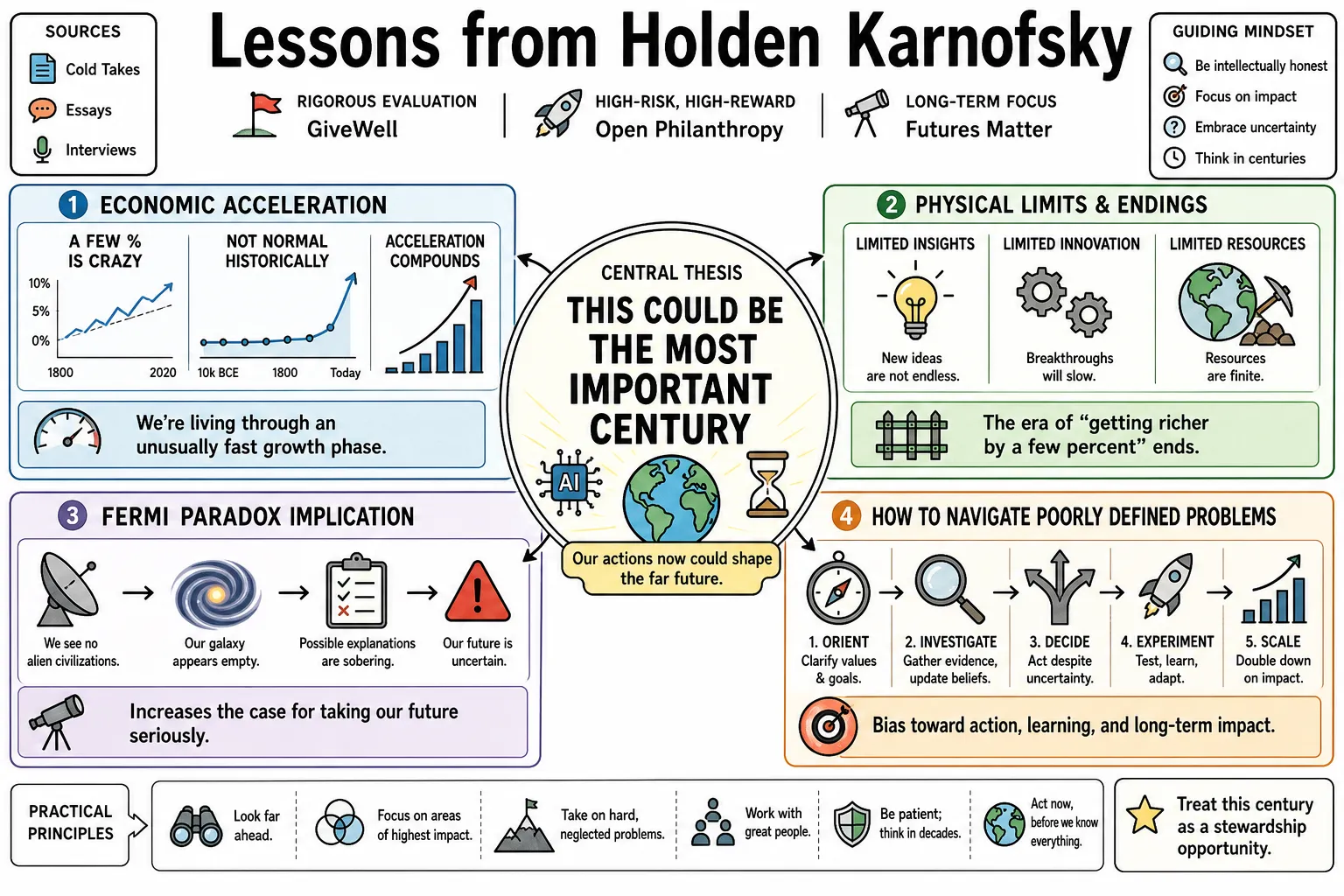
Part 1: The Most Important Century
- On economic acceleration: "Growing at a few percent a year is what we're all used to. But in full historical context, growing at a few percent a year is crazy." — Source: Cold Takes
- On historical context of growth: "This growth has gone on for longer than any of us can remember, but that isn't very long in the grand scheme of things." — Source: Cold Takes
- On physical limits: "It seems much more likely that we will 'run out' of new scientific insights, technological innovations, and resources, and the regime of 'getting richer by a few percent a year' will come to an end." — Source: Cold Takes
- On the Fermi Paradox: The absence of observed alien civilizations suggests our galaxy is currently empty, making humanity's potential to fill it a highly significant moment in cosmic history. — Source: Cold Takes
- On the wildness of all futures: Even the most conservative or skeptical views about humanity’s long-term trajectory inevitably lead to conclusions that are, by ordinary day-to-day standards, profoundly strange. — Source: Cold Takes
- On the plane analogy: "In This Can't Go On, I analogized the world to people on a plane blasting down the runway, without knowing why they're moving so fast or what's coming next." — Source: Cold Takes
- On technological lock-in: The values and societal structures established during a period of transformative technological acceleration could become locked in for billions of years. — Source: EA Forum
- On humanity's privileged position: It is difficult to avoid the conclusion that today's civilization occupies a highly unusual and consequential position relative to all of history. — Source: 80,000 Hours
- On galaxy-wide expansion: The developments of the 21st century could plausibly lead to the establishment of stable, galaxy-spanning civilizations. — Source: Cold Takes
- On the transition out of normal history: We are likely moving toward a transition away from normal historical patterns, either toward an explosive period of growth or societal collapse. — Source: Cold Takes
Part 2: Artificial Intelligence & Existential Risk
- On transformative AI timelines: There is a substantial chance that we will develop advanced AI systems capable of triggering an explosive period of technological and scientific growth within this century. — Source: Cold Takes
- On the easiest path to AI: The most straightforward and profitable paths to developing advanced artificial intelligence might naturally lead to systems that ultimately disempower humans. — Source: Cold Takes
- On human disempowerment: A major risk of highly capable AI systems is that they could outmaneuver human control, leading to a deeply unfamiliar future where humans are no longer the primary force in world events. — Source: 80,000 Hours
- On alignment difficulty: Ensuring that an artificial intelligence pursues intended goals rather than deceptive or dangerous instrumental sub-goals is an unsolved technical challenge. — Source: Dwarkesh Podcast
- On the playbook for AI risk: Addressing AI risk requires a multifaceted approach involving technical safety research, improved forecasting, governance frameworks, and careful deployment strategies. — Source: 80,000 Hours
- On digital people: Advanced technology could eventually enable the creation of digital human brains, fundamentally altering productivity, subjective experience, and resource consumption. — Source: Cold Takes
- On proactive safety measures: Because the stakes of transformative AI are unprecedented, investing in proactive safety research before systems reach dangerous capability levels is essential. — Source: Open Philanthropy
- On the uncertainty of AI development: As someone on the metaphorical speeding plane of technological progress, nobody knows exactly what future we need to be planning for, making broad preparation necessary. — Source: Cold Takes
- On warning shots: We should hope for clear warning shots, such as smaller-scale failures of AI alignment, that demonstrate the severity of the problem before existential risks materialize. — Source: 80,000 Hours
- On shovel-ready projects: The AI safety field needs more concrete, readily actionable projects that new researchers and engineers can execute to immediately reduce risk. — Source: 80,000 Hours
Part 3: Effective Altruism & GiveWell
- On the origin of GiveWell: GiveWell was founded out of frustration with the lack of transparent, evidence-backed information available to everyday donors trying to maximize their impact. — Source: GiveWell
- On quantifiable outcomes: The impact of a charitable donation is not merely a matter of good intentions, but of measurable, cost-effective outcomes that genuinely improve lives. — Source: GiveWell
- On sure bets in charity: For individual donors, it often makes the most sense to fund highly proven, heavily vetted interventions like malaria nets or antimalarial medication. — Source: GiveWell
- On the limitations of good intentions: Without rigorous evaluation, even well-meaning and heavily funded philanthropic programs can fail to produce positive results. — Source: GiveWell
- On transparency in philanthropy: Charities should be willing to share detailed data, admit failures, and openly discuss their weaknesses in order to improve resource allocation. — Source: GiveWell
- On rigorous evaluation: Finding true cost-effectiveness requires analyzing counterfactual impact, understanding what would have happened if the organization didn't exist, rather than just overhead ratios. — Source: GiveWell
- On the burden of proof: The burden of proof lies on charitable organizations to demonstrate that their interventions work, rather than on donors to prove they do not. — Source: GiveWell
- On comparing interventions: It is entirely possible for one charity to be hundreds or thousands of times more effective at saving lives per dollar than an average charity. — Source: GiveWell
- On room for more funding: A key metric for recommending a charity is assessing whether they can actually use additional marginal donations productively without diminishing returns. — Source: GiveWell
- On evidence-based giving: Philanthropy should be treated with the same intellectual rigor and demand for evidence as scientific research or financial investment. — Source: GiveWell
Part 4: Open Philanthropy & Hits-Based Giving
- On transitioning from sure bets: While GiveWell focuses on proven interventions, the greatest potential for large-scale philanthropy often lies in funding high-risk, high-reward initiatives. — Source: Open Philanthropy
- On hits-based philanthropy: Philanthropists should act more like venture capitalists, expecting many grants to fail but relying on a few massive successes to drive overall impact. — Source: Open Philanthropy
- On taking risky bets: Large foundations and individuals with vast resources are uniquely positioned to take on risks that governments and traditional institutions typically avoid. — Source: Open Philanthropy
- On historical precedents: Historical examples like the Green Revolution demonstrate how targeted, high-risk scientific funding can yield asymmetric benefits for humanity. — Source: Open Philanthropy
- On the value of failure: A philanthropic portfolio with a zero percent failure rate is a sign of extreme risk aversion and missed opportunities for greater impact. — Source: Open Philanthropy
- On long-termist grantmaking: Expanding the scope of giving to include risks facing future generations, such as pandemics and unaligned AI, is a logical extension of valuing all human lives equally. — Source: Open Philanthropy
- On worldview diversification: When facing radically different moral frameworks, institutions should allocate resources across multiple worldviews rather than placing all their bets on a single ethical theory. — Source: Open Philanthropy
- On funding neglected causes: The most cost-effective opportunities are often found in areas that are highly important and tractable, but currently ignored by mainstream funding sources. — Source: Open Philanthropy
- On expected value: Decision-making in hits-based giving relies heavily on calculating the expected value of an intervention, multiplying the potential massive upside by its probability of success. — Source: Open Philanthropy
Part 5: Navigating Wicked Problems
- On defining wicked problems: A wicked problem is vaguely defined, lacks clear goals, and offers no stable rules or objective metrics for measuring success. — Source: Cold Takes
- On the mental health gauntlet: Working intensely on poorly defined, high-stakes issues is exceptionally taxing and can serve as a severe mental health gauntlet. — Source: Cold Takes
- On deciding when to stop researching: When investigating complex topics, the hardest challenge is often deciding how deep to go into any given subtopic, as there is never an objectively correct stopping point. — Source: Cold Takes
- On changing one's mind: Frequently changing your mind about the core goal and scope of a project is not a failure, but a difficult and necessary part of the research process. — Source: Cold Takes
- On the vice of laziness: Knowing when to stop trying to perfectly resolve a difficult question and instead shifting the focus to something more manageable is a highly useful skill. — Source: Cold Takes
- On the vice of impatience: When lost in the weeds of research, you must regularly interrupt yourself to ask if the current line of inquiry is still relevant to the larger objective. — Source: Cold Takes
- On the vice of hubris: You must maintain confidence in your own judgment even when navigating complex, expert-level topics where established consensus might be lacking. — Source: Cold Takes
- On self-preservation: Prioritizing your own mental health and setting boundaries is necessary to sustain long-term engagement with difficult, open-ended problems. — Source: Cold Takes
- On learning by writing: Writing is an effective technique for understanding wicked problems, but it must be combined with active tinkering and testing to ensure arguments map to reality. — Source: Cold Takes
Part 6: Epistemology & Reasoning
- On minimal-trust investigations: When exploring new fields, it is often necessary to conduct independent, minimal-trust investigations to build your own understanding rather than solely relying on credentialed experts. — Source: Cold Takes
- On expert consensus: While expert consensus is valuable, deferring blindly to authority can be dangerous in domains where the problem is entirely unprecedented. — Source: Cold Takes
- On the value of tinkering: Abstract reasoning should be continuously grounded by building, testing, and seeking concrete feedback in the real world. — Source: Cold Takes
- On forecasting accuracy: Rigorous attempts to forecast the future, even if highly uncertain, are preferable to making implicit, unexamined assumptions about what will happen next. — Source: Open Philanthropy
- On the limits of historical analogies: Comparing future technological transitions to past events is useful, but we must recognize when a new development fundamentally breaks historical patterns. — Source: Cold Takes
- On expected value calculations: Expected value is a necessary tool for prioritization, but its outputs should be treated as rough guides rather than precise mathematical truths. — Source: Open Philanthropy
- On acknowledging uncertainty: Intellectual honesty requires clearly communicating the large error bars and deep uncertainties surrounding long-term forecasts. — Source: Cold Takes
- On epistemic humility: We should remain deeply suspicious of our own confidence, recognizing how often intelligent people have been spectacularly wrong about the future. — Source: Cold Takes
- On framing complex arguments: Breaking down massive, unintuitive conclusions into step-by-step logical premises makes it easier to identify exact points of disagreement. — Source: Cold Takes
Part 7: Future-Proof Ethics & Morality
- On common sense ethics: Relying entirely on everyday ethical intuition is risky, as historical norms often look abhorrent in hindsight. — Source: Cold Takes
- On historical moral atrocities: Recognizing that past societies comfortably engaged in terrible practices should make us actively search for our own current moral blind spots. — Source: Cold Takes
- On expanding the moral circle: Moral progress involves systematically expanding our circle of concern beyond our immediate tribe to include all humans, animals, and future generations. — Source: EA Forum
- On non-human animal welfare: Factory farming represents a massive, ongoing moral catastrophe that requires urgent philanthropic and societal attention. — Source: Open Philanthropy
- On the moral weight of future generations: Because future generations cannot advocate for themselves or participate in current markets, they are systematically disenfranchised in today's decision-making. — Source: 80,000 Hours
- On rigorous ethical frameworks: We should seek out systematic frameworks for ethics to help us avoid repeating the tragic moral errors of the past. — Source: Cold Takes
- On avoiding the mistakes of the past: Future-proofing our ethics requires actively challenging our strongest intuitions and remaining open to radically different moral conclusions. — Source: Cold Takes
- On extreme poverty vs long-term risks: Balancing the immediate, visceral suffering of extreme poverty against the abstract, probabilistic risks to the distant future is one of the hardest challenges in cause prioritization. — Source: Open Philanthropy
- On the strange implications of morality: Taking morality seriously often forces us into conclusions that seem highly counterintuitive or socially awkward by contemporary standards. — Source: Cold Takes
Part 8: Career Capital & Building Aptitudes
- On transferable skills: In an uncertain world, building versatile, highly transferable skills is often a safer and more impactful strategy than prematurely narrowing your focus. — Source: 80,000 Hours
- On kicking ass in early career: Early in your career, focus intensely on roles where you can demonstrate high competence, deliver results, and learn how to function at a professional standard. — Source: 80,000 Hours
- On generalist vs specialist paths: While specialized knowledge is vital, highly capable generalists who can synthesize information and navigate wicked problems are incredibly rare and valuable. — Source: 80,000 Hours
- On the value of hard work: Producing a high volume of quality output is one of the most reliable ways to build career capital and discover your true comparative advantages. — Source: 80,000 Hours
- On finding comparative advantage: Impact is maximized by finding the intersection of an important problem and your unique personal strengths. — Source: 80,000 Hours
- On shifting focus when necessary: You should be willing to pivot your entire career trajectory if new evidence suggests that a different cause area has become significantly more urgent. — Source: 80,000 Hours
- On building a track record: Earning the trust to take on independent, high-impact work requires first building a rock-solid track record of reliability in structured environments. — Source: 80,000 Hours
- On the importance of operational roles: Excellent operations, management, and administrative skills are massive bottlenecks for impactful organizations, and are just as necessary as research talent. — Source: 80,000 Hours
- On career flexibility: Given the potential for rapid technological transformation, maintaining the flexibility to adapt to radically altered professional landscapes is essential. — Source: 80,000 Hours