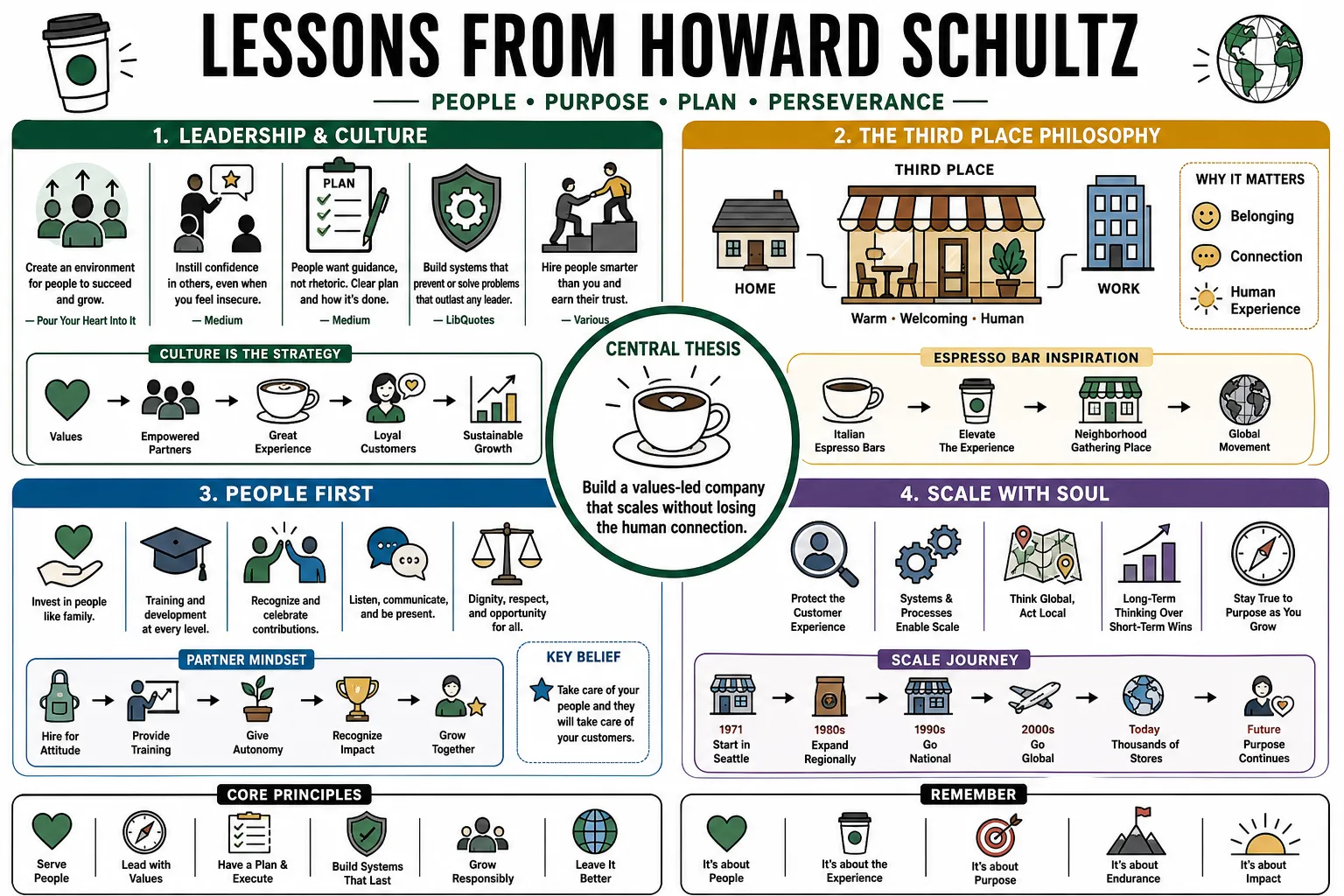
Lessons from Howard Schultz
Howard Schultz served three separate stints as Starbucks CEO, turning a regional coffee roaster into a global chain based on the Italian espresso bar concept of a third place between home and work. This profile gathers his public thoughts on building a business, managing employees, and handling the friction between scale and the customer experience.
Part 1: Leadership and Culture
- On the essence of leadership: "The essence of leadership is to create an environment in which people can succeed and grow to their full potential." — Source: Pour Your Heart Into It
- On projecting confidence: "One of the fundamental aspects of leadership is the ability to instill confidence in others when you yourself are feeling insecure." — Source: Medium
- On setting clear plans: "People want guidance, not rhetoric. They need to know what the plan of action is, and how it will be implemented." — Source: Medium
- On organizational endurance: "To be an enduring, great company, you have to build a mechanism for preventing or solving problems that will long outlast any one individual leader." — Source: LibQuotes
- On letting go: "Early on I realized that I had to hire people smarter and more qualified than I was in a number of different fields, and I had to let go of a lot of decision-making." — Source: Business Insider
- On vulnerability as a strength: "The hardest thing about being a leader is demonstrating or showing vulnerability. When the leader demonstrates vulnerability and sensibility and brings people together, the team wins." — Source: Addicted2Success
- On transparency as currency: "I think the currency of leadership is transparency. You've got to be truthful." — Source: AZQuotes
- On discovering destiny: "Leadership is discovering the company's destiny and having the courage to follow it." — Source: WordPress
- On personal responsibility: "In life, you can blame a lot of people and you can wallow in self-pity, or you can pick yourself up and say, 'Listen, I have to be responsible for myself.'" — Source: Fearless Motivation
- On shared success: "When you run a race as a team, though, you'll discover that much of the reward comes from hitting the tape together." — Source: Goodreads
Part 2: The Meaning of Coffee and Connection
- On defining the business: "We're not a beverage company serving coffee. We are a coffee company serving people." — Source: Acquired Podcast
- On the initial Italian inspiration: "When I first discovered in the early 1980s the Italian espresso bars in my trip to Italy, the vision was to re-create that for America." — Source: AZQuotes
- On the nature of transactions: "We're not in the transaction business. We have to execute transactions, but that has to go through the lens of being an experience business." — Source: Acquired Podcast
- On the romance of espresso: "It was not just the drink that mattered, but the theater of the Italian espresso bar, the sound of the machines, and the social ritual of enjoying the moment." — Source: Coffee Tasters
- On building community: "Coffee is what we sell as a product, but it's not what our brand stands for. Starbucks is about human connection and a sense of community inside our stores." — Source: Forbes
- On the third place: "Starbucks recreated the Italian model to serve as a hub between home and work where people could simply connect with one another." — Source: Quartr
- On personal rituals: "My own daily ritual reflects our early inspiration, frequently starting with a simple espresso macchiato." — Source: QuoteFancy
- On barista artistry: "The magic of the cafe experience is heavily dependent on the pride and care that baristas bring to the preparation of each cup." — Source: Coffee Tasters
- On the threat of optimization: "We cannot continue to allow the mobile app to be a runaway train that is going to consistently dilute the integrity of the experience of Starbucks." — Source: Acquired Podcast
- On losing the essence: "Everyone shows up, and all of a sudden we got a mosh pit, and that's not Starbucks." — Source: Acquired Podcast
Part 3: Employee Relations and Partners
- On prioritizing employees over shareholders: "The shareholder is not the primary person. It's the Starbucks partner in the green apron. If we exceed the expectations of our people, shareholders and customers are going to win." — Source: Acquired Podcast
- On the foundation of trust: "If there's one accomplishment I'm proudest of at Starbucks, it's the relationship of trust and confidence we've built with the people who work at the company." — Source: WordPress
- On meeting expectations: "You can't expect your employees to exceed the expectations of your customers if you don't exceed the employees' expectations of management." — Source: AZQuotes
- On building the brand internally: "We built the Starbucks brand first with our people, not with consumers." — Source: Gracious Quotes
- On viewing benevolence as growth: "Treating employees benevolently shouldn't be viewed as an added cost that cuts into profits, but as a powerful energizer." — Source: Succeed Feed
- On sharing information: "When you're building a business or joining a company, you have to be transparent; you can't have two sets of information for two sets of people." — Source: Addicted2Success
- On common purpose: "When you're surrounded by people who share a passionate commitment around a common purpose, anything is possible." — Source: Forbes
- On providing benefits: "Helping partners build their futures and care for their families is a core value of mine as an entrepreneur, an employer, and a son who watched his own family struggling." — Source: Medium
- On the fabric of the company: "The employee in the green apron is the fundamental cloth that holds the entire retail enterprise together." — Source: LikeToLearn
Part 4: Risk, Conviction, and Entrepreneurship
- On going against the grain: "There are moments in our lives when we summon the courage to make choices that go against reason, against common sense and the wise counsel of people we trust." — Source: Goodreads
- On playing it safe: "Whatever you do, don't play it safe. Don't do things the way they've always been done." — Source: AZQuotes
- On the cost of entrepreneurship: "Entrepreneurs must love what they do to such a degree that doing it is worth sacrifice and, at times, pain." — Source: Medium
- On emotional blindness: "Entrepreneurs can be blinded by emotion, by our love of what we have built, unable to see it fresh and with the eyes of a more objective outsider." — Source: Medium
- On dealing with rejection: "I was turned down by 217 of the 242 investors I initially talked to. You have to have a tremendous belief in what you're doing and just persevere." — Source: Succeed Feed
- On controlling your own destiny: "When you really believe in yourself and in your dream, you just have to do everything you possibly can to take control and make your vision a reality." — Source: ASParker
- On expanding your vision: "I think if you're an entrepreneur, you've got to dream big and then dream bigger." — Source: Addicted2Success
- On pouring your heart in: "If you pour your heart into your work, or into any worthy enterprise, you can achieve dreams others may think impossible." — Source: The Leadership Professor
- On embracing risk: "Do not be afraid to take risks, for in the end, they will only make you stronger and wiser." — Source: Podcastics
Part 5: Values, Conscience, and Society
- On the soul of a business: "A great business has to have a conscience. You have to know who you are and who you are not." — Source: Addicted2Success
- On authentic brands: "In this ever-changing society, the most powerful and enduring brands are built from the heart. They are real and sustainable." — Source: Goodreads
- On values and loyalty: "If people believe they share values with a company, they will stay loyal to the brand." — Source: Medium
- On the purpose of profit: "No business can do well for its shareholders without first doing well by the people the business touches." — Source: Medium
- On speaking out: "Speaking out is a necessary beginning, but not the same as real change." — Source: Goodreads
- On the cost of silence: "History shows that silence is unforgivable, for it gives bigotry license. And when meek words masquerade as moral courage, they are perceived as indifference." — Source: Goodreads
- On the American promise: "Your station in life does not define you. The promise of America is for all of us." — Source: Goodreads
- On refusing to be idle: "We refuse to be bystanders, even if we do not know exactly where our actions will lead." — Source: Find Your Yellow Tux
- On wealth and politics: "People of means have been able to leverage their wealth and their interest in ways that are unfair." — Source: Business Insider
Part 6: Adversity and the Roots of Ambition
- On childhood stigma: "By the time I got to high school, I understood the stigma of living in the projects and knew I had to escape the struggle my parents lived with every day." — Source: Horatio Alger
- On financial stress: "I did not have an unhappy childhood, but we lived daily with the constant stress of financial issues." — Source: Horatio Alger
- On watching a parent struggle: "Seeing my father as a beaten man and part of the working poor shaped my lifelong drive to build a different kind of workplace." — Source: Horatio Alger
- On the turning point of injury: "When my father broke his ankle and lost income due to a lack of health insurance, the trauma permanently etched the necessity of comprehensive worker benefits into my mind." — Source: JWeekly
- On living on the wrong side of the tracks: "Growing up in federally subsidized housing exposed me early to the stark realities of wealth disparity." — Source: Business Insider
- On escaping his background: "My journey was fueled by an internal need to run away from the destitution I saw around me in Canarsie." — Source: Washington Post
- On fear of failure: "Fear of failure drove me at first, but as I tackled each challenge, my anxiety was replaced by a growing sense of optimism." — Source: Succeed Feed
- On tackling insurmountable hurdles: "Once you overcome seemingly insurmountable obstacles, other hurdles become less daunting." — Source: Entrepreneur
- On finding growth in discomfort: "Success comes from sacrifice. To find success you must get comfortable with being uncomfortable." — Source: Fearless Motivation
- On taking responsibility for failure: "In the end, when things go wrong, playing the blame game doesn't change a thing. You are in control of your life and you are responsible for it." — Source: Addicted2Success
Part 7: Navigating Growth and Scale
- On the danger of big numbers: "The problem when you get this big is you start thinking about large numbers. But if you reduce it to the lowest common denominator, one store, one cup of coffee, what if all of that works?" — Source: Acquired Podcast
- On disciplined growth: "Grow with discipline. Balance intuition with rigor. Innovate around the core. Don't embrace the status quo." — Source: Business Insider
- On maintaining passion at scale: "A company can grow big without losing the passion and personality that built it, but only if it's driven not by profits but by values and by people." — Source: WordPress
- On the true metric of success: "Success is not sustainable if it's defined by how big you become. Large numbers that once captivated me are not what matter. The only number that matters is one." — Source: Medium
- On the purpose of growth: "Growth is a strategy and is not a reason for being." — Source: CNN
- On the definition of Onward: "Onward implied optimism with eyes wide open, a never-ending journey that honored the past while reinventing the future." — Source: Medium
- On diagnosing missteps: "It's not the miss that matters. It's what comes next. What's the diagnosis of the problem? What's the impact on morale? And what's the strategy to fix it?" — Source: Inc
- On respecting the competition: "The one thing we could not and should not do was dismiss the ability of any competitor to capture our customers." — Source: Medium
- On over-delivering: "A vital strategy for long-term credibility during rapid expansion is to consistently under-promise and over-deliver." — Source: ASParker
Part 8: The Customer Experience
- On the core mission statement: "To inspire and nurture the human spirit, one person, one cup, and one neighborhood at a time." — Source: Medium
- On building from the heart: "Brand foundations are stronger because they are built with the strength of the human spirit, not an ad campaign." — Source: Goodreads
- On maintaining the craft: "We cannot continue to allow the mobile app to be a runaway train that is going to consistently dilute the integrity of the retail experience." — Source: Acquired Podcast
- On the currency of trust: "Earning the currency of trust with customers is an everyday practice that cannot be taken for granted." — Source: AZQuotes
- On exceeding expectations: "Because we believed the best way to meet and exceed the expectations of our customers was to hire and train great people, we invested in employees." — Source: Gracious Quotes
- On staying curious: "Always be a learner and closely observe the customer experience to apply new ideas and improve the business model." — Source: MasterClass
- On the customer journey: "The lowest common denominator of retail success is focusing obsessively on the individual experience of one customer at a time." — Source: Acquired Podcast
- On creating a sense of place: "The design, the music, and the smell of coffee must all work together to create a sanctuary away from the pressures of daily life." — Source: Starbucks
- On the magic of human interaction: "The ultimate product isn't roasted beans; it is the momentary human connection shared across the counter." — Source: Forbes