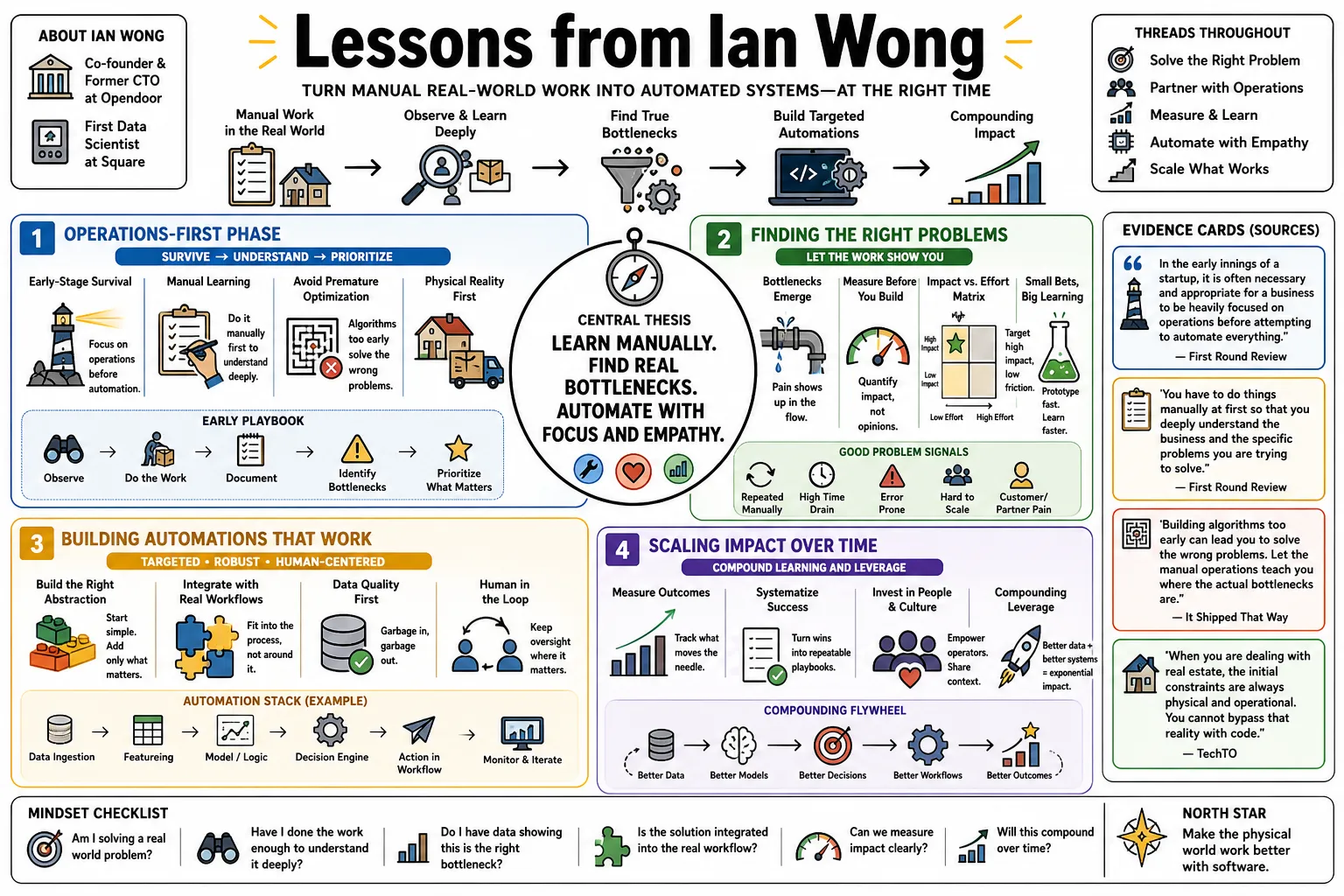
Lessons from Ian Wong
As the co-founder and former CTO of Opendoor and the first data scientist at Square, Ian Wong specialized in turning manual, operations-heavy businesses into automated systems at scale. This collection gathers his perspectives on data science, technical leadership, and building software that interacts with real-world workflows.
Part 1: The Operations-First Phase
- On early-stage survival: "In the early innings of a startup, it is often necessary and appropriate for a business to be heavily focused on operations before attempting to automate everything." — Source: First Round Review
- On manual learning: "You have to do things manually at first so that you deeply understand the business and the specific problems you are trying to solve." — Source: First Round Review
- On premature optimization: "Building algorithms too early can lead you to solve the wrong problems. Let the manual operations teach you where the actual bottlenecks are." — Source: It Shipped That Way
- On the friction of physical businesses: "When you are dealing with real estate, the initial constraints are always physical and operational. You cannot bypass that reality with code." — Source: TechTO
- On identifying automation targets: "Look for the operational workflows that cause the most pain as volume increases. Those are your first candidates for algorithmic intervention." — Source: First Round Review
- On founding teams: "The founding team needs to be willing to do the unglamorous, manual work to prove the core hypothesis before handing it off to software." — Source: TechTO
- On the cost of operations: "An operations-heavy approach is expensive and limits growth, but it buys you the exact domain expertise required to build effective models later." — Source: The Data & AI Chief Podcast
- On bridging bits and atoms: "Startups that touch the physical world must initially over-index on human operations to ensure quality control." — Source: Unite.AI
- On operational empathy: "Engineers should spend time shadowing the operations team to understand the real-world friction of the processes they are trying to replace." — Source: It Shipped That Way
Part 2: Transitioning to Algorithms & Scale
- On the tipping point: "As a startup scales, relying solely on manual operations becomes a hard limitation on growth. That is when you must transition to algorithmic decision-making." — Source: First Round Review
- On the threshold for production: "An algorithm does not need to be significantly better than a human to be deployed. It only needs to be no worse than a human for a specific subset of decisions." — Source: First Round Review
- On iterative deployment: "Deploy models incrementally. Let them handle the easiest cases first while routing complex edge cases to human operators." — Source: Unite.AI
- On building trust in models: "Internal teams will reject algorithms if they do not understand them. You have to prove the model's reliability in parallel with human operations before fully cutting over." — Source: The Data & AI Chief Podcast
- On longevity: "Data science and algorithmic decision-making become critical to achieving the efficiency required for a business to survive long-term." — Source: First Round Review
- On feedback loops: "The transition to algorithms requires setting up tight feedback loops where every human intervention trains the model for the next time." — Source: It Shipped That Way
- On managing the handoff: "The handoff from operations to algorithms is not a single event. It is a continuous, negotiated process over years." — Source: TechTO
- On risk tolerance: "You have to accept a different kind of risk when moving to algorithms. Human errors are individual, while algorithmic errors scale instantly." — Source: Unite.AI
- On replacing workflows: "Do not just try to replicate human workflows with algorithms. Use the transition as an opportunity to redesign the process entirely." — Source: First Round Review
Part 3: Structuring Data Science Teams
- On practical research: "Remember: your research is not helpful if it does not meet the immediate needs of the business." — Source: The Data & AI Chief Podcast
- On skin in the game: "Data scientists should be put on the front lines of the business so they feel the pressure and heat of real-world operations." — Source: First Round Review
- On data fidelity: "High-fidelity data is the prerequisite for any meaningful machine learning. If the inputs are noisy, the automated decisions will be dangerous." — Source: The Data & AI Chief Podcast
- On model ensembling: "For complex problems like home valuation, relying on a single model is brittle. Ensembling different approaches yields far more robust predictions." — Source: Unite.AI
- On communication: "Data scientists must hone their business communication skills. The best model will not be adopted if you cannot explain its value to non-technical stakeholders." — Source: The Data & AI Chief Podcast
- On organizational structure: "Integrating data scientists directly into product pods often works better than keeping them in an isolated research group." — Source: First Round Review
- On evaluating models: "Do not evaluate models purely on statistical accuracy. Evaluate them on how they impact the primary business metrics." — Source: TechTO
- On fraud and risk: "When building risk systems, the goal is not to eliminate fraud entirely, but to manage it at a level that enables rapid growth." — Source: Unite.AI
- On simplicity: "Start with simple heuristics. Only introduce machine learning complexity when the simple rules stop scaling." — Source: It Shipped That Way
Part 4: Hiring, Talent & Culture
- On the T-shaped professional: "I always think about talent in a T-shaped fashion — you go deep in one area, but you also have the breadth to collaborate with the other functions as well." — Source: Medium
- On hiring early data scientists: "Your first data hire should be someone comfortable with messy infrastructure, not just someone who wants to tune hyperparameters all day." — Source: First Round Review
- On assessing candidates: "I look for people who can explain a highly technical concept to a layperson without relying on jargon." — Source: The Data & AI Chief Podcast
- On cross-functional empathy: "A healthy culture requires engineers to respect the operations team, and the operations team to trust the engineers." — Source: TechTO
- On retaining technical talent: "Give technical people hard, ambiguous business problems, not just well-defined engineering tasks." — Source: It Shipped That Way
- On interview signals: "The best candidates ask piercing questions about how their work will actually be used by the business." — Source: Unite.AI
- On building teams: "You need a mix of optimists who want to push boundaries and pragmatists who want to ensure the system does not break." — Source: First Round Review
- On performance reviews: "Evaluate technical staff on business outcomes, not just code shipped or models trained." — Source: The Data & AI Chief Podcast
- On cultural alignment: "Skills can be taught, but an aversion to understanding the underlying business model is very difficult to fix." — Source: TechTO
Part 5: Engineering Leadership & Execution
- On internal tools: "Building high-impact internal tools is often more important for a scaling startup than polishing user-facing features." — Source: It Shipped That Way
- On technical debt: "Technical debt is a tool. You borrow against the future to win the present, but you must have a plan to pay it back before it bankrupts your velocity." — Source: Unite.AI
- On architecture decisions: "Design systems to be disposable in the early days. Do not build for scale you do not have yet." — Source: It Shipped That Way
- On managing managers: "The jump from managing engineers to managing managers requires letting go of the codebase and focusing entirely on context and alignment." — Source: TechTO
- On incident response: "Blameless post-mortems are essential. If people are afraid to break things, they will stop moving fast." — Source: First Round Review
- On alignment: "A leader's primary job is ensuring that the engineering roadmap directly maps to the company's existential priorities." — Source: The Data & AI Chief Podcast
- On scaling infrastructure: "Infrastructure breaks at every order of magnitude. Anticipate the breaks and over-provision slightly, but do not rebuild until it hurts." — Source: Unite.AI
- On giving feedback: "Direct, unvarnished feedback about the impact of someone's work is the highest form of professional respect." — Source: It Shipped That Way
- On setting technical vision: "The technical vision should not be an abstract document; it must be a clear explanation of how the architecture will support the next two years of growth." — Source: First Round Review
Part 6: Problem Solving & Technical Philosophy
- On distillation: "I cannot do without a blank sheet of paper and a pen. When I come across something complicated, I will try to distill the core idea until it fits on a single, hand-written page." — Source: HousingWire
- On framing: "A problem well-framed is half solved. Spend more time defining the constraints before writing any code." — Source: TechTO
- On first principles: "When you enter a traditional industry like real estate, you cannot rely on industry analogies. You have to rebuild the logic from first principles." — Source: Unite.AI
- On complexity: "Complexity is the enemy of execution. If a solution requires a dozen steps, find a way to cut it down to three." — Source: It Shipped That Way
- On debugging business models: "Treat the business model like a distributed system. When things fail, trace the error back to the originating assumption." — Source: The Data & AI Chief Podcast
- On iteration speed: "The company that can iterate the fastest usually wins, even if their initial starting point was worse." — Source: First Round Review
- On ignoring noise: "In a startup, there are a hundred fires burning. You have to get comfortable letting ninety-seven of them burn so you can put out the three that matter." — Source: TechTO
- On cross-disciplinary learning: "Some of the best ideas in data science come from studying how other disciplines manage uncertainty and risk." — Source: Unite.AI
- On false precision: "Do not mistake a highly precise numerical output for an accurate one. Averages and ranges are often more truthful in uncertain environments." — Source: The Data & AI Chief Podcast
- On the value of constraints: "Strict constraints force creativity. If you have unlimited time and resources, you will build something bloated." — Source: It Shipped That Way
Part 7: Product-Market Fit & Strategy
- On the nature of fit: "Product market fit is dynamic and changing. You can have it and you can lose it. So it's definitely not a binary thing. It's almost the degree of product market fit." — Source: Medium
- On market feedback: "The market does not care about how elegant your technology is; it only cares if you solve its problem faster or cheaper." — Source: TechTO
- On scaling operations: "Scaling requires standardizing the exceptions. You have to build playbooks for the edge cases so they stop derailing the main process." — Source: First Round Review
- On unit economics: "You cannot use venture capital to subsidize bad unit economics forever. The algorithms must eventually drive the margins into the black." — Source: Unite.AI
- On customer trust: "In high-stakes transactions, trust is your primary product. Technology is just the delivery mechanism for that trust." — Source: HousingWire
- On expanding scope: "Before you expand to a new market or product line, ensure the core engine is running without daily intervention." — Source: The Data & AI Chief Podcast
- On tracking metrics: "Pick three metrics that define the health of the business and ignore the rest until those three start moving in the right direction." — Source: TechTO
- On capital efficiency: "Data science should be viewed as a tool for capital efficiency, allowing you to deploy resources exactly where they yield the highest return." — Source: First Round Review
- On managing growth: "Rapid growth stresses every seam in the organization. The systems you built for ten users will actively sabotage you at ten thousand." — Source: It Shipped That Way
- On long-term vision: "Maintain a long-term perspective on what the market will look like in ten years, but execute ruthlessly on what the market needs today." — Source: Medium
Part 8: The Evolution of PropTech & AI
- On physical integration: "The next wave of technology will not just live on screens; it will integrate deeply with physical assets and offline workflows." — Source: Unite.AI
- On real estate data: "Real estate data is notoriously fragmented and dirty. The competitive advantage goes to the company that can clean and normalize it at scale." — Source: The Data & AI Chief Podcast
- On AI decision platforms: "We are moving from AI that merely provides insights to AI platforms that execute business decisions autonomously within defined guardrails." — Source: TechTO
- On the evolution of valuations: "Automated Valuation Models are just the beginning. The goal is to price not just the asset, but the liquidity and risk associated with it." — Source: Unite.AI
- On legacy industries: "Industries that have resisted digitization for decades are the most fertile ground for algorithmic disruption, because the baseline efficiency is so low." — Source: First Round Review
- On generative AI: "Generative AI will change how we interact with data, but it still requires a foundation of absolute factual accuracy to be useful in transactional businesses." — Source: The Data & AI Chief Podcast
- On liquidity: "Providing liquidity to illiquid markets is primarily a data problem. If you can price the risk accurately, you can provide the capital." — Source: HousingWire
- On consumer expectations: "Consumers now expect the same transaction speed for a house as they do for an e-commerce purchase. Technology has to bridge that gap." — Source: Unite.AI
- On continuous learning: "The models that power modern businesses must learn continuously from new transactions. Static models decay rapidly in changing macroeconomic environments." — Source: The Data & AI Chief Podcast
- On the ultimate goal: "The ultimate promise of technology in traditional sectors is not to remove humans, but to remove friction, allowing humans to focus on higher-order problems." — Source: TechTO