Lessons from Ilana Weinstein
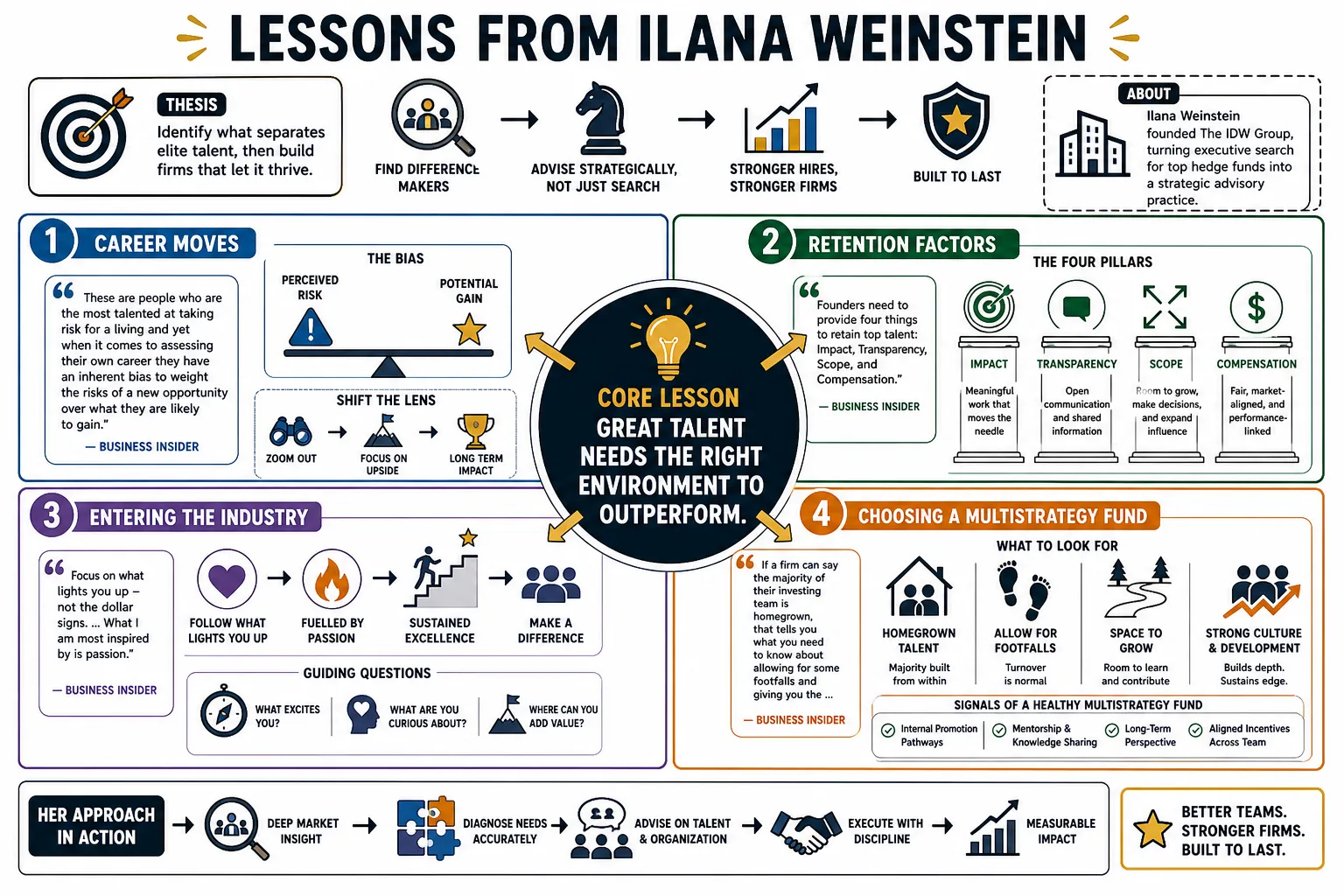
Ilana Weinstein founded The IDW Group, turning executive search for top hedge funds into a strategic advisory practice. By identifying what separates elite portfolio managers from the rest, she changed how the industry approaches hiring. The insights below outline her approach to evaluating talent, competing in the market, and building investment firms that last.
Part 1: The Genesis of a Career
- On Career Moves: Hedge fund professionals are highly skilled at taking risk professionally, yet when evaluating their own careers they show a loss-aversion bias, weighing the downside of a new opportunity more heavily than the upside they stand to gain. — Source: Business Insider
- On Retention Factors: Founders who want to retain their best people need to deliver on four fronts: giving them real impact on outcomes, transparency into how they are measured and paid, room to grow in scope, and competitive compensation. — Source: Business Insider
- On Entering the Industry: Career decisions in this industry should be guided by genuine passion for investing rather than by compensation, since visible enthusiasm for the work is what stands out most in a candidate. — Source: Business Insider
- On Choosing a Multistrategy Fund: A multistrategy fund's investing team being developed internally and promoted up, rather than hired in from outside, is a stronger signal of stability than pedigree alone. — Source: Business Insider
- On The Bar for Talent: The standard for hedge fund talent is exceptionally high, since so few candidates can meet everything the best funds are looking for. — Source: Bloomberg
- On Industry Fragility: The hedge fund industry runs like a giant Jenga puzzle: pull out just a few key people and a fund's returns, and the whole structure, can come crashing down. — Source: Business Insider
- On Non-Monetary Priorities: Elite hedge fund talent increasingly weighs whether a move will make them better developmentally and the best version of themselves, not just the size of the paycheck. — Source: HedgeWeek
- On The Power of Curiosity: "Well when I was at Penn, I had this thought that I wanted to be Barbara Walters. That was kind of where my head was." — Source: Masters in Business (Nov 2019)
- On Finding Your Path: "None of this, none of this lended itself to Goldman Sachs. I ended up at Goldman really because I didn't want to go to law school, because that's kind of what you do with an English and psych major." — Source: Masters in Business (Nov 2019)
Part 2: Identifying and Cultivating Elite Talent
- On Compensation Structures: "Right? So, I was, I also parachuted into Goldman in the middle of my senior year because I made the mistake of telling the guys interviewing me that I could start right away. I'd done, I'd just gotten kind of blown through my classes quickly. I was a little bit of a nerd in college, Barry." — Source: Masters in Business (Nov 2019)
- On The Hedge Fund Ecosystem: "I was doing double duty my senior year. Well, I finished my classes really end of my junior year, and I started at Goldman." — Source: Masters in Business (Nov 2019)
- On The Hedge Fund Ecosystem: "And BCG was really a way to play catch up. was like getting my post MBA not so much that I wanted to be a consultant but I wanted to learn about different industries and different types of problems." — Source: Masters in Business (Nov 2019)
- On Building a Business: "Well at Goldman, you know, what I realized is I didn't really love finance. I could do the work." — Source: Masters in Business (Nov 2019)
- On The Power of Curiosity: "And Goldman, very transaction driven in helping people to get from one side to the next, not just giving them advice. And that was the way I felt I could contribute." — Source: Masters in Business (Nov 2019)
- On The Evolution of Prop Trading: "How does that happen? I was at BCG and this is when the dot-com bubble was getting bigger and bigger." — Source: Masters in Business (Nov 2019)
- On Taking Risks: "And these were first of their kind types of products that these prop groups were focused on, very complex financial instruments. So we were all learning as we went and just by virtue of doing really one search, it made me the expert because no one else was doing it and so I built my business from there." — Source: Masters in Business (Nov 2019)
- On Evaluating Performance: "It is a big anniversary and it's not one I take lightly given the average hedge fund lives three years. I don't know if you're aware of that." — Source: Masters in Business (Nov 2019)
- On Multi-Strategy Funds: "Exactly. I went out on my own because I really just wanted to focus on doing the kind of work that was interesting to me." — Source: Masters in Business (Nov 2019)
Part 3: The Psychology of the Portfolio Manager
- On Early Influences: "They didn't care about being part of a big firm with hundreds of people in many offices. They cared about domain expertise, and that's what I brought to the table." — Source: Masters in Business (Nov 2019)
- On Finding Your Path: "Let me define what we do, because I feel like a fair misconception might be that as a recruiting firm, our job is to help people find jobs. That's actually not what we do." — Source: Masters in Business (Nov 2019)
- On Taking Risks: "And then we come up a level and talk about whether he's even learning the skills that will put him on his front feet to compete as things evolve in this industry. And I would say it's the amalgamation, Barry, of 20 years of intelligence, of speaking to the best people out there that no one can compete with." — Source: Masters in Business (Nov 2019)
- On What Top PMs Have in Common: "So think about it, you're happy, you're doing phenomenally well, or at least you think you're happy. You know, by the time we're done with you, you may not be that happy. (LAUGHTER)." — Source: Masters in Business (Nov 2019)
- On The Hedge Fund Ecosystem: "But you are doing well by anyone's metric. These are big numbers. There are people we're talking to where compensation was closer to nine figures than eight figures." — Source: Masters in Business (Nov 2019)
- On Data-Driven Decisions: "So it's really not about being disenfranchised or miserable or needing to find a job. They don't need to transact." — Source: Masters in Business (Nov 2019)
- On Making the Jump: "Okay, this isn't like, you know, you're sitting on the sell side and yes, you know, you're on the equity sales desk and someone doesn't need to transact with Goldman on the other side of the phone, but they do need to transact with someone. These people do not need to transact." — Source: Masters in Business (Nov 2019)
- On Finding Your Path: "The only reason they're coming in to meet with us is because they're going to learn something and there's going to be some perspective that they're going to walk out with, like the example I just gave you that they didn't have before. And that is a very different dynamic than what I think most recruiting firms do or even really able to do." — Source: Masters in Business (Nov 2019)
- On The Evolution of Prop Trading: "Much more. Think of it, Barry, as we're moving a battleship forward. That's not that easy. I think you sent me this article, actually, because I was pulling up your name on my text messages and it came up. There are more hedge funds than Burger Kings now, okay?" — Source: Masters in Business (Nov 2019)
Part 4: Structural Dynamics of Hedge Funds
- On What Top PMs Have in Common: "These aren't like the little Burger Kings sitting out in the middle of nowhere. Think of these guys that we work with as, I don't know, the biggest franchise owners of, you know, those fast food chains in the space." — Source: Masters in Business (Nov 2019)
- On The Evolution of Prop Trading: "Sometimes like I said in terms of moving a battleship forward it's just making sure that they have the best investment professionals for their existing strategies. Again no mean feat because the bar is exceptionally high and there are so many things we look for and so few people that can meet that challenge, as I said." — Source: Masters in Business (Nov 2019)
- On Multi-Strategy Funds: "What about fill in the blank? Things that he doesn't do today but may make sense and be adjacent and he's exploring all of those things." — Source: Masters in Business (Nov 2019)
- On The Hedge Fund Ecosystem: "I do, Barry. I kind of feel like, you know --." — Source: Masters in Business (Nov 2019)
- On The Role of Recruiting: "You have to wait for the book. (LAUGHTER)." — Source: Masters in Business (Nov 2019)
- On Evaluating Performance: "Which there will be one day, maybe. I'll have to be when I retire and publish under Anonymous." — Source: Masters in Business (Nov 2019)
- On Compensation Structures: "They probably will. But anyway, we'll cross that bridge when and if we come to it." — Source: Masters in Business (Nov 2019)
- On Finding Your Path: "You think you can prep someone within an inch of their life and there's every reason they should resign and go to where we've been working toward for the last six months them going and they end up staying. And then there are people who just get out like this where I think it's going to be a fight to the death to keep them." — Source: Masters in Business (Nov 2019)
- On Spotting Talent: "But you know one of the in building my business one of the most surprising things for me and this has nothing to do with my clients it's just kind of a funny thing to tell you for a firm that is a really unique niche in the hedge fund industry right, we recruit for the hedge fund industry and we do it at a level that I think is unusual, it is so difficult to recruit for ourselves. It is just, it's so hard because part of the sort of secret sauce that we were getting at earlier in terms of what makes us different, for us we need someone who is strategic, transaction driven, really into the micro, you mentioned like all the details and information that we amalgamate but then can come up a level and figure out how to commercialize that." — Source: Masters in Business (Nov 2019)
- On Multi-Strategy Funds: "It's so hard. We typically hire people out of the banks." — Source: Masters in Business (Nov 2019)
Part 5: Compensation and Value Creation
- On Founder Responsibilities: "There's so much that they are only going to learn just through the exposure and the information that they gather in being in the seat. But it's hard, it's really hard." — Source: Masters in Business (Nov 2019)
- On Compensation Structures: "There are so many good stories, Barry, but one that I'll tell, which hopefully no one will be too put off by if the protagonists self." — Source: Masters in Business (Nov 2019)
- On Building a Business: "The short answer is I was really young and I was still trying to figure out what I wanted to be when I grew up literally. I'd gone to HBS after a year at Goldman." — Source: Masters in Business (Nov 2019)
- On What Top PMs Have in Common: "And this is in the -- I was in my late 20s, this is in the mid-90s. So, the dot com because that's of course what we call it back then." — Source: Masters in Business (Nov 2019)
- On Founder Responsibilities: "The dot com bubble was just bubbling and within a year and a half, my entire class of MBAs at BCG, the class I entered with, was gone. So, I was literally -- they'd all gone to California to seek their -- start the next whatever." — Source: Masters in Business (Nov 2019)
- On The Power of Curiosity: "And done. Right. You can imagine how that ended for most of them." — Source: Masters in Business (Nov 2019)
- On Taking Risks: "So, they'd gone to try to start dot com companies and I -- that wasn't my gig. I wasn’t -- I realized I didn't really -- I'd learned a lot at BCG." — Source: Masters in Business (Nov 2019)
- On Navigating Volatility: "And before I committed to any particular pathway, I figured I would jump into another milieu where I could learn again more about companies and functions and just figure out where I wanted to commit to. And so, I joined a large recruiting firm thinking that would give me a purview and as it turned out, I was really good at it .." — Source: Masters in Business (Nov 2019)
- On The Power of Curiosity: "… and I fell into -- I quickly joined their financial services practice and that’s how I ended up in recruiting." — Source: Masters in Business (Nov 2019)
- On Career Longevity: "So, what happened was after about a year or two there, the dot com bubble burst and there -- this was this big search firm I was at, their financial services practice was really focused more on investment banking, equities, traditional asset management, sort of what I'll call older school businesses compared to what I really fell into and started to focus on, which was back in the late '90s, early 2000 as you'll remember, these were the -- this is what was fueling the sell side, this is where the action was. It was the prop groups and it was these new first-of-their-kind-type financial products." — Source: Masters in Business (Nov 2019)
Part 6: Advisory and the Strategic Pivot
- On Career Longevity: "It was the prop groups and it was these new first-of-their-kind-type financial products. It was called -- so, it was credit correlation, asset swaps, it wasn’t even called credit derivatives back then." — Source: Masters in Business (Nov 2019)
- On Making the Jump: "Highly structured first of their kind derivatives types of transactions. That's what we were focused on for the sell side clients that I was working with and that's where the juice was." — Source: Masters in Business (Nov 2019)
- On Compensation Structures: "That's what we were focused on for the sell side clients that I was working with and that's where the juice was. And all of a sudden, I developed my own business which was on fire within this big firm and it just became obvious after a few years to me to really try to do this on my own given I was acting effectively independently within a larger construct which was having issues at that time." — Source: Masters in Business (Nov 2019)
- On Early Influences: "It was perfect, Barry, right? I planned it perfectly." — Source: Masters in Business (Nov 2019)
- On The Role of Recruiting: "I was literally just understand -- I started at Goldman in the middle of my senior year Penn. I mean, I -- because I just was -- I don’t know, I was stupid. I was like working -- I just -- I got through all my classes. I didn’t have enough fun in college …." — Source: Masters in Business (Nov 2019)
- On The Evolution of Prop Trading: "Making up for -- trying to make up for a lost time now." — Source: Masters in Business (Nov 2019)
- On The Power of Curiosity: "But I was finished with my classes. I started middle of my senior year and I was out within literally a year to HBS." — Source: Masters in Business (Jul 2023)
- On Navigating Volatility: "So, this was -- it wasn’t -- that was not what really kind of what really jumpstarted my business. What it was however, you are correct in signaling the sell side as a driver of hedge fund talent because back then, it was the prop groups that were the precursors to hedge funds." — Source: Masters in Business (Jul 2023)
- On Taking Risks: "It was these, again, high-octane -- and these were the guys who got paid the most on the sell side at that time, right?" — Source: Masters in Business (Jul 2023)
- On The Evolution of Prop Trading: "Well, it -- within a sell side contacts, they were doing as well as they possibly could." — Source: Masters in Business (Jul 2023)
Part 7: Leadership and the Founder's Burden
- On Culture as a Differentiator: "Back then, you could be a superstar prop trader and earning 20, 30, 40 million bucks a year with which doesn't happen anymore." — Source: Masters in Business (Jul 2023)
- On Making the Jump: "You could be -- you could be earning more certainly than the CEO. But their buddies were leaving, many of whom were Goldman partners or just were -- just like, again, high-octane prop traders from Credit Suisse, from Deutsche Bank, from Morgan Stanley, from JPMorgan, and they were setting up shop." — Source: Masters in Business (Jul 2023)
- On Career Longevity: "But their buddies were leaving, many of whom were Goldman partners or just were -- just like, again, high-octane prop traders from Credit Suisse, from Deutsche Bank, from Morgan Stanley, from JPMorgan, and they were setting up shop. And remember back then, you could start with 50 and scale to a billion …." — Source: Masters in Business (Jul 2023)
- On Evaluating Performance: "And so -- and all of a sudden, there's no headwinds from any other part of the bank, there's no cap at all in terms of how you get paid, you can do whatever you want. And if you're an entrepreneurial person who is a great investment professional and that's your passion and that's what you want to do, why be part of a bank?" — Source: Masters in Business (Jul 2023)
- On What Top PMs Have in Common: "There was no headwinds to getting into this business and scaling if you could produce the goods. And back then, you could do that a lot more easily." — Source: Masters in Business (Jul 2023)
- On Taking Risks: "So, let me back up and tell you which I'm actually quite proud of. We've been in business for almost 17 years, 17 this February." — Source: Masters in Business (Jul 2023)
- On Early Influences: "So, we're helping him find somebody who could oversee that and build that. That's a very sophisticated person …." — Source: Masters in Business (Jul 2023)
- On The Hedge Fund Ecosystem: "… who's not -- this isn't someone looking for a job. This is somebody who has actually had great success with what they've done in the past and this is kind of an interesting maybe Chapter 2." — Source: Masters in Business (Jul 2023)
- On Culture as a Differentiator: "He's now building that business. So, it's both working on discrete assignments for our clients as well as coming to them with advice about where to take their -- how to take their funds forward." — Source: Masters in Business (Jul 2023)
Part 8: The Future of Alternative Investments
- On Taking Risks: "Well, after, again, almost two decades doing this, we typically …." — Source: Masters in Business (Jul 2023)
- On The Hedge Fund Ecosystem: "We kind of know -- I'm not going to go so far as to say we have the answer before we begin although that is often correct. Like actually formally begin the search." — Source: Masters in Business (Jul 2023)
- On The Power of Curiosity: "Well, we've done so much work in every conceivable asset class. So, many times that when we start something, it's rarely truly brand new." — Source: Masters in Business (Jul 2023)
- On Navigating Volatility: "What it can be -- because certain strategies are more cyclical than others. So, for example, when we did the -- here's a good example, when we did the head of emerging markets for one of our clients, he asked me how much work we've done in EM and I told him we had done a fair bit of work this is going back a few years but because it's a cyclical strategy not for a while." — Source: Masters in Business (Jul 2023)
- On Compensation Structures: "So, there, what we did is we threw a lasso over the universe sort of as we knew it from when we last left off and when that strategy was last en vogue and it was a pretty sizable universe. But -- and this was a global search as well, right, because it's a head of emerging markets, it's -- the person could sit here or could sit in London and we just dived in." — Source: Masters in Business (Jul 2023)
- On The Role of Recruiting: "When we do a search, any search, we're typically going through maybe 200, 300 people even though I know the answer is within 10 to 15 of those. We just want to make sure we're leaving no stone unturned and also building our own depth and breadth of knowledge." — Source: Masters in Business (Jul 2023)
- On Career Longevity: "It's really -- it's usually iterative because again there is a best three choices in its basest form which is people who are -- who can generate -- who are the people who can generate consistent P&L over time that meet with our -- with -- that meet with our investing -- our investment parameters. But your version of who those best three people are may be different than someone else's." — Source: Masters in Business (Jul 2023)
- On Spotting Talent: "But your version of who those best three people are may be different than someone else's. Part of it is cultural fit." — Source: Masters in Business (Jul 2023)
- On Career Longevity: "Part of it is just how flexible you, as a founder, are going to be with respect to giving them. You may say you're going to give them a fair degree of -- a lot of autonomy but they may need more than what you're willing to give them." — Source: Masters in Business (Jul 2023)