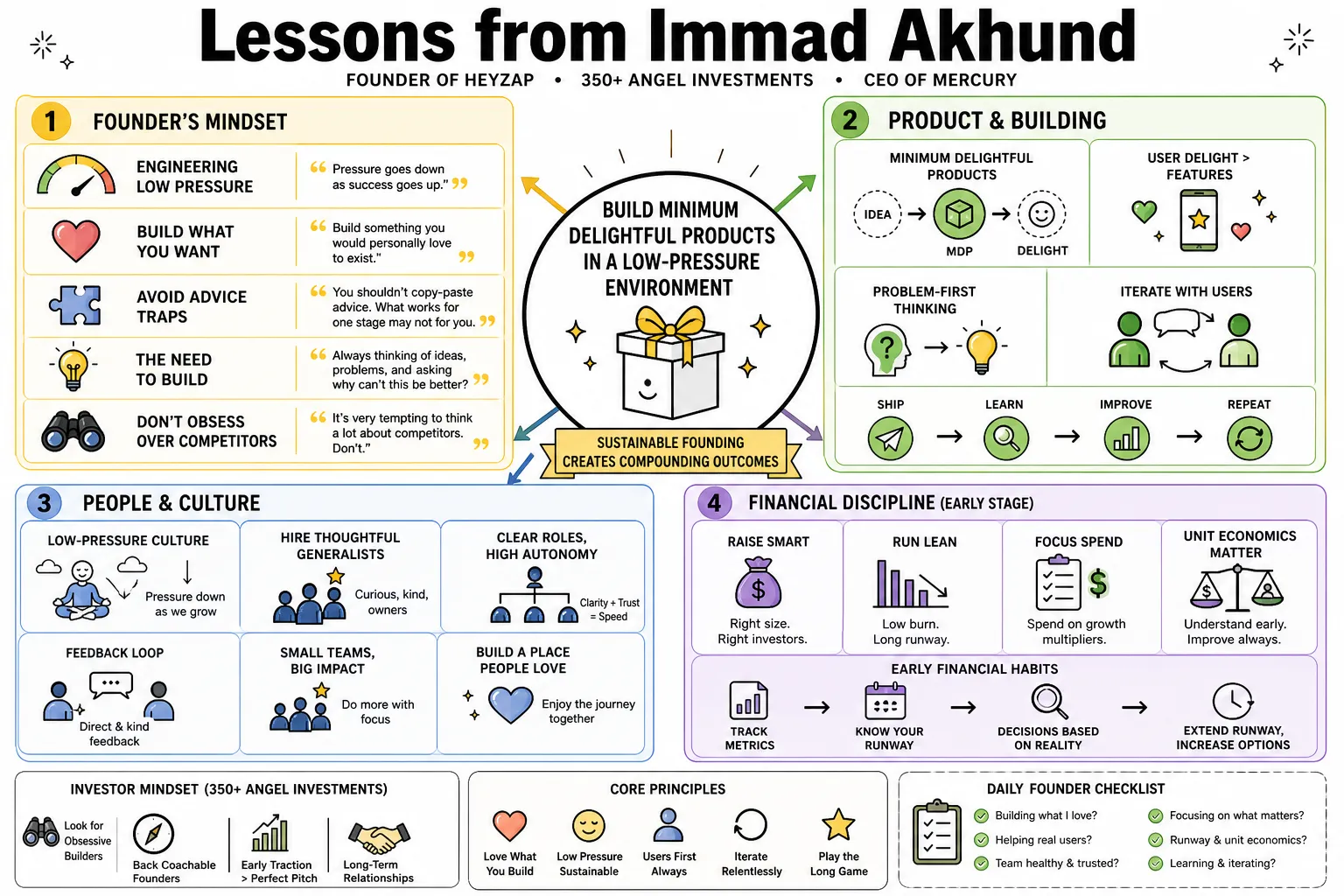
Lessons from Immad Akhund
Immad Akhund is a serial founder and the CEO of Mercury, a digital banking platform for startups. Based on his time running Heyzap and making over 350 angel investments, he focuses on building "minimum delightful products" and keeping company culture low-pressure. This profile collects his direct advice on founder psychology, hiring, and early-stage financial discipline.
Part 1: The Founder's Mindset
- On Engineering Low Pressure: "I've tried to make it so that the pressure kind of goes down as success goes up, which I think is relatively rare. If you're more successful, why are you more stressed about it?" — Source: [Knucklehead Podcast]
- On Building What You Want: "My advice to my younger self and other founders is always to build something that you would personally love to exist." — Source: [Knucklehead Podcast]
- On Avoiding Advice Traps: "You shouldn't copy-paste advice. What works for one CEO or company stage won't necessarily apply to yours." — Source: [First Round Review]
- On The Need to Build: "I'm a real startup nerd, so I'm always thinking of ideas and problems and asking why can't this be better?" — Source: [Foundr]
- On Obsessing Over Competitors: "It's very tempting as an entrepreneur to think a lot about what our competitors are doing... most of the time, it doesn't matter. The main thing is actually to focus on customers." — Source: [Fintech Architects]
- On Managing Founder Burnout: "Founders have to realize that the marathon nature of building a company means you cannot operate at a sprint constantly without breaking something." — Source: [Mercury Blog]
- On Handling Skepticism: "When we started Mercury, the industry was highly skeptical of a new startup bank, but leaning into that skepticism actually helped us identify our core differentiators." — Source: [New Economies Podcast]
- On Defining Success Early: "It just seemed obvious to me that someone would make a better bank product for startups and for entrepreneurs. It wasn't until 2017 that I could do it myself since no one else had." — Source: [a16z Podcast]
- On The Importance of Transparency: "Transparency isn't just about sharing good news; it's about sharing the mechanics of why decisions are made so the team can build trust in your judgment." — Source: [Mercury Blog]
- On Recognizing When to Pivot: "Sometimes the hardest part of being a founder is realizing that the market simply doesn't want what you're building, regardless of how elegantly you built it." — Source: [First Round Review]
Part 2: Building Product-Market Fit
- On The Minimum Lovable Product: "In fintech, you can't just launch a semi-functional MVP. You have to launch a minimum delightful product that immediately earns the user's trust." — Source: [a16z Podcast]
- On Tackling the Hard Part First: "When searching for product-market fit, don't fall into the trap of aimlessly iterating. Tackle the most difficult, fundamental problems of your product early on." — Source: [First Round Review]
- On Early PMF Signals: "Four days after launch, someone signed up, never spoke to us, and transferred $1 million into a Mercury bank account and I was like, 'Wow.'" — Source: [First Round Review]
- On Building Trust from Day One: "When dealing with people's money, the baseline functionality has to be flawless. A clean UI and essential features like wire transfers are table stakes, not nice-to-haves." — Source: [Mercury Blog]
- On Product Iteration: "The traditional Silicon Valley playbook of launching something broken and fixing it later doesn't work when the cost of a mistake is a customer's livelihood." — Source: [First Round Review]
- On Solving Personal Pain Points: "The initial vision for Mercury came from my own frustration with the slog of traditional banking during my time at Heyzap." — Source: [a16z Podcast]
- On User Feedback Loops: "We built Mercury by actually listening to what founders hated about their existing banks and simply building the opposite experience." — Source: [New Economies Podcast]
- On Designing for Simplicity: "Financial tools should feel like consumer software. The barrier to entry should be low, even if the backend mechanics are incredibly complex." — Source: [Mercury Blog]
- On The Role of the CEO in Product: "Even as a company scales, the CEO has to remain intimately connected to the core product loops and customer pain points." — Source: [First Round Review]
Part 3: The Realities of Angel Investing
- On The Founder-Investor Advantage: "Founders make natural angel investors because they understand the reality of building a company and have genuine empathy for the process." — Source: [Mercury Blog]
- On Providing True Value: "As an angel, your job isn't just to write a check. It's to offer strategic advice, make connections, or actively help the founders with recruiting." — Source: [Mercury Blog]
- On Evaluating Early Talent: "I look for founders who exhibit immense grit and determination; I prefer to invest in ideas that genuinely excite me on a personal level." — Source: [Mercury Blog]
- On The Danger of Over-Filtering: "Passing on great companies because you think the founders are 'too young' or inexperienced is a common mistake that causes angels to miss huge winners." — Source: [Business Insider]
- On Starting Small: "If you want to get into angel investing, start with smaller checks. It allows you to build experience and intuition without overcommitting your time or capital." — Source: [Mercury Blog]
- On Developing Investor Intuition: "Your first twenty angel investments are largely an educational process. It takes time and reps to develop a genuine investor intuition." — Source: [Mercury Blog]
- On Managing Deal Flow Time: "You have to be highly disciplined with your time. Allocate a specific window each week for researching, talking to founders, and managing your existing portfolio." — Source: [Mercury Blog]
- On Investor Relationships: "Founders should treat their investors as professional partners, maintaining transparency, rather than treating them like parents." — Source: [Mercury Blog]
- On Backing Product-Driven Companies: "I strongly prefer to back businesses that plan to win through superior product quality rather than aggressive pricing or marketing gimmicks." — Source: [a16z Podcast]
Part 4: Scaling Mercury and Fintech
- On Competing with Incumbents: "I am not intimidated by established incumbents. New companies can absolutely win in crowded markets by finding a new angle or building a significantly better experience." — Source: [a16z Podcast]
- On The Shift in BaaS: "The industry is moving away from middleware-heavy Banking-as-a-Service models toward banks exposing their modern APIs directly." — Source: [Fintech Architects]
- On Moving Off Synapse: "Our transition off Synapse was driven by a need to control our own destiny and provide a more reliable, direct financial infrastructure for our customers." — Source: [Fintech Architects]
- On The Financial Operating System: "We view Mercury not just as a bank, but as a financial operating system—the Google Suite of banking that integrates directly into founders' workflows." — Source: [Fintech Architects]
- On Expanding to Personal Banking: "Launching Mercury Personal was about targeting the mass affluent and recognizing that successful founders eventually need the same high-quality financial tools for their personal wealth." — Source: [Rex Salisbury Newsletter]
- On Charging for Accounts: "Choosing to charge for a bank account is a forcing function to ensure we are delivering enough undeniable value to justify the cost." — Source: [Rex Salisbury Newsletter]
- On The Future of AI in Banking: "AI will fundamentally change banking by automating the tedious financial workflows that founders currently spend hours managing manually." — Source: [New Economies Podcast]
- On Scaling Trust: "As a fintech scales, trust is your ultimate currency. You can't growth-hack your way out of a security flaw or a compliance failure." — Source: [Fintech Architects]
- On Market Downturns: "I'm fairly short-term pessimistic about the economy. Winter is coming, but it will work itself out. What businesses mostly need is stability to plan." — Source: [Fintech Architects]
Part 5: Leadership and Management
- On Removing One-on-Ones: "I actually made the decision to remove regular one-on-ones to cut down on performative management and force more organic, urgent communication." — Source: [New Economies Podcast]
- On Becoming a Bottleneck: "A CEO's primary operational job as the company scales is to continuously identify where they are the bottleneck and systematically remove themselves from that process." — Source: [Mercury Blog]
- On Managing Stress: "If leadership feels like a constant fire drill, you have engineered your company wrong. Success should buy you leverage, not just more anxiety." — Source: [Knucklehead Podcast]
- On Taking Advice as a Leader: "Listen to everyone, but filter ruthlessly. Most advice is just someone else projecting their own past trauma onto your current situation." — Source: [Mercury Blog]
- On Setting Boundaries: "Clear boundaries around ownership are essential. If everyone owns a project, no one actually owns the outcome." — Source: [Mercury Blog]
- On In-Person Collaboration: "Despite using digital tools, I highly value intense, in-person touchpoints for the leadership team to build rapport and work through complex, nuanced issues." — Source: [Knucklehead Podcast]
- On Founder Autonomy: "You have to grant your senior leaders the autonomy to fail in small ways so they can learn how to succeed in big ways." — Source: [First Round Review]
- On Radical Honesty: "Sugarcoating bad news only delays the inevitable. Your team can handle the truth much better than they can handle ambiguity." — Source: [Mercury Blog]
- On The Purpose of Meetings: "If a meeting doesn't have a clear decision to be made or a specific debate to be had, it should be an email." — Source: [New Economies Podcast]
Part 6: Navigating Y Combinator and Early Days
- On The YC Network Effect: "The true value of Y Combinator isn't just the initial capital; it's the density of high-agency individuals pushing you to move faster than you thought possible." — Source: [Mixergy]
- On Choosing Co-Founders: "I always stress the importance of choosing co-founders you have already worked with. Prior experience reveals how you handle stress and conflict together." — Source: [Mercury Blog]
- On The Heyzap Pivot: "At Heyzap, we learned that survival often requires letting go of your original, cherished idea when the market data points in a completely different direction." — Source: [Y Combinator]
- On Raising Capital Effectively: "Fundraising is fundamentally a sales process. You are selling the future version of your company, and you need to communicate that vision with absolute conviction." — Source: [Y Combinator]
- On Avoiding External Funding: "External funding is not always the right path for every business. If you lack real, underlying growth, venture capital will only accelerate your failure." — Source: [First Round Review]
- On The YC Batch Dynamics: "Being surrounded by other founders launching simultaneously creates a healthy, productive paranoia that prevents complacency." — Source: [Mixergy]
- On Selling a Startup: "Selling Heyzap was a complex emotional and operational journey. You have to ensure that the acquisition makes sense not just financially, but culturally." — Source: [Y Combinator]
- On Building Early Momentum: "In the very early days, do things that don't scale. Personal outreach and manual onboarding are how you learn what to automate later." — Source: [Y Combinator]
- On Staying Resilient: "Startups are an exercise in sheer willpower. You have to survive long enough to get lucky." — Source: [Mixergy]
Part 7: Hiring and Company Culture
- On Personality vs. Playbooks: "I never understood culture for my first three companies. Now I realize personality trumps culture playbooks. You have to define the personality you want the company to have." — Source: [First Round Review]
- On Hiring with Intention: "Hire deliberately. Focus on the specific traits that matter most to your company’s unique culture, rather than blindly following generic industry hiring trends." — Source: [First Round Review]
- On Avoiding Bonus Structures: "I generally avoid bonus-based compensation structures because they tend to optimize for short-term, selfish metrics rather than long-term company health." — Source: [Mercury Blog]
- On Contingency Recruiters: "I caution founders against relying on contingency recruiters early on. It's almost always better to lean heavily on your own network and internal referrals." — Source: [Open Source CEO]
- On Fostering Humility: "We actively screen for humility and curiosity during the interview process. We want to avoid the cutthroat, hyper-competitive dynamic that ruins many Silicon Valley startups." — Source: [First Round Review]
- On Letting People Go: "When you realize someone isn't a fit for the company's culture, letting them go quickly and respectfully is the kindest thing you can do for both them and the team." — Source: [Mercury Blog]
- On Creating Alignment: "Culture isn't a ping-pong table. It's how your team behaves when things go wrong and how aligned they are on the ultimate mission." — Source: [First Round Review]
- On Cultivating Curiosity: "A team that is genuinely curious about the customer's problems will always out-build a team that is just trying to hit a quarterly OKR." — Source: [Mercury Blog]
- On Remote vs. Office: "While remote work provides flexibility, you have to be highly intentional about replacing the casual, connective tissue that naturally forms in an office." — Source: [Knucklehead Podcast]
- On Promoting from Within: "Whenever possible, give your early employees the opportunity to scale into leadership roles before defaulting to an expensive external hire." — Source: [Mercury Blog]
Part 8: Financial Discipline for Startups
- On Early Stage Simplicity: "Before finding product-market fit, prioritize absolute simplicity in your operations and outsource your finance tasks as much as possible." — Source: [LTSE]
- On Delaying Finance Hires: "Most startups fundamentally do not need a dedicated internal finance hire until after their Series A round. Keep your headcount focused on product." — Source: [LTSE]
- On Maintaining Low Burn: "Until you have undeniable product-market fit, your primary objective is survival. Use external firms and flexible tools to keep your monthly burn rate as low as possible." — Source: [LTSE]
- On CEO Financial Ownership: "Even after you hire a VP of Finance, the CEO must remain intimately aware of the company's financial health and underlying unit economics." — Source: [LTSE]
- On Evaluating Core Metrics: "Founders need to focus on core operational metrics—specifically a healthy, sustainable combination of revenue and growth—rather than vanity numbers." — Source: [LTSE]
- On The Danger of High Valuations: "Raising at an artificially high valuation might feel like a victory in the short term, but it sets a dangerous expectation that can crush the company in the next round." — Source: [Fintech Architects]
- On Cash Flow Management: "Understanding your working capital and cash conversion cycle is just as critical as understanding your customer acquisition cost." — Source: [Mercury Blog]
- On Sustainable Growth: "Growth at all costs is a relic of a low-interest-rate environment. Today, founders must prove they can scale efficiently and profitably." — Source: [Fintech Architects]
- On Investor Alignment: "When you take capital, make sure your investors are completely aligned with your planned timeline for liquidity and your overall financial philosophy." — Source: [First Round Review]
- On Building Generational Wealth: "True wealth in a startup isn't created by optimizing your salary; it's created by building a sustainable, highly valuable equity asset over a decade." — Source: [Knucklehead Podcast]