Inbal Shani transitioned from aerospace engineering into software product management, eventually leading R&D and product strategy at companies like GitHub, AWS, and Twilio. She is best known for framing generative AI as a new abstraction layer for developers and advocating for data infrastructures that give businesses persistent memory of their customers. This profile breaks down her practical insights on systems thinking, introverted leadership, and building AI-native products.
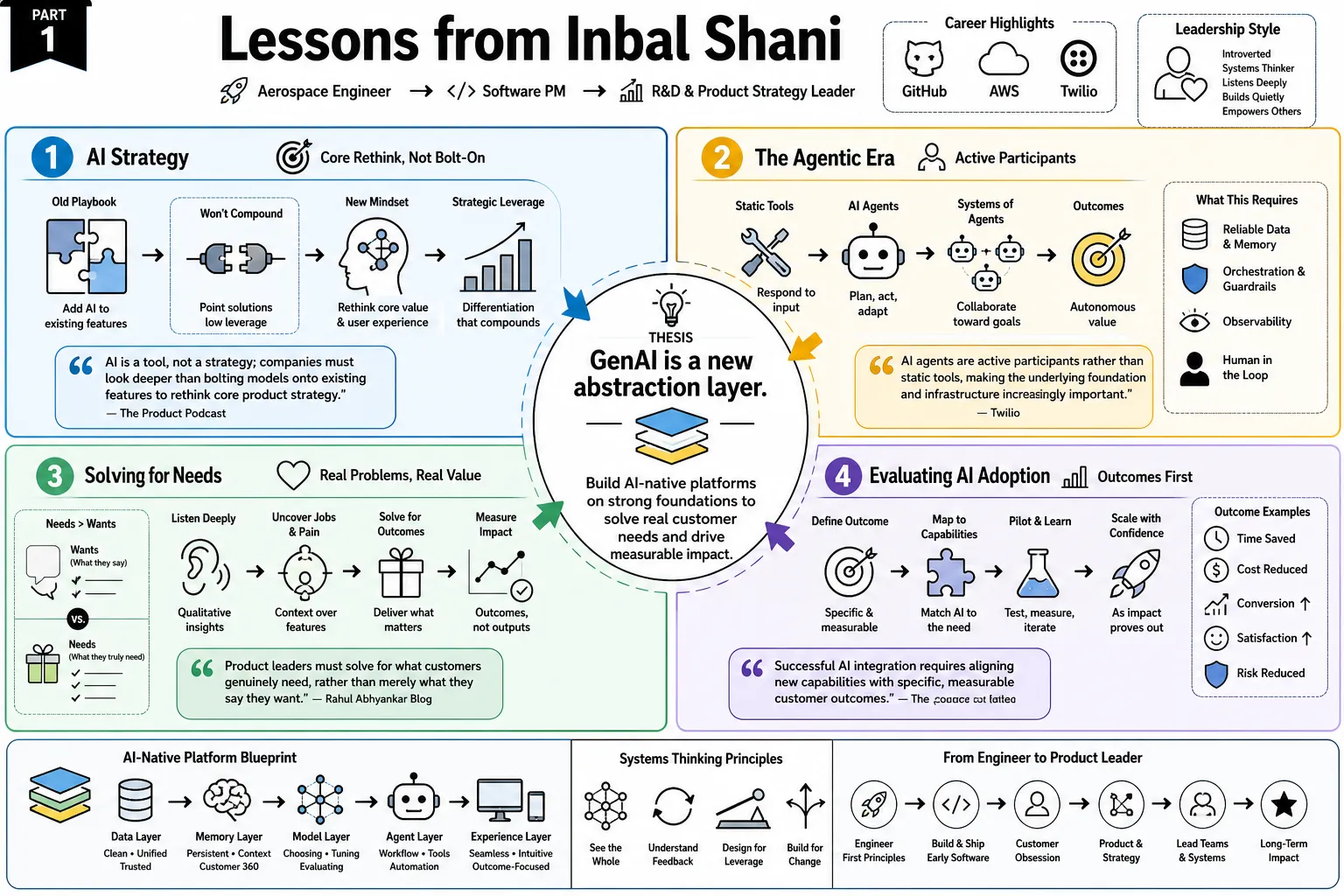
Part 1: Product Strategy & The AI-Native Platform
- On AI Strategy: Shani argues that AI adoption is not a product strategy by itself; product teams need to rethink strategy around the value AI creates for customers. — Reference: Product School podcast episode with Inbal Shani
- On the Agentic Era: "AI agents are active participants rather than static tools, making the underlying foundation and infrastructure increasingly important." — Source: Twilio
- On Solving for Needs: "Product leaders must solve for what customers genuinely need, rather than merely what they say they want." — Source: Rahul Abhyankar Blog
- On Evaluating AI Adoption: Shani's Product School episode frames successful AI integration around customer outcomes, business impact, and measurable product value. — Reference: Product School podcast episode on AI product strategy
- On Product Positioning: "Engineering leaders and product managers must master technical fluency to accurately position AI-native products." — Source: ELC Podcast
- On Persistent Memory: "Most brands still treat every conversation with a customer like it is the very first one; infrastructure must change to allow continuous context." — Source: Twilio
- On Customer Segments: "Leaders should spend time with a wide range of customers, from the largest to the smallest, and from the best to the most critical." — Source: Rahul Abhyankar Blog
- On Validating Assumptions: "Building products based solely on internal assumptions without validating them through customer conversations often leads to failure." — Source: McKinsey
- On Time-to-Value: "The ultimate measure of a new product feature is the speed at which it delivers tangible value to the end user." — Source: ELC Podcast
- On Structure and Strategy: "Organizational structure within R&D must always follow the broader business strategy, not the other way around." — Source: ELC Podcast
Part 2: Generative AI as an Abstraction Layer
- On the Role of a Copilot: "CoPilot is a copilot. It is not a pilot. It requires a human to remain at the wheel." — Source: Quora
- On the Evolution of Coding: "Generative AI serves as a new abstraction layer, allowing developers to use natural language to interact with codebases." — Source: ZDNet
- On Shifting Developer Focus: "AI tools move the developer experience away from pure syntax and toward system architecture and product outcomes." — Source: NextBigWhat
- On AI Feedback Loops: "Releasing AI tools to individual users first creates a fast feedback loop that is necessary before scaling to enterprise levels." — Source: Stripe
- On Engineering Objectives: "The objective goes beyond writing code faster; it centers on freeing developer time for complex, high-value tasks." — Source: ZDNet
- On Empowering Juniors: "AI assistance allows junior developers to learn faster and understand broader system components instead of getting stuck on basic syntax." — Source: NextBigWhat
- On the Development Lifecycle: "AI development will eventually assist the entire lifecycle, from issue creation and planning to implementation and pull requests." — Source: GeekWire
- On Agentic Limitations: "The hardest problem today lies less in generating a response and more in knowing who you are talking to, what they need, and whether you are authorized to act." — Source: Twilio
- On Frictionless Integration: "AI tools must integrate seamlessly into existing workflows to maintain the trust of the developer community." — Source: Business Insider
Part 3: Transforming Customer Engagement with Data
- On the Foundation of Engagement: "High-impact customer engagement starts with data that is real-time, contextual, and trusted." — Source: Usearch
- On Remembering the Customer: "Businesses must build platforms that allow them to remember, learn, and respond like they actually know the people they serve." — Source: Twilio
- On Continuous Narratives: "Connecting data and conversations is necessary to provide a continuous, contextual narrative across all channels." — Source: TechTarget
- On Analyzing Information: "The most unique change AI brings is the ability to better analyze and synthesize information to make real-time recommendations." — Source: Scribd
- On Standardizing Outcomes: "Plugging AI directly into communication channels helps standardize customer experiences and improve overall business outcomes." — Source: Twilio
- On Cross-Channel Consistency: "A platform built on persistent memory ensures that whether a customer reaches out via email, phone, or text, the context remains intact." — Source: CMSWire
- On Data Protection: "As organizations adopt AI, they have legitimate concerns regarding data protection, security, and copyright that must be addressed at the foundation." — Source: Business Insider
- On the Trust Imperative: "A secure and straightforward platform is necessary to power every customer moment that matters." — Source: Twilio
- On Product Quality: "Implementing AI primarily drives improvements in the fundamental quality of products through better decision-making capabilities." — Source: Scribd
- On Ending Silos: "Breaking down data silos is the prerequisite for treating customers as individuals rather than isolated support tickets." — Source: McKinsey
Part 4: Redefining R&D and Developer Productivity
- On Moving Past Output Metrics: "R&D organizations must shift from output-focused metrics to input goals that prioritize customer time-to-value." — Source: ELC Podcast
- On Unified Platforms: "Shifting from a localized management model to a unified platform strategy is necessary for cohesive R&D execution." — Source: ELC Podcast
- On Internal Alignment: "Internal R&D roadshows serve as a powerful strategic transformation tool to align distributed engineering teams." — Source: Metacast
- On Developer Flow State: "The true benefit of productivity tools lies in enabling engineers to stay in their flow state without context switching." — Source: ZDNet
- On Technical Fluency: "Product managers in an AI-native world must possess deep technical understanding to build effective roadmaps." — Source: Product School
- On Measuring Success: "Developer productivity should be measured by the business impact of deployed features rather than by lines of code." — Source: ELC Podcast
- On the Engineering DNA: "Embedding customer-centricity directly into the engineering DNA drives long-term product success." — Source: ELC Podcast
- On Cloud Scale: "Managing massive container services requires a delicate balance between rapid innovation and absolute platform stability." — Source: PR Newswire
- On Reducing Cognitive Load: "Good infrastructure abstractions reduce the cognitive load on developers, allowing them to focus on business logic." — Source: NextBigWhat
Part 5: Systems Thinking in Engineering Leadership
- On Engineering Foundations: "A background in aerospace and mechanical engineering instills a rigorous, systems-level approach to solving software problems." — Source: McKinsey
- On Breaking Down Complexity: "Systems thinking involves deconstructing massive, intractable problems into smaller, testable components." — Source: McKinsey
- On Working Backwards: "The philosophy of starting with the customer and working backwards is fundamental to building successful, scalable systems." — Source: Amazon
- On Anticipating Failure: "Systems engineering teaches that you must design architectures that handle failure gracefully under heavy load." — Source: PR Newswire
- On Platform Reliability: "When building infrastructure, the hardest challenge is maintaining reliability while simultaneously pushing new, cutting-edge features." — Source: The New Stack
- On Abstraction Design: "Creating effective abstraction layers requires a deep understanding of the complexity you aim to hide." — Source: ZDNet
- On the Boomerang Effect: Shani's career across Amazon, AWS, Microsoft, GitHub, and Twilio shows how moving across cultures can broaden a leader's understanding of systems, teams, and products. — Reference: She Leads interview with Inbal Shani
- On Technical Debt: "Managing technical debt functions as a strategic business decision that impacts time-to-market, rather than a mere engineering chore." — Source: ELC Podcast
- On Scaling Innovation: "Scaling products for millions of developers requires building systems that can learn and adapt without manual intervention." — Source: GitHub Blog
Part 6: Navigating Leadership as an Introvert
- On the Introverted Leader: "Being a hardcore introvert is not a barrier to executive leadership; it simply requires balancing natural inclinations with the role's demands." — Source: She Leads Podcast
- On Stepping Out of Comfort Zones: Shani's leadership story emphasizes career pivots, management before she expected it, and growth through roles that forced her beyond familiar ground. — Reference: She Leads interview with Inbal Shani
- On the Omnivert Evolution: Shani's introversion became a leadership strength because she learned to pair deep listening and one-on-one connection with the public demands of executive work. — Reference: She Leads interview on introverted leadership
- On Deep Connections: The She Leads episode highlights Shani's view that introverts can be highly connected leaders because they invest in deeper, more meaningful relationships. — Reference: She Leads interview on introversion as a leadership strength
- On Listening vs Talking: "The quietest leaders often absorb the most information, using deep listening to make better strategic decisions." — Source: She Leads Podcast
- On Energy Management: Shani's introvert-leadership arc points to managing energy deliberately while still showing up for the conversations, teams, and decisions that executive roles require. — Reference: She Leads interview with Inbal Shani
- On Authentic Leadership: "You do not need to adopt a loud persona to command respect; authenticity and clear communication prove more effective." — Source: She Leads Podcast
- On Building Trust: Shani's leadership framing centers empathy, listening, delegation, and real dialogue as practical ways to build trust with teams. — Reference: She Leads interview on leadership lessons
- On Thoughtful Responses: "Introverts tend to process information internally before speaking, leading to more deliberate and calculated strategic guidance." — Source: She Leads Podcast
- On Redefining Executive Presence: Shani's example suggests executive presence can come from clarity, listening, empathy, and judgment rather than a stereotypically extroverted style. — Reference: She Leads interview on introverted leadership
Part 7: The Power of Curiosity & Continuous Learning
- On Curiosity as a Trait: The She Leads write-up describes Shani as relentlessly curious, connecting her childhood habit of asking how things work to leadership and product problem-solving. — Reference: She Leads interview on curiosity and leadership
- On Childhood Exploration: Shani's early curiosity started with building, tools, and engineering influence at home, later feeding her path through aerospace engineering and technology leadership. — Reference: She Leads interview with Inbal Shani
- On Asking Questions: Shani's leadership pattern treats asking how and why systems work as a core operating habit, not a side trait. — Reference: She Leads interview on curiosity
- On Taking Feedback: Shani's episode stresses listening, dialogue, empathy, and surrounding yourself with people who push you as part of professional growth. — Reference: She Leads interview on growth and leadership
- On the Beginner's Mind: "Maintaining a beginner's mind allows experienced executives to spot opportunities that industry veterans might overlook." — Source: Twilio
- On Career Transitions: "Moving from aerospace engineering to software product management requires an insatiable appetite for continuous learning." — Source: McKinsey
- On Choosing Sponsors: Shani evaluates opportunities through learning, manager quality, and culture fit, making the choice of sponsors and support systems a deliberate career decision. — Reference: She Leads interview on career evaluation
- On Intellectual Humility: "The most effective product leaders are the first to admit what they do not know and the quickest to seek out the answers." — Source: Product School
- On Embracing the Uncomfortable: Shani's career framework asks whether a role will stretch her through a new technology, domain, or skill set before she treats it as a growth opportunity. — Reference: She Leads interview on career growth
Part 8: Building Empathy and Connected Cultures
- On Cross-Functional Empathy: "Building great products requires establishing deep, cross-functional empathy between engineering, product, and sales teams." — Source: Twilio
- On Intentional Connection: Shani's leadership style links empathy and intentional one-on-one connection to building the openness needed for teams to navigate hard problems together. — Reference: She Leads interview on empathy and listening
- On Understanding the User: "True user empathy goes beyond looking at metrics; it requires internalizing the daily friction your customers experience." — Source: McKinsey
- On Psychological Safety: "A connected R&D culture relies on psychological safety, where engineers feel comfortable proposing unconventional solutions." — Source: ELC Podcast
- On Mentoring Juniors: "Empathy in engineering means recognizing the struggles of junior developers and providing tools that accelerate their learning curve." — Source: NextBigWhat
- On the Human Element of AI: "Despite the rise of agentic AI, the human elements of trust and ethical oversight remain the most critical components of product design." — Source: Business Insider
- On Resolving Conflict: "Deep listening and a focus on one-on-one connection are the most effective tools for resolving complex organizational conflicts." — Source: She Leads Podcast
- On Celebrating Failure: Shani's product-leadership work emphasizes customer obsession, learning, and developer experience, which fits a culture that treats misses as inputs for better systems. — Reference: Product Leader's Journey episode with Inbal Shani
- On the Legacy of Leadership: "A leader's ultimate impact is measured by the capacity for empathy and innovation instilled in their teams, alongside the products they ship." — Source: ELC Podcast