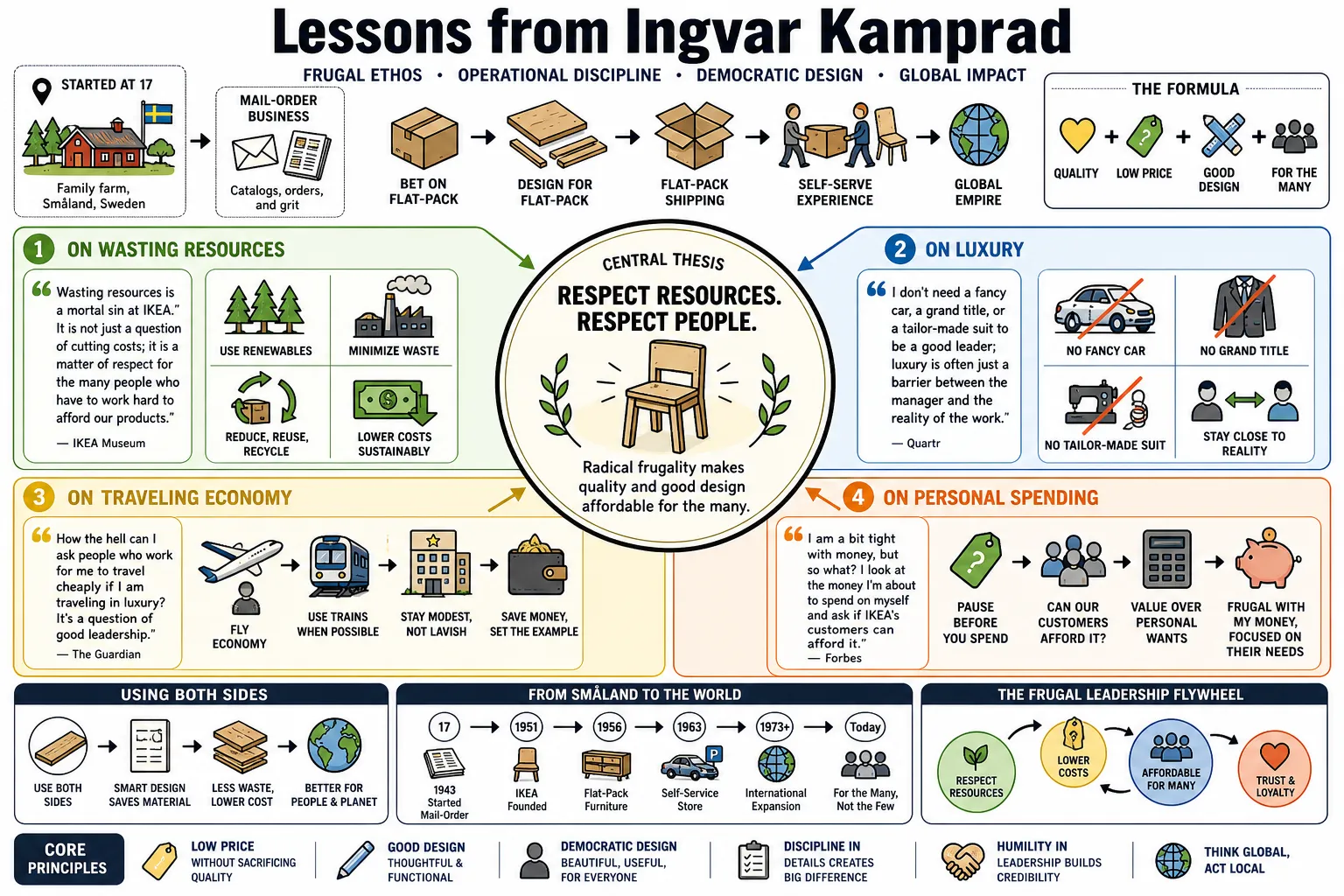
Lessons from Ingvar Kamprad
Kamprad started IKEA at 17, running a mail-order business from his family’s farm. He built a global empire by betting on flat-pack shipping and "Democratic Design," a model that used radical frugality to make quality furniture affordable. This profile breaks down the operational discipline that turned a rural Swedish venture into a retail powerhouse.
Part 1: The Ethos of Frugality
- On Wasting Resources: "Wasting resources is a mortal sin at IKEA. It is not just a question of cutting costs; it is a matter of respect for the many people who have to work hard to afford our products." — Source: IKEA Museum
- On Luxury: "I don't need a fancy car, a grand title, or a tailor-made suit to be a good leader; luxury is often just a barrier between the manager and the reality of the work." — Source: Quartr
- On Traveling Economy: "How the hell can I ask people who work for me to travel cheaply if I am traveling in luxury? It’s a question of good leadership." — Source: The Guardian
- On Personal Spending: "I am a bit tight with money, but so what? I look at the money I'm about to spend on myself and ask if IKEA's customers can afford it." — Source: Forbes
- On Using Both Sides of a Memo: "Paper is a resource like any other; we write on both sides of every sheet because every penny saved on administration is a penny we can take off the price of a chair." — Source: Hey.com
- On Budget Hotels: "I stay in cheap hotels because the expensive ones don't make the furniture better or the service faster; they only make the bill larger." — Source: The New York Times
- On the Old Volvo: "I drove an old Volvo for two decades because it still worked perfectly well; replacing something that isn't broken is a form of vanity that costs the company its focus." — Source: BBC News
- On Flea Market Clothes: "I don't think I'm wearing anything that wasn't bought at a flea market; it’s an example I want to set for everyone in the organization." — Source: Business Insider
- On Small Means: "Reaching good results with small means is a challenge for the clever; expensive solutions are usually the work of mediocrity." — Source: Battle Investment Group
- On Cost-Consciousness: "Cost-consciousness is not just about the big things; it is a way of life that begins with the smallest details, like turning off the lights when you leave a room." — Source: Inter IKEA
Part 2: Democratic Design and Product Logic
- On the Definition of Democratic Design: "Our identity is defined by a range of well-designed, functional home furnishings at prices so low that as many people as possible will be able to afford them." — Source: IKEA Museum
- On the $50 Desk: "To design a desk that costs $1,000 is easy for a furniture designer, but to design a functional and good desk which shall cost only $50 can only be done by the very best." — Source: Founders Podcast
- On the Five Dimensions: "A product is only truly finished when it balances form, function, quality, sustainability, and low price simultaneously." — Source: IKEA.com
- On Product Naming: "I used names for products because I struggled with numerical codes; naming a bed after a Norwegian place made it a person with a story rather than a line in a ledger." — Source: Sticky Branding
- On Bathroom Names: "We name bathroom items after Swedish lakes and bodies of water to maintain a sense of order and logic that even a dyslexic child could follow." — Source: Reader's Digest
- On the BILLY Bookcase: "The best products are those that are so simple they can fit into any home, like the BILLY, which was designed to be as versatile as a blank sheet of paper." — Source: BBC News
- On the LACK Table: "We looked at how hollow doors were made to create the LACK table; using air and paper inside wood allowed us to reduce weight and cost without sacrificing strength." — Source: IKEA Museum
- On Quality for the Many: "We do not make furniture for the rich; we make it for the people who want to live better but have limited resources." — Source: Leading by Design
- On Function First: "A beautiful chair that is uncomfortable to sit in is a failure; design must always serve the human body before it serves the eye." — Source: Medium
- On Sustainability as a Price Driver: "Sustainability should not make a product more expensive; it should be a method for using fewer raw materials and therefore lowering the cost for the customer." — Source: Inter IKEA Foundation
Part 3: Innovation through Constraints
- On Flat-Packing: "Flat-packing wasn't a stroke of genius; it was a solution to a table that wouldn't fit into a car, proving that physical limits are the best teachers." — Source: Destination Innovation
- On the Swedish Boycott: "The boycott by Swedish manufacturers was the best thing that happened to us; it forced us to look abroad and find cheaper, better ways to produce." — Source: YourStory
- On Polish Manufacturing: "IKEA was truly founded in Poland; by moving production behind the Iron Curtain in 1961, we decoupled ourselves from the high costs of the West." — Source: IKEA Museum
- On Smuggling Tools: "We had to smuggle files and spare parts into Polish factories in our cars to help them meet our standards; you must be willing to break convention to build a supply chain." — Source: Leading by Design
- On the Potato Field Strategy: "We built stores on former potato fields outside the city because the land was cheap and the car was becoming the customer's delivery truck." — Source: Acquired Podcast
- On Consumer Inconvenience: "Asking the customer to pick up and assemble the furniture isn't an inconvenience; it’s an invitation to participate in the savings." — Source: Shortform
- On Showrooms: "We opened showrooms so people could see the quality for themselves; when the industry tried to hide our products, we made them impossible to ignore." — Source: Masters Invest
- On the Allen Key: "The Allen key is the symbol of self-reliance; it is the only tool a person needs to build a better home." — Source: Financial Times
- On Questioning Truths: "Success comes from daring to be different and questioning established truths, especially the truth that quality must be expensive." — Source: David Lemayian
- On Limits: "Limits sharpen thinking; when you have no money and no resources, you are forced to find the most efficient path possible." — Source: Biz Bio
Part 4: The IKEA Spirit and Cultural Foundation
- On the Meaning of IKEA: "IKEA stands for my name, my farm, and my village; it is a reminder of where I came from and the simple values of the country." — Source: Limmaland
- On Enthusiasm: "Enthusiasm is the engine of our growth; without it, a company is just a collection of buildings and inventory." — Source: Quartr
- On Humbleness: "To be humble is not to be weak; it is to have the strength to admit you don't know everything and to listen to those who do." — Source: Hey.com
- On Tillsammans: "The 'togetherness' culture means we have no room for 'us' and 'them' within the company; everyone is a co-worker." — Source: IKEA Museum
- On the Underdog Mentality: "We must always feel like the small company fighting against the giants; the moment we feel like the giant, we lose our edge." — Source: Founders Podcast
- On Simplicity as a Virtue: "Simplicity is a virtue because complexity is the root of bureaucracy and the enemy of common sense." — Source: Medium
- On Bondförnuft: "Farmer’s common sense is worth more than ten degrees in economics; it’s about looking at a problem and seeing the simplest solution." — Source: John Sadowsky
- On the Småland Identity: "We Smålanders are known for being cunning and crafty with our resources; that regional character is the DNA of IKEA." — Source: IKEA.com
- On Friendliness: "Friendliness costs nothing but earns everything; a store should feel like a welcoming home, not a sterile warehouse." — Source: Leading by Design
Part 5: Leadership by Example
- On the Leader's Example: "If there is such a thing as good leadership, it is to give a good example for all the IKEA employees to follow." — Source: Quarterdeck
- On Management Titles: "We don't need titles to know who is doing the work; titles only serve to create distance between people who should be working together." — Source: Research Methodology
- On Shared Spaces: "I eat in the same cafeteria as my co-workers because the food tastes the same and the conversation is much more useful." — Source: The New York Times
- On the Shop Floor: "The best information doesn't come from reports; it comes from spending a Saturday on the shop floor helping customers find a lightbulb." — Source: Forbes
- On Listening: "A leader should have big ears and a small mouth; you cannot learn anything while you are the one talking." — Source: John Sadowsky
- On Taking Responsibility: "Taking responsibility is not a burden, it is a privilege; it is the freedom to make a decision and see it through." — Source: IKEA Museum
- On Mistakes: "Only while sleeping one makes no mistakes; making mistakes is the privilege of the active who can correct them." — Source: Hey.com
- On the Fear of Mistakes: "The fear of making mistakes is the root of bureaucracy and the enemy of development." — Source: Battle Investment Group
- On Leadership as Love: "Leadership is a form of love; it is the desire to help your co-workers grow and succeed beyond what they thought possible." — Source: Stay the Course
Part 6: Long-term Strategy and Self-Reliance
- On Profit as a Resource: "Profit gives us resources; it is not the end goal but the fuel that allows us to keep prices low and invest in the future." — Source: Inter IKEA
- On Earning Before Spending: "Our rule is simple: earn the money before you spend it; this independence from banks is what allowed us to survive every crisis." — Source: Masters Invest
- On the Foundation: "I gave the company to a foundation to ensure it can never be sold or taken public; IKEA must belong to its mission, not to shareholders." — Source: Interogo Foundation
- On Avoiding Public Markets: "A public company is forced to think in three-month intervals; we think in decades, which is why we must remain private." — Source: Acquired Podcast
- On Concentration: "The general who divides his resources will invariably be defeated; we succeed by concentrating on a few important things at a time." — Source: Quartr
- On Meatballs: "It’s difficult to do business with someone on an empty stomach; the restaurant is there to make the shopping trip a pleasure, not a chore." — Source: IKEA Museum
- On the Hot Dog Strategy: "A 5-krona hot dog is a 'price breathalyzer'; it proves to the customer that if we can be that cheap with food, we must be cheap with sofas too." — Source: Scandog
- On the Halo Effect: "If you offer one impossibly cheap item, the customer will trust that everything else in the store is also a bargain." — Source: Sticky Branding
- On Globalism: "We are a Swedish company that belongs to the world; we adapt to local cultures but we never lose our core identity." — Source: Business Insider
- On Self-Reliance: "To be self-reliant is to be free; we manufacture, we design, and we distribute so that no one else can dictate our prices." — Source: Founders Podcast
Part 7: Productivity and Personal Discipline
- On the 10-Minute Unit: "Time is your most important resource; divide your life into ten-minute units and sacrifice as few as possible to meaningless activity." — Source: Hey.com
- On Happiness: "Happiness is not reaching your goal; happiness is being on the way." — Source: Advisory Cloud
- On the Antidote to Success: "The antidote to the poison of success is to every evening think about what can be done better tomorrow." — Source: Quartr
- On Working Late: "I worked late not because I had to, but because I was obsessed with finding a way to make a chair one krona cheaper." — Source: Forbes
- On Childhood and Regret: "Childhood does not allow itself to be reconquered; my greatest regret was neglecting my family for the business." — Source: The Guardian
- On Managing One's Life: "If you cannot manage your own time, you have no business trying to manage the work of others." — Source: Medium
- On the Cigar Box: "In the early days, I kept my profits in a cigar box and used them to buy the next load of matches; that habit of reinvestment never left me." — Source: YourStory
- On Milk Van Logistics: "I used the local milk truck to deliver my first mail-order packages; always use the infrastructure that already exists to solve your problems." — Source: IKEA Museum
- On Discipline: "Self-discipline is the only way to maintain a low-price culture when you are making billions in profit." — Source: Leading by Design
Part 8: The Philosophy of Continuous Progress
- On Most Things Remaining: "Most things still remain to be done; a company that thinks it is finished will quickly die." — Source: IKEA Museum
- On Eternal Dissatisfaction: "A state of healthy dissatisfaction is the only way to drive constant renewal and improvement." — Source: Quartr
- On the Sleeping Pill of Completion: "The feeling of having finished something is an effective sleeping pill; we must never allow ourselves to feel comfortable." — Source: Ingka Group
- On the Glorious Future: "We have a glorious future because we are never satisfied with the present; we are always looking for a better way." — Source: Inter IKEA
- On Constant Renewal: "Renewal is a necessity; if we stop changing our range and our methods, the customer will find someone else who will." — Source: Advisory Cloud
- On the Duty to Progress: "It is our duty to expand and reach the many people, because everyone has the right to a better everyday life." — Source: Interogo Foundation
- On Doing it Differently: "By not following established patterns, we found better and cheaper solutions that others couldn't even imagine." — Source: David Lemayian
- On the Legacy: "I am just a furniture dealer; my legacy is not in the money I made, but in the millions of homes that are slightly better because of IKEA." — Source: Founders Podcast