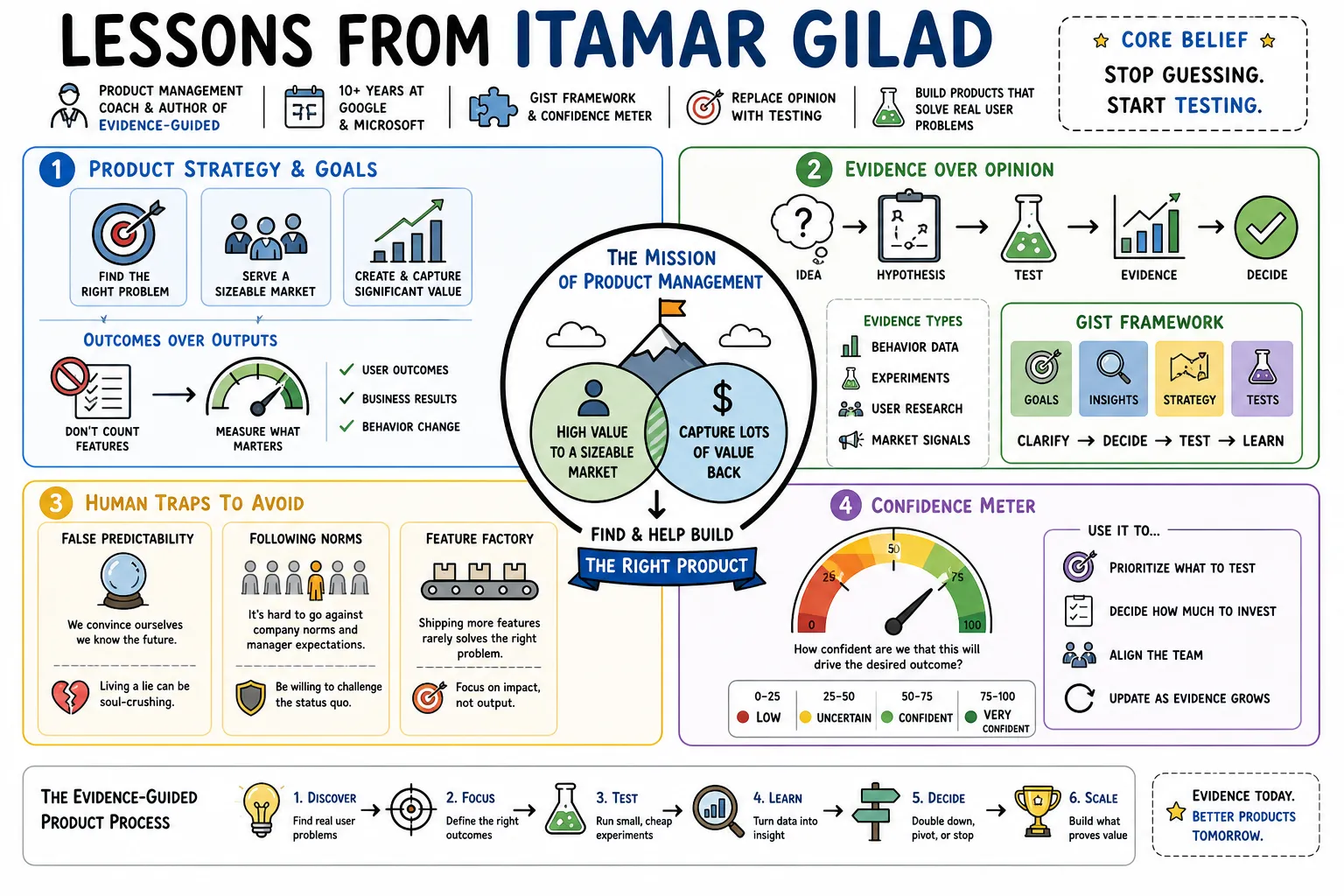
Lessons from Itamar Gilad
Itamar Gilad is a product management coach and the author of Evidence-Guided. Drawing on a decade at Google and Microsoft, he created the GIST framework and Confidence Meter to help teams replace opinion-based planning with actual testing. This profile collects his methods for validating ideas, avoiding feature factories, and building products that solve real user problems.
Part 1: Product Strategy & Goals
- On the mission of product management: "The mission of product management is to find and help build the right product. What makes a product right? Two things: It delivers high value to a sizeable market, and it helps capture lots of value back." — Source: ItamarGilad.com
- On false predictability: "False predictability is a problem partly because many of us silently commit to what we know is not real. It's hard to go against the norms of the company and the expectations of your managers, but living a lie can also be soul-crushing." — Source: ItamarGilad.com
- On outcomes versus outputs: "We need to focus on what the product achieves for the user and the business, rather than counting how many features the engineering team ships." — Source: Lenny's Podcast
- On strategic context: "Good idea prioritization requires a few key fundamentals that many companies lack, specifically a clear mission, a defined strategy, and a working growth model." — Source: ItamarGilad.com
- On starting with user needs: "Starting with user needs is just one of many ways to develop good products, and if you just practice it and nothing else you will severely limit your ability to create value, and likely also antagonize your colleagues, managers, and customers." — Source: ItamarGilad.com
- On multiple strategic tracks: "Rather than relying on a single grand plan, companies should maintain multiple strategic tracks that can adapt as market evidence changes." — Source: ItamarGilad.com
- On setting north star metrics: "A metric only matters if it connects user success directly to business sustainability. Vanity metrics look good on a dashboard but fail to guide decisions." — Source: Evidence-Guided Book
- On defining success: "Success is not launching a feature on time. Success is moving the needle on the goal you set out to achieve at the beginning of the quarter." — Source: Product Growth Podcast
- On the illusion of certainty: "Building a technology product is a bit like exploring the edge of space. Every new project is a first of a kind... and we're constantly surprised by how things turn out." — Source: ItamarGilad.com
- On shifting focus: "Strategy should be a living system that guides daily prioritization, not a static document created once a year by executives." — Source: Mind the Product
Part 2: The GIST Framework
- On replacing roadmaps: "Traditional roadmaps force teams to commit to unproven ideas months in advance. GIST replaces them with Goals, Ideas, Steps, and Tasks to maintain flexibility." — Source: ItamarGilad.com
- On defining Goals in GIST: "Goals must be measurable outcomes, such as improving retention or increasing sign-ups, rather than simply delivering a list of outputs." — Source: Airfocus
- On capturing Ideas: "You need a backlog of potential solutions to achieve your goals, and these ideas must be ranked by evidence rather than who proposed them." — Source: ProdPad
- On taking Steps: "Break large bets into small, testable mini-projects that take weeks, not months, allowing teams to validate hypotheses without writing excessive code." — Source: ItamarGilad.com
- On tracking Tasks: "Tasks are the granular work items required to execute the steps, managed using standard agile tools like Kanban or sprints." — Source: Draft.io
- On alignment: "GIST ensures that every single task an engineer or designer works on can be traced back to a tested idea and a high-level business goal." — Source: Evidence-Guided Book
- On managing risk: "By capping steps at a few weeks, the framework strictly limits the amount of time and money a company can waste on a bad idea." — Source: Mind the Product
- On agility: "GIST is an agile, outcome-driven alternative to rigid planning, allowing teams to change course as soon as an idea fails a validation step." — Source: ItamarGilad.com
- On execution flow: "The framework moves from strategy down to execution in a continuous loop, ensuring that teams don't get trapped in a feature factory mindset." — Source: Product People Podcast
Part 3: Idea Generation & Prioritization
- On throwing ideas away: "If you want to have good ideas you must have many ideas. Most of them will be wrong, and what you have to learn is which ones to throw away." — Source: ItamarGilad.com
- On the volume of ideas: "Teams should focus on discarding the vast majority of ideas, often up to 90 percent, to concentrate resources on the few that actually matter." — Source: Lenny's Podcast
- On ICE scoring: "Use Impact, Confidence, and Ease to evaluate ideas, but remember that Confidence must be derived from actual data, not internal optimism." — Source: ItamarGilad.com
- On common ICE mistakes: "Organizations often fail with the ICE model because they allow managers to inflate the Confidence score based on their personal convictions rather than market tests." — Source: Lenny's Podcast
- On building an idea bank: "Keep a central repository of all ideas, regardless of who suggested them, so they can be evaluated systematically against current goals." — Source: Evidence-Guided Book
- On killing bad ideas: "The hardest part of prioritization is telling stakeholders that their pet project has been dropped because it failed to generate sufficient evidence." — Source: Mind the Product
- On idea sources: "Good ideas come from anywhere like customer support, engineers, sales, or users, but they all must pass through the same rigorous validation filter." — Source: ItamarGilad.com
- On the impact score: "Impact should measure how much the idea moves the specific goal you are targeting, not a generic sense of business value." — Source: Product Growth Podcast
- On the ease score: "Ease is an estimation of effort, but teams should avoid wasting weeks estimating ideas that have a low confidence score to begin with." — Source: ItamarGilad.com
Part 4: Evidence-Guided Development
- On the plan and execute fallacy: "Plan & Execute is simply the method by which we start a project by creating a detailed plan and then follow with faithful execution. 20th century business management embraced Plan & Execute as a core foundation." — Source: ItamarGilad.com
- On shifting paradigms: "We need to move from opinion-based product development to a systematic, evidence-guided approach." — Source: Mind the Product
- On truth-seeking: "Product teams must prioritize truth-seeking over validation-seeking to avoid falling into confirmation bias." — Source: Evidence-Guided Book
- On sunk-cost fallacy: "Evidence-guided teams do not continue funding a project just because they have already spent six months working on it; they stop when the evidence turns negative." — Source: Product People Podcast
- On evaluating models: "All models are wrong, but some are useful is a reminder that frameworks should guide thinking rather than act as absolute laws." — Source: ITX
- On testing without code: "Many validation steps can and should be done without writing production code, using prototypes, surveys, or fake-door tests." — Source: ItamarGilad.com
- On early validation: "The earlier you can test an idea with a customer, the cheaper it is to discover that your initial assumption was flawed." — Source: Evidence-Guided Book
- On continuous discovery: "Discovery is not a phase that happens before delivery; it is a continuous process that runs parallel to building the product." — Source: Lenny's Podcast
- On managing uncertainty: "Accept that you do not know the answer at the beginning of a project. Evidence is what closes the gap between guessing and knowing." — Source: ItamarGilad.com
- On failure rates: Gilad argues that product success is hard enough that a 50% success rate is already high, and that teams should respond by combining building with learning so evidence can inform judgment. — Reference: Itamar Gilad on product failure rates, uncertainty, and evidence-guided development
Part 5: The Confidence Meter
- On assessing evidence: "The Confidence Meter is a tool designed to help product managers assess the strength of the evidence behind an idea objectively." — Source: ItamarGilad.com
- On moving away from bias: On Talking Roadmaps, Gilad describes Evidence-Guided as a way to move organizations away from opinions and judgment alone and toward decisions that combine human judgment with evidence. — Reference: Talking Roadmaps interview with Itamar Gilad on evidence-guided roadmaps and the Confidence Meter
- On low confidence: "If your only evidence is a strong gut feeling or an executive's request, your confidence score is inherently low and requires immediate testing." — Source: Lenny's Podcast
- On high confidence: "High confidence is only achieved after running functional prototypes or live A/B tests that demonstrate clear, positive user behavior." — Source: Evidence-Guided Book
- On the spectrum of proof: "Anecdotal feedback from a few friendly customers scores much lower on the Confidence Meter than behavioral data from a structured experiment." — Source: ItamarGilad.com
- On breaking ties: "When a team is stuck debating two competing ideas, the Confidence Meter acts as a neutral judge that reveals which idea actually has facts backing it up." — Source: Mind the Product
- On executive buy-in: "Showing stakeholders the Confidence Meter helps explain why their favorite idea needs more testing before full engineering resources are committed." — Source: Product People Podcast
- On iterative testing: "As an idea progresses through the Steps phase of GIST, its position on the Confidence Meter should steadily rise as more tests are completed." — Source: ItamarGilad.com
- On objectivity: "It forces teams to be honest with themselves about how little they actually know about the market's reaction to a new feature." — Source: Evidence-Guided Book
Part 6: Overcoming Opinion-Based Decisions
- On the HiPPO effect: "Companies must actively replace decision-by-HiPPO with structured, evidence-based experimentation." — Source: ItamarGilad.com
- On consensus culture: "Our well-crafted plans are often no more than a house of cards based on opinions, consensus, and sparse data. We are often blissfully unaware of our inability to predict." — Source: ItamarGilad.com
- On decision-by-committee: In his essay on why product work is hard, Gilad warns that compromise and decision-by-committee rarely produce the best decisions and can amplify friction, politics, infighting, and escalations. — Reference: Itamar Gilad on product misalignment, compromise, and decision-by-committee
- On personal convictions: "An executive's strong conviction about a product direction is a hypothesis, not a mandate for the engineering team to build immediately." — Source: Evidence-Guided Book
- On standing firm: "Even if you're a minority of one, the truth is still the truth." — Source: ItamarGilad.com
- On the danger of arrogance: "The moment a product manager believes they perfectly understand what the user wants without testing, they expose the product to massive risk." — Source: Product Growth Podcast
- On validating assumptions: "Every feature request from sales or marketing must be treated as an assumption that requires validation before entering the backlog." — Source: ItamarGilad.com
- On healthy skepticism: "Teams should cultivate a culture where asking for evidence is seen as helpful rather than confrontational." — Source: Mind the Product
- On abandoning bad habits: "The hardest transition for legacy companies is breaking the habit of funding projects based on persuasive slide decks rather than market tests." — Source: Lenny's Podcast
Part 7: Rethinking Roadmaps and Planning
- On rigid timelines: "Committing to delivery dates for unvalidated features months in advance sets the team up for failure and encourages technical debt." — Source: ItamarGilad.com
- On the planning illusion: "Planners often act as if the future is a known quantity, ignoring the reality that market conditions and user behaviors shift constantly." — Source: Evidence-Guided Book
- On shifting to themes: "Roadmaps should outline broad themes or problems to solve in a given quarter, rather than promising a strict list of predetermined features." — Source: Product People Podcast
- On budget cycles: "Annual budgeting processes clash with agile product development; companies need to fund teams to solve problems, not fund specific feature lists." — Source: ItamarGilad.com
- On managing expectations: "You must train stakeholders to expect outcomes rather than outputs, which requires a fundamental change in how progress is reported." — Source: Mind the Product
- On course correction: "A good planning framework expects and accommodates failure; if a plan cannot be altered mid-quarter, it is too rigid to survive contact with reality." — Source: ItamarGilad.com
- On project start lines: "Plan and Execute assumes all thinking is done at the beginning. Evidence-guided planning spreads the thinking across the entire lifecycle of the project." — Source: Evidence-Guided Book
- On false promises: "When roadmaps are treated as contracts, product managers are forced to deliver mediocre features just to meet an artificial deadline." — Source: Lenny's Podcast
- On measuring velocity: "Tracking how fast a team ships code is meaningless if they are shipping the wrong product; measure the speed of learning instead." — Source: ItamarGilad.com
Part 8: Leadership and Team Empowerment
- On top-down control: "Constantly asking people to commit to top-down decisions isn't a good way to lead. Your opinions should matter, and you should have some control over your area of responsibility." — Source: ItamarGilad.com
- On true empowerment: "Giving a team a list of features to build is not empowerment. Empowerment is giving a team a business problem and the autonomy to find the best solution." — Source: Evidence-Guided Book
- On the role of managers: "In an evidence-guided company, managers act as coaches who help teams design better experiments, not dictators who assign tasks." — Source: Lenny's Podcast
- On psychological safety: "Teams must feel safe enough to report that a highly anticipated idea failed its validation test without fear of punishment or blame." — Source: ItamarGilad.com
- On collaborating with engineering: "Engineers should be involved in the discovery process from day one, rather than being treated as a factory that just receives requirements." — Source: Product Growth Podcast
- On personal value: "Strive not to be a success, but rather to be of value." — Source: Lenny's Newsletter
- On reducing busywork: In his product operating model essay, Gilad contrasts bureaucratic overhead that slows innovation with modern internal services that help teams create customer and business value faster. — Reference: Itamar Gilad on product operating models, bureaucracy, and helping teams create value faster
- On cross-functional trust: "Designers, engineers, and product managers must operate as a single unit rather than passing deliverables over the wall to the next department." — Source: ItamarGilad.com
- On transparency: "Make the evidence and the Confidence Meter visible to the entire company so everyone understands exactly why certain decisions are being made." — Source: Mind the Product
- On leading change: "Transitioning a company to an evidence-guided model requires patience; start by implementing the GIST framework on a single team before trying to overhaul the entire organization." — Source: Evidence-Guided Book