Lessons from Jack Abraham
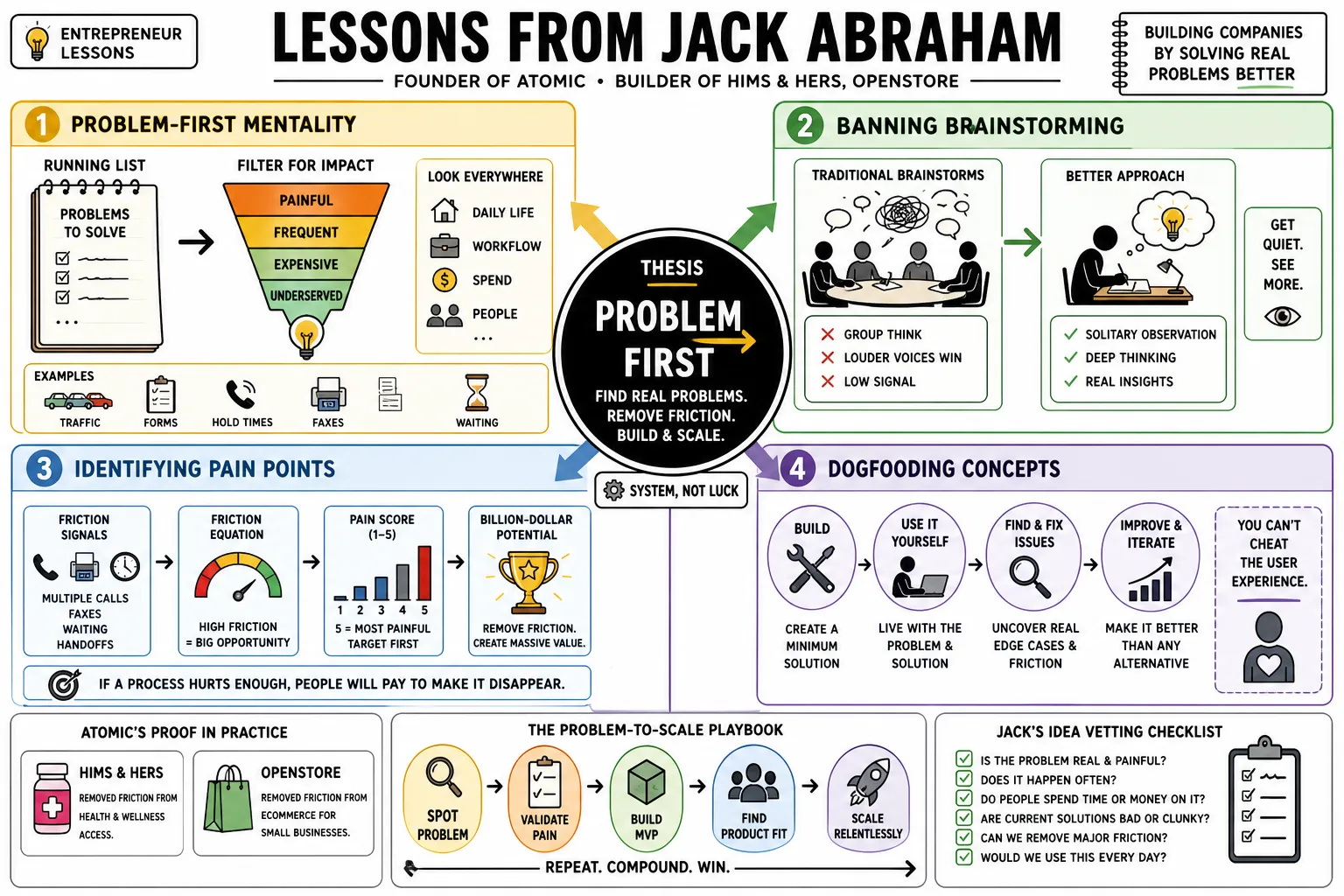
Entrepreneur Jack Abraham founded the venture studio Atomic, building companies like Hims & Hers and OpenStore from scratch. Rather than wait for founder pitches, he systemizes startup ideation by maintaining a running list of hundreds of problems to solve. This profile details his frameworks for vetting ideas and scaling new businesses.
Part 1: Ideation & Finding the Right Problem
- On Problem-First Mentality: "Keep a running list of problems in your daily life instead of trying to force business ideas." — Source: [My First Million]
- On Banning Brainstorming: "Traditional group brainstorms are often a waste of time. The best ideas come from deep, solitary observation of inefficiencies." — Source: [My First Million]
- On the Idea Sandbox: "Ideas should be treated as hypotheses to be tested rather than precious gems to be protected from criticism." — Source: [World of DaaS Podcast]
- On the Illusion of Originality: "The best businesses often take an existing behavior and simply remove the friction from it." — Source: [The Pomp Podcast]
- On Identifying Pain Points: "If a process involves multiple phone calls, faxes, or waiting periods, there is a billion-dollar company waiting to replace it." — Source: [Atomic]
- On Dogfooding Concepts: "Build products that solve your own team's internal problems first before taking them to the broader market." — Source: [World Class Podcast]
- On Market Readiness: "A great idea is useless if the market infrastructure is not ready to support it." — Source: [Bloomberg Technology]
- On the 600-Idea List: "I maintain a list of over 600 potential business ideas, constantly reviewing it to see which ones match current market trends." — Source: [My First Million]
- On Idea Validation: "Validation means getting a stranger to pay for your solution, not getting your friends to say they like it." — Source: [Forbes]
- On Recognizing Patterns: "Great business ideas often rhyme with successful models in completely different industries." — Source: [My First Million]
Part 2: The Venture Studio Model & Atomic
- On the Studio Model: "We co-found companies alongside the initial team and build the foundation from day one." — Source: [Forbes]
- On Reducing Founder Risk: "By centralizing the back-office and initial funding, we allow founders to focus entirely on building the product and finding product-market fit." — Source: [Atomic]
- On Systematic Company Building: "Starting a company should not rely on luck. It can be a repeatable, engineered process." — Source: [The Pomp Podcast]
- On Active Involvement: "Standard venture capital is passive. The studio model requires being in the trenches with the founders." — Source: [World of DaaS Podcast]
- On Capital Efficiency: "When you share resources like legal and design across multiple startups, the cost of getting an idea off the ground drops dramatically." — Source: [Bloomberg Technology]
- On Internal Rate of Return: "Targeting a high return rate requires being brutally honest about shutting down ideas that do not gain immediate traction." — Source: [World Class Podcast]
- On the Kill Rate: "We test dozens of concepts a year but only launch a handful. The ability to kill an idea early is our biggest competitive advantage." — Source: [Atomic]
- On Co-Founder Matching: "Pairing the right idea with the right executive is the hardest and most important part of the studio process." — Source: [The Pomp Podcast]
- On the Future of Studios: "In a decade, a significant percentage of all successful startups will be born out of venture studios rather than garages." — Source: [Forbes]
Part 3: Speed, Momentum, and Execution
- On the Jenga Law of Time Management: "Structure your calendar so you can pull out blocks of time without the whole day collapsing. Batch your meetings to preserve deep work." — Source: [My First Million]
- On Fast Iteration: "The speed at which a team iterates on early user feedback is the single best predictor of their future success." — Source: [World Class Podcast]
- On Corporate Bureaucracy: "Endless meetings and rigid hierarchies stifle innovation. To build fast, you often have to isolate the builders from the rest of the company." — Source: [Bloomberg Technology]
- On Secret Environments: "At eBay, we used off-site environments to accelerate development, making sure projects could move quickly before getting bogged down." — Source: [CNBC Interview]
- On Execution Versus Ideas: "Execution is the multiplier. A mediocre idea with brilliant execution will always beat a brilliant idea with mediocre execution." — Source: [The Pomp Podcast]
- On Launching Early: "If you are not embarrassed by the first version of your product, you launched too late." — Source: [Forbes]
- On Maintaining Momentum: "Momentum is a startup's lifeblood. Once you lose it, regaining it becomes nearly impossible." — Source: [Atomic]
- On Decisiveness: "Make decisions quickly. A wrong decision can be fixed, but indecision will slowly kill the company." — Source: [World Class Podcast]
- On Focus: "You can only do one or two things well at the beginning. Say no to everything else until the core loop is proven." — Source: [My First Million]
Part 4: Talent, Team, and Leadership
- On Self-Belief: "We are all worms, but I do believe I am a glow worm." — Source: [Atomic]
- On Hiring Builders: "Look for people who have a history of building things on nights and weekends, even if those things failed." — Source: [The Pomp Podcast]
- On Prioritizing People: "My primary focus is always on the people. Building a strong engineering team and maintaining high morale are fundamental." — Source: [Forbes]
- On the Founder Profile: "The best founders have a unique combination of high ambition and low ego." — Source: [World Class Podcast]
- On Retaining Top Talent: "You keep top performers with hard problems and high autonomy rather than just money." — Source: [Bloomberg Technology]
- On Managing Energy: "Leadership is largely about managing the energy and psychology of your team through the inevitable dips." — Source: [My First Million]
- On Finding Executives: "Do not hire for the stage you are at; hire for the stage you want to be in twelve months." — Source: [World of DaaS Podcast]
- On Building Trust: "Trust is built in the trenches. You have to be willing to do the unglamorous work alongside your team." — Source: [Atomic]
- On Assessing Talent: "During interviews, I look for a steep trajectory of learning rather than a long list of past credentials." — Source: [The Pomp Podcast]
Part 5: Adversity, Pivots, and Learning
- On Facing Hardship: "Having your back against a wall forces ingenuity and creative solutions. When bad things happen to you, try to realize why this ultimately could be good for you." — Source: [UPenn Alumni Event]
- On Moving Forward: "Pick your head up and find a better path forward instead of dwelling on the setback." — Source: [UPenn Alumni Event]
- On the Milo Pivot: "Milo initially failed because shoppers were too lazy to put products back on the shelf. We flipped it to a search engine used before going to the store, and it worked." — Source: [Forbes]
- On User Behavior: "Never assume you can easily change consumer behavior. Build solutions that fit into how they already act." — Source: [My First Million]
- On Failure as Data: "Early setbacks are essential data points that tell you what to avoid." — Source: [World Class Podcast]
- On Economic Downturns: "Periods of economic downturn are often the best times in history to build companies because the noise disappears." — Source: [Bloomberg Technology]
- On Resiliency: "The difference between a successful founder and a failed one is often the willingness to try one more pivot." — Source: [The Pomp Podcast]
- On Feedback Loops: "Shorten the time between a failure and the lesson learned from it. That is the engine of growth." — Source: [Atomic]
- On Intellectual Honesty: "You have to be intellectually honest when the data shows your core assumption is wrong, even if you love the idea." — Source: [World of DaaS Podcast]
Part 6: E-commerce, Scaling, and Distribution
- On Distribution: "Distribution is often more important than the idea itself. A great product with no distribution channel will fail." — Source: [The Pomp Podcast]
- On Hims & Hers Growth: "We identified a massive stigma around men's health and realized that a brand emphasizing approachability could scale incredibly fast." — Source: [Forbes]
- On OpenStore's Mission: "OpenStore was built to provide liquidity and operational support to independent e-commerce merchants who had no clear exit strategy." — Source: [Business Insider]
- On E-commerce Rollups: "The fragmented market of Shopify stores created a clear opportunity to apply centralized software and scale." — Source: [Business Insider]
- On Customer Acquisition: "If your customer acquisition cost relies entirely on paid ads, you are vulnerable. Organic flywheels are required." — Source: [World Class Podcast]
- On Software Eating Retail: "Local inventory mapping was just the beginning. The internet will eventually index and distribute every physical product." — Source: [CNBC Interview]
- On Telehealth: "Healthcare is the next major frontier for software disruption because the user experience has historically been extremely poor." — Source: [Atomic]
- On Brand Building: "A brand is the consistent promise you deliver at every touchpoint with the customer." — Source: [My First Million]
- On Scaling Operations: "Scale breaks everything. The processes that worked at ten employees will actively hinder you at one hundred." — Source: [The Pomp Podcast]
- On Capital Arbitrage: "There is an opportunity to build businesses by using capital from high-cost areas to scale operations in more efficient regions." — Source: [The Pomp Podcast]
Part 7: Geography, Cities, and Relocation
- On the Move to Miami: "Miami has become a leading destination for tech talent because of its business environment, weather, and the influx of venture capital." — Source: [CNBC Interview]
- On Silicon Valley's Monopoly: "The monopoly Silicon Valley held over tech talent is breaking. High-growth companies can now be built anywhere." — Source: [Bloomberg Technology]
- On Quality of Life: "Founders are realizing they do not have to sacrifice their quality of life to build a massive business." — Source: [Forbes]
- On Remote Work Dynamics: "While remote work is possible, there is still immense value in the serendipity of in-person collaboration for early-stage teams." — Source: [The Pomp Podcast]
- On Emerging Tech Hubs: "Cities that embrace innovation and lower the friction for entrepreneurs will capture the next wave of great companies." — Source: [World Class Podcast]
- On Geographic Arbitrage: "Decoupling location from opportunity is one of the most significant macro trends of this decade." — Source: [The Pomp Podcast]
- On Building a Local Ecosystem: "A tech hub needs density. It requires a critical mass of founders, investors, and operators casually bumping into each other." — Source: [CNBC Interview]
- On the Flight of Capital: "Capital flows to where it is treated best. Taxation and regulation heavily influence where the next generation of startups will incorporate." — Source: [Bloomberg Technology]
- On Relocating Headquarters: "Moving your company is a massive cultural reset. It can be the catalyst needed to break old habits and accelerate growth." — Source: [Atomic]
Part 8: Big Vision, Timing, and The Future
- On the Importance of Timing: "Timing is often more important than the idea itself. Success frequently depends on whether the market is ready for a specific solution." — Source: [Forbes]
- On Massive Ambition: "To attract top-tier talent and investors, you need a massive, ambitious goal. You have to aim to change the world in a specific way." — Source: [World Class Podcast]
- On The Milo Vision: "Our goal was to bring every product on every physical shelf in the world onto the internet." — Source: [CNBC Interview]
- On Software Disruption: "We are still in the early innings of software eating the world. Many legacy industries have not even begun to digitize their core workflows." — Source: [The Pomp Podcast]
- On the Democratization of Access: "The most valuable companies of the next decade will be those that take exclusive, expensive services and make them accessible to everyone." — Source: [Bloomberg Technology]
- On Crypto and Web3: "Crypto represents a fundamental shift in how trust and value are distributed on the internet, though the practical applications take time to mature." — Source: [My First Million]
- On Generational Shifts: "Pay attention to the behaviors of teenagers. What they do for fun today will dictate consumer enterprise models in ten years." — Source: [World of DaaS Podcast]
- On Long-Term Thinking: "Most people overestimate what they can do in a year and underestimate what they can achieve in a decade." — Source: [Atomic]
- On Setting the North Star: "A big vision provides a clear North Star that helps the team navigate through the inevitable daily technical challenges." — Source: [Forbes]
- On the Ultimate Goal: "The ultimate goal is to build an ecosystem of companies that outlive you and continue to solve meaningful problems." — Source: [World Class Podcast]