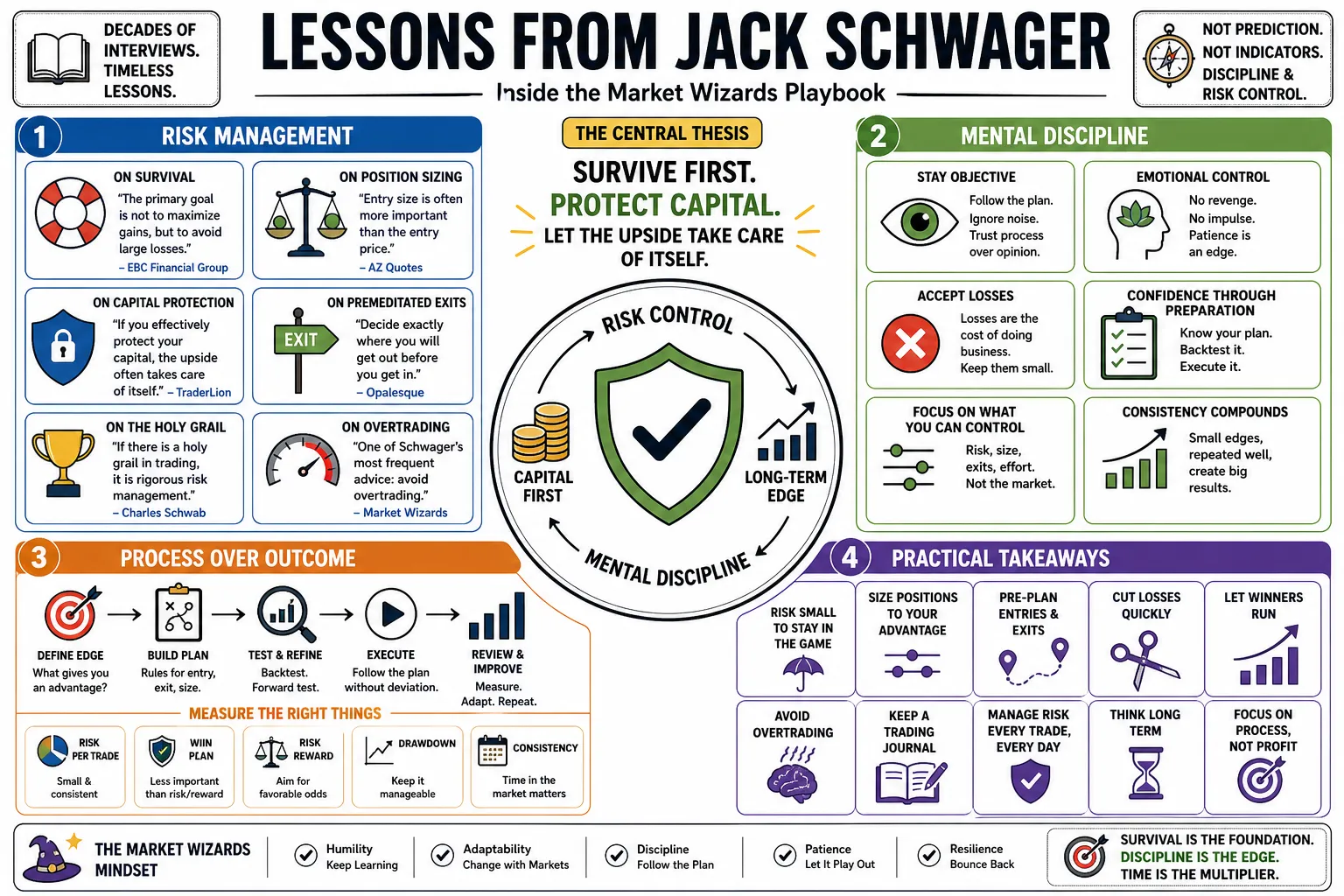
Lessons from Jack Schwager
Jack Schwager spent decades interviewing top traders for his Market Wizards books, translating their methods into plain English. He found that elite trading depends heavily on strict risk control and mental discipline rather than secret indicators. This compilation covers his main takeaways on how the best traders navigate markets and protect their capital.
Part 1: Risk Management
- On survival: "The primary goal is not to maximize gains, but to avoid large losses." — Source: EBC Financial Group
- On position sizing: "Traders focus almost entirely on where to enter a trade. In reality, the entry size is often more important than the entry price." — Source: AZ Quotes
- On capital protection: "If you effectively protect your capital, the upside often takes care of itself." — Source: TraderLion
- On premeditated exits: "A recurring piece of advice he cites is to decide exactly where you will get out of a trade before you put your money in." — Source: Opalesque
- On the holy grail: "If there is a holy grail in trading, it is rigorous risk management." — Source: Charles Schwab
- On overtrading: "One of Schwager’s most frequent pieces of advice for novice traders is to undertrade, undertrade, undertrade. Whatever position size a trader feels is appropriate, they should cut it in half." — Source: ValuePlays
- On risk limits: "Elite traders often limit risk on any single trade to a very small percentage of their total equity, usually 1% or less." — Source: Medium
- On emotional objectivity: "Determining your exit point before entering a trade removes the emotional subjectivity that occurs once you have a position on." — Source: Chat With Traders
- On the worst-case scenario: "Traders should always know their worst-case exit point, and if a trade goes against them, the only decision should be to exit." — Source: Brandeis University
- On impulsive behavior: "Risk taking with a process leads to success, while risk taking on impulse leads to regret." — Source: Reddit
Part 2: Trading Psychology
- On ego: "Actually, the best traders have no ego." — Source: Goodreads
- On being wrong: "Being wrong is acceptable, but staying wrong is totally unacceptable." — Source: Goodreads
- On flexibility: "The ability to change one's mind is probably a key characteristic of the successful investor. Dogmatic and rigid personalities rarely, if ever, succeed in the markets." — Source: The Cite Site
- On personalizing the market: "Traders must avoid personalizing the market. The market is an impersonal entity that does not care about the trader's individual success or failure." — Source: Brandeis University
- On consensus thinking: "The most successful individuals are those who can contain their emotions, remain objective, and avoid the trap of consensus thinking." — Source: Ritholtz Wealth Management
- On the laboratory of trading: In his CFA Institute interview, Schwager frames trading as a process of finding a method that fits the person, proving it has an edge, managing risk, and staying disciplined and flexible; the through-line is that markets expose behavior as much as analysis. — Reference: CFA Institute interview with Jack Schwager on great traders, edge, risk management, discipline, and flexibility
- On emotional stress: "Finding what you are comfortable trading is essential to reducing psychological stress." — Source: Sobrief
- On self-belief: "I succeeded because I didn't know that I couldn't." — Source: Goodreads
- On letting go of fixed views: "Traders must be flexible enough to adapt to changing market conditions rather than clinging to a fixed view of the market." — Source: Charles Schwab
Part 3: Developing a Methodology
- On personality matching: "Successful traders succeed because they find a methodology that aligns with their specific personality." — Source: Chat With Traders
- On universal systems: "There is no 'one size fits all' strategy; what works for a high-frequency momentum trader will likely cause a long-term trend follower to fail." — Source: Desire To Trade
- On the process: "A 'good' trade is defined by a sound, disciplined process, not necessarily by whether the trade resulted in a profit." — Source: EBC Financial Group
- On charts: "You can use charts to give you a plus or minus toward your view, but you can never start with the chart." — Source: The Cite Site
- On discipline: "A sound methodology is useless without the discipline to follow it." — Source: Medium
- On perfect systems: "There is no perfect system, which is why traders must tailor their approach to their own psychological makeup." — Source: TraderLion
- On the primary requirement: "Mastering risk management through your chosen methodology is the primary requirement for long-term success." — Source: Sobrief
- On adapting: "The best traders are flexible and willing to change their approach as market conditions shift, rather than clinging to a strategy that is no longer effective." — Source: Charles Schwab
- On outcome obsession: "Traders who obsess over the outcome often struggle with emotional decision-making." — Source: Enlightened Stock Trading
- On avoiding influence: "Stick to your own approach and avoid being influenced by contradictory opinions." — Source: Bookey
Part 4: Managing Failure
- On the cost of business: "Elite traders view losses as a cost of doing business." — Source: Charles Schwab
- On bouncing back: In Top Traders Unplugged, Schwager and George Coyle emphasize that repeated early failure was one of the surprising traits among new Market Wizards, with many traders blowing up before finding a durable edge. — Reference: Top Traders Unplugged episode with Jack Schwager and George Coyle on early failure among Market Wizards
- On losing small: "The ability to 'lose small' and move on without letting ego or frustration cloud future decisions is a defining trait of the 'Market Wizards'." — Source: Growth Manifesto
- On learning from setbacks: "Their success stemmed from their refusal to give up and their ability to learn from those failures." — Source: Blogspot
- On accepting losses: "The difference between those who succeeded and those who failed was the ability to treat losses as learning experiences rather than reasons to quit." — Source: Trading With Rayner
- On accountability: "Traders must take responsibility for their losses rather than blaming external factors." — Source: Sobrief
- On paying for losers: "If you don't stay with your winners, you are not going to be able to pay for the losers." — Source: AZ Quotes
- On expected failure: "Virtually all Market Wizards experienced significant early setbacks before finding consistent success." — Source: Trading With Rayner
- On moving forward: "Moving on without letting previous failures dictate future strategy is essential for longevity in the market." — Source: Opalesque
Part 5: Navigating Market Behavior
- On contrarian timing: "It takes several days of a market rallying before it looks really good. That's when everyone wants to buy it, and that's the time when the professionals, like myself, are selling." — Source: The Cite Site
- On buying fear: "Conversely, when the market has been down for a few days, and everyone is bearish, that's the time I like to be buying." — Source: Goodreads
- On market information: "It is impossible to consistently outperform the market by using any information that the market already knows." — Source: Goodreads
- On market evolution: "The markets are constantly evolving." — Source: Growth Manifesto
- On trading reality: "It's not about being right; it's about making money." — Source: Goodreads
- On forecasting: "Top traders recognize that markets are largely unpredictable, choosing to manage risk rather than accurately forecast price movements." — Source: Charles Schwab
- On the nature of the market: "The market does not know or care whether a trader is long or short." — Source: Brandeis University
- On adapting to conditions: In the CFA Institute interview, Schwager says flexibility separates great traders: they can change on a dime when facts change instead of hoping an existing position is right. — Reference: CFA Institute interview with Jack Schwager on flexibility as a trait of great traders
- On consensus opinion: "Taking the opposite side of popular consensus is often where the greatest opportunities lie." — Source: Ritholtz Wealth Management
Part 6: Defining the Trader
- On long bias: "A true trader is just as willing to go short as they are to go long. They do not suffer from a buy and hold bias." — Source: CFA Institute
- On active decision making: "To Schwager, a trader is defined by the active process of making decisions—when to enter, when to exit, and when to reverse a position—rather than passively holding assets." — Source: CFA Institute
- On intellectual entrepreneurship: "Success often requires intense dedication—sometimes described as intellectual entrepreneurship—where traders spend thousands of hours studying historical data and honing their craft." — Source: Chat With Traders
- On persistence: In Top Traders Unplugged, the discussion highlights traders who persisted through repeated failures and little early evidence, framing persistence as a recurring trait behind Market Wizards-level outcomes. — Reference: Top Traders Unplugged episode with Jack Schwager and George Coyle on persistence after repeated failure
- On immersion: "Great traders view the market not as a hobby, but as a full-time obsession that demands immersion." — Source: Blogspot
- On identifying edge: "Top traders spend years identifying their specific edge and rarely deviate from it." — Source: Medium
- On continuous study: "A trader is someone who remains a student of the market regardless of their net worth." — Source: The Investor's Podcast Network
- On reversing positions: "The willingness to completely reverse a position when proven wrong distinguishes professionals from amateurs." — Source: CFA Institute
- On embracing change: "Traders must accept that what worked perfectly yesterday might be a terrible strategy tomorrow." — Source: Desire To Trade
- On taking the other side: "A trader understands that for every winning trade they make, someone else is taking a loss." — Source: LiquidityFinder
Part 7: Entering and Exiting Trades
- On entry points: "The actual entry point is mathematically less crucial than how the position is managed once entered." — Source: AZ Quotes
- On early exits: "Exiting a trade early is often the smartest decision if the initial thesis proves incorrect." — Source: Brandeis University
- On stop losses: "Mastering risk management—specifically through proper position sizing and the use of stop-loss orders—is the primary requirement for survival." — Source: Sobrief
- On scaling in: "Elite traders often scale into positions as the market proves their thesis correct rather than putting all their capital at risk initially." — Source: Medium
- On cutting losers: "Cutting losers quickly is the most universally shared habit among Market Wizards." — Source: Growth Manifesto
- On holding winners: "The inability to hold a winning trade to maturity is a major psychological hurdle for developing traders." — Source: AZ Quotes
- On exit criteria: "If a trade goes against you, the exit should be automatic, eliminating all internal debate." — Source: Brandeis University
- On capital allocation: "The focus shouldn't just be on trade mechanics, but on allocating capital so one bad trade doesn't ruin the portfolio." — Source: Medium
- On protecting profits: "Once a trade is significantly profitable, experienced traders adjust their stops to protect their gains." — Source: TraderLion
Part 8: Autonomy and Independence
- On avoiding noise: "Don't ever listen to anybody when you are in a position." — Source: Bookey
- On independent thinking: "To beat the market, a trader must be willing to act entirely independently of the crowd." — Source: Ritholtz Wealth Management
- On ignoring opinions: "Being influenced by contradictory opinions usually leads to poor execution and second-guessing." — Source: Bookey
- On self-trust: "Top traders ultimately trust their own research over the advice of analysts or financial media." — Source: The Investor's Podcast Network
- On creating your own path: "The unknown wizards found success not by following a guru, but by doing the hard work to forge their own path." — Source: Instaread
- On isolation: In Top Traders Unplugged, the episode frames the hidden cost of top trading as the psychological strain of long hours in front of screens; the practical lesson is that elite trading requires protecting focus and mental clarity. — Reference: Top Traders Unplugged episode with Jack Schwager and George Coyle on the psychological cost of top trading
- On defining your rules: "Nobody can trade someone else's system effectively; you must define and own your personal rules." — Source: Chat With Traders
- On ignoring the outcome: "You have to separate the outcome of the trade from your assessment of whether you made a good decision." — Source: Enlightened Stock Trading
- On ultimate responsibility: "At the end of the day, the trader alone is responsible for every click of the mouse." — Source: Sobrief