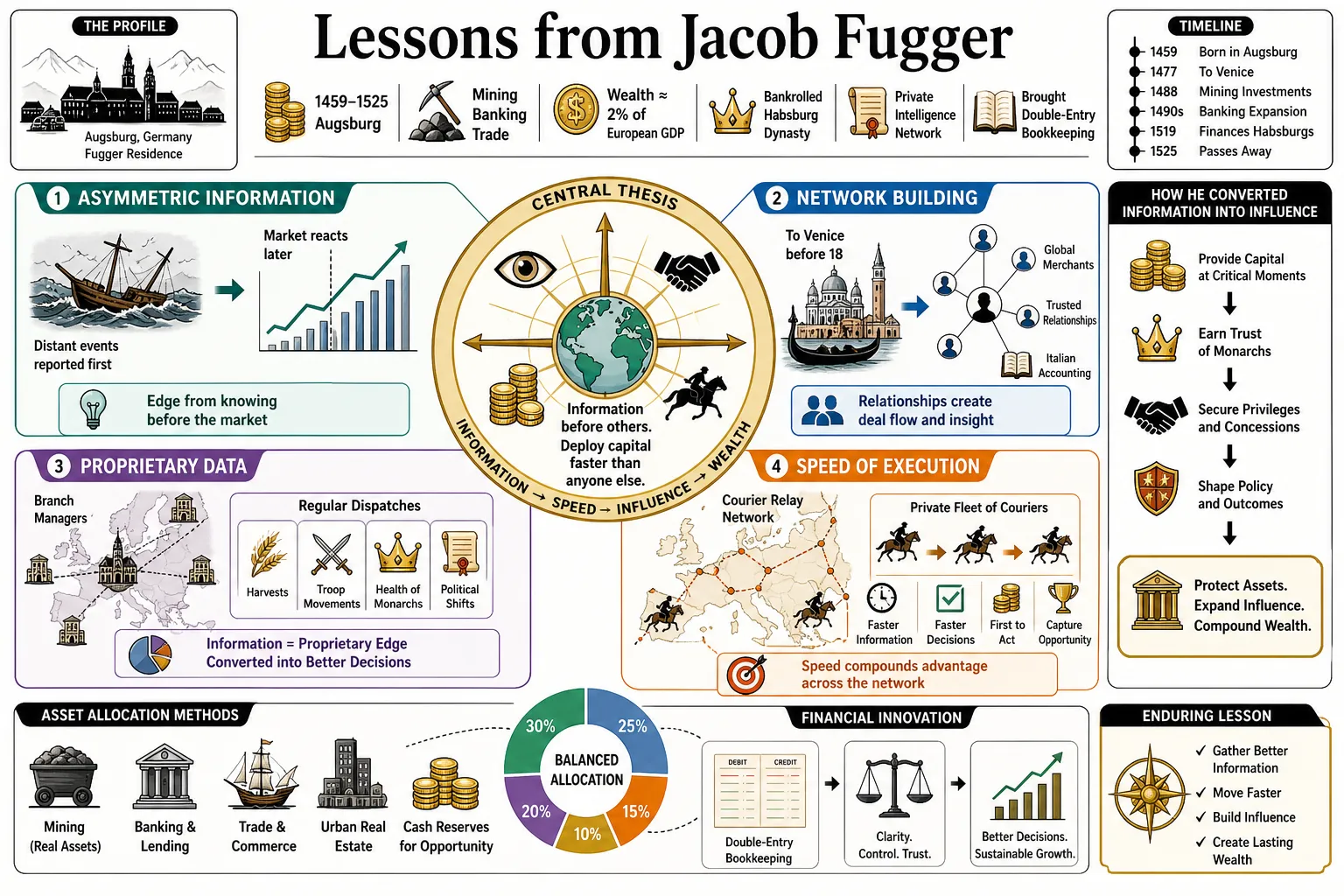
Lessons from Jacob Fugger
Jacob Fugger (1459-1525) built a fortune equal to nearly two percent of European GDP through mining, banking, and trade. Besides bankrolling the Habsburg dynasty and running a private intelligence network, he brought double-entry bookkeeping to northern Europe. This profile breaks down his documented methods for asset allocation and buying political influence.
Part 1: Information and Intelligence
- On Asymmetric Information: "He established the first documented private news service, recognizing that knowing about a distant shipwreck or political shift days before his competitors allowed him to adjust his exposure before the market reacted." — Source: [The Richest Man Who Ever Lived]
- On Network Building: "Before age eighteen, he relocated to Venice, then the commercial center of the world, specifically to build relationships with global merchants and learn Italian accounting." — Source: [The Richest Man Who Ever Lived]
- On Proprietary Data: "Fugger required his branch managers to send regular dispatches on local harvests, troop movements, and the health of monarchs, effectively trading on insider information." — Source: [Fugger Newsletters Archive]
- On Speed of Execution: "He maintained a private fleet of couriers riding in relays across Europe, ensuring his ledgers reflected political realities faster than royal decrees could be published." — Source: [History of the Fugger Family]
- On Information as Collateral: "He lent to royalty primarily for the stipulation that his agents could embed themselves in foreign courts to observe financial stability." — Source: [The Richest Man Who Ever Lived]
- On Early Warning Systems: "By tracking the price of grain in distant provinces, he could predict civil unrest and adjust his loans to local nobility before rebellions broke out." — Source: [Economic History Society]
- On Rumor Control: "He understood that circulating favorable news about his own liquidity prevented bank runs during periods of European financial panic." — Source: [Financial Times: Jakob Fugger]
- On Objective Reporting: "His newsletter correspondents were instructed to strip emotion from their reports; he wanted raw data on ship cargo manifests instead of opinions on foreign policy." — Source: [Fugger Newsletters Archive]
- On Secrecy: "He insisted his couriers memorize the most sensitive details of state loans rather than commit them to paper that could be intercepted." — Source: [The Richest Man Who Ever Lived]
Part 2: Accounting and Financial Control
- On Double-Entry Bookkeeping: "He was the first northern European to adopt the Venetian method of double-entry bookkeeping, treating accurate accounting as the foundation of his competitive edge." — Source: [The Richest Man Who Ever Lived]
- On Consolidated Balances: "He demanded that every regional branch submit annual year-end balances to Augsburg, giving him a unified view of his empire's total assets and liabilities." — Source: [Journal of Accounting History]
- On Auditing: "Fugger frequently dispatched independent auditors to his mining operations in Hungary and Tyrol to verify that local managers were not skimming profits." — Source: [The Richest Man Who Ever Lived]
- On Cash Flow Visibility: "His strict ledger system allowed him to know exactly how much liquid capital he could deploy on a day's notice, allowing him to seize sudden opportunities that illiquid rivals missed." — Source: [Harvard Business Review: History of Accounting]
- On Precision: "He viewed a missing florin in a ledger as a fatal flaw in the system that indicated managerial negligence." — Source: [The Richest Man Who Ever Lived]
- On Paper Trails: "When the Vatican challenged his fees for transferring papal taxes, he produced a flawless decade-long paper trail that proved his exact margins and silenced the inquiry." — Source: [The Richest Man Who Ever Lived]
- On Valuing Assets: "He implemented strict depreciation schedules for his mining equipment in his ledgers, a concept almost unheard of in the early 16th century." — Source: [Economic History of Europe]
- On Compartmentalization: "He maintained separate books for his political loans and his commercial ventures to clearly isolate the risk of sovereign default from his core trading business." — Source: [The Richest Man Who Ever Lived]
- On Literacy: "He refused to promote any family member into management unless they had spent years mastering the physical act of balancing the main ledger." — Source: [History of the Fugger Family]
Part 3: Risk and Crisis Investing
- On Contrarian Action: "When fear of a Turkish invasion drove foreign capital out of Hungary, Fugger stepped in and bought up copper mines at steep discounts while others fled." — Source: [The Richest Man Who Ever Lived]
- On Political Instability: "He viewed geopolitical danger primarily as a barrier to entry for competitors; if he could price the risk of war correctly, the profit margins were unmatched." — Source: [The Richest Man Who Ever Lived]
- On Securing Collateral: "He never lent on good faith alone. When he financed Archduke Sigismund, he insisted on taking direct operational control of the Tyrolean silver mines as collateral." — Source: [Economic History Society]
- On Sunk Costs: "He was ruthlessly pragmatic; if a trade route became unprofitable due to piracy, he immediately liquidated the assets rather than attempting to fight a losing war of attrition." — Source: [Fugger Newsletters Archive]
- On Exploiting Desperation: "He recognized that monarchs fighting wars were highly price-insensitive, allowing him to charge astronomical interest rates during military crises." — Source: [The Richest Man Who Ever Lived]
- On Managing Downside: "He structured his loans so that in the event of default, he received hard assets like land or mining rights that he knew he could operate more efficiently than the previous owner." — Source: [The Richest Man Who Ever Lived]
- On Peasant Revolts: "During the German Peasants' War, he correctly calculated that funding the swift suppression of the rebellion was cheaper than absorbing the losses to his regional properties." — Source: [History of the Fugger Family]
- On Capitalizing on Panic: "When his competitors faced margin calls from Venetian banks, he bought their distressed inventories of spices and textiles for pennies." — Source: [Economic History of Europe]
- On the Cost of Risk: "He explicitly factored the cost of bribing local officials and paying mercenaries into his operating margins when entering unstable territories." — Source: [The Richest Man Who Ever Lived]
Part 4: Audacity and Dealing with Power
- On Sovereign Power: "When Emperor Charles V delayed repayment, Fugger sent a letter stating, 'It is well known that your imperial majesty could not have gained the Roman Crown without my aid,' threatening the most powerful man in Europe." — Source: [The Richest Man Who Ever Lived]
- On Influencing Elections: "He single-handedly bankrolled the election of Charles V as Holy Roman Emperor in 1519, proving that centralized financial capital could outmaneuver traditional hereditary power." — Source: [BBC History: The Fuggers]
- On Changing Laws: "When the Catholic Church's ban on usury threatened his banking model, he successfully lobbied Pope Leo X to alter the doctrine and turn interest into a legitimate business practice." — Source: [The Richest Man Who Ever Lived]
- On Unapologetic Greed: "When asked by an associate when he would stop accumulating wealth, he replied, 'I want to earn as long as I can.'" — Source: [The Richest Man Who Ever Lived]
- On Royal Dependency: "He understood that if a monarch owed him a thousand florins, the monarch had a problem; if the monarch owed him a million florins, Fugger controlled the relationship." — Source: [Financial Times: Jakob Fugger]
- On Direct Confrontation: "In an era when crossing a king meant execution, he openly demanded audits of royal treasuries before agreeing to refinance their sovereign debt." — Source: [The Richest Man Who Ever Lived]
- On Manipulating the Papacy: "He managed the transfer of the Vatican’s indulgence revenues across Europe, making the Pope dependent on Fugger’s logistics to fund St. Peter’s Basilica." — Source: [The Richest Man Who Ever Lived]
- On Indispensability: "He deliberately positioned his bank so that the collapse of the House of Fugger would mean the immediate insolvency of the Habsburg Empire, guaranteeing state protection." — Source: [Economic History Society]
- On Bribing the Right People: "He treated bribery as a standard line-item expense for doing business with the Electoral Princes." — Source: [The Richest Man Who Ever Lived]
- On Outlasting Opponents: "He maintained his composure during intense negotiations with royalty, knowing that crowns were always more desperate for cash than he was for their titles." — Source: [Fugger Newsletters Archive]
Part 5: Debt, Credit, and Lending
- On Productive Debt: "Fugger realized early that borrowing money at five percent to finance a mining operation yielding twenty percent was the quickest path to exponential growth." — Source: [The Richest Man Who Ever Lived]
- On Syndicated Loans: "To finance the massive 543,000 florin bribe for Charles V's election, he invented early forms of syndicated lending by spreading the capitalization across Italian and German backers." — Source: [The Richest Man Who Ever Lived]
- On Physical Asset Backing: "He avoided lending against tax revenues when possible, preferring to secure his loans against tangible outputs like silver ore and copper ingots." — Source: [Economic History of Europe]
- On Liquidity Management: "He kept vast reserves of gold coinage in his Augsburg vaults to ensure he could immediately settle debts and maintain his pristine credit rating during panics." — Source: [History of the Fugger Family]
- On the Time Value of Money: "He rigorously enforced late fees and compound interest on sovereign borrowers, concepts that were highly controversial at the time." — Source: [The Richest Man Who Ever Lived]
- On Controlling Supply Chains: "By taking over mines in lieu of debt repayment, he vertically integrated his business and eliminated middlemen between raw extraction and final sale." — Source: [Harvard Business Review: History of Accounting]
- On Using Other People's Money: "He aggressively solicited deposits from the minor nobility, paying them modest interest while deploying their capital into high-yield sovereign loans." — Source: [The Richest Man Who Ever Lived]
- On Credit Reputation: "He believed his most valuable asset was his reputation; a promise from Fugger was considered more reliable than a treaty from a king." — Source: [BBC History: The Fuggers]
- On Default Realities: "He knew that kings could not be taken to court for default, so he structured his operations so that withholding future capital was a more painful consequence than legal action." — Source: [The Richest Man Who Ever Lived]
Part 6: Diversification and Asset Allocation
- On The Four-Part Rule: "Modern financial historians attribute to him the 'Fugger Portfolio' rule: divide your wealth into four equal parts consisting of stocks, real estate, bonds, and gold coins." — Source: [Medium: The Fugger Portfolio]
- On Expected Losses: "His asset allocation theory was built on the assumption that you must be prepared to take severe losses on at least one of your four asset classes at any given time." — Source: [Medium: The Fugger Portfolio]
- On Rebalancing: "He allegedly practiced strict rebalancing; whenever market shifts caused one of the four quadrants to over-perform, he trimmed it to buy the underperforming assets." — Source: [Medium: The Fugger Portfolio]
- On Geographic Diversification: "He intentionally spread his physical operations across Venice, Antwerp, Lisbon, and Augsburg to ensure no single localized war could wipe out his logistics network." — Source: [The Richest Man Who Ever Lived]
- On Cross-Sector Hedges: "When he heavily financed a monarch's war effort, he also invested in the supply chains for weaponry and uniforms to profit on both the loan and the expenditures." — Source: [The Richest Man Who Ever Lived]
- On Real Estate as Anchors: "He purchased vast tracts of forestry and agricultural land around Augsburg, providing a stable, illiquid hedge against the volatility of his mercantile trading." — Source: [History of the Fugger Family]
- On Hoarding Gold: "He viewed physical gold coins as both capital and the ultimate insurance policy against currency debasement by desperate monarchs." — Source: [Medium: The Fugger Portfolio]
- On Equity Risk: "His equivalent of 'stocks' involved buying into high-risk spice voyages to India, knowing most ships might sink but one success paid for the fleet." — Source: [Economic History of Europe]
- On Fixed Income: "He treated sovereign debt as his 'bonds,' providing predictable interest payments that funded his more speculative mining ventures." — Source: [The Richest Man Who Ever Lived]
- On Avoiding Concentration: "Despite his dominance in copper, he refused to abandon his textile roots, ensuring his firm retained a baseline of steady consumer revenue." — Source: [BBC History: The Fuggers]
Part 7: Monopolies and Market Dominance
- On Pricing Power: "By securing control over the vast majority of European copper, he could artificially restrict supply to drive up prices whenever his cash flow dipped." — Source: [The Richest Man Who Ever Lived]
- On Crushing Competitors: "He frequently operated his mines at a deliberate loss for short periods to drive smaller competitors into bankruptcy, then bought their assets." — Source: [Economic History of Europe]
- On Regulatory Capture: "He used his influence over Emperor Maximilian I to ensure imperial decrees explicitly exempted Fugger enterprises from anti-monopoly laws." — Source: [The Richest Man Who Ever Lived]
- On Syndicate Breaking: "When rival Venetian merchants tried to form a cartel against him, he bypassed them entirely by funding Portuguese voyages around Africa to break their spice monopoly." — Source: [The Richest Man Who Ever Lived]
- On the Value of Scale: "He understood that mining was a game of scale; whoever could afford the deepest drainage shafts controlled the entire mountain." — Source: [History of the Fugger Family]
- On Controlling the Choke Points: "He realized he did not need to own every mine; he just needed to control the central weighing houses and transport routes out of the mountains." — Source: [Fugger Newsletters Archive]
- On Information Monopolies: "His refusal to share his intelligence network's dispatches gave him a monopoly on geopolitical truth in the financial markets of Augsburg and Antwerp." — Source: [The Richest Man Who Ever Lived]
- On Vertical Integration: "He smelted his own ore, minted his own coins under royal license, and transported them on his own carts to capture the margin at every single step." — Source: [Economic History Society]
- On Market Making: "He became so large that he actively dictated the daily price of silver for the entire continent through his internal ledgers." — Source: [The Richest Man Who Ever Lived]
Part 8: Legacy, Mentality, and Influence
- On Philanthropy as Strategy: "He built the Fuggerei, the world's first social housing complex, which provided cheap rent for the poor while cementing his family's political untouchability in Augsburg." — Source: [The Richest Man Who Ever Lived]
- On Meritocracy: "Defying the norms of hereditary nobility, he structured his succession plan so that the most capable nephew took over the empire rather than the oldest son." — Source: [History of the Fugger Family]
- On Eternal Returns: "He mandated that residents of the Fuggerei pray for his soul daily, treating spiritual salvation as a transaction that could be secured through perpetual earthly endowments." — Source: [The Richest Man Who Ever Lived]
- On Wealth as a Tool: "He viewed money strictly as ammunition to acquire more influence and mining rights, rather than an end state." — Source: [BBC History: The Fuggers]
- On Ignoring Critics: "When Martin Luther violently attacked him by name for the sin of usury and capitalist greed, Fugger simply ignored the theological debate and continued his expansion." — Source: [The Richest Man Who Ever Lived]
- On Public Image: "He commissioned Albrecht Dürer to paint his portrait, consciously crafting an image of severe, sober competence rather than flashy aristocratic decadence." — Source: [The Richest Man Who Ever Lived]
- On Dynastic Planning: "He established a rigid family trust that prevented his heirs from breaking up the core capital, ensuring the business survived intact for decades after his death." — Source: [History of the Fugger Family]
- On Pragmatic Religion: "While remaining a staunch Catholic and financing the Church, he readily did business with Protestant princes when the financial terms were favorable." — Source: [Economic History Society]
- On Absolute Focus: "He lived out of a modest room next to his main counting house in Augsburg, preferring proximity to his ledgers over the sprawling country estates he owned." — Source: [The Richest Man Who Ever Lived]
- On the Final Tally: "By the time he died in 1525, he had grown the family firm's capital from a modest regional operation into an entity holding roughly two percent of Europe's entire economic output." — Source: [The Richest Man Who Ever Lived]