Lessons from Jake Knapp
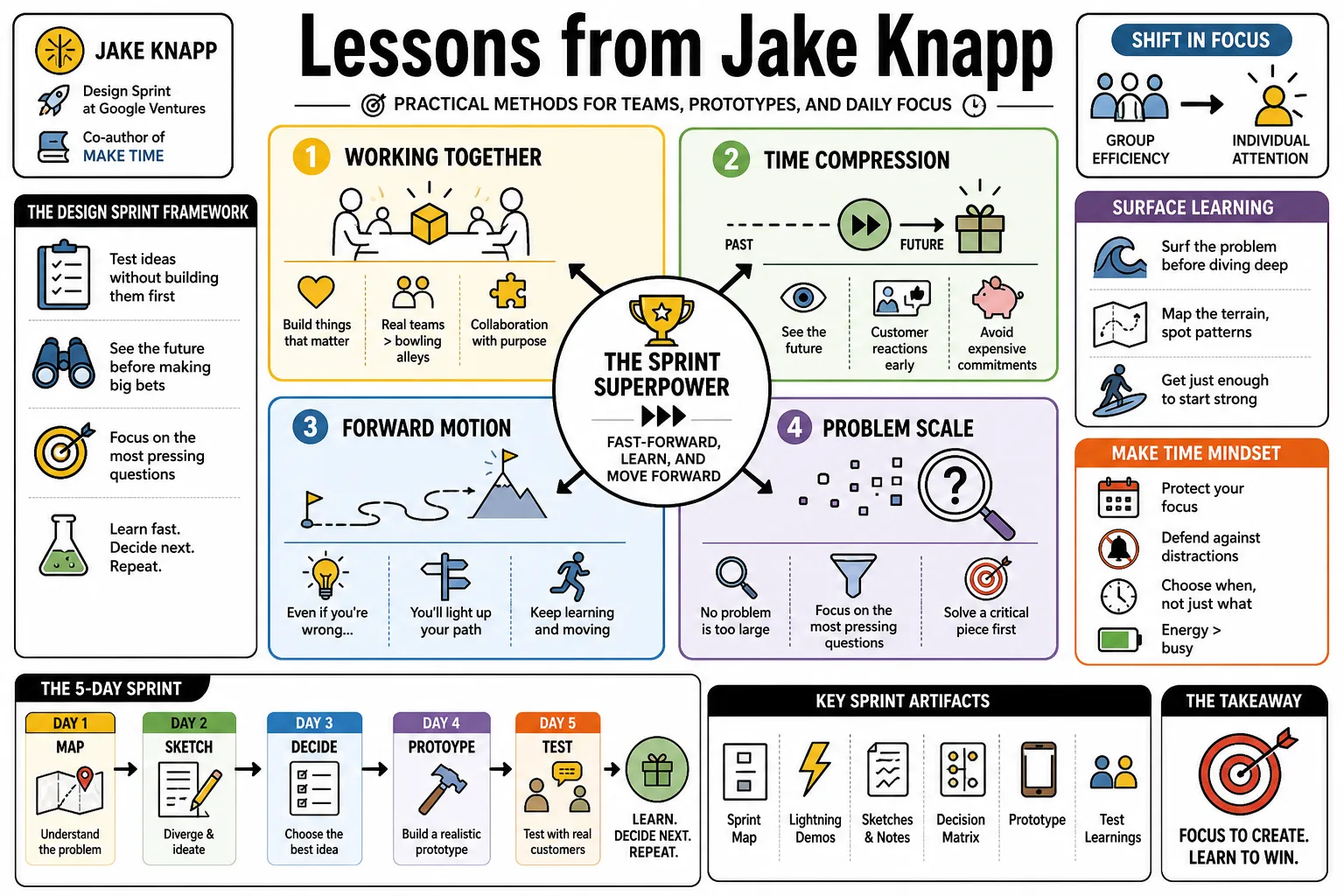
Jake Knapp developed the Design Sprint at Google Ventures so teams could test ideas without building them first. He later co-authored Make Time, turning his focus from group efficiency to individual attention. This profile outlines his practical methods for running teams, prototyping, and defending your daily focus.
Part 1: The Design Sprint Framework
- On Working Together: "It's what work should be about—not wasting time in endless meetings, then seeking camaraderie in a team-building event at a bowling alley—but working together to build something that matters to real people." — Source: [Sprint Book]
- On Time Compression: "The sprint process gives teams a superpower: They can fast-forward into the future to see their finished product and customer reactions, before making any expensive commitments." — Source: [Sprint Book]
- On Forward Motion: "Even if you're wrong the first time, the sprint process will help you light up your future path." — Source: [Voltage Control]
- On Problem Scale: "No problem is too large for a sprint. Yes, this statement sounds absurd, but there are two big reasons why it's true. First, the sprint forces your team to focus on the most pressing questions." — Source: [Sprint Book]
- On Surface Learning: "Second, the sprint allows you to learn from just the surface of a finished product." — Source: [Sprint Book]
- On Getting Started: "We've found that magic happens when we use big whiteboards to solve problems. By asking people for their input early in the process, you help them feel invested in the outcome." — Source: [Sprint Book]
- On Brainstorming: "I became a recovering group brainstormer after realizing that group brainstorming sessions often failed to produce executable ideas." — Source: [Medium]
- On Process Duration: "Take it easy and start with a five-day sprint to learn the mechanics of prototyping and testing before trying to compress it to four days." — Source: [Facilitator Club]
- On Meaningful Work: "Replacing long, unproductive meeting cycles with a structured, time-compressed framework emphasizes individual contribution and real-world validation." — Source: [AI Book Summary]
- On Working Alone Together: "The Design Sprint is built around 'working together, alone' to ensure individual focus and better results rather than groupthink." — Source: [Mind The Product]
Part 2: Redefining Productivity and Time
- On Daily Priorities: "Something magic happens when you start the day with one high-priority goal." — Source: [Make Time Book]
- On Intentionality: "You only waste time if you're not intentional about how you spend it." — Source: [Quote Fancy]
- On Perfectionism: "Perfection is a distraction—another shiny object taking your attention away from your real priorities." — Source: [Make Time Book]
- On The Highlight: "Believe in your Highlight: It is worth prioritizing over random disruption." — Source: [Make Time Book]
- On Productivity vs Intent: "Make Time is not about 'productivity' in the traditional sense of doing more, but about being intentional with your focus." — Source: [Awesome At Your Job]
- On The North Star: "Choose one single, meaningful activity to be the primary focus of your day to avoid the trap of reacting to urgent-but-unimportant tasks." — Source: [Medium]
- On Personal Energy: "Treat your body and mind like a battery. Use physical activities, such as movement, sunlight, and proper rest, to build the energy required for focus." — Source: [Make Time Book]
- On Daily Reflection: "Take a few notes at the end of the day to review what worked and how you can improve your process for the next day." — Source: [Jono Sanders]
- On Reclaiming Control: "Even if you cannot control your entire schedule, you can almost always control your attention." — Source: [WordPress]
- On Setting Examples: "When your friends, your coworkers, and your kids and family see you being intentional with your time, you'll give them permission to question their own 'always on' default." — Source: [Make Time Book]
Part 3: Escaping Distraction and Infinity Pools
- On Friction: "When distraction is hard to access, you don't have to worry about willpower." — Source: [Make Time Book]
- On The Cost of Interruption: "Every distraction imposes a cost on the depth of your focus." — Source: [Make Time Book]
- On Default Behaviors: "Both forces—the Busy Bandwagon and the Infinity Pools—are powerful because they've become our defaults." — Source: [Make Time Book]
- On The Busy Bandwagon: "The busy bandwagon operates because of our culture of constant busyness, the feeling that you must fill your calendar and clear your inbox." — Source: [Scott Kedersha]
- On Endless Content: "Infinity pools are apps and other sources of endlessly replenishing content designed to capture and hold your attention indefinitely." — Source: [Medium]
- On Accidental Habits: "Nobody ever looked at an empty calendar and said, 'The best way to spend this time is by cramming it full of meetings!' Yet that's exactly what we do." — Source: [Make Time Book]
- On Time Starvation: "Caught between the Busy Bandwagon and Infinity Pool, we have no time by default." — Source: [ReadinGraphics]
- On Environment Design: "Design your environment to create friction for distractions so you can stay focused on your Highlight without relying on willpower." — Source: [Lenny's Newsletter]
- On Parental Motivation: "Becoming a parent made me realize how easily time slips away in a blur of digital distraction, which sparked my interest in these methods." — Source: [Freedom]
Part 4: Prototyping and Fast Learning
- On The Prototype Mindset: "You can prototype anything. Prototypes are disposable. Build just enough to learn, but not more." — Source: [Sprint Book]
- On Realism: "The prototype must appear real, even if it is just a façade, to get accurate reactions from customers." — Source: [Sprint Book]
- On Validation: "By continuing with the sprint, and prototyping and testing, you and your team will learn whether those ideas are really as good as they appear." — Source: [Bookey]
- On The Ultimate Prize: "If you test your prototype with customers, you'll win the best prize of all — the chance to learn, in just five days, whether you're on the right track." — Source: [Medium]
- On Test Results: "A successful test is not the end of the process, but the beginning." — Source: [AI Book Summary]
- On Emotional Detachment: "Treat prototypes like one-night stands—you should respect them as the outcome of your ideas, but you must avoid falling in love with them so that you remain objective during testing." — Source: [Medium]
- On Speed vs Polish: "The Sprint methodology is designed to replace months of churning with a single week of focused work, gathering actionable data quickly." — Source: [Voltage Control]
- On Efficient Failure: "Efficient failures are considered positive outcomes because they provide clear, early data that prevents wasting resources on a flawed direction." — Source: [12min]
- On Every Mistake: "Every mistake is just a data point to help you adjust your process." — Source: [Make Time Book]
Part 5: Rethinking Meetings and Collaboration
- On Shared Memory: "As humans, our short-term memory is not all that good, but our spatial memory is awesome. A sprint room becomes a sort of shared brain for the team." — Source: [Sprint Book]
- On Quiet Contribution: "Group brainstorming is often inefficient because it can be dominated by the loudest voices. Working in silence allows everyone to contribute equally." — Source: [Voltage Control]
- On Fast Decisions: "Meetings should be fast and decisive. Rather than engaging in endless, draining discussions, teams should use structured exercises to reach conclusions quickly." — Source: [Bookey]
- On Team Size: "Keep collaborative teams small—ideally seven people or fewer—to ensure a diverse blend of expertise while maintaining the ability to move quickly." — Source: [Medium]
- On Early Investment: "By asking people for their input early in the process, you help them feel invested in the outcome." — Source: [Sprint Book]
- On Productivity as a Trap: "Productivity is often a dirty word because it encourages a reactive state—spending all day checking emails and attending meetings rather than doing meaningful, focused work." — Source: [Medium]
- On Visible Time: "The Time Timer is amazing. It's pure genius—it makes time visible. You'll feel an instant, visceral sense of urgency in a way that's helpful, not stressful." — Source: [Archive]
- On Unspoken Focus: "When you set a timer like this and put it on the table in a meeting, you don't even have to say anything. Everyone suddenly starts to realize that time is going by." — Source: [Time Timer]
- On Physical Tools: "A physical timer is way better than a timer app on a screen. Because it's physical it's easier to adjust and set, and absolutely impossible to ignore." — Source: [Next Big Idea Club]
Part 6: The Burner List and Managing Focus
- On Intentional Limitation: "The Burner List is intentionally limited. It forces you to acknowledge that you can't take on every project or task that comes your way." — Source: [Bookey]
- On The Front Burner: "You are allowed to have one and only one project, activity, or objective on the front burner. Not two, not three — just one." — Source: [Medium]
- On Doing What Matters: "Doing more isn't the same as doing what matters." — Source: [ReadinGraphics]
- On System Purpose: "The Burner List is not intended to make an efficient use of the damned paper surface area — it's intended to make good use of your time." — Source: [Medium]
- On The Back Burner: "Use the back burner column for your other projects, secondary tasks, or items that need attention but are not your current top priority." — Source: [Glitterball For The Mind]
- On Simplicity: "A simple, paper-based system combats the overwhelm of traditional to-do lists by forcing you to prioritize effectively." — Source: [Unstop]
- On Task Breakdown: "Write your most important current project at the top and underline it. List the specific tasks needed to move that project forward in the space below." — Source: [Medium]
- On The Kitchen Metaphor: "The system is like a kitchen stove, where a chef focuses primarily on the dish on the front burner while keeping other pots simmering on the back burners." — Source: [Glitterball For The Mind]
- On Reclaiming Attention: "By restricting what you can focus on, you avoid the trap of trying to manage too many priorities at once and regain control over your attention." — Source: [Bookey]
Part 7: Core Principles of Facilitation
- On Facilitation as Capture: "Successful facilitation is less about talking and more about capturing. A good facilitator spends significant time capturing the team's ideas on a whiteboard." — Source: [Medium]
- On Looking Competent: "If you're the Facilitator, using the Time Timer comes with two extra benefits. First, it makes you look like you know what you're doing. After all, you've got a crazy clock!" — Source: [Sprint Book]
- On Tight Schedules: "Second, although most would never admit it, people like having a tight schedule. It builds confidence in the sprint process, and in you as a Facilitator." — Source: [Sprint Book]
- On Moving Things Along: "I'm going to use this timer to keep things moving. When it goes off, it's a reminder to us to see if we can move on to the next topic." — Source: [Sprint Book]
- On Timer Flexibility: "If you're talking when the timer beeps, just keep talking, and I'll add a little more time. It's a guideline, not a fire alarm." — Source: [Sprint Book]
- On Shared Consensus: "Capturing ideas on a whiteboard ensures shared consensus is reflected and prevents endless circular debates." — Source: [Medium]
- On Presentation Narratives: "In presentations, storytelling is more powerful than slide graphics. A great presentation has a clear structure—a beginning, middle, and end." — Source: [Medium]
- On Ditching Slides: "Don't rely on slides. Cramming information onto slides or simply reading bullet points distracts the audience from the speaker." — Source: [Medium]
- On Framing Projects: "Frame products and projects around a cohesive narrative to help guide the journey from an initial idea to a successful prototype." — Source: [Medium]
Part 8: Career, Writing, and Taking Risks
- On The Difficulty of Writing: "The brain will often invent excuses like checking email or cleaning to avoid the focus required for deep work." — Source: [Medium]
- On The Path of Most Resistance: "Writing is the path of most resistance, requiring structure and rules to overcome procrastination." — Source: [Medium]
- On Taking Risks: "Taking crazy risks, like leaving a stable role to focus on writing, is almost always less risky than it feels in the moment." — Source: [Medium]
- On Habit Prototyping: "Treat your own habits as prototypes, testing and refining them rather than expecting perfection on the first try." — Source: [Medium]
- On Unconventional Schedules: "Beware the lack of structure that can come with unconventional work schedules. Make systems sustainable and manageable rather than overwhelming." — Source: [Medium]
- On Admitting Flaws: "Being transparent about your own flaws, such as struggling with organization or visual design, makes your methods feel more accessible and human." — Source: [Medium]
- On Getting in the Zone: "The Time Timer always helps me get into the zone when I want to focus on difficult tasks like writing." — Source: [Freedom]
- On Designing Defaults: "Instead of relying on willpower to push through hard work, reset your defaults so that doing the work becomes the easiest option." — Source: [Lenny's Newsletter]
- On Overcoming Procrastination: "When tackling difficult tasks, create artificial constraints to force yourself to begin." — Source: [Medium]
- On Adapting Processes: "Just as you would iterate on a product, you must continuously iterate on how you manage your own career and creative output." — Source: [Jake Knapp Blog]