Jake Stauch is an entrepreneur who transitioned from building brain-controlled video games for ADHD to co-founding Serval, an AI-native IT service management platform valued at $1 billion. He is known for the concept of "vibe coding," which uses AI to instantly generate code-based workflows, reducing the time-cost of automation in enterprise IT. This profile curates his operating philosophies on organizational talent density, the dual-agent architecture required for safe enterprise AI, and the strategy of building full platforms rather than minimal viable products.
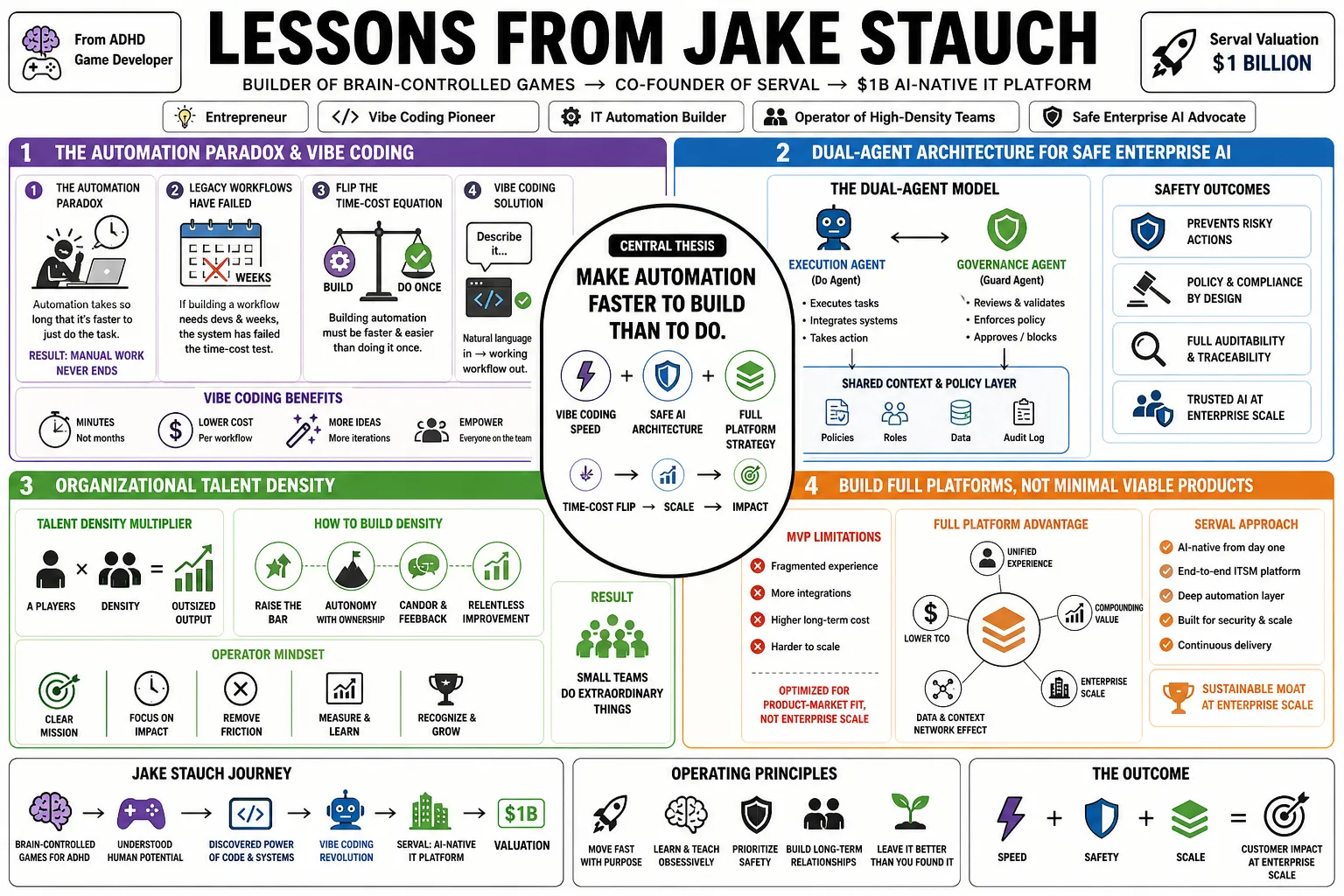
Part 1: The Automation Paradox & Vibe Coding
- On the automation paradox: "In many IT environments, building an automation takes so long that it's faster to just do the task manually, resulting in IT teams remaining buried in manual tickets." — Source: [APMdigest]
- On legacy workflows: "If creating a workflow requires dedicated developers and weeks of effort, the system has failed the fundamental test of time-cost." — Source: [Way of Product]
- On flipping the time-cost equation: "For automation to succeed, the process of building the automation must be faster and easier than performing the manual task even once." — Source: [Serval Blog]
- On natural language programming: "We use a code-generation engine to turn natural language descriptions into executable TypeScript code in seconds, effectively reducing the one-time cost of creating a workflow to nearly zero." — Source: [Sequoia Capital]
- On vibe coding: "Vibe coding on rails allows an admin to simply describe the logic, permissions, and integrations they want, and the system generates the production-ready automation instantly." — Source: [The Split]
- On economic shifts in IT: "By making the cost of creating an automation near zero, it becomes economically irrational for IT staff not to automate every incoming request." — Source: [First Round Review]
- On continuous generation: "Instead of using traditional drag-and-drop workflow builders, IT administrators can now just describe a desired automation and let the system write the underlying code." — Source: [Sequoia Capital]
- On complex conditionals: "You can request an automation like 'Reset Okta MFA, but require manager approval and limit it to twice every 24 hours,' and the system handles the deterministic output." — Source: [The Split]
- On the failure of no-code: "No-code tools often create more work than they save because the friction of the drag-and-drop builder exceeds the cost of doing it by hand." — Source: [Way of Product]
- On replacing manual overhead: "The future of IT service management is eliminating the manual overhead of traditional automation tools so that teams can focus on strategic infrastructure." — Source: [Serval Blog]
Part 2: Engineering & "Forward-Deployed" Culture
- On customer-centric engineering: "Forward-Deployed Engineers (FDEs) at Serval are full members of the software engineering team but are required to spend at least 20 percent of their time directly with customers." — Source: [First Round Review]
- On bypassing traditional cycles: "Because our platform uses AI to generate code-based workflows, FDEs can build and ship custom features for a client on the same day they receive feedback, bypassing the spec-to-sprint cycle." — Source: [First Round Review]
- On replacing product managers: "Unlike traditional tech companies that rely on Product Managers to bridge the gap between customers and engineers, we intentionally avoid hiring PMs in favor of Forward Deployed Engineers." — Source: [PMF Show]
- On recruiting founders: "The FDE role serves as an extended bootcamp for future entrepreneurs, offering accelerated equity and direct exposure to our most complex accounts." — Source: [Upstarts Media]
- On CTO energy: "The FDE model reproduces the scrappy CTO energy of a startup's early days at scale, ensuring the product solves specific, long-tail business problems." — Source: [First Round Review]
- On rate-limiting steps: "In the AI era, the rate-limiting step for enterprise software is no longer technical capability, but the ability to steer the product to solve actual business problems." — Source: [First Round Review]
- On deployment environments: "FDEs are thrown at our largest and most complex accounts to troubleshoot and build custom capabilities directly in the customer's environment." — Source: [Upstarts Media]
- On gradient descent for product: "Utilizing a small group of highly capable engineers who work directly with customers creates a gradient descent for product improvements, optimizing quickly based on immediate feedback." — Source: [Sequoia Capital]
- On training entrepreneurs: "Future founders are forged, not found. By placing aspiring founders in high-pressure, customer-facing engineering roles, we cultivate the next generation of builders." — Source: [Serval Blog]
Part 3: Talent Density & The "Fewer, Better" Philosophy
- On running understaffed: "Startups should deliberately run understaffed with exceptional talent rather than stuffing the team to feel fully resourced." — Source: [Sequoia Capital]
- On the race to the median: "I prefer a team of seven high-performers doing the work of ten, because filling seats just to relieve pressure inevitably leads to a quiet drop in the hiring bar." — Source: [First Round Review]
- On AI first refusal: "When a department is overwhelmed, the instinct is not to post a job listing, but to ask if AI can do the job first." — Source: [Sequoia Capital]
- On eliminating traditional roles: "We have eliminated traditional roles like Solutions Engineers and SDRs, relying instead on our own AI tools to generate technical answers and materials in real-time." — Source: [Sequoia Capital]
- On delaying operational hires: "We delay hiring for functions like RevOps or Enablement until the absolute limit of what AI and our existing staff can handle is reached." — Source: [Sequoia Capital]
- On increasing density at scale: "A common pitfall is that talent density dilutes as a company grows. You must actively work to increase talent density with every new hire." — Source: [The Split]
- On hiring for ambiguity: "We avoid hiring people who require extensive mentorship or defined career paths. We seek day-one productive individuals who thrive in flat, fast-moving organizations." — Source: [Sequoia Capital]
- On the only remaining moat: "Because features can be replicated overnight by competitors using AI, talent density and organizational agility are the only durable moats left." — Source: [Sequoia Capital]
- On execution speed: "A small team of incredible people can out-execute a large incumbent because they maintain higher decision-making velocity and deep customer empathy." — Source: [Sequoia Capital]
Part 4: Go Hard Early: Platform Building vs. MVP
- On challenging lean startup advice: "Instead of building a Minimum Viable Product that solves a tiny sliver of a problem, you should tackle the most difficult, complex parts of a category from day one." — Source: [First Round Review]
- On creating immediate moats: "Seeking out the hard things that unlock massive customer value but are daunting for others to build creates a moat that competitors cannot easily cross." — Source: [First Round Review]
- On platform-first development: "Most startups build a single tool and hope to become a platform later. By building a robust automation builder and ticketing system simultaneously, we ensured we weren't just a feature." — Source: [First Round Review]
- On going multi-product early: "In enterprise software, buyers want consolidated solutions. Launching multiple integrated capabilities early allows you to compete with incumbents on day one." — Source: [First Round Review]
- On technical assumptions: "Focus energy on the most technically uncertain part of the business first. Once you prove the hardest assumption, the rest of the roadmap is just execution." — Source: [First Round Review]
- On compounding advantages: "Going hard early creates a compounding advantage; once you have built the hard things, it is much harder for a fast-follower to catch up." — Source: [First Round Review]
- On roadmap conviction: "Tackling complex problems head-on allows the team to hammer out a roadmap without the constant pivoting that comes from playing it too safe." — Source: [First Round Review]
- On undeniable ROI: "In existing enterprise categories, a product cannot just be a little better; it has to be undeniable to justify the cost of switching from a legacy system." — Source: [First Round Review]
- On avoiding the wedge trap: "We chose to build full-platform replacements rather than relying on a wedge strategy, ensuring we owned the core workflow from the start." — Source: [First Round Review]
Part 5: Customer Discovery & Identifying Friction
- On flawed discovery questions: "Asking 'What is your biggest pain point?' often yields unhelpful answers because people have already solved the problems they are aware of with existing tools." — Source: [First Round Review]
- On the magic question: "The better question is: 'If you could hire somebody today to sit next to you and do your work for you, what would you have them do?'" — Source: [Apple Podcasts]
- On non-judgmental framing: "Asking what someone would delegate to an assistant allows buyers to admit they hate repetitive tasks without feeling like they are complaining about their current software." — Source: [First Round Review]
- On hidden IT problems: "Our discovery question revealed that IT leaders wanted someone to handle repetitive help desk requests—a need they had not previously framed as a ticketing problem." — Source: [First Round Review]
- On observing behavior: "Customer insight requires staying close to the metal. I personally stay in over 100 customer Slack channels to see exactly where they experience friction." — Source: [Sequoia Capital]
- On existing budgets: "It is often more powerful to build a better product in a category where people already have a budget than to try and create a new category from scratch." — Source: [First Round Review]
- On the Trojan Horse strategy: "By selling a better version of something customers already buy, you can bundle in advanced AI capabilities they might not have sought out independently." — Source: [First Round Review]
- On identifying the real competitor: "The main competitor is rarely another startup; it is the ingrained habit of doing things manually because the alternative takes too long to set up." — Source: [Way of Product]
- On boring enterprise problems: "We specifically target boring but high-value enterprise problems. Software should look boring on the surface but possess unlimited intelligence underneath." — Source: [Sequoia Capital]
- On the limits of models: "Models can write code, but high-caliber talent that maintains deep customer empathy generates the insights that pure AI cannot replicate." — Source: [Sequoia Capital]
Part 6: Bringing Consumer Quality to the Enterprise
- On the enterprise UX gap: "Enterprise buyers are also consumers who use intuitive technology at home, yet they often feel like they are stepping twenty years in the past when they log into work systems." — Source: [First Round Review]
- On consumer-quality expectations: "Winning in the enterprise market today requires delivering a consumer-quality experience to business buyers, regardless of how complex the backend is." — Source: [First Round Review]
- On making systems magical: "Even for infrastructure or security products, the user experience must feel magical to overcome the change management friction of switching away from legacy software." — Source: [Sequoia Capital]
- On intuitive workflows: "We aim to make complex IT automation workflows feel as intuitive as configuring a smart home device." — Source: [First Round Review]
- On surface area: "If you want to build a true platform, you have to be willing to bite off massive surface area and sell a complete, cohesive solution." — Source: [First Round Review]
- On owning the relationship: "Expanding into adjacent product lines early allows you to own the customer relationship across multiple touchpoints." — Source: [First Round Review]
- On Verkada's influence: "My time at Verkada taught me that business buyers will pay a premium for hardware and software that does not require a manual to operate." — Source: [First Round Review]
- On simplifying the backend: "The complexity of the system should be our problem, not the user's. The interface should shield them from the underlying technical debt." — Source: [Sequoia Capital]
- On enterprise aesthetics: "Enterprise software does not have to be ugly to be powerful. A beautiful interface builds immediate trust with the user." — Source: [First Round Review]
Part 7: Dual-Agent Architecture & Security
- On black box AI: "We distinguish our system from black-box AI by splitting intelligence into two distinct agents, ensuring total security and control." — Source: [Serval Blog]
- On the Admin Agent: "The Admin Agent acts as the builder. It works with IT admins to write code, test tools, and approve specific skills before they go live." — Source: [TechCrunch]
- On the Help Desk Agent: "The Help Desk Agent is the executor that interacts with users in Slack. It can only trigger deterministic tools that have been explicitly pre-approved by the Admin Agent." — Source: [Serval Blog]
- On preventing hallucinations: "By restricting the user-facing agent to pre-approved scripts, we prevent the AI from taking unauthorized actions or hallucinating destructive commands." — Source: [TechCrunch]
- On air-gapped automation: "Our architecture maintains an air-gapped separation between the AI that reasons about a problem and the system that executes changes to the company's infrastructure." — Source: [First Round Review]
- On autonomy vs. control: "There is a fundamental tension in enterprise AI between individuals wanting autonomy and organizations needing centralized control. Our dual-agent setup resolves this." — Source: [First Round Review]
- On safe execution: "You cannot let an autonomous agent make raw API calls to your active directory without human oversight. The automation must be deterministic." — Source: [Serval Blog]
- On building trust: "Trust in enterprise AI is built through transparency. Admins need to see the exact TypeScript code the agent generated before they allow it to run." — Source: [First Round Review]
- On tool creation: "Instead of training a model on every possible IT scenario, we use models to quickly generate specific, constrained tools that execute perfectly every time." — Source: [The Split]
- On enterprise guardrails: "An AI agent without guardrails is a liability. By forcing all actions through admin-approved code blocks, we make AI safe for legacy IT environments." — Source: [TechCrunch]
Part 8: Lessons from Hardware and Failure (NeuroPlus)
- On the time problem in health tech: "While our EEG headsets solved a clinical problem for ADHD, they exacerbated a lifestyle problem by requiring time from mothers who were already time-poor." — Source: [Way of Product]
- On opportunity cost: "NeuroPlus failed to scale because we did not account for the opportunity cost of the user's time. A product that adds another chore to the day will struggle with retention." — Source: [First Round Review]
- On market misalignment: "We assumed our market was everyone with ADHD who wanted an alternative to medication. The reality was much smaller due to the friction of using hardware daily." — Source: [PMF Show]
- On hardware friction: "Building and shipping hardware from scratch was a trial by fire. The high bar for consumer electronics makes it difficult to iterate as quickly as a pure software company." — Source: [First Round Review]
- On defensive mindsets: "At my first startup, I often felt defensive—focused on hitting the next milestone just to survive, which prevented me from taking the massive swings necessary for scale." — Source: [First Round Review]
- On giving time back: "The transition from NeuroPlus to Serval was a shift from building a product that took time away from users to one that instantly gives time back to IT teams." — Source: [Way of Product]
- On the reality of clinical tools: "Just because a technology demonstrably improves clinical metrics does not mean it fits seamlessly into a consumer's daily life." — Source: [PMF Show]
- On surviving hardware: "The complexities of manufacturing physical goods taught me to appreciate the rapid deployment cycles of pure enterprise software." — Source: [First Round Review]
- On learning from early ventures: "My years building brain-controlled video games were lean and stressful, but they forged the resilience and high talent bar I rely on today." — Source: [First Round Review]