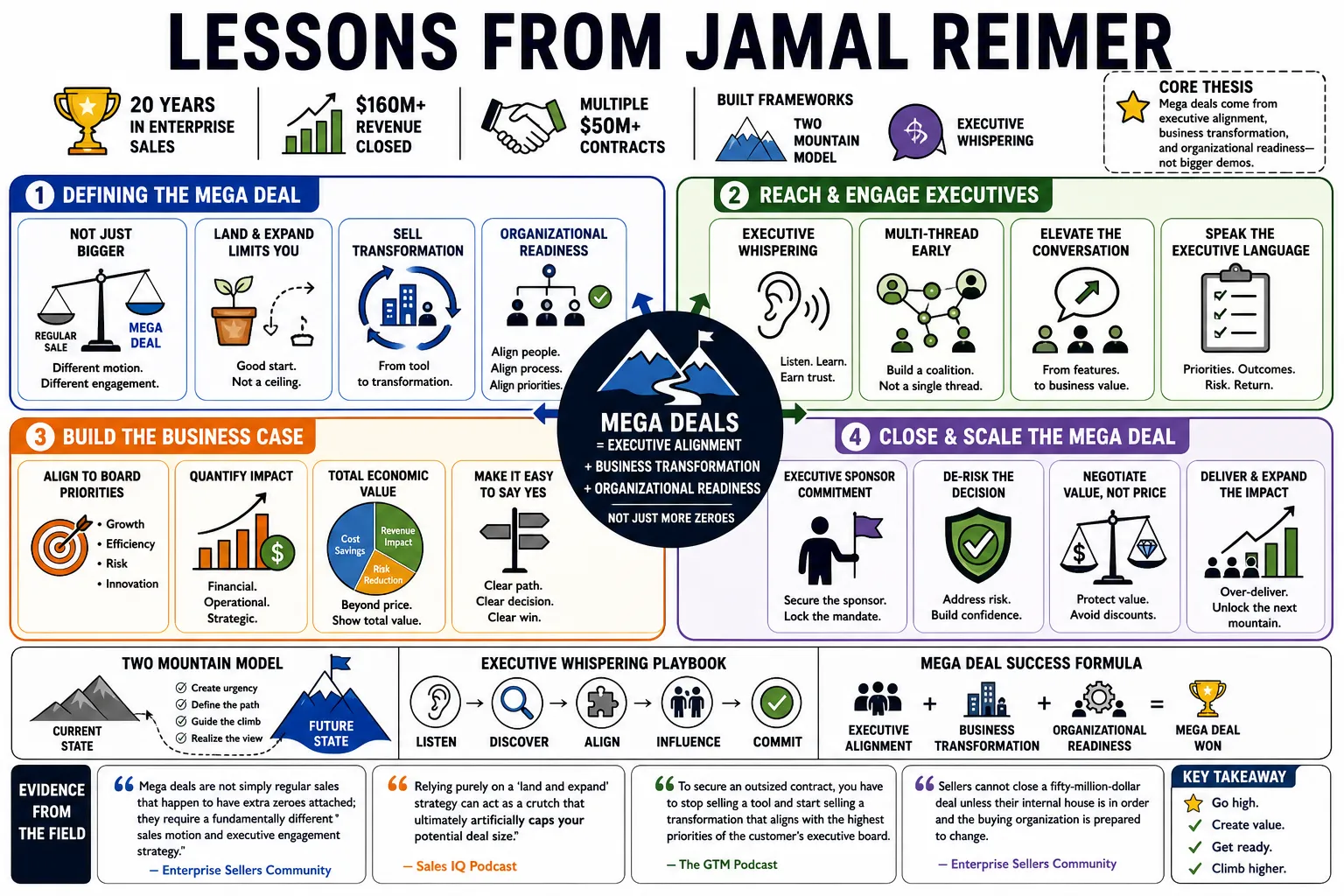
Lessons from Jamal Reimer
Jamal Reimer spent twenty years in enterprise sales, closing over $160 million in revenue and landing multiple $50-million contracts. He built frameworks like the "Two Mountain" model and "Executive Whispering" to systemize how reps close massive agreements. This profile details his tactics for reaching executives, shifting conversations from product to business value, and closing multi-million dollar deals.
Part 1: Defining the Mega Deal
- On the nature of mega deals: "Mega deals are not simply regular sales that happen to have extra zeroes attached; they require a fundamentally different sales motion and executive engagement strategy." — Source: Enterprise Sellers Community
- On the limitation of land and expand: "Relying purely on a 'land and expand' strategy can act as a crutch that ultimately artificially caps your potential deal size." — Source: Sales IQ Podcast
- On deal transformation: "To secure an outsized contract, you have to stop selling a tool and start selling a transformation that aligns with the highest priorities of the customer's executive board." — Source: The GTM Podcast
- On organizational readiness: "Sellers cannot close a fifty-million-dollar deal in a vacuum; the entire selling organization must be aligned and prepared to support an engagement of that magnitude." — Source: Mega Deal Secrets
- On identifying potential: "You have to look at your territory and realistically evaluate which accounts have the revenue, scale, and strategic need to support a truly massive contract." — Source: Daily Sales Tips Podcast
- On risk profile: "At the mega-deal level, executives are not evaluating simple returns; they are evaluating the personal and institutional risk of trusting your company with a core business function." — Source: Sales Hacker Podcast
- On the time investment: "These deals often take twelve to eighteen months, requiring a seller to maintain momentum and executive attention across multiple financial quarters." — Source: The Insiders Podcast
- On mutual commitment: "A mega deal requires as much internal selling within your own company to secure the necessary resources as it does external selling to the customer." — Source: Sales Success Stories Podcast
- On abandoning the middle: "Spending too much time with middle management on technical specifications is the fastest way to shrink a potential mega deal into a standard transaction." — Source: Mega Deal Secrets
- On defining success: "Success in this tier of selling is measured not by hitting a quota through volume, but by changing the trajectory of your own company with a single, landmark agreement." — Source: Enterprise Sellers Community
Part 2: The Two Mountain Model
- On the first mountain: "The beginning of the mega-deal cycle is the first mountain, where the primary objective is to climb to the executive suite and secure power as quickly as possible." — Source: Daily Sales Tips Podcast
- On the valley: "Once you have executive buy-in, you descend into the 'valley'—the middle of the sales cycle where teams validate the technical and operational feasibility of the vision." — Source: Sales IQ Podcast
- On surviving the valley: "The valley is where deals often stall, because sellers get bogged down in technical evaluations and lose their connection to the executive sponsor who approved the initiative." — Source: The GTM Podcast
- On the second mountain: "The second mountain is the climb out of the valley, requiring you to re-engage the C-suite to navigate procurement, finalize pricing, and secure the ultimate signature." — Source: Mega Deal Secrets
- On momentum loss: "If you take too long climbing the first mountain to reach power, you burn the enthusiasm and calendar time necessary to survive the rest of the cycle." — Source: Sales Hacker Podcast
- On executive re-engagement: "You must proactively plan your route up the second mountain before you even enter the valley, ensuring your executive sponsors expect you to return for final approval." — Source: Enterprise Sellers Community
- On mapping the terrain: "The Two Mountain framework helps sellers anticipate when they need to deploy technical resources versus when they need to deploy their own executives." — Source: Sales Success Stories Podcast
- On the procurement trap: "Many sellers mistake procurement for the peak of the second mountain; procurement is just a hurdle, the true peak is the final executive sign-off." — Source: The Insiders Podcast
- On maintaining altitude: "Even when your technical team is working in the valley, the lead seller must maintain 'altitude' by keeping the C-suite updated on the business impact of the ongoing evaluation." — Source: Daily Sales Tips Podcast
Part 3: The Imperative of Going High Early
- On skipping levels: "You have to go high, early. Engaging with SVPs, EVPs, and CEOs from day one is essential because lower-level stakeholders lack the authority to authorize eight-figure budgets." — Source: Sales IQ Podcast
- On the danger of starting low: "Starting low and hoping your contact will introduce you to the CEO rarely works; middle managers naturally want to protect their executives from salespeople." — Source: Mega Deal Secrets
- On executive relevance: "When you go straight to the C-suite, your messaging cannot be about features; it must immediately address the strategic challenges that keep the CEO awake at night." — Source: The GTM Podcast
- On earning the right: "You do not earn the right to speak to a CEO by being polite; you earn it by bringing a disruptive insight that impacts their stock price or market share." — Source: Sales Hacker Podcast
- On overcoming fear: "The biggest barrier to going high early is the seller's own imposter syndrome and fear of rejection from a high-ranking executive." — Source: Enterprise Sellers Community
- On the executive calendar: "Top executives guard their time fiercely; your initial outreach must be concise, heavily researched, and entirely focused on their corporate imperatives." — Source: Sales Success Stories Podcast
- On peer-level communication: "When communicating with a C-level executive, you must strip away all sales jargon and speak to them as a peer evaluating a joint business venture." — Source: The Insiders Podcast
- On the cost of delay: "Every week you spend negotiating with a director is a week you are not building the business case with the executive who actually controls the budget." — Source: Daily Sales Tips Podcast
- On executive curiosity: "The goal of the first C-suite interaction is not to pitch a solution, but to provoke enough curiosity that the executive mandates their team to evaluate your proposal." — Source: Mega Deal Secrets
Part 4: Crafting the Mega Deal Premise
- On the Core Imperative: "A mega deal must be anchored to a 'Core Imperative'—a massive, publicly stated goal the company is already committed to achieving." — Source: The GTM Podcast
- On manufacturing urgency: "You cannot manufacture urgency for a fifty-million-dollar deal; you must attach your solution to an urgent, existing initiative mandated by the board." — Source: Sales IQ Podcast
- On the C-Level Insight: "Your premise must include a 'C-Level Insight'—a unique perspective that reveals why their current approach to the core imperative is failing or inefficient." — Source: Mega Deal Secrets
- On distinct value: "The 'Distinctive Value Proposition' must clearly articulate why only your organization has the architecture or expertise to solve the problem at a global scale." — Source: Enterprise Sellers Community
- On testing the premise: "Before bringing the premise to the CEO, test elements of it with trusted lower-level champions to ensure your assumptions about their internal operations are accurate." — Source: Sales Hacker Podcast
- On financial modeling: "The premise is incomplete without a rigorous financial model that projects the specific revenue lift or cost reduction your intervention will generate." — Source: Sales Success Stories Podcast
- On brevity: "Despite the complexity of the deal, the Mega Deal Premise itself must be easily communicable in a two-minute conversation or a half-page executive summary." — Source: The Insiders Podcast
- On executive ownership: "A successful premise is one that the customer's executive adopts as their own idea and presents to their own board." — Source: Daily Sales Tips Podcast
- On avoiding product pitches: "If your premise mentions a specific software module or feature in the first five minutes, you have written a product pitch, not an executive premise." — Source: Mega Deal Secrets
- On iterative refinement: "The premise is a living document that must be continuously refined as you gather more proprietary information during the sales cycle." — Source: Enterprise Sellers Community
Part 5: The Art of Executive Whispering
- On choreographing leadership: "Executive Whispering is the deliberate orchestration of interactions between your company’s C-suite and the prospect's C-suite." — Source: Daily Sales Tips Podcast
- On peer-to-peer mapping: "You must map executives strategically; pair your CEO with their CEO to discuss vision, and your CFO with their CFO to discuss financial structuring." — Source: Sales IQ Podcast
- On preparing your executives: "Never put your CEO on a call without an extensive briefing document detailing the prospect's core imperatives, the deal premise, and exactly what you need them to say." — Source: The GTM Podcast
- On controlling the narrative: "The seller acts as the director of a play, ensuring that when the executives meet, they stay on script and advance the specific goals of the deal." — Source: Mega Deal Secrets
- On debriefing: "Immediate debriefs after executive meetings are critical; you need to capture the nuances of what was agreed upon before the executives get distracted by other priorities." — Source: Sales Hacker Podcast
- On utilizing board members: "In the largest deals, 'Executive Whispering' extends to leveraging your own board members or key investors to backchannel with the prospect's board." — Source: Enterprise Sellers Community
- On protecting executive time: "Use your executives sparingly and only for high-leverage moments; treating your CEO as a glorified sales engineer diminishes their impact." — Source: Sales Success Stories Podcast
- On ghostwriting: "A significant part of whispering involves drafting the exact emails and follow-ups for your executives to send to their counterparts." — Source: The Insiders Podcast
- On maintaining authority: "Even when managing your own CEO, the enterprise seller must maintain ultimate authority over the strategy and execution of the deal." — Source: Mega Deal Secrets
Part 6: Developing Financial Fluency
- On reading reports: "An enterprise seller must be able to dissect an annual 10-K report with the same fluency as an equity analyst to uncover the company's true vulnerabilities." — Source: Enterprise Sellers Community
- On speaking the language of finance: "If you cannot confidently discuss EBITDA, operating margins, and capital expenditure versus operating expenditure, the CFO will dismiss you immediately." — Source: The GTM Podcast
- On linking technical to financial: "The best sellers translate technical efficiency metrics into recognized financial metrics that impact the balance sheet." — Source: Sales IQ Podcast
- On earnings calls: "Listening to quarterly earnings calls is mandatory research; it tells you exactly what promises the CEO has made to Wall Street that they now must fulfill." — Source: Sales Hacker Podcast
- On business cases over proposals: "Stop sending price proposals and start sending robust business cases that calculate the Net Present Value and Internal Rate of Return of your solution." — Source: Mega Deal Secrets
- On executive compensation: "Understanding how the executive team's compensation is structured allows you to align your deal with the metrics that trigger their personal bonuses." — Source: Daily Sales Tips Podcast
- On proactive financial modeling: "Do not wait for the client's finance team to build the ROI model; build a conservative, defensible model yourself and ask them to validate it." — Source: Sales Success Stories Podcast
- On the cost of doing nothing: "Your financial fluency is most effectively used not to prove how much they will gain, but to quantify the exact, painful cost of maintaining the status quo." — Source: The Insiders Podcast
- On strategic pricing: "In mega deals, pricing should be structured not based on software licenses, but on a percentage of the financial value your solution will predictably create." — Source: Enterprise Sellers Community
Part 7: Shifting from Product Focus to Business Value
- On the value hypothesis: "When meeting with executives, focus entirely on the 'value hypothesis'—the transformative business outcomes—rather than the mechanics of the software itself." — Source: Enterprise Sellers Community
- On delegating the technical: "Leave the deep technical demonstrations to your solution engineers; the lead seller's role is to maintain the conversation around strategic business impact." — Source: Sales IQ Podcast
- On diagnosing before prescribing: "Pitching a product before conducting a thorough, cross-departmental diagnosis of the business problem is professional malpractice in enterprise sales." — Source: The GTM Podcast
- On the limit of features: "Features are easily commoditized by competitors; business acumen, deep industry knowledge, and the ability to execute a transformation are what command premium pricing." — Source: Mega Deal Secrets
- On framing the narrative: "Frame your solution not as a software upgrade, but as the underlying infrastructure that enables their next phase of corporate growth." — Source: Sales Hacker Podcast
- On asking better questions: "The quality of the information you receive from a C-level executive is directly proportional to the business depth of the questions you ask." — Source: Sales Success Stories Podcast
- On industry specialization: "Generalist sellers struggle with mega deals; you must deeply understand the macroeconomic forces, regulatory environment, and competitive landscape of the specific industry you are selling into." — Source: Daily Sales Tips Podcast
- On customer stories: "When sharing case studies, focus on the business metrics achieved by previous clients, not the specific modules they purchased." — Source: The Insiders Podcast
- On vision locking: "Work with the executive sponsor to lock in a shared vision of the future state before any pricing or specific product configurations are discussed." — Source: Mega Deal Secrets
- On executive indifference: "Senior leaders do not care how your software works; they only care that it reduces risk, increases revenue, or cuts costs with absolute certainty." — Source: Enterprise Sellers Community
Part 8: Orchestrating the Final Stages
- On deal orchestration: "Closing a fifty-million-dollar deal is less about individual salesmanship and more about the rigorous orchestration of legal, security, finance, and technical teams on both sides." — Source: The GTM Podcast
- On navigating procurement: "Procurement is designed to commoditize your offering; you counter this by ensuring your executive sponsor continuously mandates the unique strategic value of your solution to the buying committee." — Source: Sales IQ Podcast
- On managing legal delays: "Anticipate that legal review for a massive contract will take months, and build that buffer into your forecast rather than hoping for a rapid turnaround." — Source: Mega Deal Secrets
- On holding firm on price: "If you have effectively mapped your solution to a core imperative and quantified the returns, you must hold firm on pricing when procurement inevitably asks for a discount." — Source: Sales Hacker Podcast
- On the closing sequence: "Develop a hyper-detailed closing sequence that maps out every signature, approval, and administrative step required in the final thirty days of the cycle." — Source: Daily Sales Tips Podcast
- On multi-threading: "If you are relying on a single champion to push the deal through procurement and legal, the deal is entirely at risk; you must multi-thread across every department involved." — Source: Enterprise Sellers Community
- On executive check-ins: "Use your executives for periodic check-ins during the negotiation phase to reiterate commitment and gently pressure the client's team to maintain momentum." — Source: Sales Success Stories Podcast
- On the post-sale handoff: "The mega deal is not over at signature; the seller must orchestrate a flawless handoff to the implementation team to ensure the promised value is actually delivered." — Source: The Insiders Podcast
- On relentless execution: "At the very end of the second mountain, deals die from fatigue. The seller must be the most resilient person in the process, driving the administrative details until the ink is dry." — Source: Mega Deal Secrets