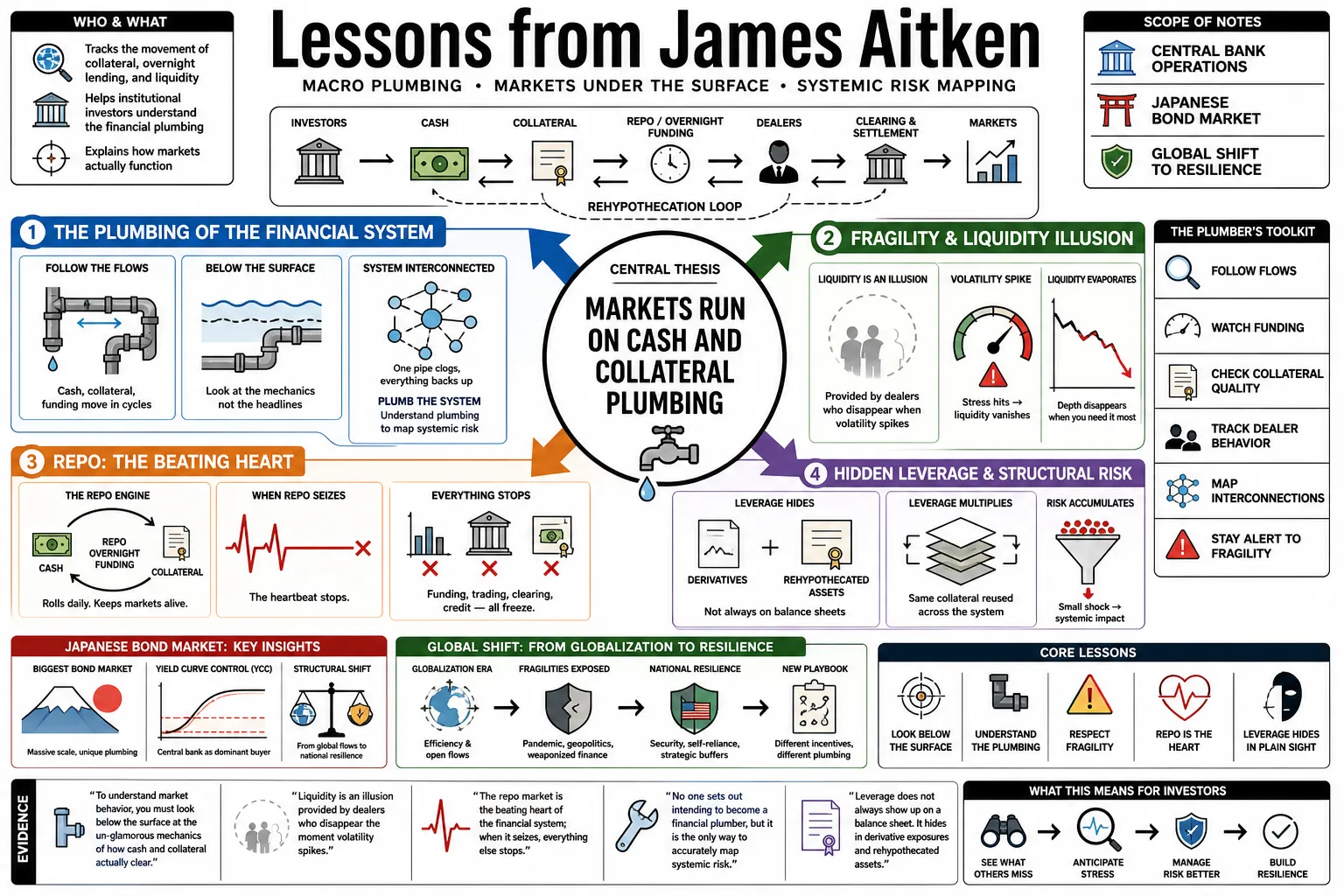
Lessons from James Aitken
Macroeconomist James Aitken runs Aitken Advisors, helping institutional investors understand the literal plumbing of the global financial system. He tracks the movement of collateral, overnight lending, and liquidity to explain how markets actually function. This collection gathers his notes on central bank operations, the Japanese bond market, and the shift from globalization to national resilience.
Part 1: The Plumbing of the Financial System
- On the financial plumbing: "To understand market behavior, you must look below the surface at the unglamorous mechanics of how cash and collateral actually clear." — Source: [The Grant Williams Podcast]
- On structural fragility: "Liquidity is an illusion provided by dealers who disappear the moment volatility spikes." — Source: [Behind the Balance Sheet]
- On repo markets: "The repo market is the beating heart of the financial system; when it seizes, everything else stops." — Source: [Hidden Forces]
- On mapping risk: "No one sets out intending to become a financial plumber, but it is the only way to accurately map systemic risk." — Source: [Behind the Balance Sheet]
- On hidden leverage: "Leverage does not always show up on a balance sheet. It hides in derivative exposures and rehypothecated assets." — Source: [Aitken Advisors]
- On clearinghouses: "Central clearing shifted risk rather than eliminating it, concentrating potential failures into a few critical nodes." — Source: [The Grant Williams Podcast]
- On market mechanics: "Headlines drive daily noise, but the mechanics of collateral velocity drive actual price action." — Source: [Hidden Forces]
- On systemic stress: "Stress in the financial system usually manifests first in obscure overnight lending rates." — Source: [Behind the Balance Sheet]
- On dealer capacity: "Bank regulation since the financial crisis has fundamentally constrained the balance sheet capacity of primary dealers." — Source: [Aitken Advisors]
- On shadow banking: "The shadow banking system relies on trust and collateral chains that can unwind with terrifying speed." — Source: [The Grant Williams Podcast]
Part 2: Central Banks and Monetary Policy
- On monetary signals: "The monetary signal is the most important indicator in markets, but it takes time to test and validate it." — Source: [The Macro Tourist]
- On central bank communication: "When the Federal Reserve changes its language, it is signaling a shift in the underlying plumbing, not just a policy preference." — Source: [Hidden Forces]
- On policy shifts: "The transition from quantitative easing to quantitative tightening alters the fundamental structure of global capital flows." — Source: [The Grant Williams Podcast]
- On rate hikes: "Raising interest rates breaks things in the real economy much slower than it breaks things in the financial plumbing." — Source: [Behind the Balance Sheet]
- On the ECB: "The European Central Bank operates within a unique political constraint that forces it to prioritize the survival of the union over pure economic optimization." — Source: [Aitken Advisors]
- On forward guidance: "Forward guidance is a tool designed to suppress volatility, but it traps central banks when macroeconomic data shifts unexpectedly." — Source: [Hidden Forces]
- On policy mistakes: "A central bank's worst fear is not inflation itself, but a loss of credibility in its ability to control inflation." — Source: [The Grant Williams Podcast]
- On the Fed's balance sheet: "Shrinking the balance sheet removes the base layer of reserves that the entire system relies upon." — Source: [Aitken Advisors]
- On intervention: "Central banks have conditioned markets to expect a rescue, creating a moral hazard that distorts asset pricing." — Source: [Behind the Balance Sheet]
- On inflation targeting: "The rigid adherence to a two percent inflation target ignores the structural realities of a changing global economy." — Source: [Hidden Forces]
Part 3: The Japanese Market and Global Contagion
- On the Bank of Japan: "The Bank of Japan is the anchor for global yield curves; any shift there reverberates across all other bond markets." — Source: [The Grant Williams Podcast]
- On yield curve control: "Yield curve control suppresses domestic volatility while exporting risk to the rest of the world." — Source: [Aitken Advisors]
- On Japanese capital: "Japanese institutions are the marginal buyers of global debt. When they step back, the impact on Western yields is immediate." — Source: [Hidden Forces]
- On policy normalization: "Japan exiting decades of loose monetary policy is a tectonic shift that most market participants are unprepared for." — Source: [The Grant Williams Podcast]
- On the Yen: "The Japanese Yen acts as a pressure valve for the Bank of Japan's domestic policy constraints." — Source: [Behind the Balance Sheet]
- On domestic inflation: "Imported inflation forced the Bank of Japan to reconsider a policy framework that had been static for thirty years." — Source: [Aitken Advisors]
- On JGBs: "The Japanese Government Bond market is heavily engineered, making it a poor indicator of true economic conditions." — Source: [Hidden Forces]
- On global liquidity: "You cannot model global liquidity without placing Tokyo at the center of the equation." — Source: [The Grant Williams Podcast]
- On structural shifts: "Japan is finally experiencing nominal growth, which completely changes the behavioral incentives for its corporate sector." — Source: [Aitken Advisors]
- On currency hedging: "The cost of hedging foreign exchange risk dictates whether Japanese capital flows into US Treasuries or stays at home." — Source: [Behind the Balance Sheet]
Part 4: Geopolitics and National Resilience
- On shifting paradigms: "We are moving away from an era of unchecked globalization toward a period defined by national resilience." — Source: [Hidden Forces]
- On supply chains: "Resilience requires redundancy, and redundancy inherently reduces the profit margins that markets grew accustomed to." — Source: [Aitken Advisors]
- On industrial policy: "Governments are intervening in capital allocation to secure critical resources, overriding pure market mechanics." — Source: [The Grant Williams Podcast]
- On energy security: "Energy transition policies must be weighed against the immediate realities of energy security." — Source: [Behind the Balance Sheet]
- On defense spending: "The structural increase in defense budgets across the West guarantees a steady flow of fiscal stimulus." — Source: [Hidden Forces]
- On decoupling: "Economic decoupling is a messy, inflationary process that redraws the map of global trade." — Source: [Aitken Advisors]
- On strategic commodities: "Control over physical commodities now dictates geopolitical leverage more than financial engineering." — Source: [The Grant Williams Podcast]
- On sovereign risk: "Investors must now price in political outcomes as a primary variable rather than a tail risk." — Source: [Behind the Balance Sheet]
- On trade routes: "Securing maritime trade routes has become a tangible cost that companies must factor into their operations." — Source: [Hidden Forces]
Part 5: Inflation and the Macro Environment
- On inflation regimes: "We have transitioned from an environment where inflation was an anomaly to one where it is a persistent structural feature." — Source: [Aitken Advisors]
- On fiscal dominance: "Fiscal policy is driving the economy, making central banks secondary players in the fight against inflation." — Source: [The Grant Williams Podcast]
- On demographics: "Aging populations in the developed world create a structural headwind for growth and a tailwind for labor costs." — Source: [Hidden Forces]
- On capital expenditures: "A prolonged period of underinvestment in hard assets guarantees supply constraints during the next economic expansion." — Source: [Behind the Balance Sheet]
- On debt burdens: "High nominal growth is the only mathematically viable way for governments to manage current debt loads." — Source: [Aitken Advisors]
- On labor markets: "The shift in bargaining power back to labor contributes directly to sticky, services-driven inflation." — Source: [The Grant Williams Podcast]
- On volatility: "Macroeconomic volatility is returning to historical norms; the low-volatility environment of the 2010s was the outlier." — Source: [Hidden Forces]
- On energy prices: "Fossil fuels remain the base layer of the global economy, and their pricing dictates the floor for inflation." — Source: [Behind the Balance Sheet]
- On the cost of capital: "A structurally higher cost of capital forces a reallocation away from speculative growth toward businesses with immediate cash flows." — Source: [Aitken Advisors]
Part 6: China and Emerging Markets
- On Chinese policy: "When the Communist Party is talking to itself, you pay attention. That's the number one rule when you think about China." — Source: [Behind the Balance Sheet]
- On the property sector: "The deflation of the Chinese real estate market removes the primary engine of global commodity demand." — Source: [The Grant Williams Podcast]
- On capital controls: "China's financial system is a closed loop, meaning its domestic debt issues do not easily spread to the West." — Source: [Hidden Forces]
- On emerging market debt: "Emerging markets suffer when the US dollar strengthens because their dollar-denominated liabilities become unmanageable." — Source: [Aitken Advisors]
- On Asian supply chains: "Countries like Vietnam and India are the primary beneficiaries as manufacturers diversify away from China." — Source: [The Grant Williams Podcast]
- On the digital Renminbi: "The push for a digital currency is an effort to track capital flows internally and bypass the dollar system externally." — Source: [Hidden Forces]
- On geopolitical premiums: "Investing in China now requires a permanent discount to account for the risk of sudden regulatory intervention." — Source: [Behind the Balance Sheet]
- On domestic consumption: "Beijing's reluctance to stimulate domestic consumption means the economy will continue to rely on manufacturing exports." — Source: [Aitken Advisors]
- On resource acquisition: "China's long-term strategy involves securing physical resources in Africa and South America to support its industrial base." — Source: [The Grant Williams Podcast]
Part 7: Investor Psychology and Patience
- On waiting: "We are paid to wait. Most market action is noise; the real returns come from identifying a structural shift and holding the position." — Source: [The Macro Tourist]
- On sentiment: "I find sentiment to be the next most important group of indicators after the monetary signal." — Source: [The Macro Tourist]
- On market realities: "Investors spend too much time predicting what should happen, and not enough time reacting to what has actually failed to happen." — Source: [Behind the Balance Sheet]
- On composure: "The ability to remain composed when consensus is panicking is the primary edge left in public markets." — Source: [Aitken Advisors]
- On skepticism: "A serious macro investor must view every narrative with skepticism and verify it against the mechanics of the plumbing." — Source: [The Grant Williams Podcast]
- On false signals: "Price action driven by forced liquidations is frequently mistaken for a shift in economic fundamentals." — Source: [Hidden Forces]
- On over-engineering: "Models fail because they assume continuous liquidity; human judgment is required when the models break." — Source: [Behind the Balance Sheet]
- On narrative drift: "Market narratives evolve to justify price action, rather than price action following the narrative." — Source: [Aitken Advisors]
- On risk management: "The survival of a portfolio depends on understanding the difference between a temporary drawdown and a permanent impairment of capital." — Source: [The Grant Williams Podcast]
Part 8: The Mechanics of Collateral and Shadow Banking
- On collateral velocity: "The speed at which collateral moves through the system determines the true level of available liquidity." — Source: [Hidden Forces]
- On rehypothecation: "Pledging the same asset multiple times creates a web of counterparty risk that is impossible to fully untangle." — Source: [Behind the Balance Sheet]
- On safe assets: "A shortage of high-quality liquid assets forces market participants to accept lower quality collateral, increasing systemic fragility." — Source: [Aitken Advisors]
- On the Eurodollar market: "The offshore dollar system operates beyond the reach of the Federal Reserve, creating offshore credit cycles." — Source: [The Grant Williams Podcast]
- On non-bank financials: "Risk has migrated from regulated banks to private credit and hedge funds, changing the nature of how distress resolves." — Source: [Hidden Forces]
- On margin calls: "In a severe market shock, the demand for cash to meet margin calls triggers the indiscriminate selling of safe assets." — Source: [Behind the Balance Sheet]
- On haircut increases: "When clearinghouses raise margin requirements, they inadvertently accelerate the very liquidations they are trying to protect against." — Source: [Aitken Advisors]
- On synthetic leverage: "Derivatives allow institutions to build massive exposures that are completely detached from their physical cash reserves." — Source: [The Grant Williams Podcast]
- On systemic mapping: "You cannot manage risk if you do not understand who owns the liability when the music stops." — Source: [Hidden Forces]