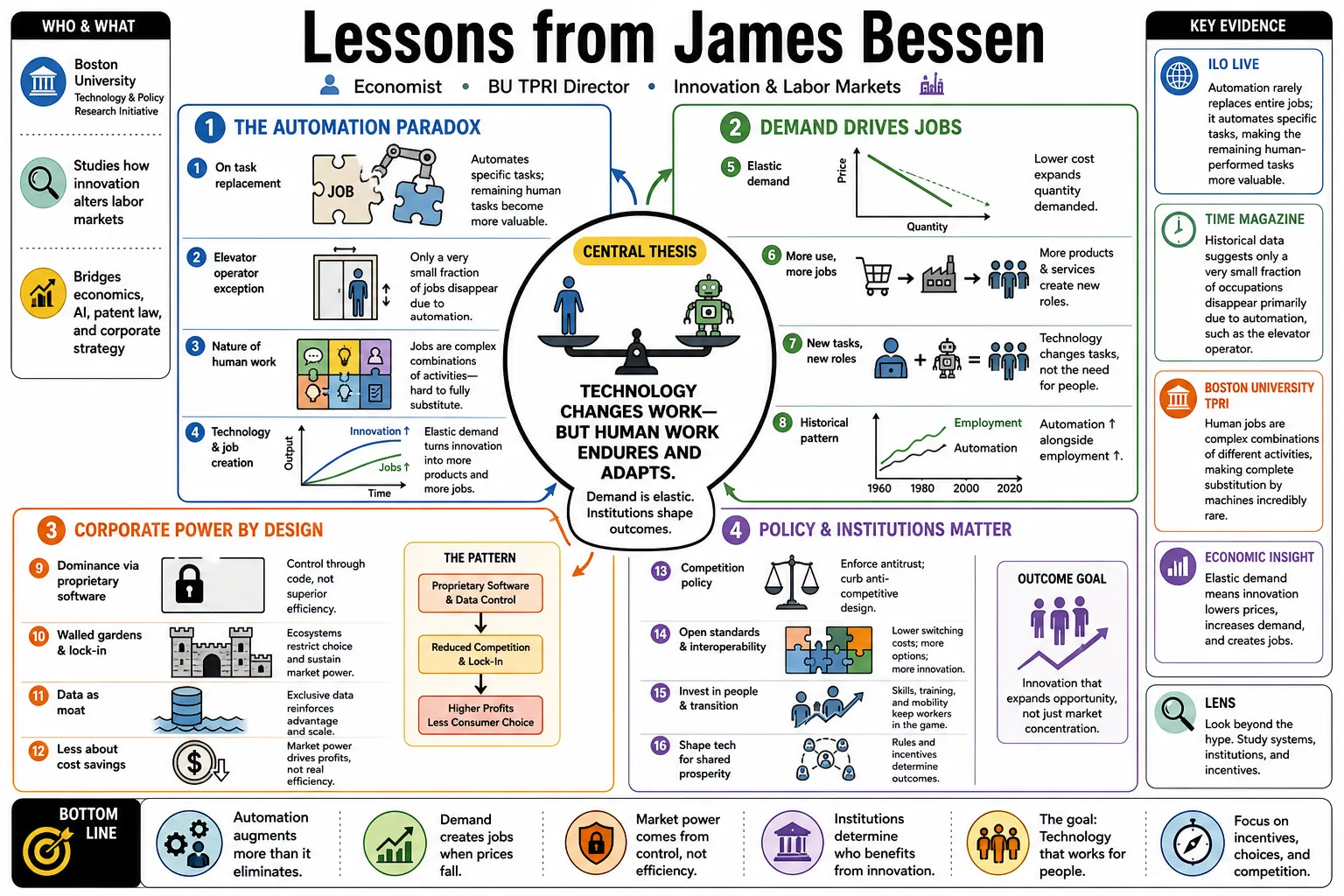
Lessons from James Bessen
James Bessen is the executive director of the Technology & Policy Research Initiative at Boston University School of Law and the author of Learning by Doing and The New Goliaths. — ITIF Innovation Files podcast: How Automation Expands Opportunities for Human Labor, with James Bessen (August 2020, transcript).
Part 1: The Automation Paradox
- On task replacement: Bessen said "When you have something that's even 98% automated, there are still lots of things for workers to do." — EconTalk: James Bessen on Learning by Doing (May 2016, transcript).
- On machines and the labor force: Bessen said "machines came along and took over tasks the humans did, but instead the labor force grew." — ITIF Innovation Files podcast: How Automation Expands Opportunities for Human Labor, with James Bessen (August 2020, transcript).
- On the real effect of computers: Bessen wrote "the real effect of computers is not so much to eliminate jobs overall, but to change the skills needed to perform them." — Yale University Press: Technology and Wages, a conversation with James Bessen (May 2015).
- On the evidence of mass job loss: Bessen said "the evidence just doesn't support any evidence of mass job loss or joblessness." — ITIF Innovation Files podcast: How Automation Expands Opportunities for Human Labor, with James Bessen (August 2020, transcript).
- On firm-level automation: Bessen said "most of these studies are pointing to actually job increases rather than job losses." — ITIF Innovation Files podcast: How Automation Expands Opportunities for Human Labor, with James Bessen (August 2020, transcript).
- On shifting work: Bessen said "it's going change the nature of jobs, it's going to change the nature of work." — ITIF Innovation Files podcast: How Automation Expands Opportunities for Human Labor, with James Bessen (August 2020, transcript).
- On the transition: Bessen wrote "right now policymakers should focus on helping people learn new skills." — Yale University Press: Technology and Wages, a conversation with James Bessen (May 2015).
- On turnover: Bessen said "People may still lose their jobs—you know, there's turnover in jobs—even if there's not a net loss of employment, and that's a significant loss." — ITIF Innovation Files podcast: How Automation Expands Opportunities for Human Labor, with James Bessen (August 2020, transcript).
Part 2: Artificial Intelligence and Employment
- On demand elasticity: Bessen said "what matters is demand to the extent that we're automating things, are we automating things that have very elastic demand or inelastic demand." — ITIF Innovation Files podcast: How Automation Expands Opportunities for Human Labor, with James Bessen (August 2020, transcript).
- On historical precedents: Bessen said "the greater degree of automation meant that the price of cotton cloth went down, and people started using more cloth." — EconTalk: James Bessen on Learning by Doing (May 2016, transcript).
- On saturated markets: Bessen said "The demand for textiles gets saturated." — EconTalk: James Bessen on Learning by Doing (May 2016, transcript).
- On the effect on demand: Bessen said "when we think about this machinery question, we typically forget about the effect on demand." — EconTalk: James Bessen on Learning by Doing (May 2016, transcript).
- On AI capital expenditure: In Fixed + Floating, Bessen frames AI capital spending as a potential source of incumbent advantage and credit risk, noting that AI capex may be more fragile than earlier infrastructure cycles. — Reference: Fixed + Floating episode on software moats and AI capex risk with James Bessen
- On AI and skills: Bessen said "increasingly you're looking at different sorts of skills that are learned on the job that require some experience." — Value Investing with Legends: The Tech Paradigm, a conversation with James Bessen (Mauboussin, transcript).
- On AI as an enhancer: Bessen said of AI "it's much more directed towards enhancing human capabilities than replacing them." — ITIF Innovation Files podcast: How Automation Expands Opportunities for Human Labor, with James Bessen (August 2020, transcript).
- On AI and IT: Bessen said "My first inclination is that in many ways, AI is going to be just like IT, but on steroids." — Value Investing with Legends: The Tech Paradigm, a conversation with James Bessen (Mauboussin, transcript).
Part 3: Learning by Doing
- On cutting-edge knowledge: Bessen wrote "A key problem is that cutting edge knowledge is difficult for many people to acquire." — Yale University Press: Technology and Wages, a conversation with James Bessen (May 2015).
- On learning on the job: Bessen said "They were skills that couldn't be taught in the classroom. And many of them were very unstandardized." — EconTalk: James Bessen on Learning by Doing (May 2016, transcript).
- On the Industrial Revolution: Bessen wrote "wages were stagnant for decades at the beginning of the Industrial Revolution while profits and productivity soared, just like today." — Yale University Press: Technology and Wages, a conversation with James Bessen (May 2015).
- On the diffusion of skills: Bessen said "What happened after the Civil War was that standardization started taking place." — EconTalk: James Bessen on Learning by Doing (May 2016, transcript).
- On the complexity of machines: Bessen said "the productivity of the machines was just deeply intertwined with these very specific technological skills that the workers had to learn on the job." — EconTalk: James Bessen on Learning by Doing (May 2016, transcript).
- On institutional support: Bessen said "we've really been inadequate in our investments in vocational education and community colleges." — ITIF Innovation Files podcast: How Automation Expands Opportunities for Human Labor, with James Bessen (August 2020, transcript).
Part 4: The Wage Stagnation Problem
- On the modern paradox: Bessen wrote "during the last three decades—as new information technologies have transformed many industries at once—the median wage has hardly budged." — Yale University Press: Technology and Wages, a conversation with James Bessen (May 2015).
- On bargaining power: Bessen said "if I was not earning enough as a weaver at one mill, somebody else is going to pay me more." — EconTalk: James Bessen on Learning by Doing (May 2016, transcript).
- On the skills gap: Bessen wrote "Schools often cannot keep up and skills learned on the job often cannot be certified, making it difficult for labor markets to compensate workers for new skills." — Yale University Press: Technology and Wages, a conversation with James Bessen (May 2015).
- On the historical parallel: Bessen wrote "In the US, a robust market for textile workers only emerged after the Civil War. Then pay grew rapidly." — Yale University Press: Technology and Wages, a conversation with James Bessen (May 2015).
- On structural inequality: Bessen wrote "Until new training institutions and robust labor markets emerge, many workers will not share in the benefits brought by greater productivity." — Yale University Press: Technology and Wages, a conversation with James Bessen (May 2015).
Part 5: Software as a Corporate Moat
- On complexity as a barrier: Bessen said "Complexity then has this added feature that it makes it difficult to copy or to imitate or to come up and challenge." — Capitalisn't: Does Software Actually Slow Innovation? (August 2022, transcript at Chicago Booth Review).
- On proprietary systems: Bessen said "These are large, custom-built systems designed to handle the specific needs of an individual firm." — BU Today: Jim Bessen's new book, software is hobbling innovation as much as promoting it (October 2022).
- On software for own use: Bessen said "Most of it doesn't have a market price of any sort, or Walmart doesn't sell or license their internal software. They use it to gain competitive advantage." — Value Investing with Legends: The Tech Paradigm, a conversation with James Bessen (Mauboussin, transcript).
- On managing complexity: Bessen wrote "The common thread running through them is that these systems manage complexity." — James Bessen, How Software Stifles Competition and Innovation, Communications of the ACM (October 2023).
- On the slowdown of diffusion: Bessen said "It's just become very difficult for the technology to diffuse." — Capitalisn't: Does Software Actually Slow Innovation? (August 2022, transcript at Chicago Booth Review).
- On building defenses: In the Fixed + Floating episode, Bessen argues that proprietary software becomes a moat when scale, data, and workflow complexity reinforce one another; the episode also frames technology spending as business-model defense, not just capex. — Reference: Fixed + Floating episode on proprietary software, scale, data, and workflow complexity
- On the complexity barrier: In Value Investing with Legends, Bessen discusses how proprietary software reshapes competitive dynamics and industry stability, emphasizing that advantage comes from the surrounding operating system and mass-customization capability, not code alone. — Reference: Value Investing with Legends episode on proprietary software and competitive dynamics with James Bessen
- On the difference from mass production: Bessen wrote "This development stands in sharp contrast to the mass production paradigm." — James Bessen, How Software Stifles Competition and Innovation, Communications of the ACM (October 2023).
Part 6: The Failure of the Patent System
- On the purpose of patents: Bessen and Meurer wrote the patent system "failed to provide clear and efficient notice of the boundaries of the rights granted." — Bessen and Meurer, Patent Failure (Princeton University Press, 2008), introduction and chapter excerpt.
- On fuzzy boundaries: Bessen, Ford and Meurer wrote that patents on software and business methods "are litigated much more frequently because they have “fuzzy boundaries.”" — Bessen, Ford and Meurer, The Private and Social Costs of Patent Trolls (Regulation, 2011).
- On the cost-benefit deficit: Bessen and Meurer wrote "By the late 1990s, these patents generated more litigation cost than profit." — Bessen and Meurer, Patent Failure (Princeton University Press, 2008), introduction and chapter excerpt.
- On the litigation explosion: Bessen and Meurer wrote "Software patents are more than twice as likely to be litigated as other patents." — Bessen and Meurer, Patent Failure (Princeton University Press, 2008), introduction and chapter excerpt.
- On stifling innovation: Bessen, Ford and Meurer wrote "these lawsuits substantially reduce their incentives to innovate." — Bessen, Ford and Meurer, The Private and Social Costs of Patent Trolls (Regulation, 2011).
- On the software problem: Bessen and Meurer wrote of why software patents are litigated more often "In a word, abstraction." — Bessen and Meurer, Patent Failure (Princeton University Press, 2008), introduction and chapter excerpt.
- On the tax on innovation: Bessen, Ford and Meurer wrote "NPE lawsuits are associated with half a trillion dollars of lost wealth to defendants from 1990 through 2010." — Bessen, Ford and Meurer, The Private and Social Costs of Patent Trolls (Regulation, 2011).
Part 7: The Decline of Economic Dynamism
- On sustained productivity at the top: Bessen said "The largest firms, they're not seeing an acceleration in productivity growth, but they're seeing sustained productivity growth." — Capitalisn't: Does Software Actually Slow Innovation? (August 2022, transcript at Chicago Booth Review).
- On the productivity gap: Bessen said "The slowdown is coming with the smaller firms that can't challenge." — Capitalisn't: Does Software Actually Slow Innovation? (August 2022, transcript at Chicago Booth Review).
- On huge internal investments: Bessen wrote "Firms, mainly large firms, are making huge investments on internal systems." — James Bessen, How Software Stifles Competition and Innovation, Communications of the ACM (October 2023).
- On worker mobility: Bessen said "We have noncompete laws, we have strengthening of trade-secret law." — Capitalisn't: Does Software Actually Slow Innovation? (August 2022, transcript at Chicago Booth Review).
- On the balance in IP law: Bessen said "that's an indication that the balance that's implicit in intellectual-property law is out of whack." — Capitalisn't: Does Software Actually Slow Innovation? (August 2022, transcript at Chicago Booth Review).
- On the M&A illusion: In Value Investing with Legends, Bessen points to proprietary software as a driver of industry stability and market concentration, shifting the explanation for declining disruption beyond mergers alone. — Reference: Value Investing with Legends episode on proprietary software, industry stability, and market concentration
- On the changing nature of competition: Bessen wrote "the actual rate of disruption has been declining in most industries." — James Bessen, How Software Stifles Competition and Innovation, Communications of the ACM (October 2023).
- On the resilience of incumbents: In Fixed + Floating, Bessen describes dominant firms as harder to disrupt when proprietary software, scale, data, and workflow complexity reinforce one another, creating structural advantages for incumbents. — Reference: Fixed + Floating episode on dominant firms, proprietary software, and structural incumbent advantages
Part 8: Reallocation and Policy Reform
- On learning through experience: Bessen said "a lot of learning about new technologies happens through experience, through learning by doing." — ITIF Innovation Files podcast: How Automation Expands Opportunities for Human Labor, with James Bessen (August 2020, transcript).
- On antitrust and licensing: Bessen said "In the past, antitrust authorities have encouraged or required dominant firms to license their patents and technologies." — BU Today: Jim Bessen's new book, software is hobbling innovation as much as promoting it (October 2022).
- On reforming education: Bessen wrote "Technologies and business models need to be standardized across multiple employers, experienced-based skills need to be certified, and employees must be free to change jobs." — Yale University Press: Technology and Wages, a conversation with James Bessen (May 2015).
- On data portability: Bessen wrote "fintech firms have not become industry disruptors partly because the large banks have made it difficult for consumers to transfer their data." — James Bessen, How Software Stifles Competition and Innovation, Communications of the ACM (October 2023).
- On a realistic future: Bessen said "Certainly not in the next 10, 20 years, which is where a lot of these forecasts are predicting massive unemployment." — ITIF Innovation Files podcast: How Automation Expands Opportunities for Human Labor, with James Bessen (August 2020, transcript).