James Liang is the co-founder and Executive Chairman of Trip.com Group, a leading global online travel agency, and a distinguished Research Professor of Economics at Peking University. A rare polymath who bridges the worlds of high-stakes technology entrepreneurship and demographic science, Liang has spent decades advocating for the critical link between population vitality and national innovative capacity.
Part 1: The Economics of Innovation
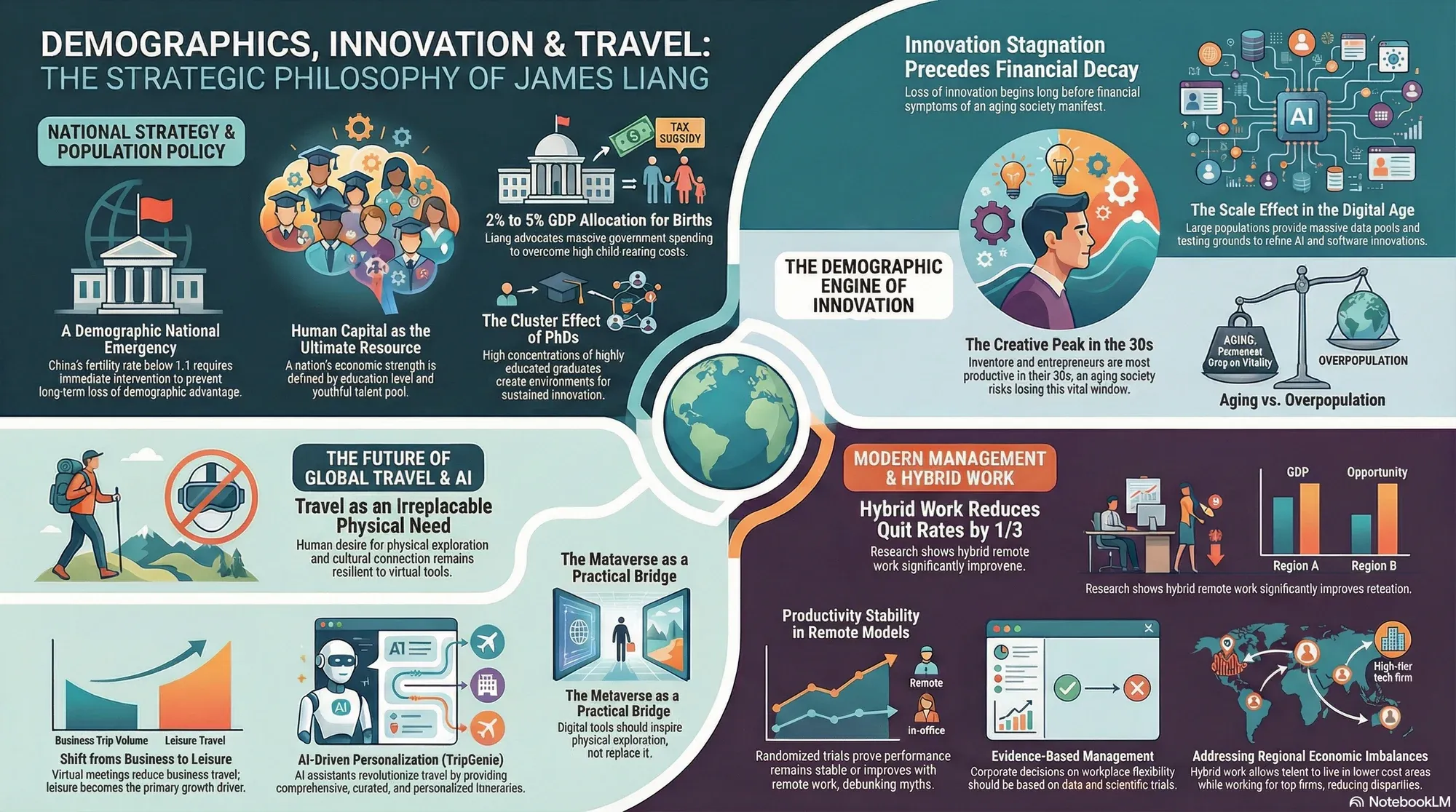
- On Innovation Stagnation: In this second Pekingnology-translated article, Liang states the innovation-loss link directly rather than as a staged process preceding financial symptoms: severe low birth rates increase the social burden of elderly care and also weaken national innovation, dragging down economic development. [8]
- On Age and Productivity: "Inventors and scientists are most productive in their 30s, and most entrepreneurs start firms at this age; an aging society risks losing this peak window of creativity." — [Source: Korea Bizwire]
- On the Scale Effect: "In the digital age, a large population provides a massive data pool and a vast testing ground, which are the most critical resources for refining AI and software innovations." — [Source: The Ticking Timebomb (YouTube Interview)]
- On Aging vs. Overpopulation: "The problems of overpopulation pale in comparison to the problem of aging on a massive global scale, which creates a permanent drag on vitality." — [Source: Everand Book Summary]
- On the Demographic Race: "Public policies should be designed to ensure the quality, vitality, and size of the workforce, as these are the primary drivers of the innovation race." — [Source: ITB China]
- On Japan’s Lesson: In his own Pekingnology-translated article, Liang draws the Japan comparison in terms of youth entrepreneurship rather than investment decline specifically: economic slowdown and aging result in less inclination among young people to innovate and start businesses, and that is similar to what has been happening in Japan over recent decades, just more rapid and severe in China. [7]
- On Economic Equilibrium: "Demographics dictate growth rates, economic equilibrium, interest rates, and the long-term health of the capital markets." — [Source: EconBiz]
- On Global Competitiveness: "If a country fails to maintain its demographic edge, it will eventually lose its position as a global leader in high-tech industries to younger, more dynamic nations." — [Source: Korea Bizwire]
- On the Vitality of Youth: "A society dominated by older individuals becomes naturally more risk-averse, which is the antithesis of the entrepreneurial spirit needed for breakthroughs." — [Source: The Ticking Timebomb (YouTube Interview)]
Part 2: The Future of Global Travel
- On the Human Desire to Explore: Liang's real words, from the interview: we've gotten used to virtual meetings, which we've found to be quite effective, but business travel is a small part of overall travel -- people still want to see the world. [3]
- On Post-Pandemic Resilience: "Trip.com performed well during a very difficult period because the psychological need for travel and human connection is resilient to temporary shocks." — [Source: Kr-ASIA]
- On Inbound Tourism Strategy: Liang's real, shorter words, per China Travel News: conditions are ready; what's missing is the final push. [1]
- On Business Travel Trends: Liang's real words, from the interview: business travel will definitely take a hit, and we've gotten used to virtual meetings and interviews, which we've found to be quite effective and much cheaper -- but business travel is a small part of overall travel. [4]
- On Travel as a Bridge: Liang's real words, per China Travel News: we hope more Chinese people will travel abroad, and more foreigners will visit China. Together, let's make the world fall in love with beautiful China. [2]
- On the Travel-Wealth Link: "As AI makes other aspects of life more affordable, disposable income will naturally shift toward travel and experiential consumption." — [Source: Aviation Business News]
- On Tourism as a Pillar: In this analysis sourced from his own office, Liang makes a narrower claim about domestic growth rather than global resilience: domestic tourism has become a major growth area for the Chinese economy specifically, and China now has far more to offer visitors than the historical, cultural, and natural attractions that drew travelers in the past. [10]
- On Interactive Inspiration: "We must make the travel experience more interactive and fun, turning digital tools into sources of inspiration for users to explore the real universe." — [Source: Pandaily]
- On Sustainable Development: In this analysis sourced from his own office, Liang frames the payoff of inbound tourism investment in more specific terms than a general sustainability claim: an influx of foreign visitors generates substantial foreign exchange earnings, boosts China's global standing, fosters technological innovation, and enhances the international competitiveness of the economy. [9]
Part 3: Demographic Destiny & Population Policy
- On the Fertility Crisis: "China’s fertility rate falling below 1.1 is a demographic national emergency that requires immediate and massive policy intervention." — [Source: Pekingnology]
- On GDP Allocation for Births: In his own Pekingnology-translated article, Liang made this a comparative estimate rather than a flat directive: some European countries raised birth rates spending roughly 2% of GDP on average, and since China's birth rate is lower, he estimated China's government may need to spend up to around 5% of GDP to see comparable improvement. [5]
- On Economic Subsidies: "Cash bonuses and tax subsidies are necessary because the high cost of raising children in modern cities is a structural barrier to family growth." — [Source: Bloomberg]
- On the Population as a Resource: In his own Pekingnology-translated article, Liang frames population size as an existing economic advantage rather than a perspective shift he is urging governments to adopt: the vitality and resilience of China's economy are driven by its advantage of having a super-large market and population, and a shrinking young population would gradually erode that advantage. [6]
- On Family Planning Reversal: "There is an urgent need for a complete reversal of restrictive family planning policies to encourage higher birth rates across all sectors of society." — [Source: SCMP]
- On the Impact of Women’s Independence: "Increased female independence is a positive social development, but it requires new societal structures to balance career growth with family life." — [Source: Reading the China Dream]
- On Social Safety Nets: "Inadequate social safety nets and gender inequality are significant deterrents that prevent young people from considering parenthood." — [Source: The Straits Times]
- On the Risks of a Small Population: "Countries with smaller populations tend to be less innovative because they lack the scale to support a diverse and competitive talent pool." — [Source: The Ticking Timebomb (YouTube Interview)]
- On National Longevity: "A shrinking population will eventually lead to a loss of demographic advantage within a century if current fertility trends are not corrected." — [Source: Reading the China Dream]
Part 4: Artificial Intelligence & The Digital Shift
- On AI in Travel Planning: "AI assistants like TripGenie revolutionize travel by moving from simple search results to providing comprehensive, personalized itineraries." — [Source: MICE in Asia]
- On the OTA Advantage in AI: "Online Travel Agencies are uniquely positioned to lead AI development because they possess proprietary, real-time data that general-purpose models lack." — [Source: PhocusWire]
- On AI and Operational Efficiency: "The use of AI chatbots for customer service has achieved high self-service resolution rates, significantly improving company efficiency." — [Source: China Daily]
- On the Metaverse and Reality: "The goal of the metaverse in travel should be to inspire people to visit real-world destinations, not to replace the physical trip with a virtual one." — [Source: Pandaily]
- On Personalized Data Filtering: "AI is most powerful when it filters massive amounts of data into curated, trustworthy lists like 'Trip.Best' for the consumer." — [Source: ITB Asia News]
- On AI and Decision Making: "Large language models still lack the real-time data and independent expertise required for complex, reliable travel verification without human oversight." — [Source: Aviation Business News]
- On Human-AI Collaboration: "Current AI models require human intervention to ensure reliability, especially for high-stakes decisions like complex international travel itineraries." — [Source: Aviation Business News]
- On Personalization at Scale: "AI allows us to offer personalization to millions of users simultaneously, which was previously impossible with traditional customer service models." — [Source: Trip.com Press Release]
- On Technology and Work-Life Balance: "Technology should be leveraged to create more flexible work environments that allow employees to balance their professional and personal lives." — [Source: Longbridge]
Part 5: Modern Management & Hybrid Work
- On the Multi-Win of Hybrid Work: "Promoting hybrid working is a multi-win for companies, employees, and society, improving satisfaction without compromising efficiency." — [Source: Trip.com Group]
- On Employee Retention: "Our research showed that hybrid remote work significantly reduced quit rates by one-third, particularly for female employees and those with long commutes." — [Source: Nature (Scientific Paper)]
- On Productivity Perceptions: "Managers often fear a drop in productivity with remote work, but our randomized trials proved that performance levels remain stable or even improve." — [Source: Stanford News]
- On Social Responsibility: "Hybrid work helps reduce traffic congestion and environmental impact, making it a key component of corporate social responsibility." — [Source: Human Resources Online]
- On the Workplace Revolution: "We are seeing a workplace revolution centered on hybrid work that could reshape norms across the entire global tech industry." — [Source: Longbridge]
- On Flexibility as a Competitive Edge: "Companies that are more open and proactive in embracing hybrid models will have a significant advantage in attracting top young talent." — [Source: Trip.com Group]
- On Reducing Regional Disparities: "Hybrid work allows people to live in areas with lower housing prices while working for high-tier tech companies, alleviating regional economic imbalances." — [Source: Trip.com Group]
- On Supporting Families: "Flexible work arrangements are one of the most effective ways a corporation can support employees in their desire to start families." — [Source: Longbridge]
- On the Future of the Office: "The office will remain a place for collaboration and culture, but it will no longer be the sole location where high-value work happens." — [Source: Fast Company]
- On Evidence-Based Management: "Management decisions regarding remote work should be based on randomized controlled trials and data, not on traditional gut feelings or biases." — [Source: Nature (Scientific Paper)]
Part 6: Education & Human Capital Development
- On the Value of College Graduates: "China’s rise as an innovation powerhouse is fueled by the fact that it produces more college and PhD graduates annually than the United States." — [Source: Korea Bizwire]
- On Human Capital and Entrepreneurship: "A nation’s human capital—defined by its education and youth—is the ultimate source of its long-term economic strength." — [Source: Stanford PhD Thesis]
- On the Talent Pool Advantage: "A massive talent pool allows for a more specialized division of labor, which is essential for solving complex technological problems." — [Source: The Demographics of Innovation (Book)]
- On Skill Acquisition in Youth: "Younger workers possess a greater ability to acquire new skills and adapt to rapidly changing technological landscapes." — [Source: Korea Bizwire]
- On Educational Reform: "Education systems must evolve to focus more on creativity and problem-solving rather than rote memorization to prepare students for an AI-driven world." — [Source: Population Strategies (Book)]
- On the Risk of Skill Decay: "In an aging society, the lack of new entrants into the workforce leads to a gradual decay of the nation's collective technical skills." — [Source: The Demographics of Innovation (Book)]
- On Global Talent Competition: "The US remains a leader because it attracts highly skilled migrants; China must similarly ensure it remains a magnet for global talent." — [Source: Korea Bizwire]
- On PhDs and Innovation: "High concentrations of PhD graduates in specific geographic hubs create the 'cluster effect' necessary for sustained innovation." — [Source: The Demographics of Innovation (Book)]
- On Lifelong Learning: "As the population ages, lifelong learning becomes not just a benefit but a necessity to keep the older workforce economically relevant." — [Source: Population Strategies (Book)]
- On Youthful Ambition: "The ambition and risk-taking typical of youth are the primary fuels for disruptive innovation that changes the world." — [Source: The Ticking Timebomb (YouTube Interview)]
Part 7: Entrepreneurship & Corporate Strategy
- On Starting Early: "Entrepreneurship is a young person's game because the opportunity cost of failure is lower and the energy for high-growth ventures is higher." — [Source: Journal of Political Economy]
- On Data-Driven Pricing: "Using AI for dynamic pricing allows a company to remain competitive while maximizing inventory utilization in the volatile travel market." — [Source: Trip.com Press Release]
- On Content as a Driver: "Curated travel content and livestream sales are essential modern marketing channels that drive consumer engagement and discovery." — [Source: Kr-ASIA]
- On Long-Term Thinking: "Sustainable development requires building a resilient foundation today through consistent investment in future-facing technologies like AI." — [Source: Forbes]
- On Customer-Centric Innovation: "True innovation in the travel industry must always solve a specific pain point for the traveler, such as the complexity of international bookings." — [Source: China Daily]
- On Corporate Agility: "A company's ability to pivot during a crisis, such as moving to livestreaming during the pandemic, defines its long-term survival." — [Source: Kr-ASIA]
- On Global Market Expansion: "Success in a domestic market should be used as a springboard for global expansion, leveraging local expertise on a global scale." — [Source: Trip.com Group Q4 Earnings]
- On Brand Trust: "In travel, brand trust is built through verified inventory and reliable customer service, which AI can enhance but not replace." — [Source: PhocusWire]
- On the Value of Research: "Integrating academic research into corporate strategy provides a deeper understanding of the macro forces, like demographics, that will shape the future." — [Source: Trip.com Group]
- On Managing Aging Workforces: "Companies must find ways to keep older employees engaged and innovative to prevent the 'stagnation trap' that often accompanies an aging staff." — [Source: NBER]
Part 8: Globalization & The Network Era
- On the Power of Networks: "In the network era, the value of a platform grows exponentially with the number of its users and the diversity of its global offerings." — [Source: The Demographics of Innovation (Book)]
- On China’s Role in Global Travel: "China is not just a source of tourists but a key destination that can foster global peace and understanding through inbound travel." — [Source: China Travel News]
- On Cross-Border Exchange: "The more people travel across borders, the more the world becomes integrated and resistant to the forces of isolationism." — [Source: China Travel News]
- On Scale and the Digital Economy: "The digital economy grants even greater scale advantages to large countries than the manufacturing era did, amplifying demographic importance." — [Source: The Ticking Timebomb (YouTube Interview)]
- On Global Standards: "To lead globally, a company must set the standards for service and technology that others in the industry feel compelled to follow." — [Source: ITB Asia News]
- On Cultural Soft Power: "Tourism is one of the most effective forms of soft power, allowing a nation to present its best face to the global community." — [Source: China Travel News]
- On Resilience in Global Trade: "Global travel demand remains resilient even when other sectors of global trade face significant disruption." — [Source: Trip.com Group Q4 Earnings]
- On the Importance of Global Citizenship: "We should all strive to be global citizens who see the world's challenges as our own, starting with the challenge of demographic decline." — [Source: Reading the China Dream]
- On the Real Universe: "Technology should always be a tool that points us back to the beauty and complexity of the real universe." — [Source: Pandaily]
Learn more:
- Trip.com Chairman James Liang: China's Inbound Tourism Poised for a Breakthrough (ChinaTravelNews)
- Trip.com Chairman James Liang: China's Inbound Tourism Poised for a Breakthrough (ChinaTravelNews)
- James Liang, Chairman and Co-Founder of Trip.com Group, on the Near-Future of Travel (The Peak Magazine)
- James Liang, Chairman and Co-Founder of Trip.com Group, on the Near-Future of Travel (The Peak Magazine)
- Pekingnology, "Demographer James Liang on China's extremely low fertility"
- Pekingnology, "Demographer James Liang on China's extremely low fertility"
- Pekingnology, "Demographer James Liang on China's extremely low fertility"
- Pekingnology, "James Jianzhang Liang on what China can learn from South Korea's 'demographic national emergency'"
- Pekingnology, "James Liang: The Economic and Strategic Importance of China's Visa-Free Policy for Six Countries"
- Pekingnology, "James Liang: The Economic and Strategic Importance of China's Visa-Free Policy for Six Countries"