Jen Allen-Knuth spent 18 years in enterprise sales before founding DemandJen to teach teams a sharper way to earn trust and close deals. Instead of pitching features, she trains sellers to quantify the "cost of inaction," forcing buyers to confront the actual financial risk of their status quo. The following lessons cover her specific tactics for discovery, aligning buying groups, generating outbound curiosity, and navigating a career pivot.
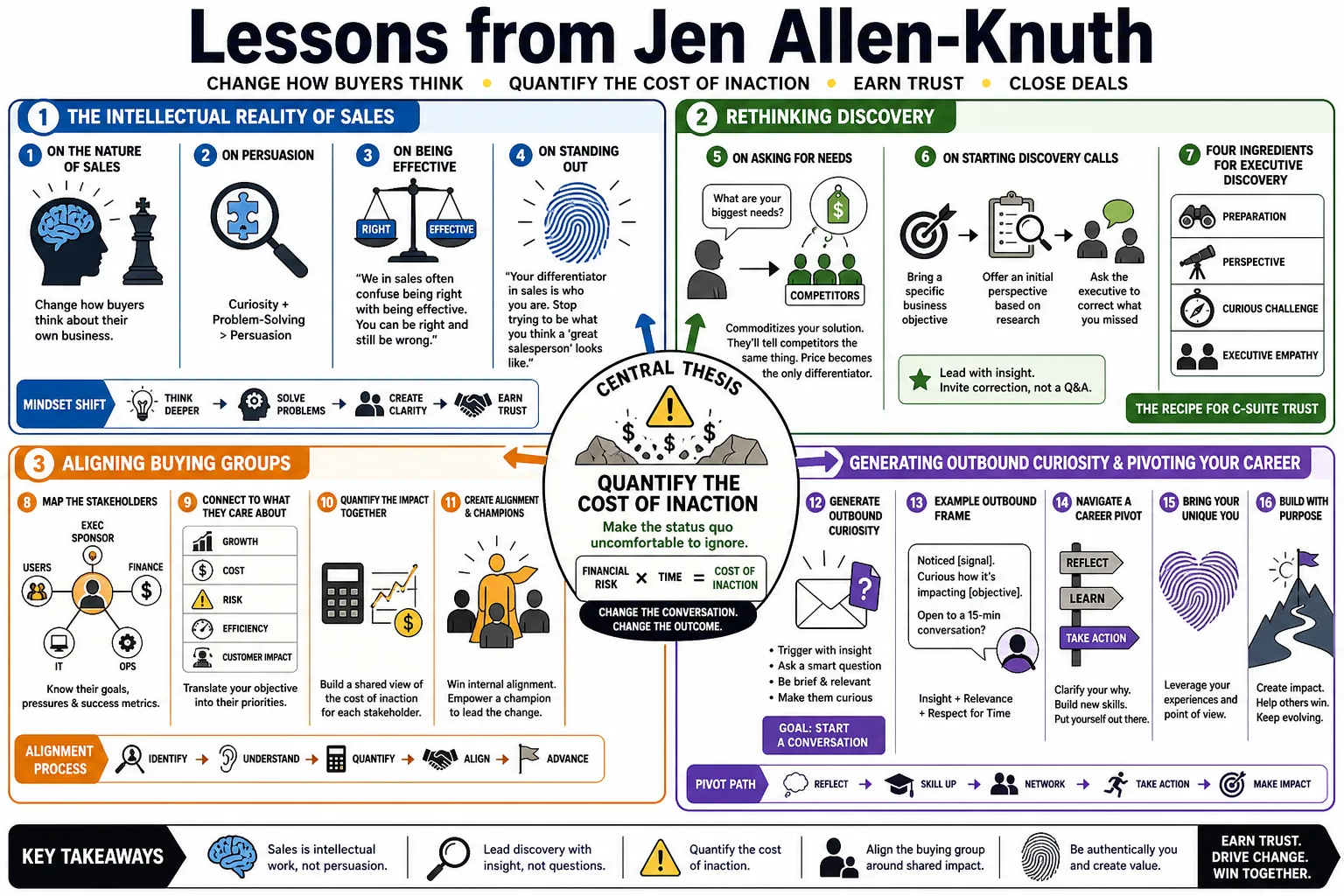
Part 1: The Intellectual Reality of Sales
- On the nature of sales: Sales is not about finding magic words to persuade someone; it is the difficult, intellectual work of changing how a buyer thinks about their own business. — Reference: Collin Cadmus Podcast
- On persuasion: Success in sales depends on curiosity and problem-solving rather than persuasion. — Reference: Path to Growth Podcast
- On being effective: "We in sales often confuse being right with being effective. You can be right and still be wrong." — Source: Path to Growth Podcast
- On standing out: "Your differentiator in sales is who you are. Stop trying to be what you think a ‘great salesperson’ looks like." — Source: Path to Growth Podcast
Part 2: Rethinking Discovery
- On asking for needs: Asking buyers to explain their needs commoditizes your solution because they will likely tell competitors the exact same thing, leaving price as the only differentiator. — Reference: DemandJen Newsletter
- On starting discovery calls: Bring a specific business objective to the call, offer an initial perspective based on research, and ask the executive to correct what you missed instead of asking generic, open-ended questions. — Reference: DemandJen Newsletter
- On four ingredients for executive discovery: Successful discovery with the C-suite requires a precise recipe of preparation, perspective, willingness to be corrected, and a focus on business-level impact over product features. — Reference: LinkedIn
- On maintaining flexibility: Hold a specific point of view during discovery to establish expertise while demonstrating that you are flexible and open to understanding the prospect's reality. — Reference: Ecosystems Blog
- On introducing an underappreciated threat: When reviewing a prospect's goal, present an overlooked obstacle to achieving that objective and ask how their view differs from what you are seeing. — Reference: DemandJen Newsletter
- On prompting a correction: Name the common methods companies use to solve a problem and validate why they seem like good ideas, which naturally encourages the buyer to explain how they handle it today. — Reference: DemandJen Newsletter
- On steering the conversation: Beat your prospect to the punch by introducing a hypothesis that actively guides the discovery process toward business problems your product can effectively solve. — Reference: 30 Minutes to President's Club
- On avoiding happy ears: Sellers must intentionally ask tough discovery questions to kill unwarranted optimism and confirm whether a prospect actually has the motivation and authority to buy. — Reference: LinkedIn
- On the goal of discovery: A discovery call should feel like two colleagues exploring a problem together to establish a strategic partnership rather than a qualification exercise for a product pitch. — Reference: DemandJen Newsletter
- On rigid formats: Sellers should avoid relying on rigid conversation templates, as authentic dialogue is more effective at driving customer engagement. — Reference: Exit Five
Part 3: The Cost of Inaction (COI)
- On ROI versus COI: Return on investment requires a human to change their behavior to realize a future benefit, whereas the cost of inaction measures the existing negative consequences of their current methods. — Reference: Metrics & Chill
- On defining the cost of inaction: Cost of inaction is completely agnostic of your solution and should focus purely on the time, money, or risk a company loses by maintaining their status quo. — Reference: Metrics & Chill
- On cross-functional alignment: Defining the cost of inaction should not be siloed; sales, marketing, engineering, and leadership must collaborate to build a complete narrative around the buyer's status quo. — Reference: Metrics & Chill
- On sizing the pain: Rather than pitching a solution early, suggest that the prospect collect internal inputs to calculate the true size of their pain before the next meeting. — Reference: DemandJen Newsletter
- On deal-killing outcomes: A significant portion of deals are lost not to pricing or competitors, but to a "no decision" outcome where the prospect simply chooses to stick with their current process. — Reference: Ecosystems Blog
- On evaluating assumptions: Sellers must uncover the specific beliefs causing a buyer to think their current, flawed approach is good enough before trying to introduce a change. — Reference: Ecosystems Blog
Part 4: Qualifying Real Pipeline
- On quantifying real pipeline: True qualification begins by proving the cost of inaction; if you cannot calculate what a buyer loses by doing nothing, you likely do not have a real deal. — Reference: LinkedIn
- On identifying competing priorities: Instead of only asking what direct competitors you are facing, directly ask what other internal initiatives and categories of spend might take priority over your solution. — Reference: LinkedIn
- On mapping all stakeholders: Ensure both you and your contact fully understand the broader buying group, often spanning 10 or more people, who will ultimately decide if the problem is worth solving. — Reference: LinkedIn
- On assessing champion skill and will: Even the best solution will fail if your internal messenger lacks the motivation or ability to act as a change agent, so actively help them craft a compelling change narrative. — Reference: LinkedIn
- On confirming steps to signature: Put ego aside and explicitly confirm the exact procurement, security, and financial steps required to get a signature to prevent losing deals you should have won. — Reference: LinkedIn
- On early disqualification: If a prospect's highest priority problems do not match what your solution solves, disqualify the deal early to avoid wasting resources on a lengthy no-decision outcome. — Reference: Ecosystems Blog
Part 5: Trust, Evidence, and Customer Stories
- On buyer motivations: "[T]he motivation of a salesperson is to close a deal; the motivation of a customer is to solve a problem." — Source: UserEvidence Blog
- On leading with evidence: Sellers should lead with concrete customer evidence to preemptively address objections before the prospect even voices them, rather than immediately singing their product's praises. — Reference: UserEvidence Blog
- On buyer agency: "Why would I ever go to a salesperson early when I could go to a bunch of other people and learn what to watch out for, so I’m not the least informed person at the table?" — Source: UserEvidence Blog
- On honest differentiation: When sellers focus strictly on validating peer concerns and offering verified stories, they build authentic trust that stands out in a crowded market. — Reference: UserEvidence Blog
- On utilizing customer stories: Focus on the specific problem a past customer needed to solve rather than restricting proof points to match a prospect's exact industry or size. — Reference: UserEvidence Blog
- On conversational proof: Sales enablement teams should provide sellers with quick, conversation-starting narratives to emotionally hook a prospect before delivering a formal written case study. — Reference: UserEvidence Blog
- On sharing call recordings: To create better collateral, sales leaders should share actual call recordings with marketing to reveal exactly where deals stall and where current content falls short. — Reference: UserEvidence Blog
- On resonating with buyers: Pay attention to the specific language prospects use to describe their "before state" and mirror those exact terms to ensure case studies land effectively. — Reference: 30 Minutes to President's Club
- On introducing new evidence: Use plural pronouns like "we" when presenting data that contradicts a prospect's beliefs to keep both parties on the same side of the table and avoid pointing fingers. — Reference: DemandJen Newsletter
Part 6: Buyer Psychology and Internal Change
- On status quo as a competitor: The most dangerous competitor in any B2B sales cycle is not another vendor, but the buyer's own comfort with the status quo. — Reference: Mostly Growth
- On buyer confidence over features: Buyers ultimately care more about their confidence in the outcome and the mitigation of risk than they do about a long list of product features. — Reference: Mostly Growth
- On winning the argument: "Winning the argument that we’re better only matters if the buyer has already decided the problem is worth solving." — Source: Path to Growth Podcast
- On reframing problems: Prompt prospects with targeted questions that act as a mirror, allowing them to recognize the severity of their own problems rather than telling them what is wrong. — Reference: Ecosystems Blog
- On selling internal change: Sales principles apply to internal teams as well; executives like CROs and CFOs must use these tactics to sell change effectively inside their own companies. — Reference: Mostly Growth
Part 7: Executive Selling and C-Suite Strategy
- On earning C-suite meetings: Do not rely on generic value propositions; earning time with a CXO requires a highly specific, insight-driven approach that addresses their immediate corporate objectives. — Reference: LinkedIn
- On opening without sounding like a vendor: Begin executive calls by immediately focusing on their business goals and industry shifts, deliberately avoiding typical vendor pitches and corporate overviews. — Reference: LinkedIn
- On never attacking the status quo: Aggressively attacking an executive's current strategy triggers defensiveness; instead, position external shifts as the villain that makes their previously successful strategy vulnerable today. — Reference: LinkedIn
- On building internal champions: Connect with end users because their personal desires to hit performance metrics and improve productivity align directly with the broader profitability goals of top executives. — Reference: UserEvidence Blog
Part 8: Buying Groups and Driving Consensus
- On identifying a true champion: A true champion has both the influence and the willingness to drive change internally, whereas a friendly contact might lack the power to secure a deal. — Reference: LinkedIn
- On ghostwriting buying-group invites: To ensure cross-functional attendance, write the calendar invite on behalf of your champion, carefully framing the problem so invitees prioritize the meeting. — Reference: LinkedIn
- On surfacing hidden friction: Actively hunt for objections and hidden friction points among stakeholders before the full group meets, ensuring you are not blindsided by resistance. — Reference: LinkedIn
- On sequencing team meetings: When presenting to a large group, always address the problem first, outline the cost of inaction second, and present alternatives including your solution last. — Reference: 30 Minutes to President's Club
- On drawing out quiet voices: During larger group meetings, consciously call on the stakeholders who are not voicing their perspectives to create a safe environment for airing out true concerns. — Reference: 30 Minutes to President's Club
- On securing consensus: Even when a buying committee appears to reach an agreement, push to involve one additional relevant stakeholder before moving forward with a final solution recommendation. — Reference: 30 Minutes to President's Club
Part 9: Outbound Strategy and Messaging
- On perceptual curiosity: Study great marketing and psychology to understand perceptual curiosity, crafting outbound copy that challenges buyers' deep-seated beliefs rather than sounding like every other vendor. — Reference: LinkedIn
- On generating curiosity: To make outbound campaigns successful, sellers must abandon self-centered messaging and write emails designed to spark genuine curiosity in the prospect. — Reference: Exit Five
- On automation: The rise of sales automation and AI tools often breaks outbound outreach because it prioritizes making the seller's job easier rather than considering what is actually best for the buyer. — Reference: Collin Cadmus Podcast
- On unsure tonality: Use a tone that seeks to be corrected rather than assuming you know the prospect's exact problem, which lowers their guard and dramatically increases reply rates. — Reference: LinkedIn
- On cold email formatting: Keeping cold emails under 50 words and using boring subject lines consistently yields higher reply rates. — Reference: SaaS Backwards Podcast
- On shifting focus in email: Move away from pitching features in initial outreach and use a problem-focused framework to secure meetings with C-suite buyers. — Reference: 30 Minutes to President's Club
- On protecting trust in the AI era: As the explosion of shiny tools and AI noise floods inboxes, thoughtful, buyer-centric messaging is the only way to cut through the clutter and build real trust. — Reference: Exit Five
- On diagnosing pipeline blockers: Before trying to fix messaging or campaigns, teams should run exercises to quantify exactly how much pipeline they are losing and determine if the root cause is a messaging, market, or execution problem. — Reference: Exit Five
- On simplifying research: Using ChatGPT to explain a target prospect's business model to a ten-year-old helps reps build clarity and craft stronger messages before making contact. — Reference: 30 Minutes to President's Club
Part 10: Career Growth and Entrepreneurship
- On building a network before needing it: Engage sincerely on social channels where your future clients spend time, and accept that sharing strong opinions will attract useful feedback even if you are not for everyone. — Reference: LinkedIn
- On studying marketing before launching: Marketing skills are arguably more important than sales skills for a new founder, because being able to close a deal does not matter if you cannot open the door first. — Reference: LinkedIn
- On testing a future role through intrapreneurship: Creating and pitching a new initiative within your current company, such as launching a chief evangelist role, can build the confidence needed to eventually go solo. — Reference: LinkedIn
- On making precise asks of founders: Do not ask to "pick a founder's brain"; lead with a highly specific question about something they did to stand out and make it easy for them to reply. — Reference: LinkedIn
- On doing free work to build proof: Earning client testimonials by offering free work in a low-pressure environment is one of the best ways to refine your offering before charging money. — Reference: LinkedIn
- On career identity: Realizing that professional self-worth is not tied to a corporate employer's brand can give sellers the confidence to transition into entrepreneurship. — Reference: Parentaly Podcast
- On personal branding: Consistently publishing unscripted, clear video content on platforms like LinkedIn helps establish an audience and lays a strong foundation for launching a business. — Reference: Exit Five
- On finding energy: When considering a career pivot, pay attention to the side projects that give you energy rather than the core job duties that leave you uninspired. — Reference: Parentaly Podcast
- On identifying common threads: Evaluate potential new roles by identifying the common themes in your past successes to ensure the new opportunity aligns with what actually motivates you. — Reference: Parentaly Podcast