Jamin Ball is a Partner at Altimeter Capital and the author of "Clouded Judgement," a widely read newsletter tracking cloud software metrics, market sentiment, and venture capital trends. He is best known for translating public market data for private founders, helping them understand how software businesses are valued across shifting macroeconomic cycles. This profile distills his perspectives on growth efficiency, AI infrastructure, and the core metrics that define enduring software companies.
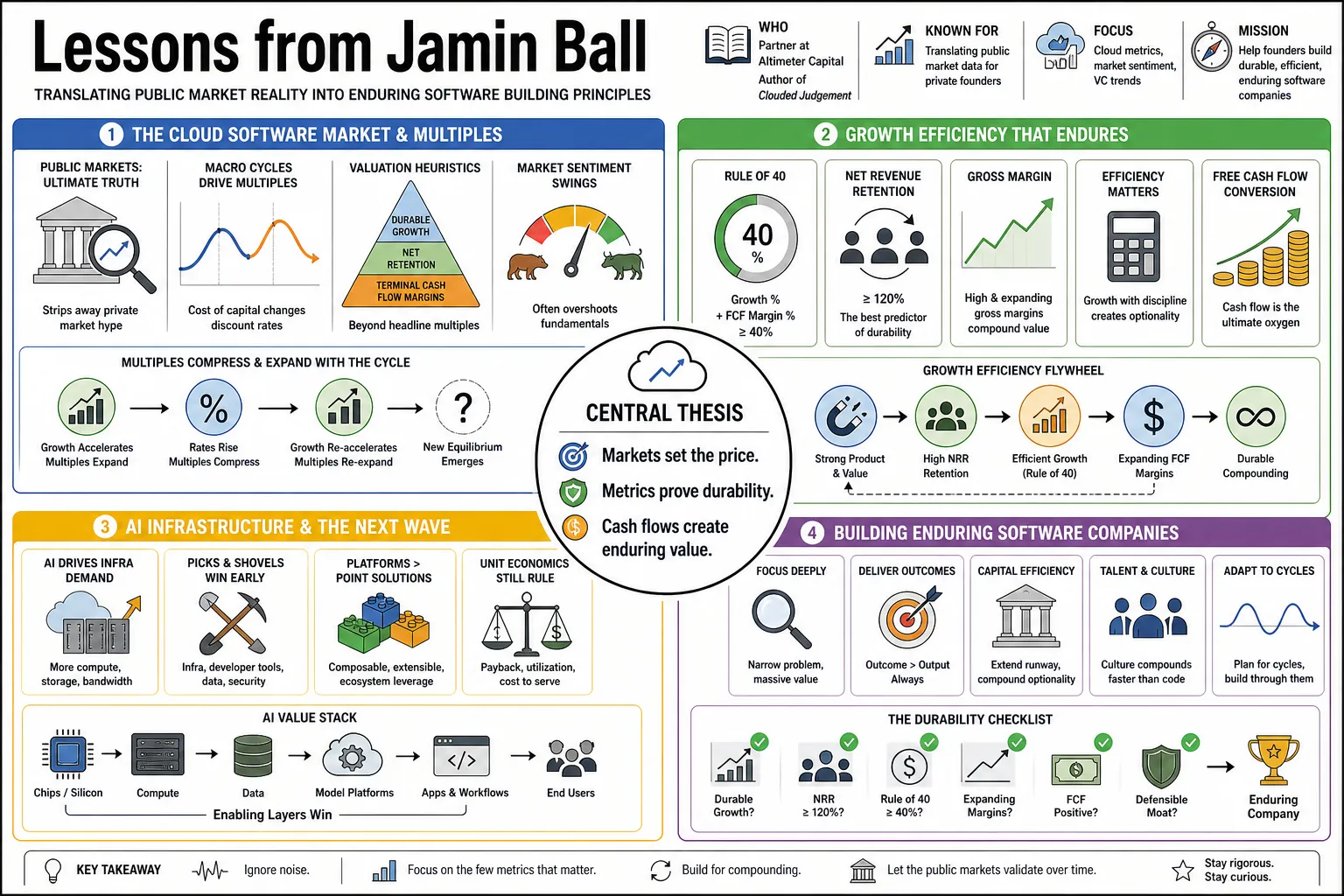
Part 1: The Cloud Software Market and Multiples
- On public market reality: "Public markets are the ultimate arbiter of truth for software valuations, stripping away private market hype to reveal the underlying financial reality." — Source: Clouded Judgement
- On macro cycles: "Software multiples compress not just because growth slows, but because the cost of capital fundamentally alters the discount rate applied to future cash flows." — Source: Clouded Judgement
- On valuation heuristics: "While multiples provide a snapshot, true valuation is a reflection of durable growth, net retention, and terminal cash flow margins." — Source: Software Snack Bites
- On market sentiment: "Market sentiment often swings like a pendulum, over-rewarding growth in expansionary times and overly penalizing the lack of immediate profitability during corrections." — Source: Clouded Judgement
- On public vs. private disconnect: "A major source of friction occurs when private market valuations become unmoored from the structural realities of public market multiples." — Source: BG2 Podcast
- On top-quartile performance: "Being in the top quartile of cloud companies isn't just a vanity metric; it fundamentally alters your cost of capital and ability to attract talent." — Source: Clouded Judgement
- On forward multiples: "Investors must look at next-twelve-months (NTM) revenue multiples, as trailing metrics fail to capture the forward momentum or deceleration of a software business." — Source: Clouded Judgement
- On interest rates: "You cannot decouple software valuations from the broader interest rate environment; zero-interest-rate policy temporarily masked structural inefficiencies." — Source: Software Snack Bites
- On the premium for predictability: "The market assigns a premium multiple not just to high growth, but to highly predictable, recurring revenue streams." — Source: Clouded Judgement
- On long-term investing: "We invest through business cycles by focusing on essential infrastructure that will inevitably be adopted regardless of short-term macro fluctuations." — Source: Software Snack Bites
Part 2: The Rule of 40 and Evaluating Growth
- On the Rule of 40 limitation: "The Rule of 40 is a useful benchmark, but a company growing at 0% with a 40% margin is fundamentally different than one growing at 100% with a -60% margin." — Source: Clouded Judgement
- On weighted metrics: "Growth and profitability should not always carry equal weight; markets often apply a growth multiplier depending on the macro environment." — Source: Clouded Judgement
- On quality of growth: "The market increasingly looks beyond the raw Rule of 40 score to evaluate the underlying quality of growth and the long-term durability of cash flows." — Source: Clouded Judgement
- On standardization: "Despite its flaws, the Rule of 40 remains an industry standard because it provides a comparable baseline for companies that are not yet generating meaningful free cash flow." — Source: Clouded Judgement
- On shifting priorities: "As market cycles shift, we see the reward mechanism transition from purely expansionary growth to a strict demand for cash flow efficiency." — Source: Clouded Judgement
- On sustainable growth: "Growth that is purchased through unsustainable customer acquisition costs will eventually collapse the Rule of 40 calculus." — Source: Software Snack Bites
- On early-stage benchmarking: "Applying the Rule of 40 too early in a startup's lifecycle can stifle necessary investment in product and market capture." — Source: BG2 Podcast
- On top-line deceleration: "When revenue growth decelerates, the pressure to instantly manufacture margin improvement becomes the ultimate test of a management team." — Source: Clouded Judgement
- On the composition of 40: "How a company achieves its Rule of 40 score—whether through hyper-growth or ruthless cost-cutting—tells you everything about its future trajectory." — Source: Clouded Judgement
- On re-acceleration: "Re-accelerating growth at scale is incredibly difficult and rare; once a company shifts to a margin-first story, it is hard to revert." — Source: Clouded Judgement
Part 3: Profitability and Free Cash Flow
- On true profitability: "Adjusted EBITDA is a stepping stone, but true free cash flow margin is the ultimate metric for financial independence." — Source: Clouded Judgement
- On stock-based compensation: "Ignoring stock-based compensation gives a distorted view of profitability; real shareholder dilution has a tangible cost." — Source: Clouded Judgement
- On the pivot to cash flow: "The swift pivot from 'growth at all costs' to 'cash flow matters' caught many management teams structurally unprepared." — Source: Software Snack Bites
- On operating leverage: "Software businesses should inherently demonstrate massive operating leverage as they scale, dropping incremental revenue cleanly to the bottom line." — Source: Clouded Judgement
- On gross margins: "A structurally low gross margin software business will always struggle to reach top-tier free cash flow generation, no matter how much they cut operating expenses." — Source: Clouded Judgement
- On capital constraints: "Operating with capital constraints often forces healthier, more disciplined decisions regarding unit economics." — Source: BG2 Podcast
- On cash conversion: "The speed at which a software company converts bookings into recognized revenue and ultimately cash defines its working capital efficiency." — Source: Clouded Judgement
- On mature profiles: "At maturity, elite SaaS businesses should target free cash flow margins north of twenty-five to thirty percent." — Source: Clouded Judgement
- On survival: "In tightening macro environments, free cash flow isn't just a valuation metric; it is the ultimate measure of survival and optionality." — Source: Software Snack Bites
Part 4: The AI Infrastructure and CapEx Cycle
- On the Red Queen Effect: "In the AI infrastructure race, tech companies are caught in a 'Red Queen Effect,' feeling forced to throw money in and double-down just to avoid falling behind rivals." — Source: Clouded Judgement
- On expansionary spending: "We are in a period of rapid expansionary spending where budgeting is often disconnected from the immediate ROI of the compute spend." — Source: Clouded Judgement
- On Big Tech CapEx: "When you track the earnings commentary of Meta, Microsoft, and Google, the commitment to scaling AI infrastructure is absolute and unprecedented." — Source: Clouded Judgement
- On transitioning to applications: "The market will eventually transition from rewarding pure infrastructure spend to demanding real proof points and durable growth from AI applications." — Source: Clouded Judgement
- On historical parallels: "While the current AI CapEx cycle is uniquely capital-intensive, it mirrors the fundamental platform shifts of past technology cycles." — Source: Clouded Judgement
- On compute as a moat: "For hyperscalers, massive capital expenditure is not just operational scale; it acts as a defensive moat against new entrants." — Source: BG2 Podcast
- On data infrastructure: "AI relies on data, meaning the underlying data infrastructure companies are primary beneficiaries before the application layer fully matures." — Source: Software Snack Bites
- On the 'hamster wheel': "There is a debate over whether AI spending is a hamster wheel of depreciating costs or a foundational investment that will yield generational returns." — Source: Clouded Judgement
- On GPU supply: "Constraints on hardware have dictated the pace of AI development, making access to compute a primary strategic priority." — Source: BG2 Podcast
- On long-term payoffs: "The true economic payoff of this CapEx cycle will be measured in the productivity gains embedded within enterprise software over the next decade." — Source: Clouded Judgement
Part 5: Consumption vs. Seat-Based Pricing
- On pricing models: "Consumption-based models offer a direct alignment of value and cost, but they introduce revenue volatility that public markets historically struggle to digest." — Source: Software Snack Bites
- On macro sensitivity: "Usage-based companies are the first to feel a macroeconomic slowdown as customers optimize their cloud spend, but they are also the first to recover." — Source: Clouded Judgement
- On seat-based friction: "Seat-based pricing provides predictable revenue, but it can create friction for product adoption across wider teams within an organization." — Source: Clouded Judgement
- On cloud optimization: "Cloud optimization occurs in cycles; when budgets tighten, companies aggressively audit their usage-based tools, temporarily pausing net retention growth." — Source: Software Snack Bites
- On forecasting challenges: "Wall Street prefers predictability, making consumption models difficult to forecast and often leading to wider valuation swings during earnings seasons." — Source: Clouded Judgement
- On hybrid models: "We are increasingly seeing companies adopt hybrid pricing, using base commitments to satisfy investors while capturing upside through overage consumption." — Source: Clouded Judgement
- On land and expand: "Consumption models are the ultimate 'land and expand' vehicle, removing the barrier to entry for the initial developer adoption." — Source: Software Snack Bites
- On customer success: "In a usage-based business, the customer success function essentially becomes a revenue-generating role, driving adoption rather than just managing renewals." — Source: Clouded Judgement
- On AI pricing: "As AI features are rolled out, software companies are being forced to rethink their pricing structures to account for the heavy compute costs on the backend." — Source: Clouded Judgement
Part 6: Venture Capital and Private Markets
- On VC transition: "The venture markets have transitioned from a high-margin cottage industry to an institutionalized lower-margin industry, which has major implications for founders." — Source: BG2 Podcast
- On overcapitalization: "Receiving too much funding too early can lead to diluted focus and unrealistic pressures that negatively impact a startup's long-term sustainability." — Source: BG2 Podcast
- On fund sizes: "The shift toward larger venture funds has sometimes led to a misalignment of incentives, prioritizing capital deployment over maximizing long-term founder value." — Source: BG2 Podcast
- On 'hype' rounds: "There is a distinct difference between a 'hype' funding round driven by momentum and a 'fundamental' round driven by underlying business metrics." — Source: Clouded Judgement
- On the power law: "Venture returns rely heavily on the power law, meaning investors will continue to aggressively fund category leaders even in tighter macroeconomic conditions." — Source: BG2 Podcast
- On paper valuations: "Founders must recognize that high private market valuations are often structured with preferences that behave like debt if the company fails to exit at a premium." — Source: Clouded Judgement
- On down rounds: "Accepting a down round to clean up the cap table is often healthier for a company's morale and options pool than sustaining an artificial valuation." — Source: Clouded Judgement
- On late-stage investing: "Late-stage venture requires a public market mindset; you have to evaluate the business based on the metrics Wall Street will demand at IPO." — Source: Software Snack Bites
- On secondary markets: "The liquidity demands of early employees and seed investors are forcing private companies to rely more heavily on secondary transactions in a delayed IPO environment." — Source: Clouded Judgement
Part 7: Go-To-Market and Sales Efficiency
- On CAC Payback: "CAC payback periods are the ultimate barometer of sales efficiency; anything stretching beyond 18 to 24 months is a red flag in a tight capital environment." — Source: Clouded Judgement
- On product-led growth: "Product-Led Growth (PLG) lowers top-of-funnel acquisition costs, but transitioning those users into enterprise contracts still requires a sophisticated enterprise sales motion." — Source: Clouded Judgement
- On sales cycles: "As macroeconomic conditions tighten, we see elongated sales cycles and increased scrutiny from CFOs on every new software purchase." — Source: Clouded Judgement
- On net revenue retention: "Net Revenue Retention (NRR) is the engine of compound growth; without a strong expansion motion, you are constantly fighting against customer churn." — Source: Clouded Judgement
- On quota attainment: "Monitoring rep quota attainment provides an early warning signal; if the majority of reps are missing quota, the GTM machine is broken." — Source: Clouded Judgement
- On marketing spend: "Brand marketing in software is a luxury; performance marketing and direct sales must prove their ROI before top-of-funnel brand spend is justified." — Source: Software Snack Bites
- On segmenting customers: "A high CAC is acceptable for enterprise customers with massive lifetime value, but applying that same motion to the mid-market will destroy margins." — Source: Clouded Judgement
- On the CFO veto: "Software vendors must now sell business value directly to the CFO, as the era of developers swiping credit cards unchecked has largely ended." — Source: Clouded Judgement
- On sales comp: "Aligning sales compensation with actual cash collected or usage consumed, rather than just booked contract value, ensures better customer quality." — Source: Clouded Judgement
Part 8: Advice for Founders and Operators
- On macro awareness: "Founders need to be macro aware but micro obsessed; you cannot control interest rates, but you can control your execution and unit economics." — Source: Software Snack Bites
- On managing expectations: "Do not raise capital at a valuation you cannot grow into within two years; it sets an impossible hurdle for both your employees and future investors." — Source: BG2 Podcast
- On capital discipline: "Treat every dollar of venture funding as if it is the last dollar you will ever raise, focusing on reaching default alive status." — Source: Clouded Judgement
- On transparency: "Being transparent with your board and team about decelerating metrics builds trust faster than trying to spin a broken growth narrative." — Source: Clouded Judgement
- On hiring: "During hyper-growth, it is tempting to solve problems by adding headcount, but the best companies solve problems with process and software." — Source: Software Snack Bites
- On defining the core: "In difficult times, ruthlessly cut experimental projects and refocus all resources on the core product that drives the majority of your revenue." — Source: Clouded Judgement
- On understanding metrics: "As a founder, you cannot outsource the understanding of your financial metrics to your VP of Finance; you must own the numbers." — Source: Clouded Judgement
- On alignment: "Ensure that the incentives of your investors align with your timeline; misaligned time horizons between founders and funds destroy value." — Source: BG2 Podcast
- On endurance: "Building an enduring software business is a decade-long exercise in compounding; do not let short-term market volatility distract from long-term value creation." — Source: Software Snack Bites