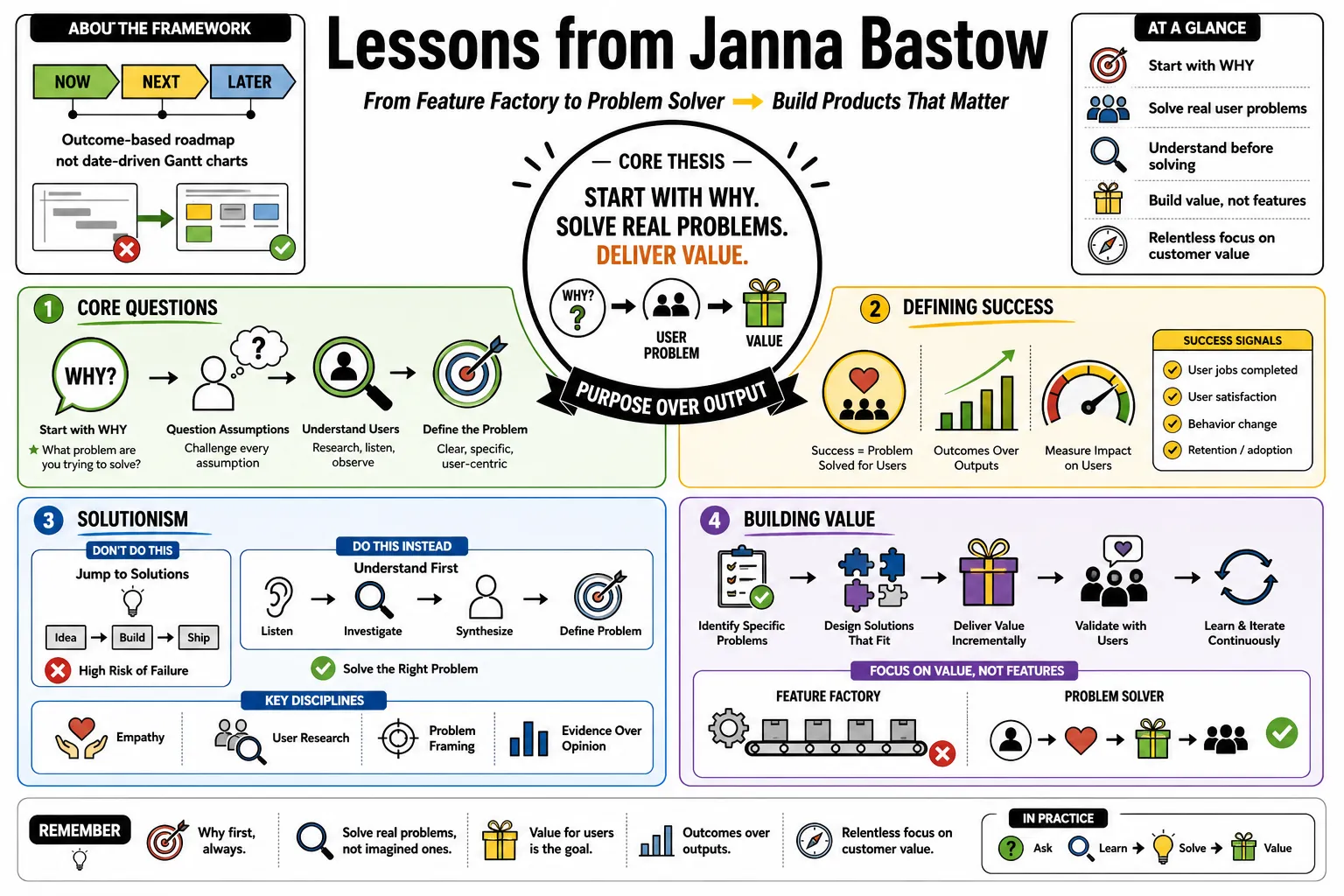
Lessons from Janna Bastow
As CEO of ProdPad and co-founder of Mind the Product, Janna Bastow created the Now-Next-Later roadmap framework to replace date-driven Gantt charts with outcome-based planning. This profile collects her practical advice on escaping the feature factory, avoiding the agency trap, and building products that actually solve customer problems.
Part 1: The Purpose of Product Management
- On Core Questions: "Product management should always start with the question of WHY. What problem are you trying to solve?" — Source: Hashnode
- On Defining Success: "A product is successful if it solves a problem for its users." — Source: Medium
- On Solutionism: Product teams must resist jumping straight to solutions; true product work lies in thoroughly understanding user pain points first. — Source: Hashnode
- On Building Value: Successful product management means building products to solve specific, identified problems for users rather than simply building features to check off a roadmap. — Source: Scrum.org
- On First Principles: The foundation of good product practice is a relentless focus on why a feature matters to the customer, avoiding a narrow focus on how it functions. — Source: Mind the Product
- On Output vs Outcome: True value is found in the outcome delivered to the market, instead of the sheer volume of output generated by the team. — Source: ProdPad
- On User Navigation: Focusing merely on building out requested features can result in a Frankenstein product that becomes nearly impossible for users to navigate successfully. — Source: ProdPad
- On Grounding the Conversation: When discussions get bogged down in feature details, ask "What problem are you trying to solve?" to bring the team back to the actual value provided to the customer. — Source: Turing Fest
- On The Heart of PM: Product managers are strategic thinkers responsible for ensuring every effort creates tangible user value, rather than project managers tracking tasks. — Source: Mind the Product
Part 2: Escaping the Feature Factory
- On The Delivery Trap: Many product teams fall into a delivery mode trap where they become addicted to shipping features to satisfy internal pressures rather than solving user problems. — Source: ProdPad Blog
- On Frankenstein Products: Building without a clear strategy leads to a disjointed product that feels stitched together and fails to serve a cohesive user journey. — Source: Aurelius Podcast
- On The Output Illusion: Being totally driven by output and hitting arbitrary deadlines comes at the direct expense of generating real market insight. — Source: ProdPad
- On Backlog Dumping Grounds: A clear sign of a feature factory is a product backlog that has devolved into a massive dumping ground for unvalidated requests. — Source: Medium
- On Breaking the Cycle: To escape the feature factory cycle, organizations must intentionally shift their focus toward discovery methodologies and outcome-based planning. — Source: Substack
- On Internal Pressure: Teams must learn to manage pressure from sales and executives, pushing back on feature requests that lack clear connection to strategic outcomes. — Source: ProdPad
- On Mindless Execution: Organizations that prioritize feature volume over customer value risk spending immense resources building things nobody actually needs. — Source: Medium
- On Discovery Deficits: A feature factory starves the discovery process, leaving teams with no time to properly research whether their next build is the right build. — Source: Aakash Gupta
- On The True Cost of Features: Every new feature adds technical debt and maintenance burden, making it imperative to only build what truly drives value. — Source: ProdPad Blog
Part 3: The Now-Next-Later Roadmap
- On Roadmap Evolution: "Gantt charts versus Now/Next/Later? Imagine swapping a strait jacket for a comfy cardigan. The Now/Next/Later framework isn't tied up in dates, it's all about flexibility and adapting as you go." — Source: How to Web
- On Strategic Prototyping: A roadmap should act as a prototype for your product strategy; the true value is found in the process of planning, not the artifact itself. — Source: Product Talk
- On Horizon Planning: The framework organizes product initiatives into three horizons based on their level of certainty rather than strict calendar dates. — Source: ProdPad
- On The 'Now' Bucket: Initiatives in the Now phase are those currently being worked on or well-defined enough for immediate action by the team. — Source: FunRetrospectives
- On The 'Next' Bucket: Items in the Next phase are high priority but less defined; their execution often depends on the outcomes or learnings from the Now initiatives. — Source: Votito
- On The 'Later' Bucket: The Later category is for strategic goals, blue-sky ideas, and broad problems to solve in the distant future, remaining intentionally flexible. — Source: Product Talk
- On Distant Certainty: The further away a potential initiative is in time, the less certainty there is about its viability or necessity, preventing wasted effort on over-planning. — Source: Votito
- On Managing Stakeholders: The Now/Next/Later format helps product teams clearly communicate direction and priorities without being trapped by rigid, outdated schedules. — Source: ProdPad
- On Escaping Deadlines: Removing fixed delivery dates from the long-term vision empowers teams to focus on problem-solving instead of simply checking boxes. — Source: Lenny's Newsletter
- On Strategy vs Delivery: While delivery teams might need short-term sprint plans, the broader product roadmap must remain a strategic document unburdened by granular execution timelines. — Source: Product Talk
Part 4: The Fallacy of Timelines and Gantt Charts
- On Stating Intent: "Product roadmaps should be a statement of intent and direction, not a Gantt chart of features." — Source: Aakash Gupta
- On False Certainty: Traditional, time-bound Gantt charts create a dangerous illusion of certainty by assigning fixed deadlines to distant, fundamentally uncertain projects. — Source: ProdPad
- On Inflexible Commitments: Strict timeline roadmaps insist on rigid deadlines, depriving product teams of the flexibility necessary to do their best and most creative work. — Source: Mind the Product
- On Strategic Distraction: When teams are forced to track progress against a Gantt chart, they inevitably focus on fixed outputs and arbitrary dates rather than strategic outcomes. — Source: Aurelius Podcast
- On Inevitable Failure: Promising exact delivery dates months in advance sets teams up for failure, as software development involves inherent unknowns that cannot be predicted. — Source: Agile Alliance
- On Planning Waste: Spending hours detailing a long-term timeline roadmap is largely wasted effort, as changing market conditions will render those plans obsolete before they arrive. — Source: Tyner Blain
- On Communication Breakdown: While a Gantt chart might look impressive to stakeholders, it communicates a false reality that erodes trust when estimates inevitably shift. — Source: ProdPad Blog
- On Missing the Point: Plotting out features on a calendar does nothing to validate whether those features will actually solve a customer problem or drive business growth. — Source: Medium
- On Agile Contradictions: Trying to run an agile delivery process while beholden to a strict timeline roadmap creates cognitive dissonance and friction within the organization. — Source: Agile Alliance
Part 5: Navigating the Agency Trap
- On The Ultimate Goal: "Agencies don't change the world, product companies do." — Source: Medium
- On Bespoke Builds: The Agency Trap occurs when a supposedly product-led company begins building custom features to order for individual clients. — Source: ProdPad
- On Reactive Roadmaps: In the One Knight in Product episode, Bastow describes the agency trap as building features for individual clients, which pulls a product company away from solving bigger market problems. — Reference: One Knight in Product episode on avoiding the agency trap with Janna Bastow
- On Losing Scalability: Operating like an agency by trading time and custom development for money is fundamentally unscalable for a business trying to build a universal product. — Source: ProdPad
- On Distracted Missions: While building custom software is a legitimate model for an agency, it distracts product companies from their core mission of creating broad, high-value solutions. — Source: Synergist
- On Short-Term Temptations: Leaders must guard against the short-term temptation of chasing easy revenue from big logo customers at the expense of their long-term product vision. — Source: ProdPad
- On Strategic Identity: Companies must make a conscious decision about their identity: scale by solving universal problems, or remain a consultancy that builds to order. — Source: SlideShare
- On Sales-Led Detours: When a company falls into the agency trap, the roadmap is no longer driven by product strategy, but by the immediate demands of the sales team. — Source: Scoro
- On Breaking Free: Escaping the agency trap takes strong product leadership capable of saying no to lucrative one-off requests in order to protect the scalable core product. — Source: ProdPad Blog
Part 6: Building Community and Mind the Product
- On Finding Peers: The spark for Mind the Product came from a simple desire to connect with other product managers in an era where the role was often isolated within startups. — Source: Mind the Product
- On Grassroots Origins: Motivated by the rarity of meeting peers, Bastow spearheaded the first ProductCamp London in 2010, which eventually grew into a massive global community. — Source: Mind the Product
- On Identifying a Need: Similar to product management, the foundation of Mind the Product was rooted in identifying a clear problem: a lack of a dedicated professional network for PMs. — Source: Lenny's Newsletter
- On Organic Growth: What started as a casual meetup in a pub evolved organically because it addressed a deep, shared need for professional camaraderie and shared learning. — Source: How to Web
- On Shared Struggles: In Intercom's interview, Bastow says Mind the Product began because she wanted to learn from other PMs and lacked a network; she also notes that PMs increasingly struggle with stakeholder management, influence, and objection handling. — Reference: Intercom interview on Mind the Product origins and common PM stakeholder challenges
- On Formalizing the Network: Co-founding Mind the Product formalized a growing movement, transforming local meetups into global conferences and an enduring professional organization. — Source: Mind the Product
- On Parallel Paths: The frustrations Bastow heard from PMs in the community directly informed her work in founding ProdPad, aiming to build better tools for the discipline. — Source: ProdPad
- On Elevating the Craft: Communities like Mind the Product have played a major part in defining and maturing product management from an ambiguous title into a recognized discipline. — Source: Lenny's Podcast
- On Continuous Learning: The most successful product managers are those who actively engage with a community to challenge their assumptions and learn from the experiences of others. — Source: Intercom
Part 7: Strategy, OKRs, and Outcomes
- On Bridging the Gap: OKRs are an effective tool to bridge the gap between high-level company strategy and the day-to-day execution of the product team. — Source: Inside Product
- On Outcome Focus: Product strategy must shift away from old-school, date-driven feature lists toward a relentless focus on measurable business and customer outcomes. — Source: Product Side
- On Communication Tool: A roadmap is ultimately an alignment and communication tool, while OKRs act as the mechanism to measure progress toward those communicated outcomes. — Source: Mind the Product
- On The "Why" Behind the Work: Tying product initiatives directly to OKRs provides the clear logic behind the items on a roadmap, ensuring teams solve problems that support broader goals. — Source: ProdPad
- On Avoiding Perfectionism: Do not get paralyzed trying to build a flawless roadmap; start simple, focus on the core problems to solve, and use OKRs to maintain direction. — Source: Mind the Product
- On Organizational Silos: As teams scale, the instinct to add more structured roadmaps can increase silos; it is better to align roadmaps with collaborative team structures instead. — Source: Enterprise Zone
- On Living Documents: Because roadmaps are forward-looking projections, they must be treated as living documents that evolve as priorities shift and new insights are gained. — Source: ProdPad
- On Strategic Value: Delivering a feature is meaningless if it does not move the needle on a defined Key Result or create tangible value for the customer. — Source: Inside Product
- On Shared Understanding: In Mind the Product's roadmap AMA recap, Bastow frames roadmaps as alignment and communication tools and recommends using OKRs with roadmaps so executives and product teams can collaborate around progress while preserving roadmap flexibility. — Reference: Mind the Product AMA recap on OKRs, alignment, and flexible roadmaps
- On Adapting to Constraints: A healthy strategic process acknowledges that constraints will appear, requiring the flexibility to pivot initiatives while still aiming for the same OKRs. — Source: ProdPad Blog
Part 8: Discovery, Feedback, and Validation
- On Checking Assumptions: "The whole point is that you just share your early assumptions with other people on the team, with customers, even, like anybody who will listen and just check that you're on the right path." — Source: Craft.io
- On Customer Feedback: Balancing raw customer feedback with strategic business objectives helps avoid building a product that tries to please everyone but serves no one well. — Source: Aurelius Podcast
- On Hiring for Discovery: When interviewing product managers, focus on their soft skills and behavioral stories regarding how they uncover user needs, instead of relying entirely on their CVs. — Source: ProdPad
- On The Value of 'No': Effective discovery often leads to saying no to ideas; a successful validation process proves what shouldn't be built just as much as what should. — Source: ProdPad Blog
- On Gamifying Growth: Through experimentation and listening to users, optimizing onboarding flows and testing value-based pricing can dramatically improve retention and growth. — Source: Churn.FM
- On Navigating Plateaus: Overcoming revenue plateaus requires stepping back, analyzing user behavior data, and being willing to test bold changes to the core product experience. — Source: SaaS Club
- On Continuous Discovery: Discovery is rarely a phase that happens once before development; it is a continuous habit that must be maintained throughout the entire product lifecycle. — Source: Product Talk
- On Reducing Waste: Deep validation before committing to development is the most effective way to reduce engineering waste and protect team morale. — Source: Until the Ice Cream Truck
- On Embracing Uncertainty: Good product managers are comfortable living in the ambiguous space of discovery, relying on evidence rather than gut feeling to find clarity. — Source: Mind the Product
- On The Core Question Revisited: At every stage of discovery and validation, the team must constantly return to the grounding question: "What problem are you trying to solve?" — Source: Turing Fest