Jared Kushner is an American investor, real estate developer, and former senior advisor to President Donald Trump. He is best known for his role in brokering the Abraham Accords and his efforts to apply private-sector management tactics to federal bureaucracy. The following collection synthesizes his perspectives on diplomacy, business, and crisis management during his time in the White House and the private sector.
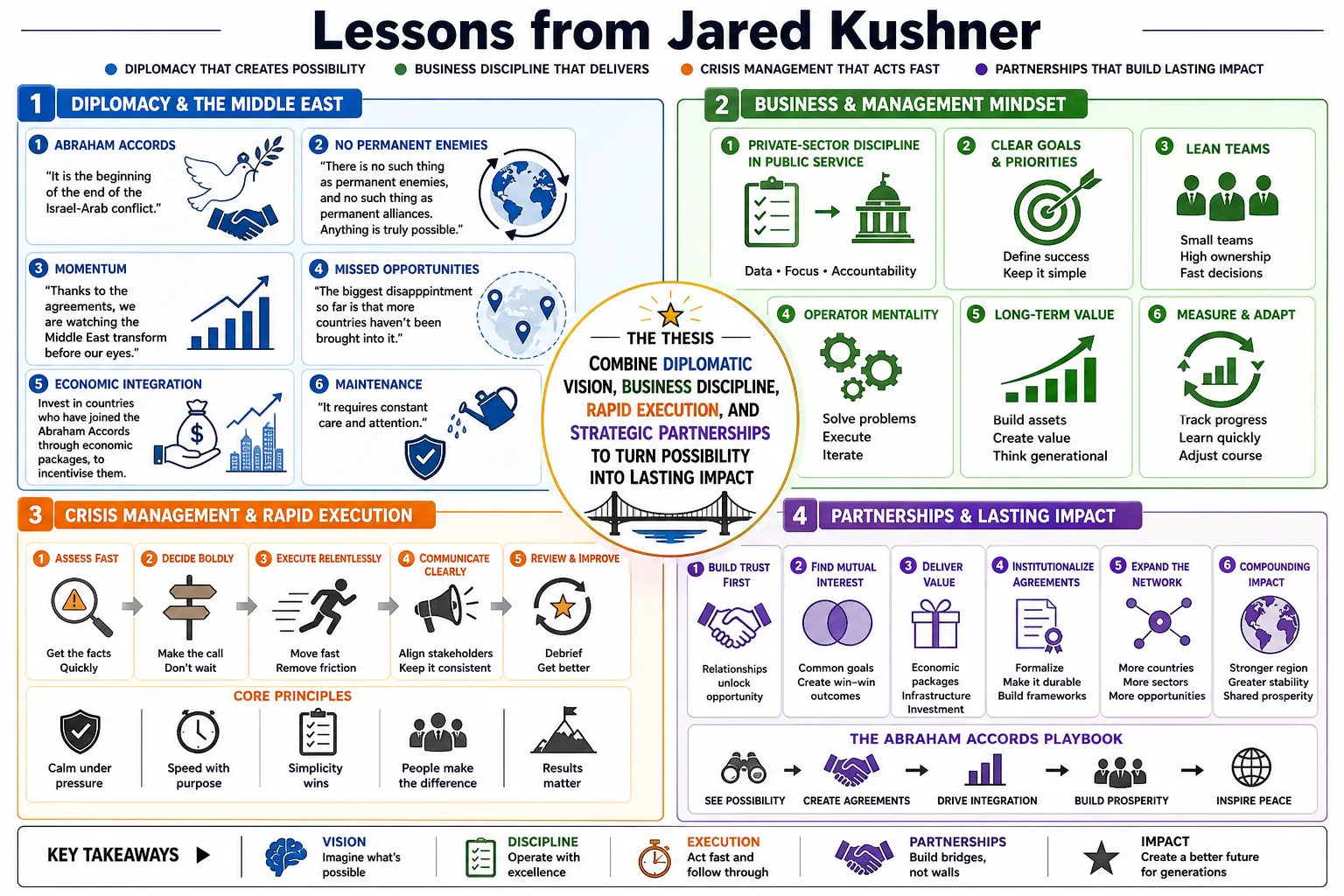
Part 1: Diplomacy and the Middle East
- On the Abraham Accords: "It is the beginning of the end of the Israel-Arab conflict." — Source: [Mother Jones]
- On permanent alliances: "The US-brokered Abraham Accords... have shown that there is no such thing as permanent enemies, and there's no such thing as permanent alliances, and that anything is truly possible." — Source: [Arab News]
- On momentum: "Thanks to the agreements, we are watching the Middle East transform before our eyes." — Source: [The Forward]
- On missed opportunities: "I think the biggest disappointment so far is that more countries haven't been brought into it." — Source: [The Media Line]
- On economic integration: We need to find ways to "invest in countries who have joined the Abraham Accords" through "economic packages, to incentivise them." — Source: [Middle East Monitor]
- On maintenance: "If [the Abraham Accords] are not nurtured, we run the risk that they could go backward." — Source: [The Forward]
- On complexity: The issues regarding the Israeli-Palestinian conflict "aren't as complicated as people have made them out to be." — Source: [Mother Jones]
- On regional stability: "Once the whole Arab-Israeli conflict is over, I think that you will have an era of prosperity and peacefulness in that region that will endure for a very, very long time." — Source: [The Media Line]
- On the UN paradigm: "Palestinians are a force within the hallways of the United Nations, so when the General Assembly voted on the resolution, I considered the forty-four countries that either abstained or voted against it to be a positive indicator that we were forging strategic partnerships." — Source: [Goodreads]
- On Gaza's potential: "Gaza's waterfront property, it could be very valuable, if people would focus on kind of building up livelihoods." — Source: [Harvard University]
Part 2: The Art of Negotiation
- On breaking stalemates: You have to bypass formal bureaucratic channels in favor of direct communication to be efficient in high-pressure situations. — Source: [London Review of Books]
- On talking to opponents: "I wasn't always successful, but it is the responsibility of those in power to try. We can't solve problems by talking only to those who agree with us." — Source: [Goodreads]
- On detail work: "I find that in the real world, the way you solve problems is by really going into the details, putting forward proposals, agreeing, disagreeing on certain things—that's very healthy, that's how you resolve a conflict." — Source: [VOA News]
- On personal relationships: Direct, personal relationships with foreign leaders move negotiations past traditional diplomatic bottlenecks. — Source: [Puck News]
- On Moneyball strategy: Negotiations require focusing on high-return investments and optimizing limited diplomatic resources. — Source: [The Forward]
- On posturing: Grandstanding and criticism during negotiations are expected behaviors rather than signs of failure. — Source: [VOA News]
- On calculated risk: Success in negotiations often requires being "unpredictable," building "warm rapport" with counterparts, and being "willing to change course at any minute and take calculated risks." — Source: [Word Explain]
- On breaking assumptions: As an outsider, you must question established assumptions to break through long-standing stalemates. — Source: [London Review of Books]
- On the value of friction: Normalizing the cycle of agreement and disagreement is a healthy and necessary part of resolving deep conflicts. — Source: [VOA News]
Part 3: Business and the Private Sector
- On government limitations: "Government has limitations. At their best they can set the right policy. But without the private sector, policy means nothing." — Source: [Jared Kushner interview]
- On early experience: "I ran my own business when I was 19, buying condos and renovating apartment buildings." — Source: [Forbes]
- On work ethic: "I was raised to work for my father when I was four." — Source: [Forbes]
- On CEO diplomacy: It is better to operate as a "results-driven executive" rather than a traditional career diplomat. — Source: [London Review of Books]
- On efficiency: Applying private-sector efficiency to public-sector challenges is essential for breaking down bureaucratic barriers. — Source: [Jared Kushner interview]
- On age: "Age is a convenient barometer of what a person is capable of, but it is only one." — Source: [Forbes]
- On wealth and character: Quoting Michael Harris, "Money just makes you more of what you already are." — Source: [Lex Fridman Podcast]
- On data-driven models: Rigorous data collection and analysis must form the basis of any meaningful policy recommendation. — Source: [Wikiquote]
- On transactional reality: High-stakes statecraft is often functionally similar to closing complex, private real estate deals. — Source: [The Guardian]
Part 4: White House Operations and Crisis Management
- On facilitating power: A senior advisor's role is to act as a "facilitator" of the President’s agenda, not the author of it. — Source: [Time]
- On surfing the wave: When working for an unpredictable leader, you cannot control the waves they create; your job is to surf them. — Source: [Forbes]
- On the Cheshire Cat philosophy: "If you don't know where you're going, any path will get you there." — Source: [The Week]
- On January 6th: "What is clear to me is that no one at the White House expected violence that day... I'm confident that if my colleagues or the president had anticipated violence, they would have prevented it from happening." — Source: [The Guardian]
- On the "Three Rules of Trump": 1. Controversy elevates message. 2. When you're right, you fight. 3. Never apologize. — Source: [Word Explain]
- On the scientific method in government: During Operation Warp Speed, decisions had to be entirely "fact-based and straightforward," letting data drive policy. — Source: [Reddit]
- On managing federal stockpiles: "The notion of the federal stockpile was it's supposed to be our stockpile, it's not supposed to be states' stockpiles that they then use." — Source: [Los Angeles Times]
- On private sector engagement: Engaging the private sector is the only way to fast-track massive government initiatives like vaccine development. — Source: [Salon]
- On avoiding distraction: You have to focus on execution rather than philosophical or moral debates when implementing executive goals. — Source: [Time]
- On internal opposition: Navigating government requires pushing past active resistance from cabinet members to achieve bipartisan legislative wins. — Source: [WRAL]
Part 5: Criminal Justice Reform
- On the First Step Act: The legislation is a vital starting point for broader improvements in the justice system. — Source: [National Archives]
- On recidivism: "The costs of criminal activity are unacceptably high, but the reforms supported by the president promise to reduce costs and cut down on recidivism. We can improve [the] expensive, ineffective system by lowering recidivism." — Source: [National Archives]
- On state models: "We've based it on a lot of what's been done in a lot of the states like Mississippi." — Source: [ProPublica]
- On bipartisanship: Passing reform requires building a diverse coalition, from the ACLU to the Koch brothers' network. — Source: [The Guardian]
- On personal motivation: Policy work is often driven by personal experience; in this case, a deep understanding of the prison system's toll. — Source: [The Guardian]
- On institutional inertia: The Department of Justice often serves as the biggest roadblock to reforming the justice system. — Source: [WRAL]
- On data in justice: Modernizing the penal system requires shifting from punitive measures to data-driven rehabilitation models. — Source: [ProPublica]
- On fiscal responsibility: Criminal justice reform is not just a moral imperative, but a fiscal necessity for the federal government. — Source: [National Archives]
- On incremental progress: You cannot fix the entire system at once; you must secure the first step to prove reform is possible. — Source: [National Archives]
Part 6: Trade and North America
- On branding trade deals: "I want it to be called the USMCA, like [the] U.S. Marine Corps." — Source: [CBC]
- On hardball tactics: "Please let the prime minister know that his negotiators are about to blow up a $600 billion trade relationship over butter." — Source: [Bloomberg Linea]
- On leveraging the President: "They are playing chicken with the wrong guy. Trump would be thrilled to go forward with Mexico and impose tariffs on Canada." — Source: [Bloomberg Linea]
- On crisis management: "What if I get President Peña Nieto and Prime Minister Trudeau to call right now and ask you not to cancel NAFTA, and then you can put out a statement that says you will give them time to negotiate..." — Source: [CBC]
- On preventing collapse: Behind-the-scenes conduits are necessary to put trade deals back together when public negotiations stall. — Source: [Global News]
- On backchannel diplomacy: Leveraging personal relationships with foreign ministers is more effective than relying solely on official trade representatives. — Source: [Global News]
- On holding the line: "He made a promise to the dairy farmers, and he isn't going to budge." — Source: [Bloomberg Linea]
- On defusing threats: You manage an executive's threat to withdraw from a treaty by orchestrating immediate, high-level foreign interventions that offer a face-saving delay. — Source: [CBC]
- On indispensable architects: Major international agreements often rely entirely on a single, unofficial liaison to bridge the gap between volatile leaders. — Source: [VOA News]
Part 7: The Media and Public Perception
- On press coverage: The media's coverage often exaggerates the threat of emerging crises to drive engagement. — Source: [Salon]
- On reliance on leaks: "I don’t know what he did or what he didn’t take, but right now we’re relying on leaks to the media." — Source: [Business Insider]
- On minimizing scandals: Federal investigations into political figures are often framed by the press as existential threats when they are merely "an issue of paperwork." — Source: [Business Insider]
- On quiet influence: It is better to prefer private diplomacy over public-facing press engagement to avoid unnecessary blowback. — Source: [Substack]
- On official statements: Denying allegations of improper contact is best done through brief, prepared statements without taking questions from the press. — Source: [Time]
- On legacy building: You should focus on moral architecture and long-term legacy rather than immediate headlines. — Source: [JS Tribune]
- On media hostility: The press operates under assumptions that outsiders must ignore if they intend to disrupt the status quo. — Source: [Goodreads]
- On modernizing government: Reforming government technology is one of the few initiatives that warrants stepping out from a behind-the-scenes role to address the public directly. — Source: [Jared Kushner interview]
- On controlling the narrative: A memoir is the ultimate tool for a former official to bypass the media and reframe their own historical role. — Source: [Goodreads]
Part 8: Philosophy and Personal Drive
- On leading by example: "I believe in leading by example and being a role model for others." — Source: [JS Tribune]
- On success: "Success is about constantly challenging yourself." — Source: [Bookey]
- On setbacks: "Setbacks are temporary." — Source: [JS Tribune]
- On character: "Character, not circumstance, defines destiny." — Source: [JS Tribune]
- On studying failure: You must study past failures in diplomacy to develop new, effective approaches. — Source: [VOA News]
- On viewing obstacles: Obstacles should be viewed as doorways rather than walls. — Source: [JS Tribune]
- On execution over theory: Theoretical arguments are useless if they cannot be translated into actionable, results-oriented execution. — Source: [London Review of Books]
- On quiet discipline: A disciplined, understated approach is often more effective than loud posturing. — Source: [JS Tribune]
- On adaptability: True leadership requires the willingness to adapt instantly in the face of sudden crises. — Source: [JS Tribune]
- On outsider perspective: Bringing an outsider's lens to entrenched systems is the only way to identify solutions that insiders have been trained to ignore. — Source: [Puck News]