Jason Crawford, the founder of The Roots of Progress, has become a prominent voice in the discourse on human progress, technological development, and the future of civilization. Through his extensive writings and interviews, he advocates for a renewed appreciation of the industrial and technological revolutions that have shaped the modern world. His work encourages "industrial literacy" and a "philosophy of progress" for the 21st century.
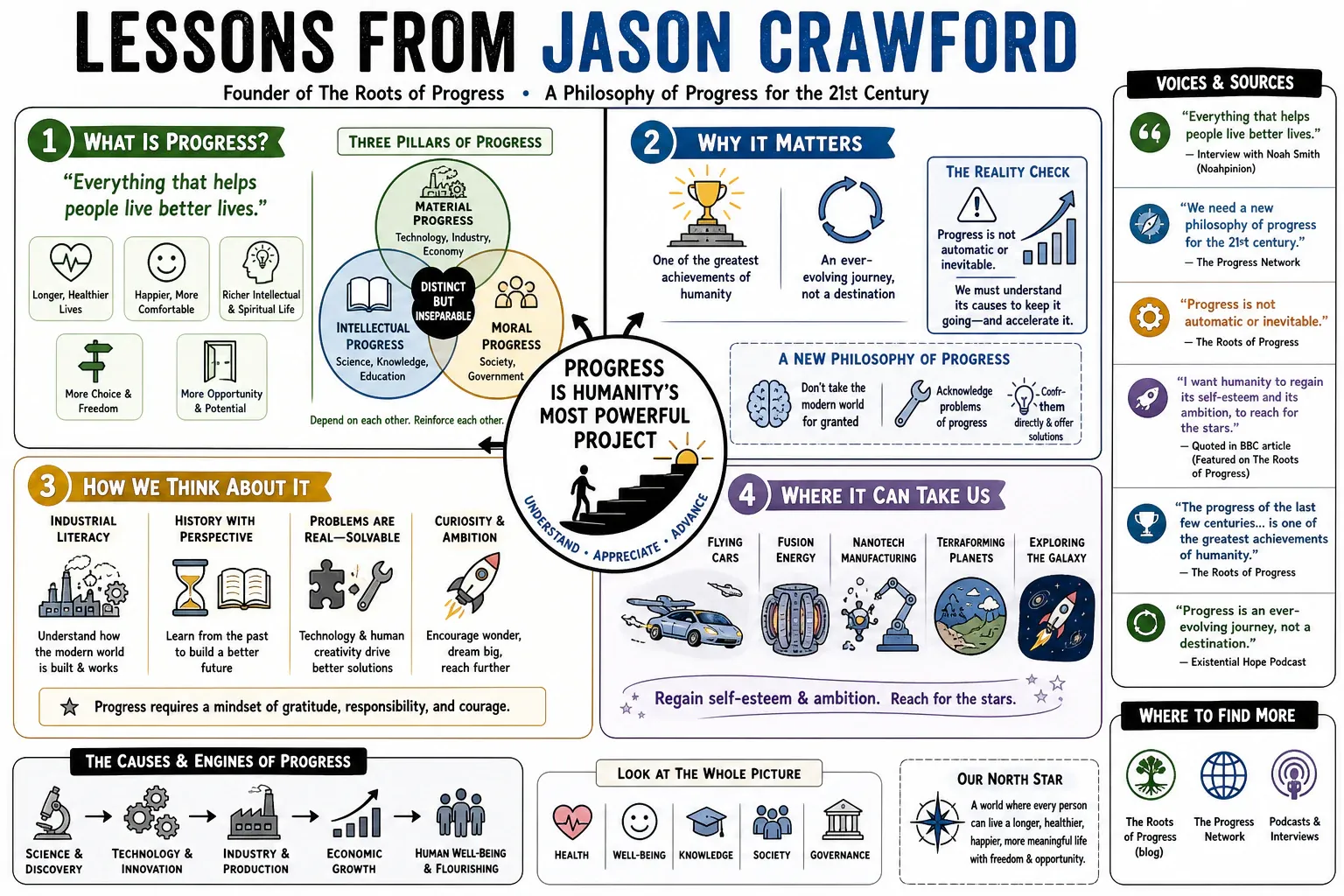
On the Nature and Importance of Progress
- "In the broadest sense, 'progress' is everything that helps people live better lives—lives that are longer, happier, healthier, and more comfortable; with more intellectual and spiritual richness; with more choice, freedom, and opportunity." [Noahpinion]
- Source: Interview with Noah Smith, Noahpinion
- Link: https://www.noahpinion.blog/p/interview-jason-crawford-nonprofit
- On a new philosophy of progress: Crawford said "we need a new philosophy of progress for the 21st century," which he calls his tagline. — Idea Machines Podcast #40: Philosophy of Progress with Jason Crawford (transcript).
- "Progress is not automatic or inevitable. We must understand its causes, so that we can keep it going, and even accelerate it." [3]
- Source: The Roots of Progress
- Link: https://blog.rootsofprogress.org/
- "I want humanity to regain its self-esteem and its ambition, to figuratively and literally reach for the stars. I want us to dream of flying cars, fusion energy, nanotech manufacturing, terraforming planets, exploring the galaxy." [3]
- On national self-esteem: Crawford said "America had a sort of national self-esteem crisis around the late '60s / early '70s, with Vietnam, Watergate, and the oil shocks all hitting around the same time." — Noahpinion: Interview with Jason Crawford on his nonprofit
- Source: Quoted in a BBC article, featured on The Roots of Progress
- Link: https://blog.rootsofprogress.org/
- "The progress of the last few centuries—in science, technology, industry, and the economy—is one of the greatest achievements of humanity." [3]
- Source: The Roots of Progress
- Link: https://blog.rootsofprogress.org/
- On the three categories of progress: Crawford said "I see three main categories of progress: material progress (technology, industry, and the economy), intellectual progress (science, knowledge, and education), and moral progress (including society and government)." — Noahpinion: Interview with Jason Crawford on his nonprofit.
- "If you care about human life and well-being and health and happiness, then you have to look at that fact and be somewhat in awe of it. You have to ask, 'how did we get here?' 'Why did it take so long, and how can we keep it going?'" [5]
- Source: MachinePix Weekly #61
- Link: https://www.machinepix.com/p/machinepix-weekly-61-jason-crawford
- "Ultimately, progress increases our agency. In fact, in some sense, I think increasing human agency could just be a north star for progress, the key thing that we're trying to enable." [6]
- Source: Lux Capital, Jason Crawford on The Techno-Humanist Manifesto
- Link: https://www.luxcapital.com/content/jason-crawford-on-the-techno-humanist-manifesto
- On the importance of material progress: Crawford called material progress over the last two or three centuries "one of the—perhaps the most important—fact in all of human history." — MachinePix Weekly #61: Jason Crawford, founder, The Roots of Progress.
On Industrial Literacy
- "Industrial literacy is understanding… That the food you eat is grown using synthetic fertilizers, and that this is needed for agricultural productivity, because all soil loses its fertility naturally over time if it is not deliberately replenished." [7]
- Source: The Roots of Progress blog, Industrial literacy
- Link: https://blog.rootsofprogress.org/industrial-literacy
- "Industrial literacy means understanding that the components of the global economy are not arbitrary. Each one is there for a reason—often a matter of life and death." [7]
- Source: The Roots of Progress blog, Industrial literacy
- Link: https://blog.rootsofprogress.org/industrial-literacy
- "With industrial literacy, you can see the economy as a set of solutions to problems. Then, and only then, are you informed enough to have an opinion on how those solutions might be improved." [7]
- On the Chesterton's Fence of industrial civilization: Crawford wrote "Without knowing the basics, industrial civilization is one big Chesterton's Fence to some people: they propose tearing it down, because they don't see the use of it." — The Roots of Progress: Industrial literacy (essay)
- Source: The Roots of Progress blog, Industrial literacy
- Link: https://blog.rootsofprogress.org/industrial-literacy
- On gratitude for industrial civilization: Crawford said "people should look around" at industrial civilization "with a little bit of awe and wonder and gratitude." — Better Future x Foresight Institute podcast #4 with Jason Crawford (video).
- "That half of everyone you know over the age of five is alive today only because of antibiotics, vaccines, and sanitizing chemicals in our water supply." [7]
- Source: The Roots of Progress blog, Industrial literacy
- Link: https://blog.rootsofprogress.org/industrial-literacy
On Solutionism and Problem-Solving
- "Believing in the next solution is not blind optimism or even wishful thinking — it is a recognition that humans are problem-solving animals." [2]
- On agency: Crawford said "whether you're optimistic or pessimistic just don't be fatalistic, don't be defeatist, right, let's be solutionists and let's work towards a better future." — Better Future x Foresight Institute podcast #4 with Jason Crawford (video)
- Source: Freethink
- Link: https://www.freethink.com/people/jason-crawford
- On solving problems with progress: Crawford said the way forward is "solving the problems of progress with more progress, which is how we've solved most of the problems of progress throughout most of history." — Jason Crawford, The Roots of Progress, Episode 162 (video).
- On progress creating new problems: Citing David Deutsch's The Beginning of Infinity, Crawford said "any new solution will create new problems" and that we should see this "not as an indictment of progress but simply as the natural order of the Universe." — Jason Crawford, The Roots of Progress, Episode 162 (video).
- "Problem-solving is fundamental to human nature." [2]
- Source: Freethink
- Link: https://www.freethink.com/people/jason-crawford
On the History of Technology
- On the S-curve of technology: Crawford said "every individual technology or even broad technological areas go through something like" an S-curve: slow at first, a faster ramp-up, then levelling off. — Jason Crawford, The Roots of Progress and the History of Technology (video).
- "How then do we get exponentially increasing progress over a very long period of time? Well, we do it by overlapping the S-curves." [9]
- Source: YouTube, Jason Crawford - The Roots of Progress & the History of Technology
- Link: https://www.youtube.com/watch?v=otyrj5SnS4I
- On the three revolutions: Crawford said "it's not a coincidence that we kind of had three revolutions that all happened around the same time roughly speaking in history": the scientific revolution, the industrial revolution and the "revolution of democratic republics." — Jason Crawford, The Roots of Progress and the History of Technology (video).
- "If cement weren't 10,000 years old, it would seem like a futuristic technology: liquid rock!" [3]
- Source: The Roots of Progress, "Featured essays"
- Link: https://blog.rootsofprogress.org/
- "Why did we wait so long for the bicycle? Why weren't bicycles invented until the late 1800s or something, even when... It didn't obviously depend on some scientific breakthrough, right?" [6]
- Source: Lux Capital, Jason Crawford on The Techno-Humanist Manifesto
- Link: https://www.luxcapital.com/content/jason-crawford-on-the-techno-humanist-manifesto
- "Tech trees are a very real thing." [ClearerThinking podcast episode 078]
- "It's common for people to look at the early industrial revolution and think that it actually didn't have much to do with science because so much of it was sort of mechanical tinkering, but I think this is wrong— it had a lot to do with the broader scientific culture, the approach to observation and measurement." [5]
- Source: MachinePix Weekly #61
- Link: https://www.machinepix.com/p/machinepix-weekly-61-jason-crawford
- On the gift of the present: Crawford said "if you're alive right now you've won the cosmic lottery," and that the clothes you wear, your breakfast and a hot shower are "a gift from our ancestors." — Jason Crawford, The Roots of Progress, Episode 162 (video).
- On nuclear power and stagnation: Crawford called nuclear power "the number one example that I point to of technological stagnation in the late 20th century technology that should have grown much farther than it did and was really stunted in its infancy." — MachinePix Weekly #61: Jason Crawford, founder, The Roots of Progress.
- On technology and identity: Crawford said "you shouldn't get too emotionally attached to any particular technology—you certainly shouldn't let a technology become your identity." — Noahpinion: Interview with Jason Crawford on his nonprofit
On Culture and Mindset
- "The mission of the organization is to establish a new philosophy of progress for the twenty-first century." [Noahpinion]
- Source: Interview with Noah Smith, Noahpinion
- Link: https://www.noahpinion.blog/p/interview-jason-crawford-nonprofit
- On the history of the idea of progress: Crawford said "the idea of progress is more the exception rather than the rule in history." — Jason Crawford, The Roots of Progress, Episode 162 (video).
- "Doers, they need a creed, they need some set of answers to those questions. They need some basic philosophic ideas about what is our goal? Why are we doing this? What justifies it?" [6]
- Source: Lux Capital, Jason Crawford on The Techno-Humanist Manifesto
- Link: https://www.luxcapital.com/content/jason-crawford-on-the-techno-humanist-manifesto
- "The world is ripe for a reset. We need not to go back to some of the views of the past, which were definitely naive in some crucial ways, but to go forward with a new synthesis." [6]
- Source: Lux Capital, Jason Crawford on The Techno-Humanist Manifesto
- Link: https://www.luxcapital.com/content/jason-crawford-on-the-techno-humanist-manifesto
- "My wife is amazing and has been amazingly supportive as I've made this career transition and gone off on this. 'Wait, so you're going to write your blog full time. What is this?'" [13]
- Source: Daniel Scrivner, #75 Jason Crawford of Roots of Progress
- Link: https://www.danielscrivner.com/75/
- On learning: Crawford said "definitely learning is a superpower." — Daniel Scrivner: #75 Jason Crawford of Roots of Progress.
- On a positive vision: Crawford named "a positive vision of the future" as a key area: "what's the future that we are excited to create, what's a future that we really want to live in?" — Jason Crawford, The Roots of Progress, Episode 162 (video).
- On prescriptive optimism: Crawford said "I believe in prescriptive optimism—work hard and make it happen!—whether or not descriptive optimism is warranted." — Noahpinion: Interview with Jason Crawford on his nonprofit
- "If people see material progress as a destructive engine, then you're going to get a lot fewer people who are putting their time and talent and resources into it, and you're gonna get a lot more people who are putting their resources into fighting it." [ClearerThinking podcast episode 078]
- "The Techno-Humanist Manifesto is a book laying out a new philosophy of progress." [3]
- Source: The Roots of Progress
- Link: https://blog.rootsofprogress.org/
On Economics and Society
- "Economic growth is driven by ideas, not resources — and as history shows, the well of innovation is unlikely to ever run dry." [2]
- Source: Freethink
- Link: https://www.freethink.com/people/jason-crawford
- "Predictions of resource scarcity have a fundamental flaw." [2]
- Source: Freethink
- Link: https://www.freethink.com/people/jason-crawford
- On liberty and progress: Of failed progress such as the Soviet agricultural experiments, Crawford said "what was missing" was "Liberty and freedom" and individual rights, "things that we must absolutely protect, even as we move technological and industrial progress forward." — Idea Machines Podcast #40: Philosophy of Progress with Jason Crawford (transcript).
- On progress for people: Crawford said "Technological progress ultimately is... progress for people." — Idea Machines Podcast #40: Philosophy of Progress with Jason Crawford (transcript).
- "At the highest level, economic growth throughout all of human history is like a super-exponential curve." [5]
- Source: MachinePix Weekly #61
- Link: https://www.machinepix.com/p/machinepix-weekly-61-jason-crawford
- "If we get AI right, it will accelerate empowerment, enabling people to learn any subject, start any business, and realize any vision." [2]
- Source: Freethink
- Link: https://www.freethink.com/people/jason-crawford
- "The humble plastic bag is an engineering marvel." [15]
- Source: The Roots of Progress newsletter, 2021 in review
- Link: https://newsletter.rootsofprogress.org/p/13361625_2021-review
- "Retirement is a 20th-century invention." [15]
- Source: The Roots of Progress newsletter, 2021 in review
- Link: https://newsletter.rootsofprogress.org/p/13361625_2021-review
- "I have never gotten so much pushback and dog piling as when I said that actually the automobile was one of the greatest inventions ever." [5]
- Source: MachinePix Weekly #61
- Link: https://www.machinepix.com/p/machinepix-weekly-61-jason-crawford
- On the big question of progress: Crawford said "the big question of progress is how much does technological and Industrial progress translate to human progress." — Jason Crawford, The Roots of Progress, Episode 162 (video).
Learn more:
- Jason Crawford on progress and the history of technology - Luminary.fm
- Jason Crawford - Freethink
- The Roots of Progress
- #72 Roots of Progress: On the history of technological progress and how innovation and invention happen with Founder & CEO Jason Crawford. - Daniel Scrivner
- Jason Crawford, founder, The Roots of Progress - MachinePix Weekly #61
- Jason Crawford on The Techno-Humanist Manifesto - Lux Capital
- Industrial literacy - The Roots of Progress
- Stripe Press — Ideas for progress
- Jason Crawford - The Roots of Progress & the History of Technology - YouTube
- ClearerThinking.org Podcast | What causes progress? And how can we stop it from slowing? (with Jason Crawford)
- Jason Crawford | Substack
- Jason Crawford — The Roots of Progress | Episode 162 - YouTube
- #75 Jason Crawford of Roots of Progress: My favorite books, tools, habits, and hacks.
- Philosophy of Progress with Jason Crawford [Idea Machines #40]
- 2021 in review - by Jason Crawford - The Roots of Progress