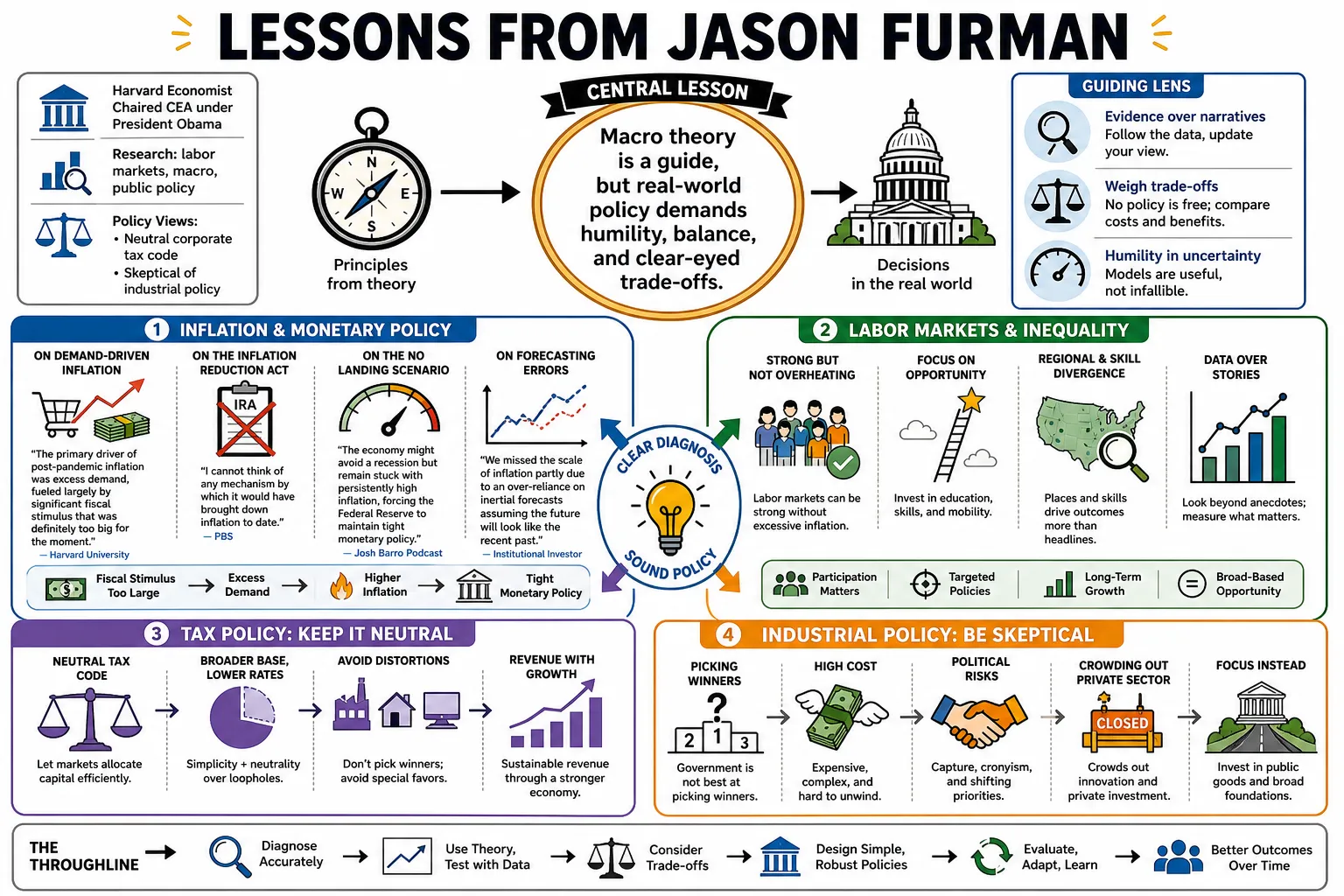
Lessons from Jason Furman
Harvard economist Jason Furman chaired the Council of Economic Advisers under President Obama. He researches labor markets, favors a neutral corporate tax code, and is skeptical of industrial policy. This profile collects his thoughts on how macroeconomic theory applies to actual government decisions.
Part 1: Inflation & Monetary Policy
- On demand-driven inflation: "The primary driver of post-pandemic inflation was excess demand, fueled largely by significant fiscal stimulus that was definitely too big for the moment." — Source: Harvard University
- On the Inflation Reduction Act: "I cannot think of any mechanism by which it would have brought down inflation to date." — Source: PBS
- On the no landing scenario: "The economy might avoid a recession but remain stuck with persistently high inflation, forcing the Federal Reserve to maintain tight monetary policy." — Source: Josh Barro Podcast
- On forecasting errors: "We missed the scale of inflation partly due to an over-reliance on inertial forecasts assuming the future will look like the recent past." — Source: Institutional Investor
- On supply-side narratives: "It is a mistake to view inflation solely as a product of global supply chain disruptions; policymakers underestimated the impact of massive fiscal injections." — Source: Brookings Institution
- On cooling the economy: "Balancing the labor market is important to reaching the Fed’s 2% inflation target." — Source: Brookings Institution
- On political labels: "We should be wary of political labels that promise to reduce inflation without clear, direct mechanisms to do so." — Source: Reddit AMA
- On Federal Reserve independence: "The Federal Reserve’s independence is an essential foundation for maintaining long-term economic stability." — Source: Top1000Funds
- On early intervention: "When confronting inflation, taking fiscal impact seriously from the start is more effective than attempting to course-correct late." — Source: The Unseen and the Unsaid
- On monetary levers: "Monetary and fiscal policy levers remain the primary factors in bringing inflation back under control." — Source: Josh Barro Podcast
Part 2: The Labor Market & Wages
- On healthy labor markets: "A successful labor market goes beyond reaching a target unemployment rate; it must encourage labor force participation and support the creation of quality jobs." — Source: National Archives
- On minimum wage disemployment: "Our view is that zero is a perfectly reasonable estimate of the impact of the minimum wage on employment." — Source: Talking Points Memo
- On raising the wage floor: "I would raise the minimum wage as much as possible. The higher you think the minimum wage should be, the larger is the problem associated with it being too low." — Source: Noahpinion
- On monopsony power: "In markets where employers have significant bargaining power over workers, raising the minimum wage can improve worker outcomes without negative employment effects." — Source: Harvard Magazine
- On making work pay: "The effectiveness of raising the minimum wage at making work pay is a positive that far outweighs what evidence says is a very minor disemployment effect." — Source: Washington Center for Equitable Growth
- On data fixation: "We should avoid drawing major conclusions from a single month of data, as statistics are often noisy and subject to revisions." — Source: Third Way
- On multiple measures: "It is better to use broader indicators, such as the realistic unemployment rate, and compare different data sources like payroll and household surveys." — Source: Harvard University
- On hot labor markets: "When the labor market is too hot, it can drive nominal wage growth to levels inconsistent with Federal Reserve inflation targets." — Source: Peterson Institute for International Economics
- On structural trends: "The aging U.S. population and the retirement of baby boomers are persistent factors exerting downward pressure on labor force participation, independent of the business cycle." — Source: The Hamilton Project
- On algorithmic solutions: "Addressing labor market challenges requires targeted economic policy rather than just focusing on technological shifts or algorithmic solutions." — Source: Economic Innovation Group
Part 3: Economic Growth & Productivity
- On the core of middle-class growth: "Reducing inequality is part of a broader agenda to boost middle-class incomes, which also depends heavily on productivity growth." — Source: National Archives
- On the crisis response: "Being aggressive early with economic policy is necessary because political obstruction tends to increase over time." — Source: Yale University
- On real-world applications: "Real-world applications and the diffusion of technology are what ultimately drive meaningful, lasting productivity gains." — Source: NBER
- On industrial policy: "State-led investments in sectors like microchips can potentially divert resources from their most efficient uses and may act as a net negative for overall economic productivity." — Source: IAI
- On rent control: "Rent control has been about as disgraced as any economic policy in the tool kit." — Source: Los Angeles Times
- On evaluating growth: "While labor force growth has been very good recently, inflation, high interest rates, and real wages remaining below previous trends complicate the economic picture." — Source: Harvard University
- On the limits of policy: "Policy cannot simply mandate faster growth; it must focus on removing barriers to efficient capital allocation." — Source: Harvard University
- On the envy of the world: "We really are right now economically the envy of the world. So it makes a lot of sense that we worry about our problems and figure out what we can do to make it even better." — Source: Conversations with Bill Kristol
- On economic realism: "I don't think I am an economic pessimist regarding investment; I think I am an economic realist." — Source: Conversations with Tyler
Part 4: Artificial Intelligence & Automation
- On the fear of automation: "Fears of machines replacing humans date back centuries, but technology generally creates new jobs and consumer demand even as it disrupts old roles." — Source: PCWorld
- On job transformation: "Rather than taking jobs away, AI will transform tasks, reshape wages, and shift inequality." — Source: NBER
- On human complementarity: "While some jobs may disappear, others will be created, and human labor and machines are often very complementary." — Source: Harvard University
- On the real AI threat: "This is not something we should be afraid of. We should be afraid of not having enough of it to give us the innovation we need for education, for wages, for medical research." — Source: Harvard Kennedy School
- On shaping outcomes: "The impact of AI is not inevitable; it will be heavily shaped by public policy choices." — Source: NBER
- On adaptation programs: "We should implement policies that help workers adapt to labor market changes through training and education, rather than broad interventions like universal basic income." — Source: NBER
- On decentralized regulation: "A single, overarching AI regulator is a mistake; we need a decentralized approach where experts assess the risks within specific sectors." — Source: Harvard Kennedy School
- On macroeconomic impact: "While AI is an exciting area of innovation, its macroeconomic impact has historically been limited and will likely emerge gradually." — Source: National Archives
- On the AI boom: "It is difficult to quantify exactly, but looking at the current developments in artificial intelligence, there is something enormous going on here." — Source: Harvard University
Part 5: Fiscal Policy & The Deficit
- On historical deficit reduction: "During the period of low interest rates, policymakers rightly focused on urgent social problems rather than obsessing over deficits." — Source: NYU
- On fiscal constraints: "Even when borrowing is cheap and easy, policymakers cannot ignore fiscal constraints entirely." — Source: Econlib
- On current deficit levels: "The current U.S. fiscal deficit is shocking, and the nation's fiscal path remains unsustainable." — Source: YouTube
- On debt stabilization: "An adjustment of between 0.7 and 4.6 percent of GDP is necessary to stabilize the current trajectory of the national debt." — Source: Economic Strategy Group
- On unknown risks: "While the traditional risks of debt are known, the unknown unknowns, such as the risk of losing future borrowing capacity, are potentially much more consequential." — Source: Economic Strategy Group
- On super PAYGO: "We should establish strict PAYGO rules to ensure that any new legislation is deficit-neutral or deficit-reducing." — Source: Harvard University
- On entitlement reform: "Addressing the fiscal path requires reforming Social Security and Medicare to eliminate their respective actuarial deficits." — Source: Harvard University
- On primary balance: "The government should set a tangible goal to achieve primary budget balance, excluding interest payments, by the year 2030." — Source: Harvard University
- On tax expiration: "To help stabilize the debt, policymakers must allow expiring tax cuts to lapse or replace them with revenue-increasing reforms." — Source: Harvard University
- On borrowing costs: "We transitioned from an era where the cost of borrowing was essentially zero to one where interest payments represent a rapidly growing share of the budget." — Source: Hoover Institution
Part 6: Tax Policy & Corporate Neutrality
- On tax neutrality: "The organizing principle of business tax reform should be neutrality; the more neutral the tax system is, the better it would be." — Source: National Archives
- On corporate rates: "Raising the corporate tax rate from 21% to 28% is a necessary step to improve long-term revenue collection." — Source: The Hamilton Project
- On expensing and deductions: "We should implement full expensing of business investment while simultaneously disallowing interest deductions to focus taxation on economic rents." — Source: Brookings Institution
- On base broadening: "Requiring large pass-through businesses to file as C corporations and closing wasteful tax loopholes will increase the fairness of the tax base." — Source: The Hamilton Project
- On R&D incentives: "Expanding tax incentives for research and development is vital, as these investments have high social returns that the current code fails to adequately support." — Source: Harvard University
- On the 2017 tax cuts: "The macroeconomic data suggests the impact of the Tax Cuts and Jobs Act on business investment and long-term growth was not much." — Source: Harvard University
- On low revenue: "The U.S. currently collects very low corporate tax revenue compared to its historical average and other advanced economies." — Source: House.gov
- On short-term stimulus: "The primary effect of recent tax cuts was short-term demand stimulation rather than a transformative increase in long-term capital formation." — Source: Tax Policy Center
- On innovation boxes: "Targeted tax breaks like innovation boxes are a step in the wrong direction, compounding existing problems with overseas income while failing to properly incentivize actual innovation." — Source: National Archives
Part 7: The Role of Economic Advising
- On the power to persuade: "The Council of Economic Advisers lacks statutory power and instead must rely entirely on the power to persuade." — Source: Democracy Journal
- On objective insight: "An effective CEA chair must provide useful, objective economic insights to help the President make informed decisions, rather than acting as a political adviser." — Source: Democracy Journal
- On addressing inequality: "By the end of the Obama administration, our policies had achieved some of the most significant investments in reducing inequality since the Great Society era." — Source: The Guardian
- On practical application: "Economic policy is not just about theory; it requires the practical application of economic models in a highly constrained political environment." — Source: UCLA
- On crisis management: "The financial crisis was larger than initially anticipated, proving that quick, decisive action is paramount during severe downturns." — Source: Yale University
- On evaluating evidence: "Policymakers must rely on what the overwhelming bulk of the evidence says rather than selectively choosing studies that support pre-existing political biases." — Source: Washington Center for Equitable Growth
- On institutional knowledge: "The strength of economic advising relies on maintaining institutional memory about what works and what fails across different business cycles." — Source: Harvard University
- On public communication: "Economists have a responsibility to act as foul-weather friends, appearing in the media to explain complex realities when the economic outlook is uncertain." — Source: Josh Barro Podcast
- On balancing priorities: "Advising the President requires constantly linking immediate political demands to the foundational factors of productivity growth, labor force participation, and inequality reduction." — Source: National Archives
Part 8: Political Economy & Markets
- On Kamala Harris's instincts: "Her instincts are just a little bit more towards wanting to pal around with CEOs than labor leaders relative to Joe Biden." — Source: Conversations with Bill Kristol
- On Donald Trump's governance: "There's one Trump, with responsible advisors, who doesn't do anything he says on the campaign and things turn out basically fine." — Source: Conversations with Bill Kristol
- On the risks of populism: "There's another Trump who does follow through, and that could be a downside for growth and a large downside in terms of higher inflation." — Source: Conversations with Bill Kristol
- On neoliberalism: "Shifting too far away from traditional market-oriented economic policies carries the risk of inefficient capital allocation and reduced long-term growth." — Source: IAI
- On state capacity: "The government must recognize its limits in directly managing complex industries, focusing instead on setting the rules of the game." — Source: IAI
- On market competition: "Active competition is the most effective tool we have for ensuring that economic gains are broadly shared among consumers rather than captured by monopolies." — Source: Harvard Magazine
- On international standing: "Our position in the global economy remains remarkably strong, but complacency in the face of structural challenges threatens that advantage." — Source: Conversations with Bill Kristol
- On trade and tariffs: "Broad tariffs act as a regressive tax on consumers and disrupt the precise supply chains that drive modern efficiency." — Source: Peterson Institute for International Economics
- On the limits of executive action: "Lasting economic reform requires legislative consensus; executive orders alone are insufficient to address structural issues like the deficit or tax neutrality." — Source: Yale University