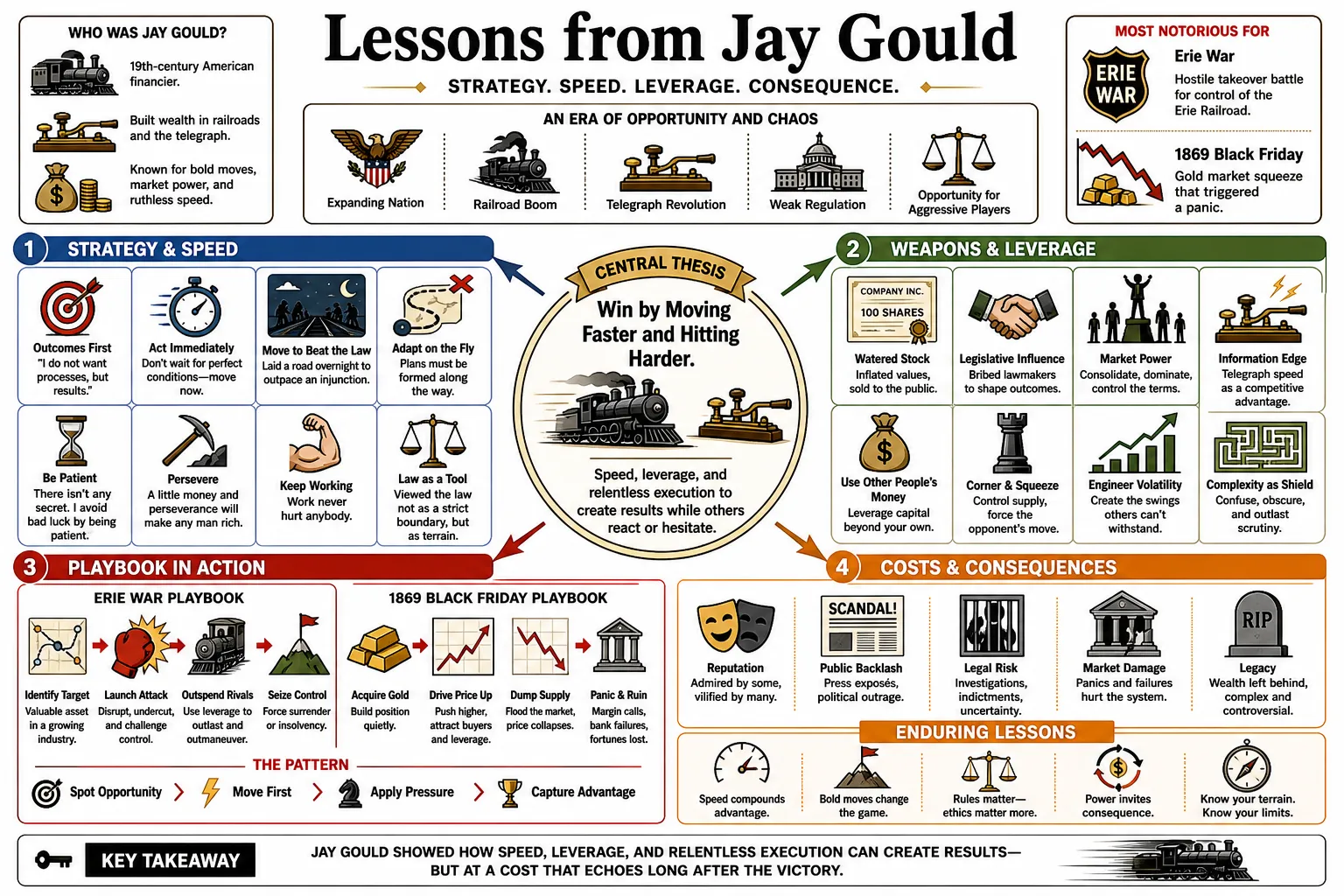
Lessons from Jay Gould
The 19th-century American financier Jay Gould built his fortune consolidating railroads and dominating the telegraph industry. He remains most notorious for his maneuvers during the Erie War and the 1869 Black Friday gold panic. This profile details how he exploited an unregulated economy by watering stock and bribing legislatures, often driving his competitors into ruinous price wars.
Part 1: Strategy and Speed
- On outcomes: "I do not want processes, but results." — Source: [Quoteswise]
- On pacing: "He believed that waiting for perfect conditions was a mistake, preferring to act immediately to force opponents onto the defensive." — Source: [Fall Tide]
- On momentum: "In his early career, he laid a road for a tanning business overnight to outpace a legal injunction, demonstrating that physical motion could override legal delays." — Source: [Fall Tide]
- On adaptability: "Plans must be formed along the way." — Source: [Fall Tide]
- On patience: "There isn't any secret. I avoid bad luck by being patient." — Source: [Quoteswise]
- On persistence: "A little money and perseverance will make any man rich." — Source: [Quoteswise]
- On continuous effort: "Work never hurt anybody." — Source: [Quoteswise]
- On legal boundaries: "He viewed the law not as a strict boundary, but as a framework of obstacles that could be outmaneuvered with speed and political capital." — Source: [Wikipedia]
- On long-term vision: "He bought distressed railroad assets during economic panics, knowing that physical infrastructure would inevitably appreciate when the business cycle recovered." — Source: [Britannica]
Part 2: Capital and Debt
- On starting out: "Without inherited wealth, he traded his labor and management skills for equity, partnering with older men who had capital but lacked energy." — Source: [Fall Tide]
- On capital intensity: "He recognized early that controlling a company did not require owning all of it, just a concentrated, decisive minority stake." — Source: [Deeply Driven]
- On debt: "He used corporate debt aggressively to finance expansion, betting that the increased revenue from a larger network would outpace the interest payments." — Source: [The Business History Conference]
- On market panics: "He saw financial panics as buying opportunities rather than disasters, acquiring the Union Pacific railroad when its stock crashed." — Source: [PBS]
- On stock watering: "He diluted the value of existing shares by issuing new stock without corresponding assets, using the new paper to fend off hostile takeovers." — Source: [History.com]
- On physical assets: "While he manipulated paper stocks, he fundamentally understood that real power lay in owning the physical rails and telegraph wires that connected markets." — Source: [University of Houston]
- On risk distribution: "He preferred to risk other people's money whenever possible, keeping his personal assets insulated from his more speculative corporate raids." — Source: [Fall Tide]
- On liquidity: "During the 1873 panic, he maintained enough cash on hand to avoid ruin, allowing him to dictate terms to desperate competitors." — Source: [PBS]
- On valuation: "He rarely cared about a company's past earnings; he valued businesses based on the damage they could do to a competitor if he controlled them." — Source: [The Robber Barons)]
- On scale: "He understood that fixed costs in railroading meant that whoever controlled the most track could offer the lowest rates and starve competitors of capital." — Source: [Britannica]
Part 3: Disruption and Competition
- On pricing wars: "He slashed telegraph rates ruthlessly to bleed established monopolies, knowing he could absorb short-term losses better than they could." — Source: [Vibe NYC Tours]
- On parallel infrastructure: "When a competitor refused to sell at his price, he would threaten to build a parallel railroad line directly next to theirs to destroy their margins." — Source: [Wikipedia]
- On monopoly: "He fought monopolies not out of moral objection, but because he wanted to replace them with his own consolidated systems." — Source: [The Business History Conference]
- On unpredictability: "He frequently changed his position in the stock market from long to short, making it impossible for rivals to guess his true financial exposure." — Source: [PBS]
- On forcing errors: "By moving faster than the established cartels, he forced them into reactive, poorly planned defensive maneuvers." — Source: [Fall Tide]
- On weakening rivals: "He bought newspapers, such as the New York World, specifically to attack the reputations of his business competitors." — Source: [PBS]
- On geographic chokepoints: "He focused on acquiring the terminal facilities in major cities, knowing that owning the tracks meant nothing if trains had nowhere to unload." — Source: [The Robber Barons)]
- On consumer benefit: "Though motivated purely by profit, his aggressive price-cutting inadvertently lowered shipping costs across the country, spurring broader economic growth." — Source: [Engelsberg Ideas]
- On wearing down opponents: "He was willing to endure years of litigation and public hatred if it meant ultimately exhausting a rival's legal budget." — Source: [History.com]
Part 4: Information and Secrecy
- On inside information: "He bought control of Western Union largely because it gave him the ability to monitor the private telegraph communications of his rivals." — Source: [University of Houston]
- On misdirection: "He frequently leaked false rumors to the press to drive down the price of stocks he secretly intended to buy." — Source: [PBS]
- On silence: "He rarely gave interviews and preferred to let his actions on the stock exchange speak for him, denying enemies the advantage of knowing his thoughts." — Source: [The Robber Barons)]
- On personal networks: "He maintained a tight circle of brokers who executed his trades in small batches to mask his total market position." — Source: [PBS]
- On reading the tape: "He spent hours silently watching the ticker tape, developing an intuitive sense for when artificial manipulation was driving a stock's price." — Source: [The Robber Barons)]
- On government intelligence: "During the gold ring scheme, he attempted to bribe the President's brother-in-law to gain advance notice of federal gold sales." — Source: [Texas.gov]
- On corporate espionage: "He placed loyal operatives in lower-level management positions at rival railroads to report on their freight volumes and expansion plans." — Source: [The Robber Barons)]
- On controlling the narrative: "When his physical safety was threatened, he hired armed guards but kept them hidden to project an image of unbothered control." — Source: [American Aristocracy]
- On written records: "He preferred to give instructions verbally, minimizing the paper trail that legislative committees could later use against him." — Source: [The Robber Barons)]
Part 5: Tactics in the Erie War
- On fighting scale: "When Cornelius Vanderbilt tried to buy the Erie Railroad out from under him, he realized he could not match Vanderbilt's cash, so he changed the rules of the game." — Source: [Wikipedia]
- On infinite supply: "He and his partners simply printed new, unauthorized shares of Erie stock faster than Vanderbilt could buy them." — Source: [Vibe NYC Tours]
- On legal jurisdiction: "When New York judges ruled against him, he fled across the river to New Jersey, taking the corporate books and millions in cash with him." — Source: [Wikipedia]
- On legislative bribery: "Realizing the law was against him, he traveled to Albany with a suitcase of cash and successfully bribed the state legislature to legalize his illegal stock issuance retroactively." — Source: [American Aristocracy]
- On exploiting loopholes: "He argued that the Erie charter allowed the board to issue convertible bonds for railroad improvements, which he then immediately converted to stock." — Source: [Vibe NYC Tours]
- On physical defense: "During the standoff in New Jersey, he fortified his hotel headquarters with armed guards and cannons, turning a corporate dispute into a physical siege." — Source: [Wikipedia]
- On settling disputes: "Instead of destroying Vanderbilt completely, he negotiated a truce that refunded Vanderbilt's money in exchange for leaving Gould in control of the railroad." — Source: [Wikipedia]
- On ruthlessness: "He demonstrated that in an unregulated environment, the party willing to act with the least moral restraint holds the tactical advantage." — Source: [History.com]
- On financial attrition: "He kept Vanderbilt tied up in injunctions and counter-injunctions until the older man grew exhausted with the legal fees." — Source: [Wikipedia]
- On public opinion: "He completely ignored public outrage over the Erie War, focusing solely on the math of the share count and the votes of the legislature." — Source: [The Robber Barons)]
Part 6: Consolidation and Systems
- On national networks: "He envisioned a transcontinental system controlled by a single entity, recognizing that fragmented, regional railroads were inefficient." — Source: [University of Houston]
- On rate wars: "He used rate wars to hurt competitors and to force them to the negotiating table to agree to regional traffic-sharing pools." — Source: [Britannica]
- On vertical integration: "He sought to own the telegraph lines that ran alongside his tracks, controlling both the movement of physical goods and the data that coordinated them." — Source: [Shelf Awareness]
- On systemic risk: "His attempt to corner gold in 1869 was built on the premise that controlling a single, vital input could allow him to dictate the price of all agricultural exports." — Source: [PBS]
- On structural advantages: "He focused heavily on the Southwest, building a rail empire in a region where he faced less entrenched competition than in the Northeast." — Source: [Wikipedia]
- On asset stripping: "When a railroad could not be saved, he was known to strip its valuable assets and let the hollowed-out corporate shell fall into receivership." — Source: [The Robber Barons)]
- On administrative control: "Unlike many speculators, he actually learned the operational details of running a railroad, allowing him to cut costs effectively." — Source: [Wikipedia]
- On the telegraph: "He recognized early that the telegraph was the nervous system of modern business, and capturing Western Union gave him power over the entire economy." — Source: [University of Houston]
- On unifications: "By combining the Union Pacific, the Missouri Pacific, and other lines, he created a system that accounted for over ten thousand miles of track." — Source: [Wikipedia]
Part 7: Human Nature and Alliances
- On domestic life: "Every man has natural inclinations of his own. Mine are domestic. They are not calculated to make me particularly popular in Wall Street, and I cannot help that." — Source: [Wikiquote]
- On betrayal: "He frequently turned on his own business partners when it suited his financial interests, viewing alliances as strictly temporary conveniences." — Source: [PBS]
- On judging character: "He assumed that politicians and judges were inherently venal, treating bribes simply as another cost of doing business." — Source: [American Aristocracy]
- On working with rivals: "He was willing to partner with former bitter enemies, such as J.P. Morgan, if a mutual profit could be engineered." — Source: [Wikipedia]
- On vulnerability: "He exploited the personal financial weaknesses of his competitors, striking when he knew their cash reserves were tied up in other ventures." — Source: [The Robber Barons)]
- On isolation: "His ruthless methods resulted in his exclusion from New York high society, a rejection he largely ignored in favor of spending time with his family." — Source: [Wikipedia]
- On loyalty: "He demanded absolute loyalty from his subordinates but offered very little in return beyond financial compensation." — Source: [The Robber Barons)]
- On public relations: "He vastly underestimated the human cost of his actions, failing to foresee that his market corners would destroy the livelihoods of ordinary farmers." — Source: [PBS]
- On sentimentality: "He viewed business as a cold mathematical equation, deliberately removing emotion and personal animosity from his strategic calculations." — Source: [Wikipedia]
Part 8: Public Perception and Legacy
- On infamy: "He calmly accepted his status as the most hated man in America, refusing to apologize for his wealth or his methods." — Source: [Wikipedia]
- On press attacks: "He believed that negative press was largely irrelevant as long as he maintained voting control of his corporations." — Source: [The Robber Barons)]
- On philanthropy: "Unlike Carnegie or Rockefeller, he gave relatively little to public charities, preferring to keep his wealth concentrated within his immediate family." — Source: [History.com]
- On systemic flaws: "His career highlighted the severe lack of federal oversight in the 19th century, serving as a primary catalyst for the creation of the Interstate Commerce Act." — Source: [The Business History Conference]
- On wealth preservation: "He structured his estate carefully, ensuring his fortune was passed to his children intact, insulated from the claims of his many enemies." — Source: [Wikipedia]
- On physical decline: "Despite his immense wealth, his health suffered from the constant stress of his business battles, leading to an early death from tuberculosis." — Source: [Britannica]
- On market regulation: "His ability to corner the gold market proved that the financial system was too fragile to operate without central banking interventions." — Source: [Texas.gov]
- On posthumous reputation: "For decades after his death, historians used his name as shorthand for unchecked corporate greed and market manipulation." — Source: [PBS]
- On economic acceleration: "Modern historians acknowledge that his brutal competitive tactics forced the rapid modernization and price deflation of the American transportation network." — Source: [Engelsberg Ideas]
- On the nature of capital: "His life demonstrated that in a pure free market, the individual who combines capital with total operational ruthlessness will inevitably consume his competitors." — Source: [Wikipedia]