Jean-Denis Grèze is the former Chief Technology Officer at Plaid and current co-founder and CEO of the AI-driven tax startup Town. He is known for practical frameworks on engineering leadership, specifically his advocacy for "spiky" organizational design and probabilistic management. This overview catalogs his public commentary on hiring, scaling infrastructure, and managing technical teams.
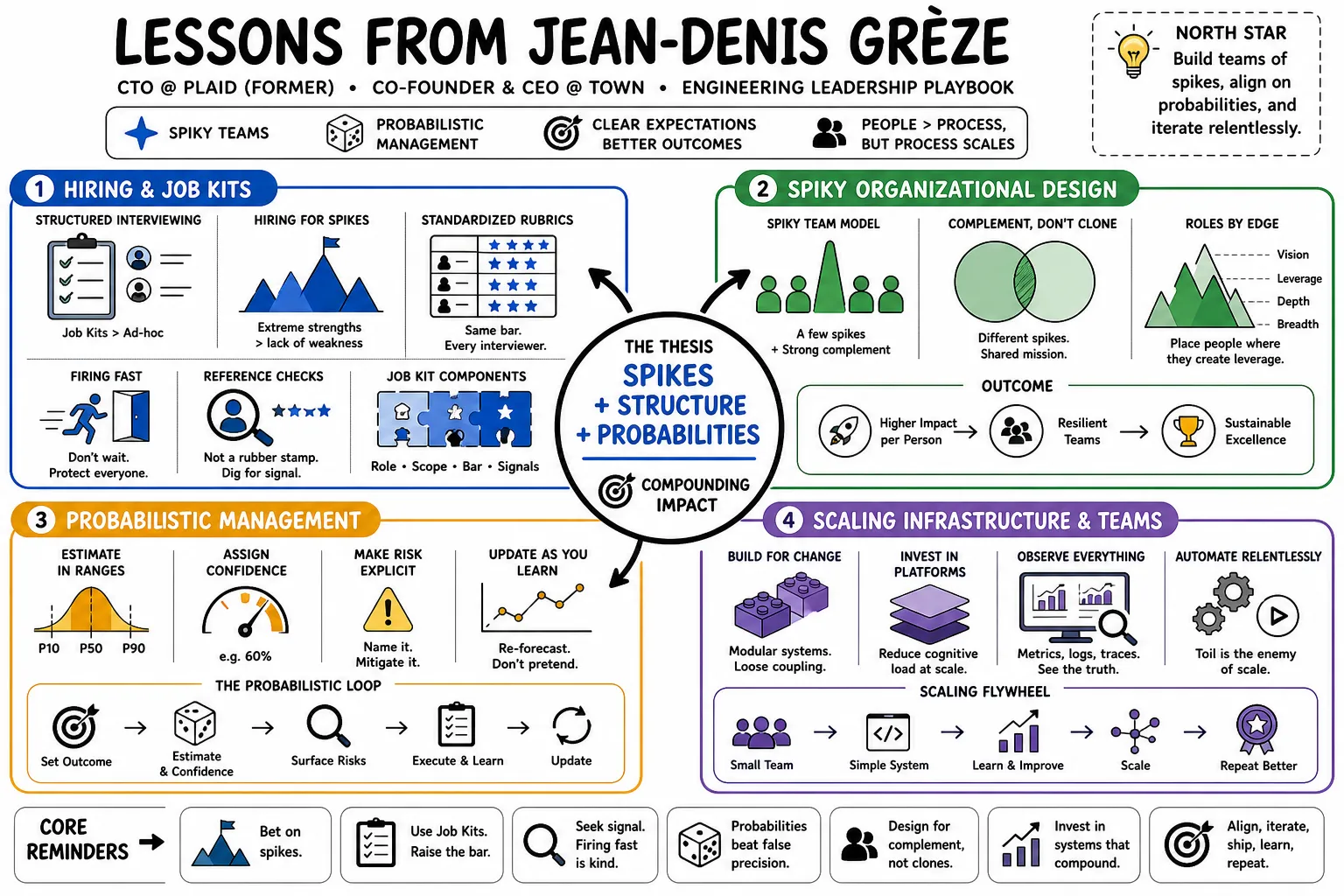
Part 1: Hiring and Job Kits
- On structured interviewing: "The traditional technical interview is broken; we need structured 'Job Kits' to standardise what we are actually testing for." — Source: Hatchways Podcast
- On hiring for spikes: "Don't hire for lack of weakness. Hire for extreme strengths and build teams that complement the inevitable gaps." — Source: ELC Podcast
- On standardizing rubrics: "A Job Kit ensures every interviewer understands the role's precise expectations, eliminating bias from ad-hoc questioning." — Source: Hatchways Podcast
- On firing fast: "If you know someone is not working out, waiting only hurts the team, the company, and the individual's long-term career." — Source: 20VC
- On reference checks: "References are not a rubber stamp. They are your best tool for understanding how to manage the person once they join." — Source: 20VC
- On open-sourcing hiring tools: "Sharing our Job Kits publicly forced us to hold ourselves to a higher standard and helped the broader engineering community improve." — Source: Hatchways Podcast
- On candidate experience: "Treat the interview process as the first stage of employee onboarding. How you interview is how they expect you to work." — Source: First Round Review
- On technical tests: "Take-home tests only work if they reflect the actual day-to-day work, otherwise they are just gatekeeping." — Source: Hatchways Podcast
- On identifying leaders: "Look for engineers who naturally gravitate toward the unglamorous work of unblocking others." — Source: First Round Review
- On interview signaling: "If a candidate focuses more on titles than on the impact of the work during the interview, it is often a red flag for a scaling startup." — Source: 20VC
Part 2: Building a Culture of Ownership
- On true autonomy: "Autonomy does not mean working on whatever you want; it means having total ownership over how you solve a tightly defined business problem." — Source: First Round Review
- On the reality of infrastructure: "The most critical engineering work is often the least glamorous. Celebrate the people maintaining the hidden systems." — Source: First Round Review
- On avoiding blame: "A strong engineering culture looks at a failure and asks what broke in our system rather than who broke the system." — Source: Modern CTO
- On aligning incentives: "You get the behavior you reward. If you want ownership, you have to promote based on sustained impact, not just shipping features." — Source: First Round Review
- On scaling culture: "Culture is not what you write on the wall; it is the behavior you tolerate when things get stressful." — Source: 20VC
- On engineering at Plaid: "We prioritized autonomy to move quickly across a highly fragmented financial ecosystem, even if it meant absorbing coordination costs later." — Source: First Round Review
- On managing technical debt: "Technical debt is a tool. You take it on intentionally to buy time, but you must have a concrete plan to pay it down before it bankrupts your roadmap." — Source: Software Engineering Daily
- On cross-functional trust: "Engineers must sit next to product managers and designers from day one. Silos destroy the shared sense of ownership." — Source: First Round Review
- On long-term sustainability: "Burning out your team to hit a quarterly goal is a failure of leadership. Ownership includes pacing." — Source: Simple Leadership
- On decision making: "Push decisions down to the lowest possible level. The people writing the code usually have the most accurate context." — Source: First Round Review
Part 3: Designing Spiky Organizations
- On defining spikiness: "A spiky organization intentionally over-invests in a few critical areas of excellence while accepting mediocrity in areas that do not matter right now." — Source: ELC Podcast
- On the myth of balance: "Striving for uniform excellence across every department simultaneously is a recipe for moving too slowly." — Source: ELC Podcast
- On rotating focus: "You do not stay spiky in the same area forever. Over years, you shift your organizational spikes to build broad capabilities sequentially." — Source: ELC Podcast
- On isolation strategy: "If you need a new capability to thrive, sometimes you have to isolate that team from the rest of the company so they are not bogged down by existing processes." — Source: ELC Podcast
- On managing gaps: "When you choose a spike, you are choosing a gap. Leaders must communicate clearly why a certain gap is acceptable temporarily." — Source: ELC Podcast
- On distinct values: "Isolated, high-priority business units might need to operate with completely different metrics and rhythms than your core product teams." — Source: ELC Podcast
- On applying shocks: "Occasionally, an organization needs a structural shock to break complacency and build a new spike." — Source: ELC Podcast
- On resource allocation: "You cannot sprinkle headcount evenly. You have to aggressively funnel resources into your spikes to achieve escape velocity." — Source: ELC Podcast
- On communicating strategy: "Engineers are smart. If you explain the strategic reason for an organizational imbalance, they will usually support it." — Source: ELC Podcast
- On adapting to growth: "What makes you spiky at 100 people will break your company at 1,000 people. You have to continually redesign the organization." — Source: ELC Podcast
Part 4: Probabilistic Management
- On deterministic illusions: "Management is not deterministic. You cannot build a perfect process that prevents every bug, resignation, or missed deadline." — Source: Medium
- On probabilistic thinking: "Instead of trying to stop all failures, build systems that reduce the probability of failure and minimize the blast radius when it happens." — Source: Medium
- On inevitable bad weeks: "Everybody has two bad weeks a year. Your organizational system must be resilient enough to absorb normal human fluctuations without collapsing." — Source: Medium
- On handling turnover: "People will leave. A probabilistic manager ensures documentation and cross-training exist so that no single departure is a catastrophe." — Source: Medium
- On evaluating risks: "When making technical choices, ask what the probability is that this scales for the next 18 months rather than asking if it will scale forever." — Source: Modern CTO
- On emotional resilience: "Accepting that things will go wrong probabilistically reduces the emotional toll on engineering leaders when they inevitably do." — Source: Medium
- On process weight: "Heavy processes are usually attempts to drive failure rates to zero. It is often cheaper to accept a low failure rate and fix issues quickly." — Source: Medium
- On continuous mitigation: "Leadership is a constant exercise in identifying the highest-probability risks and nudging the odds in your favor." — Source: Medium
- On celebrating recovery: "Reward the teams that detect and recover from failures rapidly, not just the ones that never seem to fail at all." — Source: Medium
Part 5: Engineering Mobility and Growth
- On operationalizing mobility: "You have to build structural pathways for engineers to move between teams. If it is ad-hoc, only the loudest people get opportunities." — Source: Modern CTO
- On retaining top talent: "The best engineers get bored. If you do not offer them internal mobility, they will find their next challenge at another company." — Source: Modern CTO
- On cross-pollination: "Rotating engineers across business units spreads best practices naturally and breaks down tribal knowledge." — Source: Modern CTO
- On manager hoarding: "Leaders must be measured by how well they export talent to the rest of the company, not just how well they guard their own team." — Source: First Round Review
- On continuous learning: "Mobility forces engineers to learn new codebases and paradigms, which fundamentally makes them better architects." — Source: Modern CTO
- On onboarding efficiency: "When internal transfers happen, it pressure-tests your onboarding documentation. If it takes a month for an internal transfer to commit code, your docs are broken." — Source: Modern CTO
- On career trajectories: "Not everyone needs to become a manager to grow. We must provide distinct, highly respected tracks for individual contributors." — Source: First Round Review
- On forced changes: "Sometimes you need to move people around just to ensure the system is resilient and that knowledge is not locked in one person's head." — Source: ELC Podcast
- On psychological safety: "Engineers must feel safe raising their hand for a new role without fear that their current manager will view it as a betrayal." — Source: Modern CTO
Part 6: Scaling FinTech and Product UX
- On API as a product: "When your product is an API, the developer experience is your user experience. It has to be flawless." — Source: Software Engineering Daily
- On security first: "In fintech, security and privacy cannot be features you add later. They have to be the foundation upon which everything else is built." — Source: Fintech Leaders
- On the UX moat: "People overstate UX as a moat. Great UX is table stakes; true defensibility comes from the depth and reliability of your infrastructure." — Source: 20VC
- On handling fragmentation: "The financial system is incredibly fragmented. The engineering challenge is abstracting that chaos into a simple, predictable interface." — Source: Software Engineering Daily
- On privacy engineering: "Do not take shortcuts with user data. Privacy engineering requires strict, systematic management of access and retention." — Source: Modern CTO
- On financial connectivity: "Our goal was to make connecting a bank account as seamless as logging in with an email address." — Source: Tearsheet
- On scaling operations: "Hyper-growth means rebuilding your systems while you are flying the plane. You have to over-communicate changes to the engineering team." — Source: Tearsheet
- On building for trust: "Consumers will not use financial products they do not trust. Engineering's job is to ensure that trust is never broken at the system level." — Source: Fintech Leaders
- On long-term roadmaps: "In infrastructure, you have to plan years ahead while delivering value every quarter. It is a difficult balance of pacing." — Source: Tearsheet
Part 7: Transitioning from Operator to Founder
- On leaving Plaid: The Digits episode frames Greze as a former Plaid CTO who moved back into company-building as co-founder of Town, shifting from scaled fintech infrastructure to a new AI-tax startup. — Reference: Between Two Founders episode with Jean-Denis Greze
- On founder mentality: Greze's post-Plaid arc is presented as a return to first-principles company building: defining the problem, shaping the product, and proving whether AI-driven tax infrastructure can serve small businesses. — Reference: Between Two Founders episode with Jean-Denis Greze
- On zero-to-one engineering: The Digits profile describes Greze discussing developer products, fintech infrastructure, and AI-driven tax solutions, a mix that favors fast validation over premature organizational complexity. — Reference: Between Two Founders episode with Jean-Denis Greze
- On raising capital: Town's positioning around AI-driven tax solutions for small businesses shows why early funding matters: the company is pursuing a regulated, complex problem that requires product, compliance, and trust work from the start. — Reference: Between Two Founders episode with Jean-Denis Greze
- On hiring the first team: Greze's background scaling Plaid and building developer-facing systems makes early hiring a culture-setting decision, especially for a startup combining fintech, AI, and accounting workflows. — Reference: Between Two Founders episode with Jean-Denis Greze
- On shedding titles: "Titles mean nothing at a startup. You are successful only if the product finds product-market fit." — Source: 20VC
- On market selection: The Digits episode summarizes Town as an AI-driven tax solution for small businesses, which grounds Greze's market choice in a painful, recurring financial workflow rather than a novelty use case. — Reference: Between Two Founders episode with Jean-Denis Greze
- On leaning on experience: Greze's experience as former Plaid CTO and his broader fintech-infrastructure work give him a practical lens on what reliable financial software needs before it can scale. — Reference: Between Two Founders episode with Jean-Denis Greze
- On the emotional shift: Moving from senior operator to co-founder changes the ownership burden: Greze is now responsible for Town's product direction, market proof, and company-building choices, not only the technical system. — Reference: Between Two Founders episode with Jean-Denis Greze
Part 8: AI and the Future of Tax
- On the ultimate AI challenge: In Sasha Orloff's interview, Greze discusses tax as an AI challenge for SMBs because the work combines structured rules, messy documents, and high-stakes financial accuracy. — Reference: Tech Finance interview with Jean-Denis Greze
- On augmenting humans: Greze presents the opportunity as helping tax and accounting professionals work through complexity faster, not simply removing human judgment from a sensitive financial workflow. — Reference: Tech Finance interview with Jean-Denis Greze
- On LLMs in Fintech: "Large Language Models have reached a tipping point where they can accurately parse financial documents that previously required human eyes." — Source: Fintech Leaders
- On SMB pain points: The Tech Finance episode positions Town around SMB tax pain: small businesses need help with a recurring, complex process that larger companies can often attack with more resources. — Reference: Tech Finance interview with Jean-Denis Greze
- On accuracy constraints: Greze's tax-AI framing makes accuracy central because financial and tax workflows cannot tolerate casual hallucination; automation has to be paired with controls and reviewable output. — Reference: Tech Finance interview with Jean-Denis Greze
- On data digestion: Greze's AI-tax argument depends on turning receipts, statements, invoices, and other business records into usable tax context without making owners manually reconstruct every detail. — Reference: Tech Finance interview with Jean-Denis Greze
- On market disruption: Town sits at the intersection of fintech infrastructure, developer-product experience, and AI-native tax work, which makes the category plausible for a new operating model rather than a thin software wrapper. — Reference: Between Two Founders episode with Jean-Denis Greze
- On building Town: Greze describes Town as an AI-powered tax solution for SMBs, aimed at reducing the complexity small-business owners face around tax and financial compliance. — Reference: Tech Finance interview with Jean-Denis Greze
- On the future of software: "Every piece of B2B software over the next decade will be rewritten to be AI-first. Tax is just where the impact is most immediate." — Source: Fintech Leaders