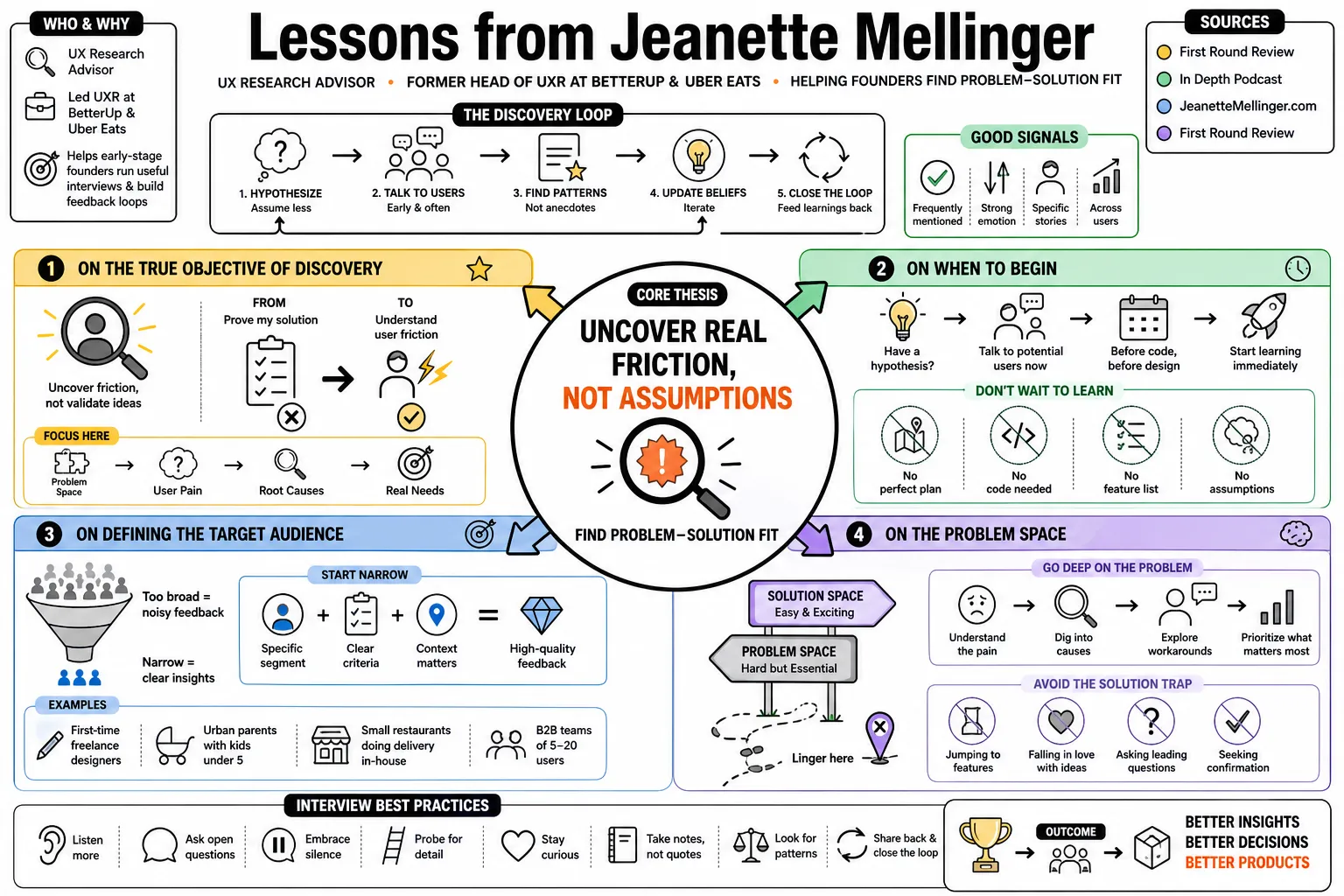
Lessons from Jeanette Mellinger
Jeanette Mellinger is a user experience research advisor who previously led UXR at BetterUp and Uber Eats. She helps early-stage founders run useful customer interviews and build reliable feedback loops. This compilation gathers her frameworks for getting past assumptions to find actual problem-solution fit.
Part 1: Early-Stage Customer Discovery
- On the true objective of discovery: "Discovery is fundamentally about uncovering the actual friction points users experience, rather than searching for evidence that your proposed solution is correct." — Source: First Round Review
- On when to begin: "The moment you have a hypothesis about a market need is the moment you should start talking to potential users, long before writing a single line of code." — Source: In Depth Podcast
- On defining the target audience: "Start with a narrow, highly specific user segment. Broadening your audience too early dilutes the quality of the feedback you receive." — Source: JeanetteMellinger.com
- On the problem space: "Founders naturally gravitate toward the solution space. Force yourself to linger in the problem space until you deeply understand the user's pain." — Source: First Round Review
- On embracing uncertainty: "Approach early conversations with a genuine sense of curiosity and a willingness to have your core assumptions challenged." — Source: In Depth Podcast
- On the danger of assuming: "Operating on untested assumptions is the fastest way to build a product nobody wants. Every assumption needs to be treated as a hypothesis to validate." — Source: First Round Review
- On risk mitigation: "Think of user research in the early days not as a slow-down mechanism, but as the most effective way to de-risk your business model." — Source: First Round Review
- On casual validation: "Friends and family will tell you your idea is great. Real discovery requires systematic inquiry with people who have no vested interest in your feelings." — Source: In Depth Podcast
- On narrow focus: "A common mistake is trying to solve three problems at once. Find the one acute pain point and ignore the rest until you solve it." — Source: First Round Review
- On extreme behaviors: "Pay attention to the users who have built elaborate, duct-taped workarounds. They represent the clearest signal of an unmet need." — Source: First Round Review
Part 2: Structuring User Interviews
- On question design: "Frame questions so they cannot be answered with a simple yes or no. You want the user to tell you a story." — Source: In Depth Podcast
- On leading questions: "If you ask a user if they would use a feature, they will usually say yes. Ask them how they currently handle the task instead." — Source: First Round Review
- On past behavior: "The best predictor of future behavior is past behavior. Focus the interview on specific, recent instances where they encountered the problem." — Source: In Depth Podcast
- On root causes: "When a user mentions a frustration, ask why repeatedly until you hit the underlying emotional or functional driver." — Source: First Round Review
- On the use of silence: "After a user finishes a thought, wait three seconds before speaking. That silence often prompts them to reveal the most valuable insight of the interview." — Source: In Depth Podcast
- On interview scripts: "Write a discussion guide to ensure you cover your core topics, but treat it as a map, not a script. Follow the interesting tangents." — Source: First Round Review
- On asking for examples: "Whenever a user makes a general statement about their frustration, ask them to walk you through a specific time they felt that way." — Source: First Round Review
- On hypothetical answers: "Discount any feedback that starts with what a user would do. Anchor them back to what they actually did last Tuesday." — Source: In Depth Podcast
- On note-taking: "If possible, have a dedicated note-taker or record the session. The interviewer should be entirely focused on active listening and reading body language." — Source: First Round Review
- On ending the session: "Always conclude by asking what you should have asked them but didn't. It often yields insights you hadn't even considered." — Source: In Depth Podcast
Part 3: Achieving Problem-Solution Fit
- On defining the fit: "Problem-solution fit happens when you have clear evidence that the problem is real, and the target audience agrees your proposed solution actually addresses it." — Source: First Round Review
- On symptoms versus causes: "If you build a solution for a symptom, the fix is temporary. If you solve the root cause, you build a lasting product." — Source: First Round Review
- On the intensity of the problem: "You are looking for urgent problems. If the user only finds the issue mildly annoying, they won't go through the friction of adopting your solution." — Source: In Depth Podcast
- On frequency: "A severe problem that happens once a year is hard to build a habit-forming business around. Look for high frequency combined with high friction." — Source: First Round Review
- On evaluating workarounds: "The best validation of a problem is discovering that users are spending time or money hacking together their own imperfect solutions." — Source: First Round Review
- On willingness to pay: "Don't ask what they would pay. Find out what they are currently paying to solve the problem, whether in dollars or hours." — Source: In Depth Podcast
- On alignment with vision: "Ensure the problem you are solving aligns with the company you want to build. You can find problem-solution fit for something you hate doing." — Source: JeanetteMellinger.com
- On false positives: "Enthusiasm during an interview is a false positive. True validation is the user asking when they can start using the product." — Source: First Round Review
- On knowing when to pivot: "If you conduct twenty interviews and the problem doesn't consistently resonate, it is time to adjust the hypothesis, not force the solution." — Source: In Depth Podcast
Part 4: Testing and Validation Frameworks
- On prototyping early: "A prototype doesn't need to be coded. A sketch, a slide deck, or a clickable mockup is enough to start gathering directional feedback." — Source: First Round Review
- On low-fidelity testing: "Presenting unpolished, low-fidelity designs encourages users to give honest, critical feedback because it doesn't look like a finished product." — Source: First Round Review
- On validation thresholds: "Before you run a test, define exactly what metric or outcome will convince you to move forward. Do this before you see the results." — Source: In Depth Podcast
- On competitive evaluation: "Ask users to show you how they use competing products. Watching them navigate the flaws of alternatives highlights your opportunity." — Source: First Round Review
- On behavior versus intent: "What people say they will do and what they actually do are rarely the same. Design tests that require users to take a real action, like giving an email address." — Source: First Round Review
- On landing page tests: "A landing page test measures initial interest, but it doesn't prove you can deliver the value. It is the beginning of validation, not the end." — Source: In Depth Podcast
- On concierge minimum viable products: "Manually performing the service for your first users is highly unscalable, but it provides the deepest understanding of the mechanics required to solve the problem." — Source: First Round Review
- On speed in testing: "The goal of early testing is learning velocity. If a test takes a month to build, it is too complex for this stage." — Source: First Round Review
- On iterating on feedback: "Don't change your entire strategy based on one user's feedback. Look for patterns across multiple sessions before making a structural change." — Source: In Depth Podcast
Part 5: Managing Founder Bias
- On confirmation bias: "Founders subconsciously highlight feedback that supports their idea and ignore feedback that challenges it. You have to actively fight this instinct." — Source: First Round Review
- On falling in love with the solution: "Fall in love with the problem. If you marry your solution, you will miss the signals that it isn't working." — Source: In Depth Podcast
- On conversational discipline: "Stop pitching during discovery interviews. If you spend more than twenty percent of the time talking, you are doing it wrong." — Source: First Round Review
- On listening to dissent: "The users who don't understand your product are often more valuable than the ones who do. Dig into their confusion." — Source: First Round Review
- On separating ego from ideas: "Treat your ideas as hypotheses held loosely. Your self-worth shouldn't be tied to whether a specific feature works out." — Source: In Depth Podcast
- On the sunk cost fallacy: "Just because you spent two weeks building a prototype doesn't mean you should keep going if the user feedback is universally poor." — Source: First Round Review
- On polite encouragement: "Hearing polite encouragement and interpreting it as market demand is a fatal error. Distinguish between politeness and genuine need." — Source: In Depth Podcast
- On seeking invalidation: "Structure your questions to actively try to break your idea. If it survives the stress test, you have something real." — Source: First Round Review
- On maintaining objectivity: "After an interview, write down the facts before you write down your interpretations. Keep the raw data separate from your conclusions." — Source: First Round Review
Part 6: Integrating UXR into Product Teams
- On the first research hire: "Don't wait until you have a massive product team to hire a researcher. The earlier you integrate UXR, the less technical debt you accumulate from bad assumptions." — Source: JeanetteMellinger.com
- On cross-functional collaboration: "Research shouldn't happen in a silo. Invite engineers and product managers to sit in on user interviews so they hear the pain directly." — Source: First Round Review
- On democratizing research: "A single researcher cannot handle every question. Teach product managers the basics of interviewing so they can run their own lightweight evaluative research." — Source: In Depth Podcast
- On internal education: "Part of a UX researcher's job is internal marketing. You have to consistently show the team the return on investment of talking to users." — Source: First Round Review
- On balancing speed and rigor: "Academic research prioritizes absolute certainty; startup research prioritizes speed and risk reduction. Know when good enough data is sufficient to make a decision." — Source: In Depth Podcast
- On strategic partnership: "Research should inform the product roadmap, not just validate features after they have already been decided." — Source: First Round Review
- On overcoming resistance: "If a team resists research, start small. Run a quick usability test that highlights an obvious flaw, and use that win to build trust." — Source: First Round Review
- On scaling operations: "As the company grows, invest in research ops early. Managing participant recruitment and incentives becomes a bottleneck very quickly." — Source: JeanetteMellinger.com
- On embedding researchers: "Researchers embedded within specific product squads develop deeper domain expertise than those operating as a centralized agency." — Source: First Round Review
- On defining impact: "Measure the success of UXR not by the number of reports generated, but by the number of product decisions that were changed or accelerated by user data." — Source: First Round Review
Part 7: Synthesizing and Acting on Data
- On organizing raw notes: "Schedule fifteen minutes immediately after an interview to clean up your notes and capture the highest-level takeaways while they are fresh." — Source: In Depth Podcast
- On finding patterns: "Synthesis is about looking for the repeating behaviors across multiple interviews, rather than indexing heavily on one loud user." — Source: First Round Review
- On actionable insights: "An insight is useless if it doesn't imply an action. Translate your findings into clear recommendations for the product team." — Source: First Round Review
- On analysis paralysis: "You will rarely have absolute certainty. Synthesize until you have strong directional confidence, then ship and learn from reality." — Source: In Depth Podcast
- On sharing findings: "Nobody wants to read a forty-page research report. Distill the findings into a concise, easily digestible format like a quick video or a short slide deck." — Source: First Round Review
- On building a repository: "Create a centralized, searchable database for research findings. Insights from six months ago might answer a question the team has today." — Source: First Round Review
- On the role of personas: "Use personas to align the team on who you are building for, but ensure they are based on actual behavioral data, not fictional stereotypes." — Source: JeanetteMellinger.com
- On tracing insights: "Always link your synthesized conclusions back to raw quotes or video clips. This builds credibility and allows the team to verify the context." — Source: First Round Review
- On visualizing data: "Use journey maps or service blueprints to visually demonstrate the friction points in the user's current workflow." — Source: First Round Review
Part 8: Continuous Discovery
- On the shift to continuous discovery: "Customer discovery is not a phase you complete and move on from. It is a continuous habit that persists through the entire lifecycle of the company." — Source: First Round Review
- On building habits: "Commit to talking to at least one customer every week, regardless of how busy the team gets. It prevents you from drifting away from reality." — Source: In Depth Podcast
- On the AI era: "As generative tools make it easier to build and ship fast, the competitive advantage shifts to those who have the deepest, most accurate understanding of the user's problem." — Source: JeanetteMellinger.com
- On adapting to change: "User needs are not static. Continuous discovery allows you to detect shifts in behavior and market conditions before your competitors do." — Source: First Round Review
- On post-launch research: "Launching a feature is the beginning of the next research phase. Now you have to observe how they use it in the wild." — Source: First Round Review
- On keeping a pulse: "Set up passive feedback channels, like in-app surveys or support ticket reviews, to complement your active user interviews." — Source: In Depth Podcast
- On feedback loops: "Ensure there is a tight feedback loop between the insights gathered in continuous discovery and the prioritization of the product backlog." — Source: First Round Review
- On empowering teams: "A continuous discovery culture requires empowering product teams to act on the insights they uncover without waiting for executive approval." — Source: First Round Review
- On long-term relationships: "Treat early users as co-creators. Nurture those relationships over time; they will become your most valuable source of honest feedback." — Source: In Depth Podcast