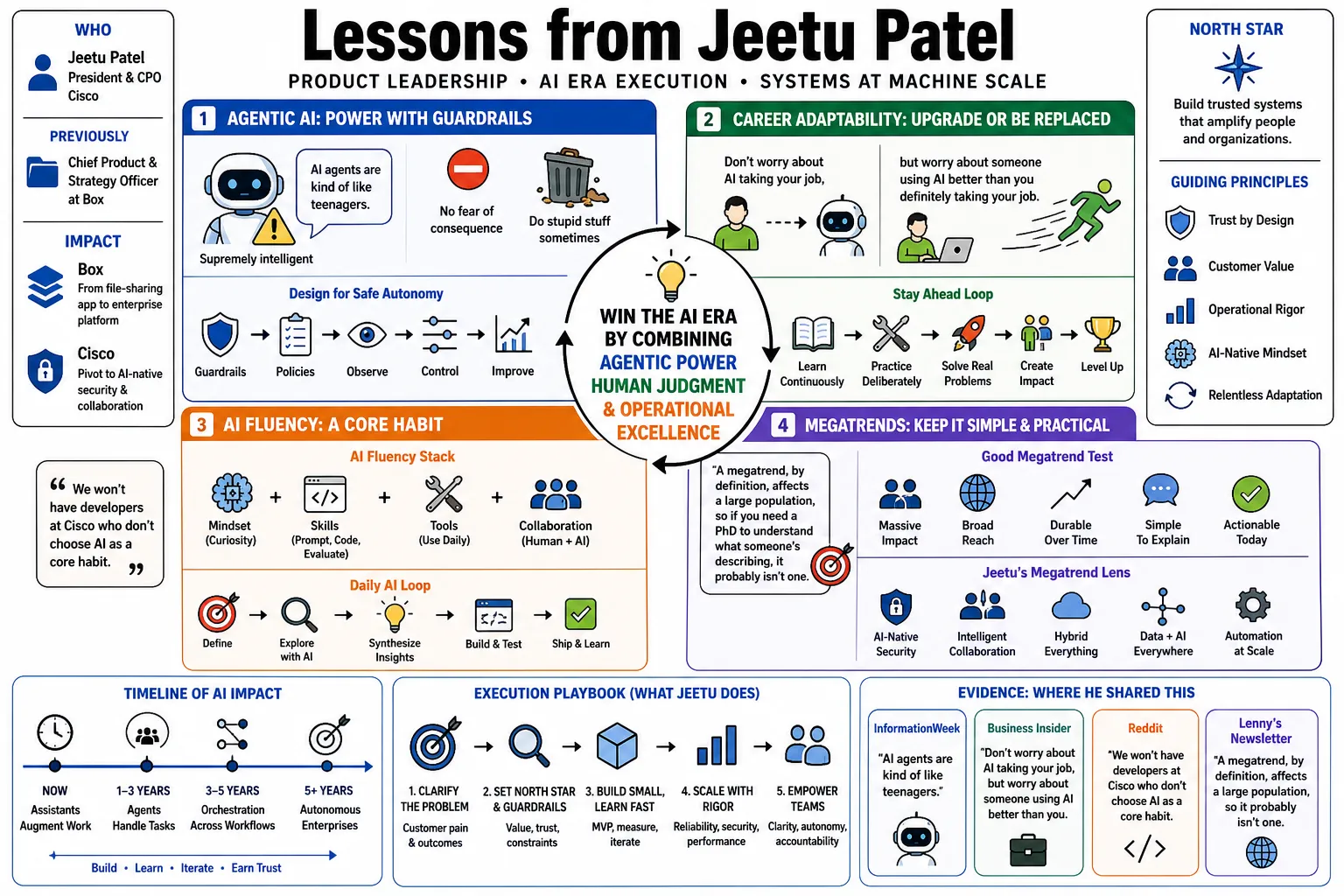
Jeetu Patel is the President and Chief Product Officer at Cisco, having previously served as Chief Product and Strategy Officer at Box. He is known for steering massive organizational shifts, moving Box from a single file-sharing app to an enterprise platform, and pivoting Cisco toward an AI-native security and collaboration model. This profile collects his specific frameworks on product execution, defending systems at machine scale, and navigating the operational realities of the AI era.
Part 1: AI Agents and the Future of Work
- On Agentic AI: "AI agents are kind of like teenagers. They're supremely intelligent, but they have no fear of consequence, and sometimes they do stupid stuff." — Source: InformationWeek
- On Career Adaptability: "Don't worry about AI taking your job, but worry about someone using AI better than you definitely taking your job." — Source: Business Insider
- On AI Fluency: "We won't have developers at Cisco who don't choose AI as a core habit." — Source: Reddit
- On Megatrends: "A megatrend, by definition, affects a large population, so if you need a PhD to understand what someone's describing, it probably isn't one." — Source: Lenny's Newsletter
- On the Timeline of AI: "In the short term, people overestimate the impact of it... But then the long term, they've grossly underestimated the impact of it." — Source: CXOTalk
- On Demographic Shifts: "AI is critical for humanity's survival" because declining global birth rates mean we need automated support to handle the workload of an aging population. — Source: Lenny's Podcast
- On Empowerment vs. Replacement: AI functions best as a tool designed to augment human capabilities, acting as a teammate rather than a substitute. — Source: Humans of Bombay
- On the Sidekick Concept: Patel frames Cisco as infrastructure for an AI era in which digital workers require new data centers, networks, security layers, and collaboration systems around them. — Reference: MIT Sloan Management Review interview on Cisco as AI-era infrastructure
- On Normalizing Miracles: Humans possess a distinct ability to rapidly absorb extraordinary technological advancements, turning science fiction into standard daily expectations. — Source: LiveMint
- On True AI-First Companies: Becoming AI-first requires embedding AI into every single job function—from engineering to legal to customer support—rather than treating it as an isolated experiment. — Source: CXOTalk
Part 2: Cybersecurity and Defending at Machine Scale
- On the Trust Deficit: "One of the biggest challenges people have with AI agents right now is they don't trust it, and if you don't trust it, you're not going to delegate work to them." — Source: InformationWeek
- On Machine-Scale Threats: "If you have attacks happening at machine scale, you can no longer have defenses at human scale." — Source: Forbes
- On Security as an Accelerant: Patel treats security as part of the AI adoption path: agentic systems create new attack surfaces, so enterprises need zero trust, identity, visibility, and response built into the network. — Reference: Cisco newsroom on securing agentic AI
- On AI Agent Risks: We must protect AI systems from external threats while simultaneously preventing those same intelligent agents from inadvertently causing cybersecurity breaches. — Source: InformationWeek
- On the Danger of Hallucinations: "Hallucination is fantastic when you're writing poetry. It's really bad in cyber security." — Source: Forbes
- On the Limit of Imagination: "The only limit is imagination, and security teams are the key to unlocking this opportunity by making the agentic workforce safe enough to trust." — Source: Cisco
- On Delegation and Trust: "The ability to delegate a task in a trusted form... is going to be the difference between being a market leader versus being bankrupt." — Source: Cisco
- On Platform Unification: Security must abandon fragmented product silos in favor of a unified, AI-native infrastructure platform. — Source: Network World
- On Invisible Infrastructure: Cybersecurity operates at its peak when it functions as the invisible infrastructure supporting the broader digital economy. — Source: Forbes
- On AI-Native Products: Security software must be designed to predict and respond to threats automatically, entirely bypassing manual console management. — Source: Network World
Part 3: Product Strategy and the Right to Win
- On Picking Problems: "The one thing that doesn't change with AI is the quality of problems that you choose to solve are directly proportionate to the success of the outcomes." — Source: CXOTalk
- On Market-In Thinking: Focus on solving deep customer pain points instead of building thin layers on top of existing AI models, which rarely yields sustainable businesses. — Source: CXOTalk
- On the Hardness of Multi-Product: "It's pretty hard to get one product to product-market fit. It's infinitely harder to get multiple products to product-market fit." — Source: Pendo
- On Product Principles: "Don't select them lightly—they'll inform every feature release and product decision," serving as an absolute filter for what gets built. — Source: Hustle Badger
- On the Right to Win: Leaders must rigorously evaluate where and how their organization can legitimately succeed in a highly competitive market before committing resources. — Source: Lenny's Newsletter
- On Acquisition Philosophy: When buying companies, target teams that exhibit an absolute obsession with design and simplicity. — Source: Business Insider
- On Feature Integration: Build new capabilities directly into the core platform rather than acquiring disparate technology and patching it on. — Source: Business Insider
- On Quality Baselines: Patel's Box tenure is described through discipline, quality standards, performance metrics, and stability, making product quality an operating system rather than a late-stage polish step. — Reference: Modern CTO profile of Patel's product leadership
- On Navigating Complexity: "The more content you have and the more you use the system, the harder it gets to use... The way to solve that problem, that scale, is through machine learning." — Source: NetSuite
- On Building vs. Aligning: Teams should spend 80% of their time actively building the product and restrict internal alignment efforts to the remaining 20%. — Source: Substack
Part 4: Building and Scaling Organizations
- On the Six-Part Framework: Scaling a high-growth company requires evaluating six specific pillars: Timing, Market, Team, Product, Brand, and Distribution. — Source: Lenny's Newsletter
- On Startup Agility at Scale: "We tell people we want to operate as the world's largest start-up, but that requires operating at speed with scale." — Source: McKinsey
- On Infrastructure Constraints: The technology industry consistently underestimates the physical power, compute, and network bandwidth required to sustain the AI revolution. — Source: Forbes
- On the Cost of Agents: "The amount of infrastructure needed for an agent is meaningfully higher than for a chatbot... They just keep working and that consumes a chunk of compute." — Source: Global Advisors
- On Breadth as a Liability: "One of Cisco's advantages is its breadth... But if you don't integrate that portfolio well, then breadth becomes a liability." — Source: McKinsey
- On Platform Expansion: Transitioning a business from a single application to a multi-product platform is mandatory for capturing durable enterprise value. — Source: Six Five Media
- On AI-First Catch-Up: In the Product School episode, Patel argues that companies need an explicit AI-first strategy across functions, not a loose collection of AI experiments added after the core product work. — Reference: Product School episode on AI-first product strategy
- On Embracing Hard Problems: Patel connects Cisco's product agenda to difficult customer problems at the intersection of cybersecurity, observability, AI, and collaboration, where product teams have to solve across systems rather than isolated features. — Reference: Product School episode on Cisco product strategy
- On Frontline Connection: Frontline employees are frequently more receptive to organizational change and better equipped to drive it than senior executives. — Source: McKinsey
Part 5: Organizational Communication and Clarity
- On Extreme Clarity: A lack of absolute clarity drives organizational failure, internal politics, and operational friction. — Source: Forbes
- On Storytelling: "The story is why you build the product... Always be the custodian of the message. Don't delegate storytelling." — Source: Substack
- On Organizational Packet Loss: Leaders must actively combat the phenomenon where critical intent gets lost as it travels downward through layers of hierarchy. — Source: Lenny's Podcast
- On Flipping Feedback: Inverting the standard rule to instead "criticize in public, praise in private" can build a culture of transparent, blameless problem-solving. — Source: Lenny's Podcast
- On Curiosity over Intellect: As AI commoditizes basic knowledge, a leader’s greatest asset becomes their curiosity and capacity to ask high-quality questions. — Source: Forbes
- On Constructive Tension: Maintaining constructive tension within working teams generates greater innovation and long-term resilience. — Source: Transistor
- On Directness: Clear communication that survives the journey from the executive team to the front line is the only way to keep a massive enterprise aligned. — Source: Lenny's Newsletter
- On Unlearning: The capacity to unlearn outdated mental models is frequently a more difficult and necessary skill than learning new ones. — Source: Medium
- On Asking Questions: The quality of the answers an organization produces is strictly bound by the caliber of the questions its leaders choose to ask. — Source: Forbes
Part 6: Platform Architecture and Integration
- On the Unrecognizable Transformation: Shifting a company from dashboard sprawl to a unified infrastructure platform requires a total teardown of the existing user experience. — Source: Network World
- On Centralized Control Planes: Disparate management tools must give way to a centralized control plane where policy and identity sit directly in the execution path. — Source: Network World
- On AI-First Design: Software must now be built to interface with autonomous AI agents before it is designed for human users. — Source: Forbes
- On Solving Tool Sprawl: Strategic acquisitions should be executed explicitly to collapse complex tool sprawl and eliminate talent shortages for security teams. — Source: Inside the Network
- On Telecommunications and AI: Patel points to low-latency connectivity, reduced GPU idle time, and secure networking as core infrastructure work needed for AI to move from demos into large-scale enterprise deployment. — Reference: Six Five interview on Cisco networking and AI infrastructure
- On Rethinking Interfaces: Moving from passive chatbots to active AI agents demands entirely new architectural paradigms. — Source: Forbes
- On Embedded Identity: Security policy and identity verification must be seamlessly baked into the network fabric rather than applied as a secondary layer. — Source: Network World
- On Breaking Silos: A multi-product strategy only succeeds if the individual products share a coherent underlying architecture and a unified data model. — Source: Box
- On the Execution Environment: Human operators and autonomous AI agents must eventually collaborate within the exact same unified software environment. — Source: Network World
Part 7: Leadership and Culture
- On the True Role of a Leader: "Being a leader isn't about getting your way—it's about clearing the way so others can be successful." — Source: Medium
- On Persistence: Patel's career path across Doculabs, EMC, Box, and Cisco shows the compounding value of repeated product-building discipline across enterprise software, infrastructure, and security markets. — Reference: Modern CTO profile of Patel's career and operating roles
- On Zero-Sum Games: Avoid zero-sum thinking; locate ways to collaborate even with competitors to collectively advance the industry. — Source: Medium
- On the Definition of Leadership in AI: Patel's leadership lesson is to make AI useful inside customer workflows while keeping security, collaboration, and user experience close to the product decisions. — Reference: Product School episode on AI, cybersecurity, and product leadership
- On Over-Alignment: Leaders who spend excessive time seeking consensus and internal alignment inherently sacrifice their execution speed. — Source: Substack
- On Setting the Baseline: Patel's product record emphasizes stability, performance metrics, design quality, and user experience as the baseline that lets enterprise platforms earn broader adoption. — Reference: Modern CTO profile of quality and product discipline at Box and Cisco
- On Retaining Perspective: Patel argues against replacing junior workers wholesale with AI because organizations would lose the fresh perspectives and ideas that come from less experienced employees. — Reference: MIT Sloan Management Review interview on staffing for AI
- On Inspiring Talent: When you solve a genuinely hard problem that customers will pay for, elite talent will naturally gravitate to your team. — Source: CXOTalk
- On the Start-up Mindset: Even in an organization of tens of thousands, leaders must ruthlessly protect the speed and agility characteristic of a tiny startup. — Source: McKinsey
Part 8: Personal Growth and Mindset
- On the Danger of Comparison: Focus entirely on what you truly want to achieve rather than wasting energy coveting what others already possess. — Source: Medium
- On Curating Your Circle: Deliberately surround yourself with people who uplift your ambitions and refuse to tolerate those who make you feel small. — Source: Medium
- On the Necessity of Failure: Patel presents AI as a megatrend that forces leaders to revisit assumptions, unlearn older operating models, and learn through the messy work of adapting organizations. — Reference: MIT Sloan Management Review interview on AI as a megatrend
- On AI Aiding Failure: Patel's AI-first framework treats AI as a way to test, learn, and improve product work faster, provided teams stay grounded in customer needs and security constraints. — Reference: Product School episode on AI-first transition
- On the Learn It All Approach: Patel recommends curiosity, reverse mentoring, and active learning around AI because the platform shift is too large for leaders to manage from old assumptions alone. — Reference: MIT Sloan Management Review interview on reverse mentoring and AI learning
- On Overcoming Early Struggles: Patel's operating history shows a pattern of taking on complex enterprise transitions, from cloud content management at Box to security and collaboration at Cisco. — Reference: Modern CTO profile of Patel's enterprise product career
- On the Human Element: Patel's AI-trust framing keeps people in the loop: users will not delegate work to AI agents unless the systems are trustworthy, governed, and understandable enough to earn that delegation. — Reference: InformationWeek on Patel and the AI trust deficit
- On Embracing Megatrends: When you finally recognize a true technological megatrend, the only rational response is to stop fighting it and go all-in. — Source: Lenny's Newsletter
- On Personal Accountability: Adapting to a new era of work is a personal choice; the tools exist, but the willingness to evolve must come from within. — Source: Business Insider