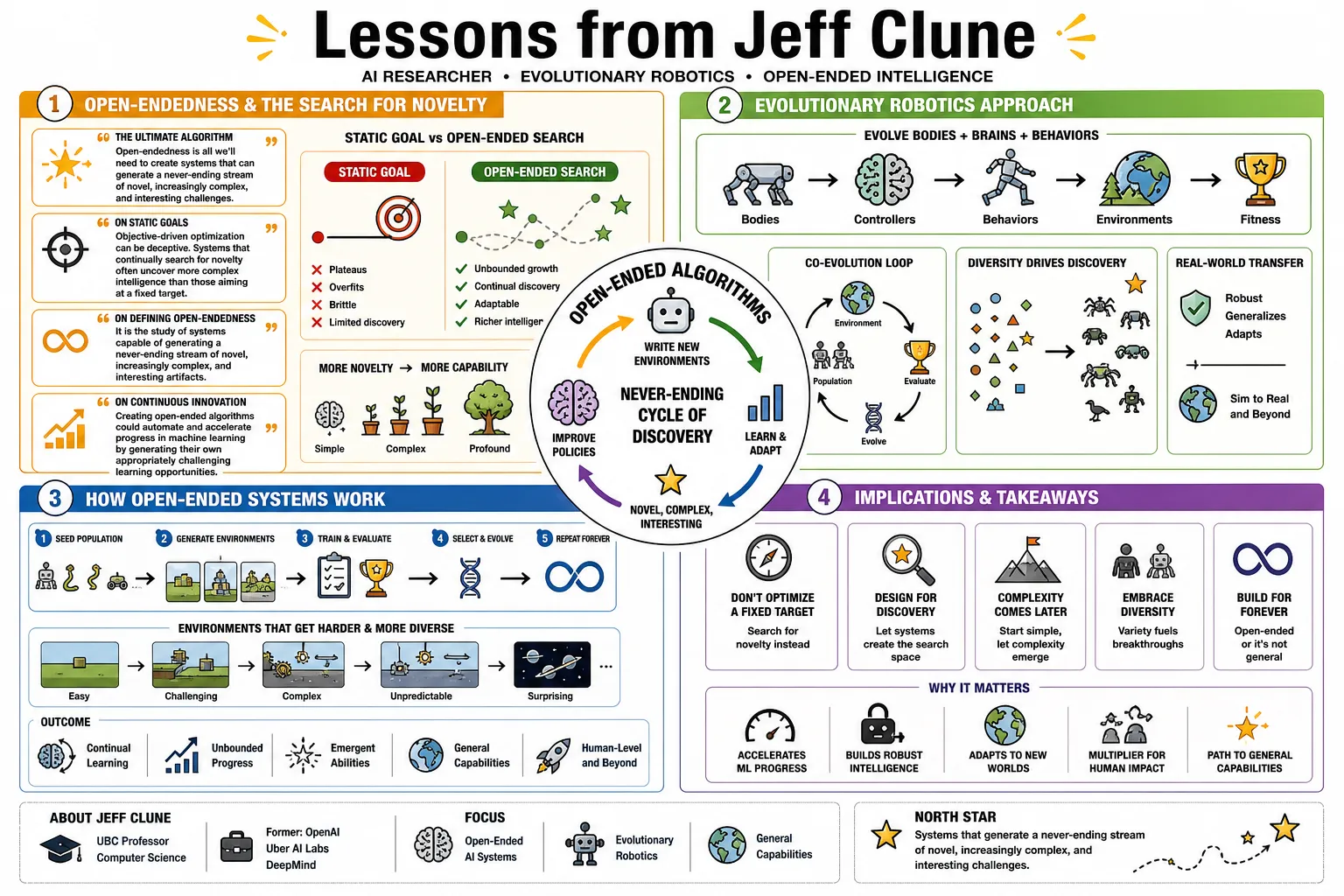
Lessons from Jeff Clune
Jeff Clune is a UBC computer science professor and AI researcher whose background includes stints at OpenAI, Uber AI Labs, and DeepMind. His work focuses on open-endedness: building algorithms that write their own training environments to continuously learn. The material below gathers his views on evolutionary robotics and how machine learning might actually achieve general capabilities.
Part 1: Open-Endedness and the Search for Novelty
- On the ultimate algorithm: "Open-endedness is all we'll need to create systems that can generate a never-ending stream of novel, increasingly complex, and interesting challenges." — Source: [Jeff Clune's Website]
- On static goals: "Objective-driven optimization can be deceptive. Systems that continually search for novelty often uncover more complex intelligence than those aiming at a fixed target." — Source: [Machine Learning Street Talk]
- On defining open-endedness: "It is the study of systems capable of generating a never-ending stream of novel, increasingly complex, and interesting artifacts." — Source: [arXiv: Open-Endedness]
- On continuous innovation: "Creating open-ended algorithms could automate and accelerate progress in machine learning by generating their own appropriately challenging learning opportunities." — Source: [PMLR: POET]
- On the POET algorithm: "The Paired Open-Ended Trailblazer automatically generates increasingly complex environments alongside the agents capable of solving them." — Source: [Uber AI Labs Archive]
- On breaking bottlenecks: "Manual engineering becomes a bottleneck; open-ended search provides a way to solve problems that are otherwise too difficult to engineer by hand." — Source: [Vector Institute]
- On surprise and discovery: "An algorithm should surprise its creator. If you know exactly what the system will output, it isn't truly open-ended." — Source: [The Gradient Podcast]
- On complex environments: "Intelligence requires complex environments. Without a rich world to interact with, an agent's cognitive capabilities will inevitably plateau." — Source: [TalkRL Podcast]
- On co-evolution: "When the environment and the agent co-evolve, the curriculum emerges naturally, continuously pushing the boundaries of what the system can achieve." — Source: [ICLR Publications]
- On the frontier of AI: "Open-endedness remains one of the most critical, yet underdeveloped, frontiers for moving beyond current artificial intelligence limitations." — Source: [Quanta Magazine]
Part 2: AI-Generating Algorithms (AI-GAs)
- On the AI-GA paradigm: "Rather than manually designing intelligence, we should focus on creating algorithms that autonomously generate their own training data, environments, and architectures." — Source: [arXiv: AI-GAs]
- On the three pillars: "The path to general intelligence through AI-GAs relies on three pillars: meta-learning architectures, meta-learning algorithms, and auto-generating learning environments." — Source: [TWIML AI Podcast]
- On scientific automation: "The stories of science fiction of a scientist starting an experiment, going to sleep, and awakening to discover they have created sentient life are far more conceivable in the AI-GA paradigm." — Source: [Reddit Machine Learning AMA]
- On manual vs. generated AI: "The manual path to AI requires humans to hardcode every capability. AI-GAs shift the burden of design from human intuition to vast computational search." — Source: [UBC Computer Science]
- On computational scale: "As compute increases, algorithms that leverage search and learning invariably outperform methods reliant on human knowledge." — Source: [Jeff Clune's Website]
- On bootstrapping intelligence: "An AI-generating algorithm bootstraps complexity from simplicity, creating a self-reinforcing loop of capability discovery." — Source: [Vector Institute Research]
- On the acceleration of progress: "By automating the discovery of the algorithm itself, we remove the human researcher from the tightest loops of trial and error." — Source: [TalkRL Podcast]
- On meta-learning architectures: "The network must learn how to structure itself. We cannot hand-design the optimal wiring diagram for artificial general intelligence." — Source: [Google DeepMind Profile]
- On the shift in research focus: "Researchers should spend less time engineering specific solutions and more time designing the initial conditions that allow solutions to emerge." — Source: [Machine Learning Street Talk]
- On long-term feasibility: "AI-GAs represent a pragmatic roadmap to achieving general artificial intelligence through scalable computation." — Source: [TWIML AI Podcast]
Part 3: Evolutionary Robotics and Biological Inspiration
- On nature's algorithm: "How does the relatively unintelligent algorithm of Darwinian evolution produce all the amazing marvels in the natural world? Evolution has been innovating endlessly for 3.5 billion years." — Source: [Vector Institute]
- On evolutionary robotics: "By simulating evolution, we can discover physical robot morphologies and control software that humans would never have designed." — Source: [Substack Articles]
- On damage recovery in robots: "Evolutionary techniques allow robots to recover from physical damage by rapidly searching for and adopting new ways to move." — Source: [Nature Journal]
- On generative encodings: "Biological organisms are not encoded like blueprints; they develop from a set of rules. We use generative encodings to evolve complex artificial systems." — Source: [Jeff Clune's Website]
- On the diversity of life: "The biological process of evolution produces a diverse array of species rather than a single perfect organism. AI should seek similar diversity." — Source: [CIFAR Profile]
- On soft robotics: "Evolving the physical bodies of soft robots reveals designs that seamlessly integrate material properties with computational control." — Source: [Google Scholar Publications]
- On the limits of biomimicry: "We don't need to copy every detail of biology, but we must extract the core algorithmic principles that drive biological innovation." — Source: [The Gradient Podcast]
- On artificial life: "The boundary between biological evolution and machine learning is blurring. Recreating open-ended invention inside a computer is the ultimate artificial life challenge." — Source: [TalkRL Podcast]
- On agent-environment interaction: "An agent's form should be dictated by its environment. Evolution naturally shapes morphology to exploit ecological niches." — Source: [University of Wyoming Archive]
Part 4: Quality-Diversity and Exploration
- On escaping local optima: "If you only optimize for the single best outcome, you often get stuck. Quality-diversity algorithms maintain a library of different, high-performing strategies." — Source: [CIFAR Research]
- On the MAP-Elites algorithm: "By illuminating the search space, MAP-Elites discovers a diverse set of solutions, each excelling in a different combination of characteristics." — Source: [arXiv: MAP-Elites]
- On the definition of success: "Success in a search process should not be defined merely by the peak performance, but by the richness of the behavioral repertoire." — Source: [Jeff Clune's Website]
- On divergent search: "Objective-based search is convergent. To truly explore complex domains, we need divergent search methods that reward doing things differently." — Source: [Machine Learning Street Talk]
- On curiosity-driven exploration: "Agents that seek novelty and are motivated by curiosity often learn robust representations of their environment faster than those driven by external rewards." — Source: [The Gradient Podcast]
- On robustness through diversity: "A diverse population of solutions provides robustness. When the environment changes, a quality-diversity system already has alternative strategies ready to deploy." — Source: [Uber AI Labs Archive]
- On stepping stones: "In complex search spaces, the stepping stones that lead to a great solution rarely look like the final objective. Diversity preserves these crucial stepping stones." — Source: [TalkRL Podcast]
- On solving deceptive problems: "Deceptive problems punish early progress toward the goal. Quality-diversity ignores the goal and explores thoroughly, eventually finding a path to the solution." — Source: [Google DeepMind Profile]
- On generating training data: "A diverse set of generated environments provides a richer curriculum for training reinforcement learning agents, preventing them from overfitting to narrow tasks." — Source: [ICLR Publications]
Part 5: Artificial General Intelligence (AGI) and Ambition
- On scientific ambition: "I love to swing for the fences and I am most interested by ambitious ideas that might not even be ready for current technology, but you might have to wait decades to fully be realized." — Source: [TalkRL Podcast]
- On the historic quest: "The attempt to build truly intelligent AI is the most ambitious scientific quest in human history." — Source: [UBC Computer Science]
- On the timeline: "Because I believe it is going to be invented one way or another, I personally believe I should embrace the opportunity and the challenges to make the development go as well as possible." — Source: [Jeff Clune's Website]
- On paradigm shifts: "AGI will likely not result from a single algorithmic tweak, but from a fundamental shift toward open-ended, self-improving systems." — Source: [TWIML AI Podcast]
- On foundation models: "While current large language models are impressive, true AGI will require continuous, open-ended interaction with environments to learn causal reasoning." — Source: [Machine Learning Street Talk]
- On evaluating general intelligence: "A general intelligence cannot be measured by a static benchmark. It must be evaluated on its ability to rapidly adapt to completely novel situations." — Source: [Vector Institute]
- On the inevitability of progress: "The trajectory of computational power suggests that the raw resources required for AGI will be available. The bottleneck is the algorithmic paradigm." — Source: [Quanta Magazine]
- On aiming high: "Incremental research is safe, but transformative breakthroughs come from researchers willing to risk failure on decades-long bets." — Source: [The Gradient Podcast]
Part 6: The Mechanics of Meta-Learning and Neural Networks
- On meta-learning: "Learning to learn is the key. An algorithm that can improve its own learning process will rapidly outpace any statically programmed system." — Source: [arXiv Publications]
- On deep neuroevolution: "Evolutionary strategies can be a highly competitive alternative to traditional gradient-based methods for training deep reinforcement learning agents." — Source: [Uber AI Labs Archive]
- On interpretability: "You cannot reduce a trillion-parameter system to simple explanations. The answers are going to be complicated." — Source: [Quanta Magazine]
- On catastrophic forgetting: "Neural networks tend to overwrite old knowledge when learning new tasks. Solving this is crucial for lifelong, open-ended learning." — Source: [Google Scholar Publications]
- On structural plasticity: "The architecture of the network itself should be plastic. Connections must grow and prune dynamically as the agent encounters new domains." — Source: [ICLR Publications]
- On AI neuroscience: "We must study artificial neural networks with the same rigor that biologists study brains, mapping pathways and identifying functional regions." — Source: [Vector Institute Research]
- On the limits of backpropagation: "While backpropagation is incredibly powerful, biological brains suggest there are other, highly distributed mechanisms for credit assignment worth exploring." — Source: [TalkRL Podcast]
- On large-scale training: "The success of deep learning demonstrates that scale is a fundamental driver of intelligence, but it must be paired with the right meta-learning framework." — Source: [Jeff Clune's Website]
- On representation learning: "A truly general system must learn modular representations that can be recombined to solve unseen problems without retraining from scratch." — Source: [Google DeepMind Profile]
Part 7: AI Safety, Alignment, and Superintelligence Risks
- On the stakes of alignment: "The first artificial superintelligence is likely to be the last. We have to get alignment right on the first try." — Source: [Peter Diamandis Interviews]
- On control vs. creativity: "There is an inherent tension between creating open-ended AI that is capable of endless creativity and maintaining strict safety controls over its behavior." — Source: [arXiv: AI Safety]
- On automated capability discovery: "We can use foundation models to improve AI safety by automatically discovering and testing the latent capabilities of other AI systems." — Source: [Reddit Machine Learning AMA]
- On the responsibility of researchers: "The benefits are tremendous, but the risks are profound. Researchers have a duty to try to make the development of self-improving AI go as well as possible." — Source: [Jeff Clune's Website]
- On unpredictability: "Open-ended systems are defined by their ability to surprise us. Ensuring that these surprises remain safe is a fundamental unsolved challenge." — Source: [Machine Learning Street Talk]
- On safe exploration: "An agent learning in a complex environment must explore safely, meaning it cannot take actions that cause irreversible catastrophic harm to itself or its surroundings." — Source: [Vector Institute]
- On defining values: "Encoding human values into an algorithm is exceptionally difficult because human values are complex, contradictory, and culturally dependent." — Source: [UBC Computer Science]
- On regulatory recommendations: "We need proactive regulatory frameworks that monitor the capabilities of large-scale systems before they are deployed in open environments." — Source: [CIFAR Policy Papers]
- On the speed of takeoff: "If an AI-generating algorithm succeeds, the transition from human-level intelligence to superintelligence could happen remarkably fast, leaving little time for reactive safety measures." — Source: [TalkRL Podcast]
Part 8: The Philosophy of Scientific Discovery and Automation
- On automating science: "The AI Scientist is a research pipeline that automates the entire scientific process, from generating ideas and conducting experiments to writing and reviewing papers." — Source: [CBC Radio Quirks & Quarks]
- On the role of human researchers: "As AI handles more of the experimental loop, the role of the human scientist will shift from executing experiments to guiding high-level algorithmic search." — Source: [The Gradient Podcast]
- On algorithmic discovery: "We are moving toward an era where the most significant scientific discoveries will be credited to the algorithms that found them, rather than the humans who built the algorithms." — Source: [Jeff Clune's Website]
- On the limits of human intuition: "Human intuition is a useful starting point, but it is ultimately constrained. Unbiased algorithmic search can uncover solutions that defy human logic." — Source: [Uber AI Labs Archive]
- On scientific metrics: "Traditional metrics for scientific success often reward incremental progress. We need new frameworks that incentivize high-risk, open-ended exploration." — Source: [Machine Learning Street Talk]
- On peer review automation: "Language models have reached a level of capability where they can provide meaningful, constructive peer review for novel scientific literature." — Source: [arXiv: The AI Scientist]
- On experimental design: "An automated system can explore the space of possible experimental designs far more efficiently than a human committee." — Source: [TalkRL Podcast]
- On interdisciplinary search: "Algorithms do not respect academic boundaries. They will naturally synthesize ideas from physics, biology, and computer science if the search space allows it." — Source: [Vector Institute]
- On the acceleration of knowledge: "By closing the loop between hypothesis generation and empirical testing within a simulation, we can accelerate the accumulation of knowledge by orders of magnitude." — Source: [Google DeepMind Profile]
- On the ultimate goal of research: "We aim to build tools that build better tools, creating an infinite runway for technological advancement." — Source: [UBC Computer Science]