Jeff Shiner joined 1Password in 2012 when the company had just 20 employees, eventually guiding it into a major enterprise security platform valued in the billions. He is recognized for navigating the transition from a bootstrapped, consumer-focused app to a business-to-business enterprise tool while maintaining a strict focus on usability. This collection organizes his perspectives on scaling businesses, managing culture, and the practical realities of the shift toward passwordless security.
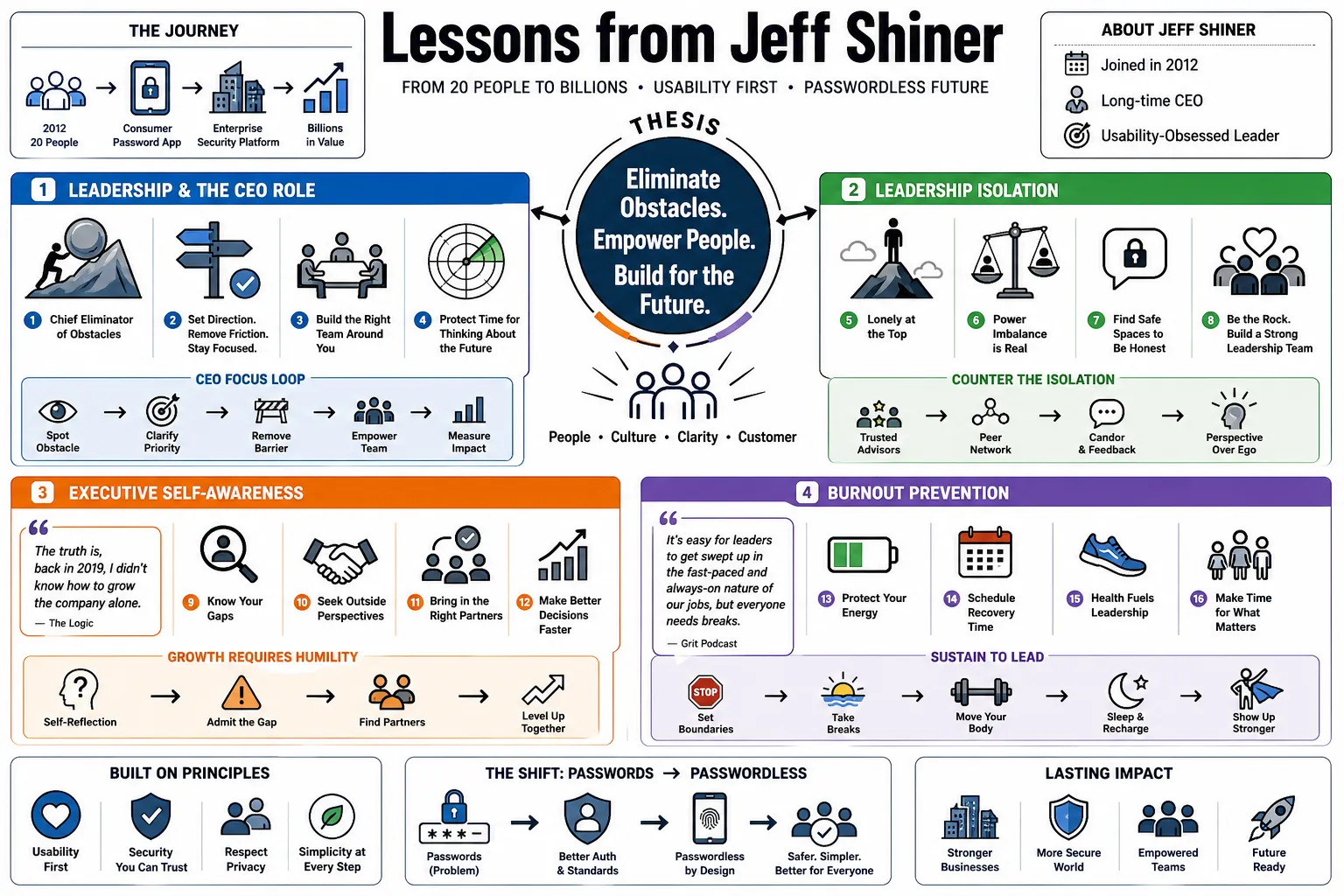
Part 1: Leadership and The CEO Role
- On the Core Function of a CEO: The Grit episode itself frames Shiner as a “chief eliminator of obstacles,” capturing his view that leadership is less about heroics and more about clearing the blockers that keep good teams from doing their best work. — Reference: Apple Podcasts page for Grit episode #159 with Jeff Shiner
- On Leadership Isolation: "Being the CEO of a large company is lonely. You're trying to be the rock for others, but you're always conscious of the power imbalance." — Source: Canadian Business
- On Executive Self-Awareness: "The truth is, back in 2019, I didn't know how to grow the company alone. Recognizing that gap is what led us to partner with external investors." — Source: The Logic
- On Burnout Prevention: "It's easy for leaders to get swept up in the fast-paced and always-on nature of our jobs, but everyone needs a hobby or distraction from work to maintain a healthy mind." — Source: 1Password Blog
- On Command and Control: "You can't mandate great work. You can only set the conditions that make great work the natural outcome of the environment." — Source: Nash Squared
- On Prioritization: Apple's episode summary spotlights Shiner's “we need to do less” theme, suggesting that scaling well depends on narrowing focus instead of letting every worthwhile idea compete for equal attention. — Reference: Apple Podcasts page for Grit episode #159 with Jeff Shiner
- On Admitting Mistakes: "When the CEO is willing to say they were wrong about a decision, it gives the entire organization permission to experiment and iterate." — Source: Spotlight On Accel
- On Empowering Managers: "If I were to go back in time, I would spend a lot more time proactively training leaders rather than just letting them figure it out on the job." — Source: Accel Interviews
- On Pacing: Accel's Spotlight On episode describes 1Password's path as patient growth, with Shiner using funding and expansion only when the company had a clear purpose for it rather than chasing speed for its own sake. — Reference: Accel Spotlight On episode with Jeff Shiner
- On Information Flow: In the Accel transcript, Shiner says remote organizations drift when people are even a few degrees off from one another, which is why leaders have to repeat the company's purpose constantly and keep communication unusually explicit at scale. — Reference: Accel Spotlight On transcript with Jeff Shiner
Part 2: Company Culture and Hiring
- On Treating Hiring as an Honor: "We all agree that hiring is one of the most important things we do. Yet I watch interviewer after interviewer show up and wing it. Instead, we treat hiring like an honor." — Source: Accel Spotlight
- On Cultural Deliberation: "You have to be very deliberate about the type of culture you want, and then hire people who fit that culture already." — Source: Accel Interviews
- On Core Traits: "We look for people who are intrinsically motivated and low ego. It doesn't matter which country you're from or which gender you are, those traits scale." — Source: Accel Spotlight
- On Preserving Culture During Hypergrowth: "I just worry about as the company grows, what's going to happen. Am I eventually going to wake up some day at a company that I don't like working for? That is my worst nightmare." — Source: 37signals Podcast
- On Remote Work Fundamentals: "Operating as a distributed team requires you to over-communicate context. Without hallway conversations, the 'why' behind decisions has to be explicit." — Source: Running Remote
- On Managing Egos: "The moment you allow brilliant jerks to thrive, you signal to the rest of the company that your stated values are just marketing material." — Source: Nash Squared
- On Employee Retention: "People stay when they feel their work is connected to a meaningful outcome and they are treated like adults." — Source: Canadian Business
- On Interview Preparedness: "If a candidate takes the time to prepare for us, the least we can do is properly prepare to evaluate them." — Source: Accel Spotlight
- On Trusting the Team: First Round's interview shows Shiner preserving 1Password's product sensibility by hiring leaders who already care about customer experience, then trusting them to shepherd those values rather than trying to enforce them with slogans alone. — Reference: First Round In Depth transcript with Jeff Shiner
Part 3: Bootstrapping and Scaling
- On Early Profitability: Accel's episode notes that 1Password stayed cash-flow positive for 14 years, giving Shiner the flexibility to build the B2B product and SaaS platform without outside investors forcing the timing. — Reference: Accel Spotlight On episode with Jeff Shiner
- On the Timing of Fundraising: "As a profitable company, we were not actively looking for new investment, but the expertise of new partners was necessary to accelerate business growth." — Source: PR Newswire
- On the Market Opportunity: "Every company, and every person, that stores passwords on sticky notes is a potential customer." — Source: Business Insider
- On Operational Maturity: "We had a great product, but we didn't have go-to-market motions and we didn't have marketing. The funding helped us mature the company and our processes." — Source: BetaKit
- On the Shift in Scale: "At the time of our Series A, we said we were going to take that partnership and really, what I call, grow and grow." — Source: BetaKit
- On Building During Downturns: "Economic shifts don't change the fundamental need for security; they just change how companies scrutinize their budgets." — Source: The Logic
- On Valuations: "A high valuation is a reflection of past success and future expectations, but it doesn't change the daily work of building a reliable product." — Source: Crunchbase News
- On Attracting Leadership: "One of the primary reasons for taking external capital was that it was hard to attract world-class executives without the backing and network of established investors." — Source: The Logic
- On Maintaining Discipline: "Just because you have hundreds of millions in the bank doesn't mean you stop evaluating ROI on your spending." — Source: Spotlight On Accel
- On the Bootstrap Mindset: First Round's transcript says bootstrapping gave 1Password room to make the risky consumer-to-B2B jump with only the founders and Shiner deciding whether the bet made sense, preserving flexibility even before he later decided they had waited too long to raise capital. — Reference: First Round In Depth transcript with Jeff Shiner
Part 4: Product Strategy and The User Experience
- On Product Philosophy: "Know your product, know your customers and love them both." — Source: Canadian Business
- On Usability vs. Security: "When it comes to security and productivity, it shouldn't be an either-or situation. Solutions must keep employees protected without sacrificing their ability to work." — Source: MSP Today
- On Singularity of Focus: "Everybody's trying to run their own business. Apple's trying to sell you devices. Google's trying to sell you ads. Our job is only to make you more secure." — Source: Security Weekly
- On Design Simplicity: "We are always thinking about how to make it easy for people. If security gets too complicated, people will simply abandon it." — Source: 9to5Mac
- On User Trust: In First Round's interview, Shiner argues that security products only work when they make life easier for the human using them, which turns trust into something earned through usability and reliability rather than brand claims alone. — Reference: First Round In Depth transcript with Jeff Shiner
- On Feature Creep: The Grit episode's focus on doing less aligns with Shiner's broader operating style: he would rather narrow the product and company agenda than let useful-but-distracting work pile up until it blurs what matters. — Reference: Apple Podcasts page for Grit episode #159 with Jeff Shiner
- On Customer Feedback: "Users will tell you what is broken, but it is the product team's job to figure out the systemic fix rather than just patching the symptom." — Source: Tech Talks
- On Consistent Performance: "A security tool that slows down a user's computer will eventually be uninstalled, no matter how secure it is." — Source: Altitude Accelerator
- On the Definition of Quality: "Quality means the app behaves exactly as the user expects it to, across every device and platform they own." — Source: Canadian Business
Part 5: Bridging B2B and B2C Markets
- On the Consumer Foundation: In the Accel transcript, Shiner says the consumer side of 1Password still matters because people bring their security habits from home into work, making the original consumer product a strategic foundation for the enterprise business. — Reference: Accel Spotlight On transcript with Jeff Shiner
- On B2B Adoption: "Employees are consumers too. When they love using a tool at home, they inevitably drag it into the workplace." — Source: Accel Spotlight
- On Market Convergence: "Over the last few years, our personal and professional lives have merged, making cross-context security tools even more essential." — Source: PR Newswire
- On Dual Demands: "Balancing the needs of vastly different customers means ensuring the platform remains accessible to families while powerful enough for IT administrators." — Source: Spotlight On Accel
- On Employee Perks: "Offering family plans as a corporate benefit increases product stickiness and encourages users to practice good security hygiene everywhere." — Source: Contrary Research
- On Enterprise Sales: "You don't win enterprise deals just with a slick UI; you win them by proving to the CISO that you meet their stringent compliance requirements." — Source: BetaKit
- On Scaling Go-To-Market: "Transitioning to a B2B revenue model meant we had to learn how to sell to committees, not just individuals with credit cards." — Source: The Logic
- On Consumer Trust as a B2B Asset: Accel's interview explains that giving every business user a separate free family account creates a flywheel, letting trust built in personal use spill back into workplace adoption and strengthen the moat on the business side. — Reference: Accel Spotlight On transcript with Jeff Shiner
- On Product Continuity: "A user shouldn't have to learn two different interfaces for managing their work credentials and their personal bank logins." — Source: Canadian Business
Part 6: Human-Centric Security
- On the Root Cause of Breaches: "We need to solve security problems as a people problem, not as an IT problem." — Source: Canadian Business
- On Removing the Target: "IT solutions are often trying to make up for humans' bad habits. We need to remove the reward that scammers are after—your credentials." — Source: Canadian Business
- On Security Culture: "You cannot punish your way to a secure company. You have to build a culture where employees want to participate in their own protection." — Source: Tech Talks
- On External Audits: "Increasing our bug bounty to $1 million attracts another layer of outside expertise to make sure our systems are as secure as possible." — Source: Forbes
- On Employee Workarounds: "If a security policy takes ten steps to follow, employees will find a two-step workaround that completely bypasses your controls." — Source: MSP Today
- On Blaming the User: "Whenever a company blames a breach on 'user error,' what they are really admitting is a failure in their system design." — Source: Security Weekly
- On Constant Vigilance: "Security isn't a feature you ship; it's a posture you maintain every single day." — Source: Nash Squared
- On Threat Evolution: "Attackers are constantly updating their methods to exploit human psychology. Our defenses must adapt just as quickly to support human behavior." — Source: Altitude Accelerator
- On Transparency: "When incidents happen in the industry, the only acceptable response is complete transparency about what occurred and how it is being fixed." — Source: The Logic
- On the Core Mission: "At our core, regardless of the technology we use, we are simply making it easier for people to stay safe." — Source: Crunchbase News
Part 7: Passkeys and The Passwordless Transition
- On Phishing Resistance: "Passkeys combat modern threats by making it mathematically impossible for attackers to steal user credentials through traditional phishing." — Source: The Logic
- On the Cost of Convenience: "Convenience shouldn't come at the expense of security. Technology should make our lives easier, but logging in has become extremely complicated." — Source: Help Net Security
- On Driving Adoption: "Ongoing education on how passkeys are good for security, revenue, and usability will unlock a new, safer passwordless era." — Source: Help Net Security
- On Big Tech's Influence: "As much as I would love to influence billions of people, it's the platform players—the Apples, Microsofts, and Googles—that have the megaphone to drive mass adoption." — Source: Fast Company
- On Ecosystem Alignment: "Anytime the major platform providers are influencing users to have better security hygiene, it ultimately benefits the entire industry." — Source: PCMag
- On Personal Passkey Usage: "My own use of passkeys is still infrequent but growing in frequency, currently making up about 10 to 15 percent of my logins." — Source: PCMag
- On the Transition Period: "We will be living in a hybrid world of passwords and passkeys for a long time. The goal is to make managing both completely seamless." — Source: 9to5Mac
- On Biometrics: "Tying authentication to biometrics on a physical device removes the weakest link in the chain: human memory." — Source: Altitude Accelerator
- On Abandonment Rates: "If adopting a passkey introduces friction to a checkout process, businesses won't implement it. The UX has to be flawless." — Source: Fast Company
Part 8: Agentic AI and The Future of Work
- On AI Autonomy: "AI agents will rapidly become the hardest-working members of today's workforce. They operate non-stop at machine speed, scaling workflows in ways we've never seen." — Source: 1Password Blog
- On AI Security Gaps: "The problem with autonomous agents is that they do not currently have the same security oversight or access controls as human employees." — Source: ZDNet
- On AI as an Employee: "We have to start treating AI agents as a distinct segment of the workforce that requires rigorous identity governance and credential management." — Source: TechRadar
- On Machine-Speed Risks: "The speed at which these agents operate means that a small misconfiguration can lead to rapid-scale data exposure before a human even notices." — Source: BarnDoor AI
- On Shadow AI: "Businesses must adapt to employees using generative AI tools before formal security policies are in place, because the adoption is happening regardless." — Source: Nash Squared
- On Least Privilege for AI: "Implementing 'Agentic AI Security' involves enforcing least-privilege access to ensure that AI actions strictly align with business intent." — Source: 1Password Blog
- On AI-Powered Attacks: "As AI lowers the barrier to entry for cybercriminals, defensive tools must lean heavily into removing static credentials entirely." — Source: The Logic
- On Visibility: "You cannot secure what you cannot see. The first step to governing AI in the enterprise is gaining visibility into exactly which systems these agents are touching." — Source: Biometric Update Podcast
- On the Future of Identity: "In a world where AI can mimic human behavior and voices perfectly, verifying the cryptographic identity of the requester becomes the only reliable defense." — Source: TechRadar