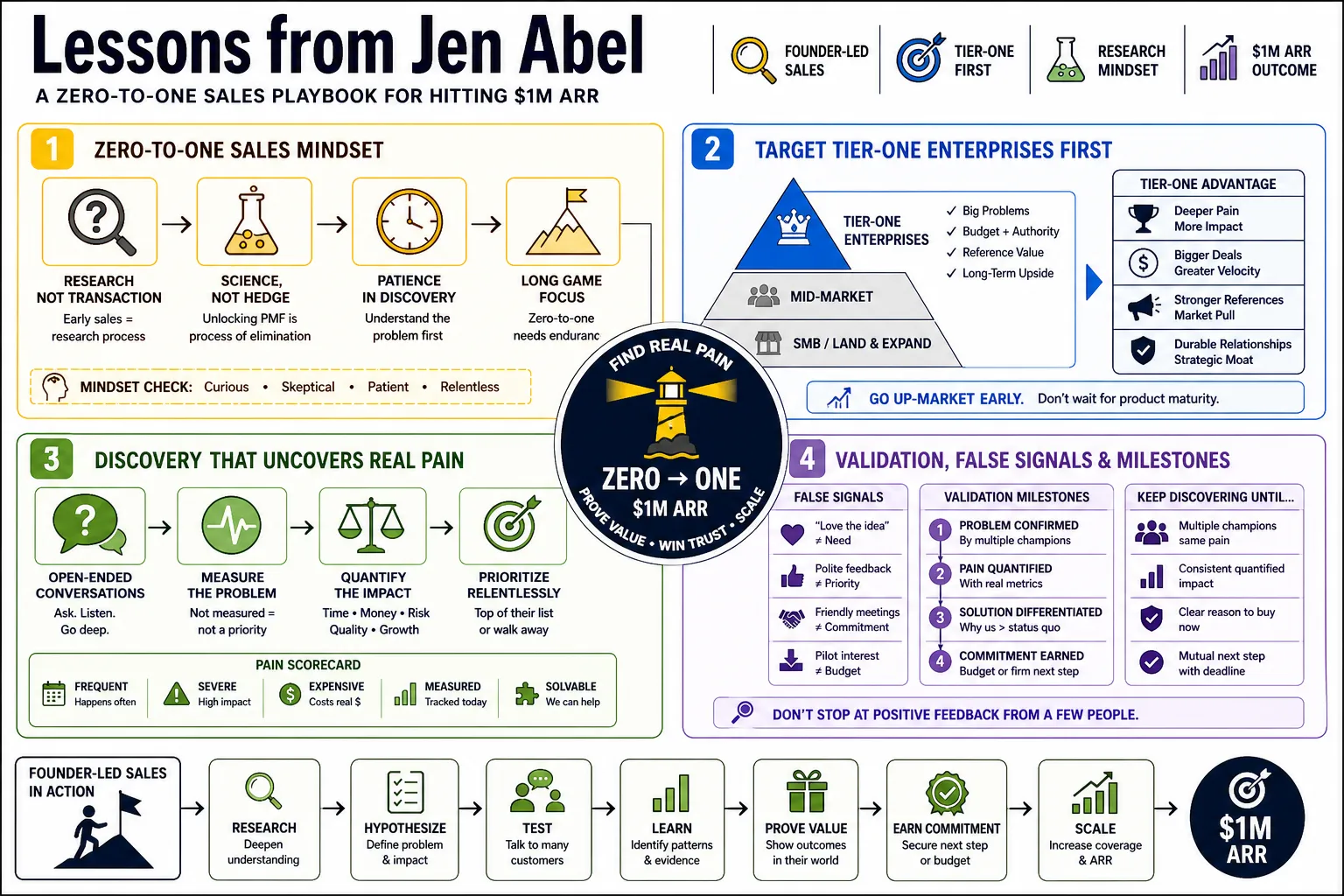
Lessons from Jen Abel
Jen Abel, co-founder of JJELLYFISH, helps early-stage B2B startups navigate the zero-to-one phase. She is best known for her founder-led sales frameworks and her push to target tier-one enterprises before the mid-market. This collection turns her approach to discovery and pitching into a concrete playbook for hitting $1M in recurring revenue.
Part 1: The Zero-to-One Sales Mindset
- On Early Validation: "Unlocking product-market fit is a process of elimination like science, instead of a hedge." — Source: JJELLYFISH
- On the Definition of B2B Sales: "Sales in the early stages is fundamentally a research process instead of a transaction." — Source: Medium
- On Patience in Discovery: "Founders often rush into selling a product before they truly understand the customer's problem." — Source: Underline Ventures
- On Measuring Pain: "If a problem is not already being measured or managed by a potential customer, it is rarely a high enough priority to build a business around." — Source: JJELLYFISH
- On Validation Milestones: "Don't take positive feedback from a few people as enough validation to stop discovery and start building." — Source: Underline Ventures
- On False Signals: "A polite meeting is no substitute for validation; early conversations must validate or invalidate specific assumptions." — Source: JJELLYFISH
- On the Right to Sell: Abel frames early founder-led sales as a learning process: founders should use customer discovery to understand the buyer, the problem, and the sales motion before trying to scale the pitch. — Reference: Lenny's Podcast episode with Jen Abel on founder-led sales, customer discovery, and the first $1M ARR
- On Early Expectations: "The goal of zero-to-one sales is learning if you are building the right thing for the right people, instead of purely driving immediate revenue." — Source: Underline Ventures
- On Market Focus: "You cannot bleed your focus across different market segments early on; you must pick one and win it." — Source: TeamDay
Part 2: Rethinking Customer Discovery
- On Discovery Goals: "Early interactions should be focused entirely on validating or invalidating assumptions and learning." — Source: Medium
- On the Quality of Questions: "The caliber of a founder's questions determines the effectiveness of the entire discovery process." — Source: JJELLYFISH
- On Avoiding Product Pitches: "A common mistake is leading with the solution instead of centering the specific problem." — Source: Lenny's Newsletter
- On Understanding the Buying Process: "Founders must map how the customer currently buys software, instead of how they use tools." — Source: JJELLYFISH
- On Research Over Revenue: "In the zero-to-one phase, extracting insights from your target buyer holds more value than closing a premature deal." — Source: Medium
- On the Status Quo: "You must map how they currently manage or measure the problem to understand your actual competition." — Source: JJELLYFISH
- On Discovery Agendas: "Never let a product demo become the focus of your early discovery calls." — Source: JJELLYFISH
- On Identifying Priority: "If the executive isn't actively spending money or time trying to solve the problem today, your product won't change their mind." — Source: Medium
- On Earning Trust: "Conducting discovery like an industry peer instead of a software vendor is how you build early market trust." — Source: StartHere
- On Active Listening: "Listen for the absence of a solution just as carefully as you listen to complaints about existing ones." — Source: JJELLYFISH
Part 3: Pitching and Vision-Casting
- On Selling the Alpha: "Instead of focusing on fixing broken processes, show executives how your solution gives them alpha and puts them ahead of the market." — Source: Lenny's Newsletter
- On the Superhero Effect: "Don't sell the mushroom; sell Mario on Blast. Say, 'Here is how you become a superhero because of what we built.'" — Source: TeamDay
- On Vision-Casting: "Vision-casting means selling the gap between where they are and where they could be." — Source: TeamDay
- On Founder Passion: "Eighty percent of early sales is getting them excited by you, the Founder, and how you see the world." — Source: JJELLYFISH
- On Product Importance: "The product accounts for the other twenty percent in early-stage deals; the founder's unique perspective is the real hook." — Source: JJELLYFISH
- On Pitching Solutions: "Stop problem-solving in the pitch and start showing them a completely new reality." — Source: TeamDay
- On Executive Priorities: "Executives buy business outcomes and market advantages instead of feature sets and workflows." — Source: Lenny's Newsletter
- On the Role of Demos: "The demo should focus on the outcome it enables instead of the product itself." — Source: JJELLYFISH
- On Creating Urgency: "Urgency comes from highlighting the cost of staying in the status quo versus the upside of your vision." — Source: JJELLYFISH
Part 4: The Founder-Led Sales Imperative
- On Visionary Leadership: "If the founder is not leading sales from a visionary perspective, every salesperson is set up to fail." — Source: Underline Ventures
- On Market Adaptation: "Founders are uniquely positioned to recognize emerging market signals and adapt their vision on the fly." — Source: Underline Ventures
- On Early Hiring: "A seed-stage startup should never have a VP of Sales." — Source: JJELLYFISH
- On Founder Authenticity: "Because no one else understands the product as deeply as the founder, they are the most effective person to conduct initial calls." — Source: StartHere
- On Delegating Too Soon: "Outsourcing sales before you have a repeatable playbook will burn cash and obscure market feedback." — Source: Lenny's Newsletter
- On the Founder Advantage: "Founders get away with messy early products because buyers are betting on the individual's trajectory." — Source: JJELLYFISH
- On Iteration Speed: "When the founder sells, the feedback loop between the market and the engineering team is instantaneous." — Source: Underline Ventures
- On Building the Playbook: "Founders must do the unscalable work of selling to build the exact playbook future reps will execute." — Source: Lenny's Podcast
- On Earning Respect: "Enterprise buyers want to talk to the person building the future instead of a junior sales rep reading a script." — Source: TeamDay
- On Founder Conviction: "Your conviction in the problem you are solving remains your strongest sales asset in the first year." — Source: JJELLYFISH
Part 5: Navigating Tier-One Enterprises
- On Target Selection: "Go after tier-one logos first. This is the exact opposite of conventional VC advice." — Source: TeamDay
- On Enterprise Risk-Taking: "Tier-ones have to stay number one, so they will take swings on anything that gives them an advantage." — Source: TeamDay
- On Approaching the Fortune 500: "Fortune 500 companies are more willing to test new technologies than mid-tier companies if it provides a competitive edge." — Source: JJELLYFISH
- On Navigating Procurement: "Procurement is a process you have to manage proactively instead of a roadblock you wait for." — Source: Lenny's Newsletter
- On Executive Sponsorship: "You cannot sell a transformative vision without an internal executive sponsor championing it." — Source: JJELLYFISH
- On Landing Big Logos: "Landing a tier-one logo early creates a halo effect that makes selling to the rest of the market easier." — Source: Lenny's Newsletter
- On Enterprise Budgets: "Large enterprises hold discretionary budgets for innovation; your job is to tap into that specific pool." — Source: TeamDay
- On Enterprise Timelines: "Enterprise sales cycles are long, but the resulting contracts validate your business model at scale." — Source: JJELLYFISH
- On Corporate Inertia: "The biggest competitor in enterprise sales is the company's internal inertia, not another startup." — Source: Medium
Part 6: Avoiding Common GTM Traps
- On the Mid-Market Myth: "The mid-market doesn't exist. If you bleed your focus between self-serve and enterprise, you lose." — Source: TeamDay
- On Market Selection: "You are either playing upper-end small business or lower-end enterprise." — Source: TeamDay
- On Design Partners: "Design partners rarely convert and remain the hardest logos to upsell because they got a low price when the product was messy." — Source: TeamDay
- On Misaligned Customers: "Selling to anyone who will buy is the fastest way to build a product that serves no one perfectly." — Source: JJELLYFISH
- On Premature Scaling: "Scaling your sales team before you have a founder-proven motion is a fatal mistake." — Source: Lenny's Podcast
- On the Demo Trap: "Focusing too much on the demo turns a strategic conversation into a tactical feature review." — Source: JJELLYFISH
- On Ignoring Procurement: "Founders often celebrate a verbal yes without understanding the labyrinth of enterprise procurement." — Source: Lenny's Newsletter
- On Confusing Interest with Intent: "A prospect asking for more information is entirely different from a prospect committing to solve a problem." — Source: JJELLYFISH
- On Founder Detachment: "The moment a founder steps completely away from the customer in the early days, product-market fit starts to slip." — Source: Underline Ventures
Part 7: Pricing and Packaging Early Products
- On Initial Price Anchoring: "Your initial price anchors everything. Start at $75K to $150K to establish enterprise value." — Source: TeamDay
- On Upselling Difficulty: "If you land at $10K with Walmart and try to expand to $100K, procurement will ask for the 10x value difference. That is impossible to defend." — Source: TeamDay
- On Value Perception: "Pricing too low signals to enterprise buyers that your solution lacks strategic weight." — Source: Lenny's Newsletter
- On Discounting: "Never discount without getting something in return, whether that means a case study or a multi-year commitment." — Source: JJELLYFISH
- On Free Trials in Enterprise: "Free trials devalue enterprise software; buyers should pay for a structured pilot instead." — Source: JJELLYFISH
- On Pilot Structure: "Paid pilots require clear, mutually agreed-upon success metrics that automatically trigger a larger contract." — Source: Lenny's Podcast
- On Pricing Psychology: "Your price reflects your confidence in the business outcome you deliver." — Source: JJELLYFISH
- On Defending Price: "When asked about price, direct the conversation to the cost of the problem instead of the cost of your servers." — Source: Medium
- On Tiered Packaging: "Keep early pricing structures simple; overly complex tiers confuse buyers and delay their decisions." — Source: JJELLYFISH
Part 8: Scaling Beyond the Founder
- On the Transition Phase: "Scaling from $1M to $10M requires shifting from founder magic to a documented, repeatable playbook." — Source: Lenny's Newsletter
- On Hiring the First Rep: "Your first sales hire should be a pathfinder who can operate without a perfect playbook, instead of a coin-operated rep." — Source: Lenny's Podcast
- On Documenting the Playbook: "The playbook is the exact profile of who buys, why they buy, and the milestones required to close." — Source: JJELLYFISH
- On Founder Involvement: "Even after hiring sales reps, the founder must stay involved in closing the largest and most strategic deals." — Source: Lenny's Newsletter
- On Shifting Metrics: "At the $1M mark, the metric shifts from asking if we can sell this to asking if someone other than the founder can sell this." — Source: JJELLYFISH
- On Training Sales Teams: "You cannot train a sales team purely on product features; you must train them on the customer's worldview." — Source: Underline Ventures
- On Building Revenue Operations: "As you scale towards $10M, revenue operations becomes just as essential as the sales reps themselves to maintain efficiency." — Source: Lenny's Podcast
- On Maintaining Feedback Loops: "The biggest risk in scaling sales is breaking the feedback loop between the frontline reps and the product team." — Source: JJELLYFISH
- On Upmarket Expansion: "Moving upmarket requires a fundamental shift in messaging from tool-level efficiency to executive-level transformation." — Source: Lenny's Newsletter
- On Sustainable Growth: "Growth at all costs is dead; scaling from $1M to $10M must be done with predictable unit economics." — Source: JJELLYFISH