Jen Prosek is the founder and CEO of Prosek Partners, a communications firm specializing in the financial sector. She built her business by treating every employee as a potential rainmaker, a philosophy she detailed in her book Army of Entrepreneurs. Her approach emphasizes directness, integrated storytelling, and using personal authenticity as a competitive advantage in formal industries.
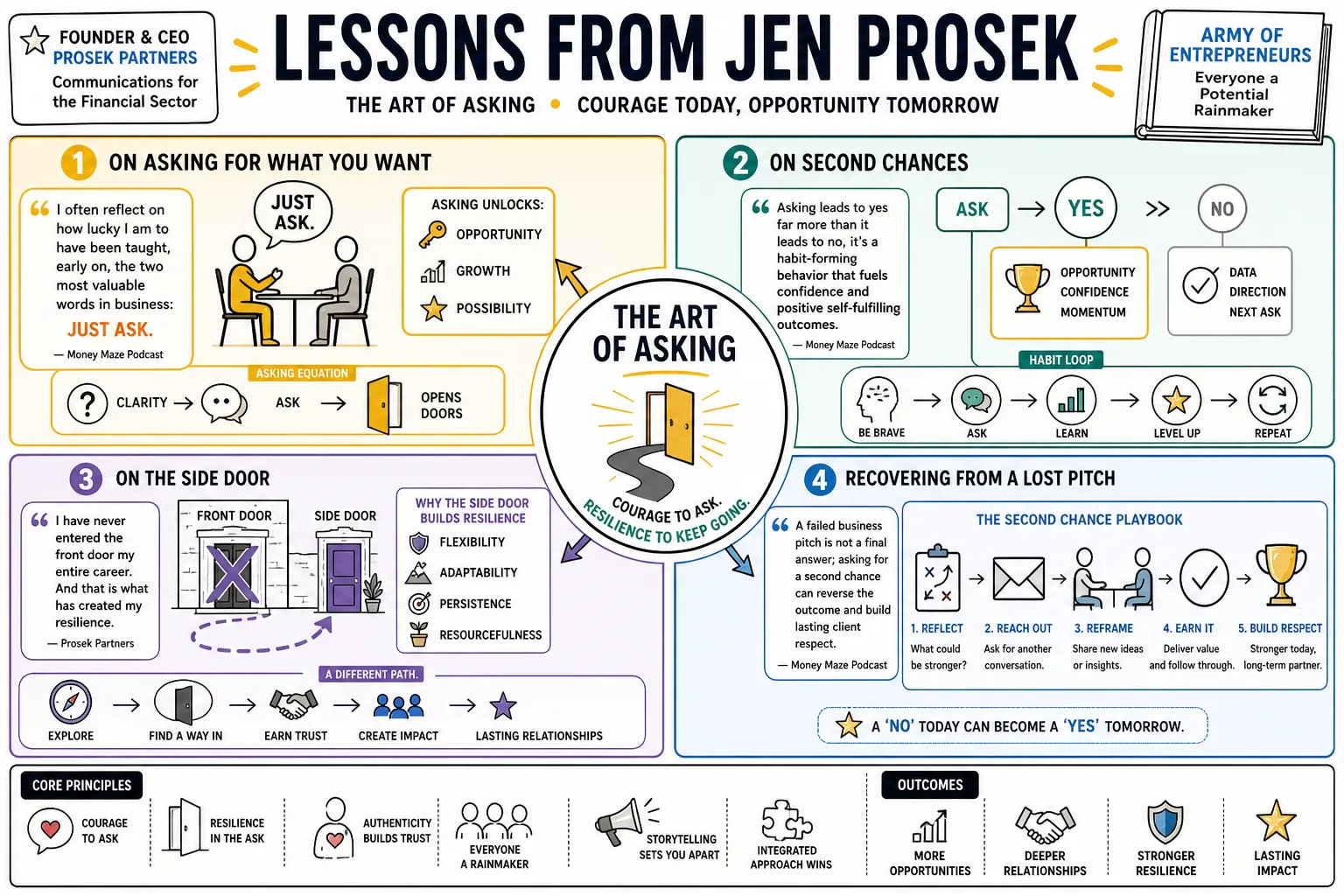
Part 1: The Art of Asking
- On asking for what you want: "I often reflect on how lucky I am to have been taught, early on, the two most valuable words in business: Just Ask." — Source: Money Maze Podcast
- On second chances: "Asking leads to yes far more than it leads to no, it's a habit-forming behavior that fuels confidence and positive self-fulfilling outcomes." — Source: Money Maze Podcast
- On the side door: "I have never entered the front door my entire career. And that is what has created my resilience. I explained that I've never – and I mean never – gotten what I wanted the first time." — Source: Prosek Partners
- On recovering from a lost pitch: A failed business pitch is not a final answer; asking for a second chance can reverse the outcome and build lasting client respect. — Source: Money Maze Podcast
- On habit-forming behavior: The act of asking for opportunities builds a feedback loop of confidence, reducing the fear of rejection over time. — Source: Money Maze Podcast
- On navigating closed doors: When traditional entry points are blocked, finding alternative routes forces you to develop persistence and adaptability. — Source: Prosek Partners
- On resilience: Setbacks in early career stages build the thick skin necessary for managing high-stakes client crises later. — Source: Prosek Partners
- On the fear of rejection: Most professionals hesitate to make a direct request out of fear, leaving valuable opportunities on the table for those willing to ask. — Source: Money Maze Podcast
- On self-fulfilling outcomes: Believing that an ask will yield a positive result changes how you present the request, increasing the likelihood of success. — Source: Money Maze Podcast
Part 2: The Army of Entrepreneurs
- On the army's definition: "An Army of Entrepreneurs is an internal force of committed, creative employees. It is also a proven management and leadership model." — Source: Army of Entrepreneurs
- On the owner's mindset: "Entrepreneurs act more like owners than employees. They're clear about the mission and about their contribution." — Source: Army of Entrepreneurs
- On shared responsibility: "While I once felt single-handedly responsible for my business and my team, I am now standing shoulder-to-shoulder with my Army of Entrepreneurs." — Source: Army of Entrepreneurs
- On employee productivity: Workers who understand how their daily tasks contribute to the company's bottom line become naturally more focused and efficient. — Source: Army of Entrepreneurs
- On teaching entrepreneurship: The ability to spot business opportunities is not entirely innate; it can be cultivated through deliberate training and incentive structures. — Source: Institute for Public Relations
- On the myth of the rainmaker: Relying on one or two star dealmakers limits a firm's growth; a better model distributes the responsibility of revenue generation across the staff. — Source: Army of Entrepreneurs
- On empowerment and risk: Employees must feel explicitly authorized to make decisions and take calculated risks without fear of harsh penalties for failure. — Source: Army of Entrepreneurs
- On continuous growth: A culture where everyone acts like an owner creates an environment where staff are constantly searching for the next expansion opportunity. — Source: Army of Entrepreneurs
- On unlocking internal forces: The most underutilized asset in many companies is the existing workforce, which can drive growth if properly motivated. — Source: Army of Entrepreneurs
- On replicable management: The process of turning employees into intrapreneurs can be scaled across organizations of any size, from startups to large corporations. — Source: Army of Entrepreneurs
Part 3: Authentic Leadership
- On showing your personality: "Honestly, once I gained confidence in being myself and showing my personality, our business really started to take off." — Source: Prosek Partners
- On building trust: "Being a leader today, and gaining trust, requires you to show your stakeholders a bit about who you really are." — Source: Prosek Partners
- On the failure of strict professionalism: "Nobody wants to work for – or do business with – someone who comes off as inauthentic or overly cautious about everything they do or say." — Source: Prosek Partners
- On industry norms: Deliberately injecting personality into conservative sectors like finance helps differentiate your firm from traditional competitors. — Source: Prosek Partners
- On caution: Over-indexing on risk management in your personal communication style can make you appear robotic and unapproachable. — Source: Prosek Partners
- On corporate transparency: Modern leadership requires a willingness to share your thought process, rather than just handing down finalized directives. — Source: Prosek Partners
- On vulnerability as a tool: Admitting past mistakes to your team demonstrates confidence and creates a safe environment for them to report their own errors early. — Source: Prosek Partners
- On aligning style and substance: A leader's personal brand should reflect their actual operational strengths, ensuring that their outward style reinforces their core competence. — Source: Prosek Partners
- On standing out: In a sea of identical corporate suits, embracing a distinctive personal style is a legitimate business strategy. — Source: Prosek Partners
Part 4: Presence and Perception
- On first impressions: "If you take the stage, recognize that your audience is forming an impression long before you've finished your first sentence." — Source: Prosek Partners
- On unspoken signals: "We like to think people are judged solely on the quality of their ideas, but that's rarely how the world works." — Source: Prosek Partners
- On visibility: "Visibility Brings Opportunity." Whether seeking a promotion or a new client, you must be visible to be considered. — Source: Prosek Partners
- On style competing with substance: "The strongest personal brands ensure that style reinforces substance rather than competing against it." — Source: Prosek Partners
- On taking the stage: Leaders must physically and metaphorically step up to the podium to claim authority in their field. — Source: Prosek Partners
- On being understood: It is not enough to be competent; your stakeholders must actively comprehend your specific skills and values. — Source: Prosek Partners
- On board seats and promotions: Advancement in the upper echelons of business relies heavily on how others perceive your readiness for the role. — Source: Prosek Partners
- On audience perception: People evaluate your competence based on your demeanor and energy level before they process your actual arguments. — Source: Prosek Partners
- On professional presence: Maintaining a steady, composed presence during high-stress situations projects reliability to clients. — Source: Prosek Partners
Part 5: Communications in Volatility
- On periods of uncertainty: During market shifts or internal crises, the baseline requirement for communication increases dramatically. — Source: Prosek Partners
- On over-communicating: When the environment is volatile, leaders must increase their touchpoints with stakeholders to prevent rumors from filling the void. — Source: Prosek Partners
- On stress-testing narratives: Corporate messages must be evaluated against worst-case scenarios to ensure they hold up under public scrutiny. — Source: Prosek Partners
- On simplicity: Complex financial or operational issues must be distilled into simple, digestible statements during a crisis. — Source: Prosek Partners
- On platform consistency: A message delivered to employees must align perfectly with what is said to investors, as audiences now monitor all channels. — Source: Prosek Partners
- On managing panic: Calm, transparent, and frequent updates are the most effective tools for stabilizing a nervous client base. — Source: Prosek Partners
- On market shifts: A company's narrative must remain flexible enough to adapt to macroeconomic changes without losing its core identity. — Source: Prosek Partners
- On defending reputation: Reputation management in a downturn requires proactive storytelling rather than defensive reactions. — Source: Prosek Partners
- On clarity during chaos: Ambiguity is the enemy of trust; leaders must speak in absolute, verifiable terms when the market is unstable. — Source: Prosek Partners
Part 6: Integrated Strategy and PR
- On breaking silos: Corporate communications, marketing, and investor relations must operate as a single unit rather than isolated departments. — Source: Prosek Partners
- On inflection points: Major events like M&A or restructuring require a coordinated approach to ensure the market understands the strategic rationale. — Source: Prosek Partners
- On M&A communication: The success of an acquisition often hinges on how clearly the combined value is articulated to both sets of employees on day one. — Source: Prosek Partners
- On multi-stakeholder engagement: Modern PR requires addressing employees, customers, and competitors simultaneously with a unified narrative. — Source: Prosek Partners
- On the blurring of audiences: The divide between internal and external communication is gone; assume any internal memo will be read by the press. — Source: Prosek Partners
- On earnings calls: Quarterly reports are no longer just for analysts; they are public broadcasts that shape the broader perception of the company. — Source: Prosek Partners
- On digital platforms: Prosek argues that first impressions now form before a meeting: trusted coverage, LinkedIn activity, bylines, interviews, and consistent public content become the training data that shapes an executive's reputation. — Reference: Prosek note on How I Invest covering owned media, digital blink, and first impressions
- On the state of the PR profession: The industry has evolved from media relations to comprehensive reputation and business strategy consulting. — Source: PR Masters Series
- On proprietary content: Firms should act as their own publishers, creating white papers and reports to own their industry narrative. — Source: Prosek Partners
- On clear positioning: A differentiated market position relies on a narrative that competitors cannot easily replicate or adopt. — Source: Prosek Partners
Part 7: Branding Private Markets
- On financial services marketing: Prosek's private-markets survey found that branding and PR are moving to the center of fundraising and dealmaking, with a majority of respondents planning to increase brand and PR investment. — Reference: Prosek private markets survey on branding, PR, fundraising, and deal flow
- On branding as a driver: A strong brand directly correlates to an easier time raising capital and securing better deal terms. — Source: Capital Allocators
- On fundraising: Institutional investors use public perception and brand strength as secondary due diligence metrics. — Source: Capital Allocators
- On deal flow: Founders and target companies prefer to partner with private equity firms that have a clear, well-regarded public identity. — Source: Capital Allocators
- On talent acquisition: The best financial talent is drawn to firms that clearly articulate their culture and market position publicly. — Source: Capital Allocators
- On the reluctance to market: Overcoming the financial sector's traditional preference for secrecy requires demonstrating the tangible ROI of visibility. — Source: Capital Allocators
- On podcasts as a tool: Prosek points to owned media and long-form conversations as part of how financial-services leaders clarify their narrative, build differentiation, and create trust in a competitive capital landscape. — Reference: Prosek note on How I Invest covering owned media, narrative, differentiation, and trust
- On shortening sales cycles: Prosek links brand clarity to commercial efficiency: financial firms that are easier to understand and prefer can improve fundraising, deal flow, and trust before a live pitch begins. — Reference: Prosek note on How I Invest covering efficiency, preference, fundraising, and deal flow
- On durable content: Prosek's Reaching for Retail report treats education, paid, owned, earned, and social media as repeatable marketing infrastructure for private-capital firms trying to build recognition and preference. — Reference: Prosek Reaching for Retail report on education, owned media, paid social, and recognition
- On the power of storytelling: Even highly technical financial products require a compelling narrative to convince allocators to invest. — Source: Capital Allocators
Part 8: Human Connection and Culture
- On the people business: "We are in a 'people business,' and understanding how people react and respond to connection is an essential professional skill." — Source: Prosek Partners
- On the gift of presence: Being entirely focused during a conversation, without looking at a phone or distracted by the next meeting, is a rare and powerful trait. — Source: Prosek Partners
- On listening: True listening involves processing the emotional undertone of a client's request, rather than just the factual parameters. — Source: Prosek Partners
- On remembering details: Retaining small facts about colleagues and clients demonstrates a level of care that transactional interactions lack. — Source: Prosek Partners
- On culture as a competitive advantage: "I think culture is a competitive advantage." A cohesive internal culture translates directly to better client service. — Source: Prosek Partners
- On hybrid work: Maintaining corporate culture when employees are remote requires deliberate, scheduled efforts rather than relying on organic office interactions. — Source: Prosek Partners
- On live events and convening: Bringing people together physically remains one of the most effective ways to solidify industry relationships. — Source: Prosek Partners
- On building relationships: Long-term business success relies on cultivating a network of individuals who trust your character as much as your competence. — Source: Prosek Partners
- On deepening connections: Following up on personal conversations and checking in during quiet periods proves that a relationship is not purely mercenary. — Source: Prosek Partners