Jeni Britton dropped out of art school to start an ice cream stand in Ohio, eventually growing Jeni's Splendid Ice Creams into a national business. After decades running her company, she stepped away to launch Floura, a startup turning discarded fruit trimmings into high-fiber snacks. This profile covers her approach to flavor creation, crisis survival, and the process of incubating a second brand.
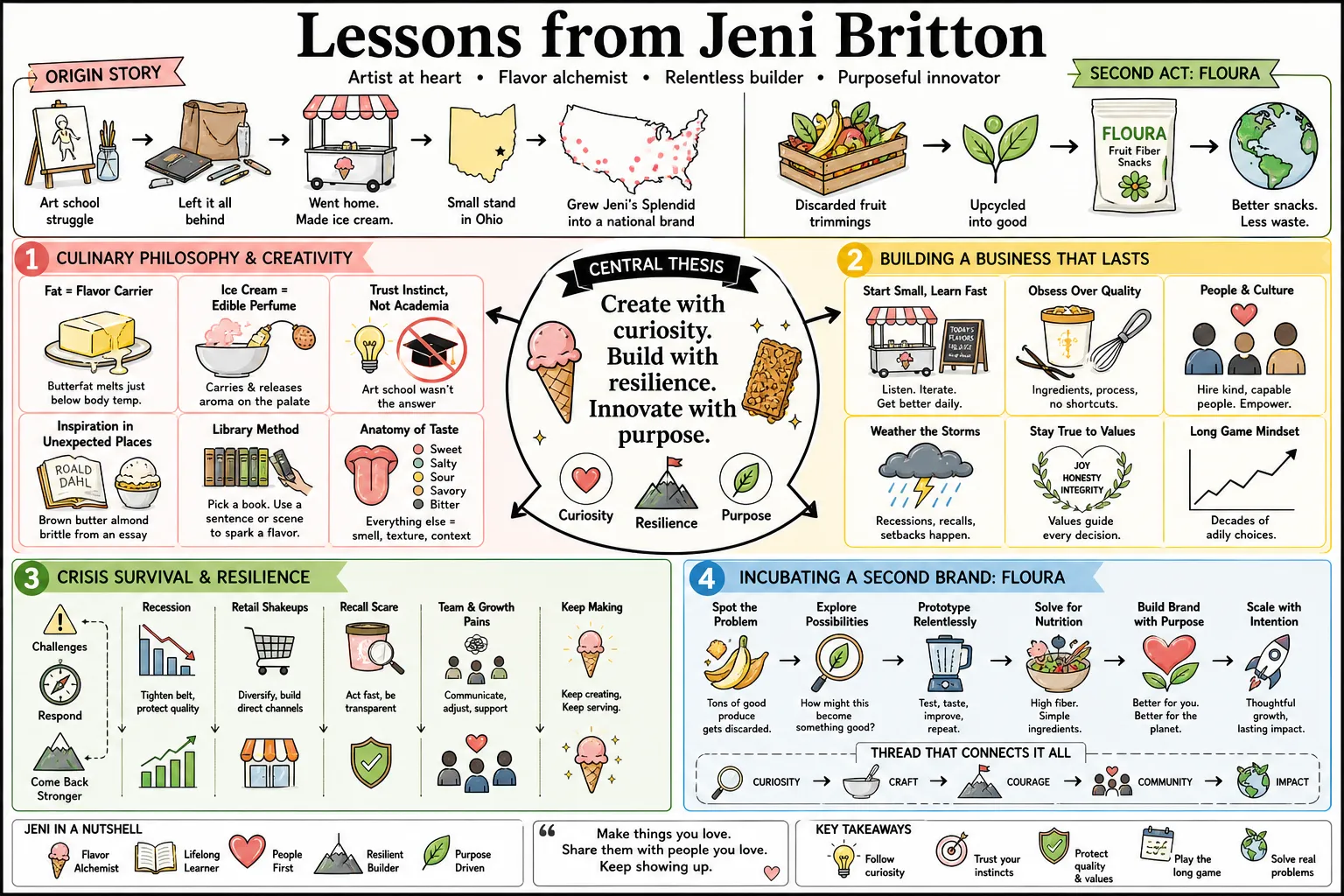
Part 1: Culinary Philosophy and Creativity
- On the connection between fat and flavor: She discovered that because butterfat melts right below body temperature, it functions perfectly to absorb and release scent directly onto the palate. — Reference: Cherry Bombe
- On ice cream as edible perfume: Remembering her grandmother’s warning to keep butter away from onions so it wouldn't absorb their smell, she realized that ice cream functions exactly like a fragrance carrier. — Reference: FINIEN
- On trusting artistic instinct over academia: After struggling in an art school figure drawing class, she abandoned her portfolio and expensive supplies in the classroom, went home to make ice cream, and never returned to school. — Reference: Cherry Bombe
- On finding inspiration in literature: Rather than leaning on culinary trends, she draws flavor ideas from unexpected places, such as creating a brown butter almond brittle ice cream based on an essay by Roald Dahl. — Reference: Cherry Bombe
- On imaginative flavor development: When feeling uninspired, she visits a library, picks a random book off a shelf, and challenges herself to invent an ice cream flavor based on how a specific sentence or historical scene might smell and taste. — Reference: USA Today
- On the anatomy of taste: She points out that the tongue only detects basic profiles like sweet, salty, sour, savory, and bitter; everything else that makes a flavor unique is actually processed as scent. — Reference: FINIEN
- On creativity as a mindset: True creativity in a business context isn't always about wild ideas; it often comes down to finding clever efficiencies that make the work possible. — Reference: Podscan.fm
Part 2: Personal Branding and The Founder's Journey
- On the power of first impressions: Early in her career, she dressed like a counterculture artist with pink hair and thrifted clothes, eventually realizing this aesthetic inadvertently alienated potential customers and critics. — Reference: Create & Cultivate
- On removing ego for the sake of the product: To build trust after an early business failure, she adopted a uniform of a starched white shirt, apron, and natural hair color, deliberately shifting all focus from herself to her ice cream. — Reference: Create & Cultivate
- On earning the right to express yourself: After spending over two decades building unshakeable credibility and a trusted brand, she felt she had finally earned the freedom to take personal risks and dye her hair pink again. — Reference: Create & Cultivate
- On using a lack of resources as fuel: Growing up without a safety net gave her an edge; she reasoned that jumping off a cliff without a parachute was ultimately safer than staying stuck with the wolves on the other side. — Reference: Create & Cultivate
- On the difference between founders and business people: She acknowledges that creative entrepreneurs are not inherently standard business operators, making it vital to surround oneself with executives who can manage things like corporate finance. — Reference: USA Today
- On the emotional toll of building a company: Entrepreneurship isn't merely a day job; it requires a level of obsession and care for the work that is so deep it can actually hurt. — Reference: Create & Cultivate
- On building your own world: The role of a founder involves designing and constructing a unique world and inviting customers into it, rather than just selling a product. — Reference: The Gravity Podcast
Part 3: Overcoming Setbacks and Crisis Management
- On eliminating self-pity: After reading a self-help book early in her career, she adopted a strict policy to never ask why a bad thing happened to her, choosing instead to assess the situation unemotionally and take the next step. — Reference: USA Today
- On relying on core values during chaos: When a crisis hits and a situation no longer makes sense, leaders must let their foundational values dictate their immediate actions. — Reference: How I Built This
- On prioritizing safety over profit: Faced with a potential Listeria issue in 2015, the company enacted a total product recall within hours to guarantee customer safety, despite the devastating financial hit that reduced their sales to zero. — Reference: EntreLeadership
- On embracing the cleansing power of a crisis: During their 2015 shutdown, she used the pause to evaluate exactly what elements of the company needed to stay and what could be discarded. — Reference: EntreLeadership
- On rapid operational pivots: When the COVID-19 pandemic began, the leadership team realized their scoop shops might stay closed, so they immediately shifted their supply chain to produce retail pints instead of bulk buckets to ensure they had inventory for delivery. — Reference: Thanx
- On rewriting the corporate mission for emergencies: She temporarily changed the company's marching orders during the pandemic to focus strictly on surviving the year and keeping people safe, allowing leadership to make entirely different choices. — Reference: Thanx
- On dividing and conquering disaster: When a major threat arises, executive teams should split their focus; while her CEO managed federal regulators and recovery plans, she immediately began reformulating the ice cream to prepare for their return. — Reference: EntreLeadership
Part 4: Leadership and Team Dynamics
- On fostering a fellowship: She views her employees as a fellowship bound together by a shared mission and mutual care, treating the workforce as a community rather than a strict corporate hierarchy. — Reference: WABE
- On captaining the ship: A founder's job is to build a reliable vessel, accept that the journey will be chaotic, and convince a dedicated crew to get on board and trust the navigation. — Reference: Create & Cultivate
- On employee psychological safety: Before a company can successfully deliver its product to the public during a crisis, leadership must first ensure the internal team feels safe and comfortable coming into work. — Reference: How I Built This
- On the collective strength of female founders: While individual women in business often battle imposter syndrome, they can overcome personal insecurities by leaning on the collective encouragement of their peers. — Reference: Create & Cultivate
- On balancing metrics and instincts: Effective leadership requires managing the constant tension between concrete data sets and the unquantifiable gut intuition of a founder. — Reference: WABE
- On continuous communication: A significant portion of daily leadership involves verbally communicating vision and standards, checking in with teams in person, and finding ways to assist them on the ground. — Reference: USA Today
Part 5: Business Strategy and Growth
- On starting before you're ready: She advises aspiring founders not to over-research their ideas at the beginning, warning that knowing too much about the difficulty of a venture will only scare them out of trying. — Reference: USA Today
- On the necessity of originality: Copying an existing business model strips away the otherworldly passion required to sustain a founder through the inevitable hardships of building a company. — Reference: USA Today
- On adapting to seasonality: To combat the natural drop in ice cream demand during winter, she developed rich, bakeshop-inspired flavors featuring handmade marshmallows to give customers a specific reason to visit. — Reference: FINIEN
- On building an omnichannel safety net: Establishing direct nationwide shipping and grocery distribution long before the pandemic is what ultimately saved the brand when physical storefronts were forced to close. — Reference: Thanx
- On the realities of the entrepreneurial path: She recognizes that unexpected obstacles make up the actual road to success, rather than acting as temporary delays. — Reference: Create & Cultivate
- On the experience of unboxing: Shipping ice cream is treated as an exercise in storytelling, where the packaging, catalogs, and unboxing process elevate the product into a premium holiday gift. — Reference: FINIEN
- On continuous self-education: Recognizing her gaps in formal business training, she leans heavily on executive partners who introduce her to resources like specialized finance books for entrepreneurs. — Reference: USA Today
Part 6: Transition and The Second Act
- On knowing when to step back: After the pandemic forced her away from the daily operations of Jeni's, she realized the team was thriving without her and recognized her direct involvement had become more disruptive than helpful. — Reference: The Quality Edit
- On transitioning to a consulting role: Even after stepping away from daily management, she remains a minority owner and supports the ice cream company from the periphery by populating a shared document with new flavor ideas. — Reference: Columbus Monthly
- On the cost of the entrepreneurial grind: She spent decades driving her business forward with constant adrenaline, only to realize by 2020 that she had neglected her own well-being and didn't know what it felt like to be truly healthy. — Reference: The Quality Edit
- On defining true health: She believes wellness is not about physical fitness or projecting perfection, but about achieving internal alignment where outward actions match who you are inside. — Reference: The Quality Edit
Part 7: Nutritional Philosophy and The Fiber Gap
- On identifying a systemic health issue: After experiencing immediate benefits from eating more fresh fruit, she researched the American diet and learned that 95% of the population lacks sufficient daily fiber, contributing directly to chronic disease. — Reference: Nosh.com
- On how fiber changes sugar digestion: She stopped worrying about the sugar content of eating high volumes of fruit after learning that natural fiber fundamentally slows down the body's digestion of that sugar. — Reference: The Quality Edit
- On eating for human flourishing: She connects dietary fiber and microbiome health directly to the Greek concept of eudaimonia, viewing gut health as a baseline requirement for human flourishing. — Reference: Columbus Monthly
- On maximizing plant diversity: To support the gut microbiome efficiently, she formulated her new fruit bars to include 12 distinct whole plants, attempting to cover nearly half of a person's recommended weekly fiber diversity in a single snack. — Reference: Columbus Monthly
Part 8: Product Development and Market Testing
- On turning food waste into product bases: Touring a fresh produce processing facility, she realized that discarded but nutrient-dense trimmings like apple cores and watermelon rinds could be harvested and upcycled into high-fiber snacks. — Reference: Nosh.com
- On choosing lighter base ingredients: Instead of using sticky, overly sweet date paste like most snack bars, she opted for apple core paste to create a lighter, fruit-forward flavor profile. — Reference: The Quality Edit
- On the advantage of a soft launch: For her second company, she used Kickstarter to raise initial capital and intentionally distributed imperfect prototypes to a small community of early adopters. — Reference: Inc.com
- On building the brand alongside the customer: She recommends that founders get their product to market quickly, using direct customer feedback to refine the company's visual identity and point of view before an official rollout. — Reference: Inc.com
- On launching in mid-sized markets: She credits starting in Columbus rather than a coastal city with keeping startup costs low, allowing her to invest her early capital entirely into the quality of the product instead of expensive rent. — Reference: Apple Podcasts
- On the forgiveness of smaller cities: Beyond lower costs, mid-sized cities rally behind local founders, creating an environment where entrepreneurs can experiment, fail, and maintain the community's support. — Reference: Apple Podcasts
- On expanding product formats: While she started her second act with a convenient fruit bar, she envisions eventually using upcycled fiber to create everyday items like pancakes and pizza crusts. — Reference: Nosh.com