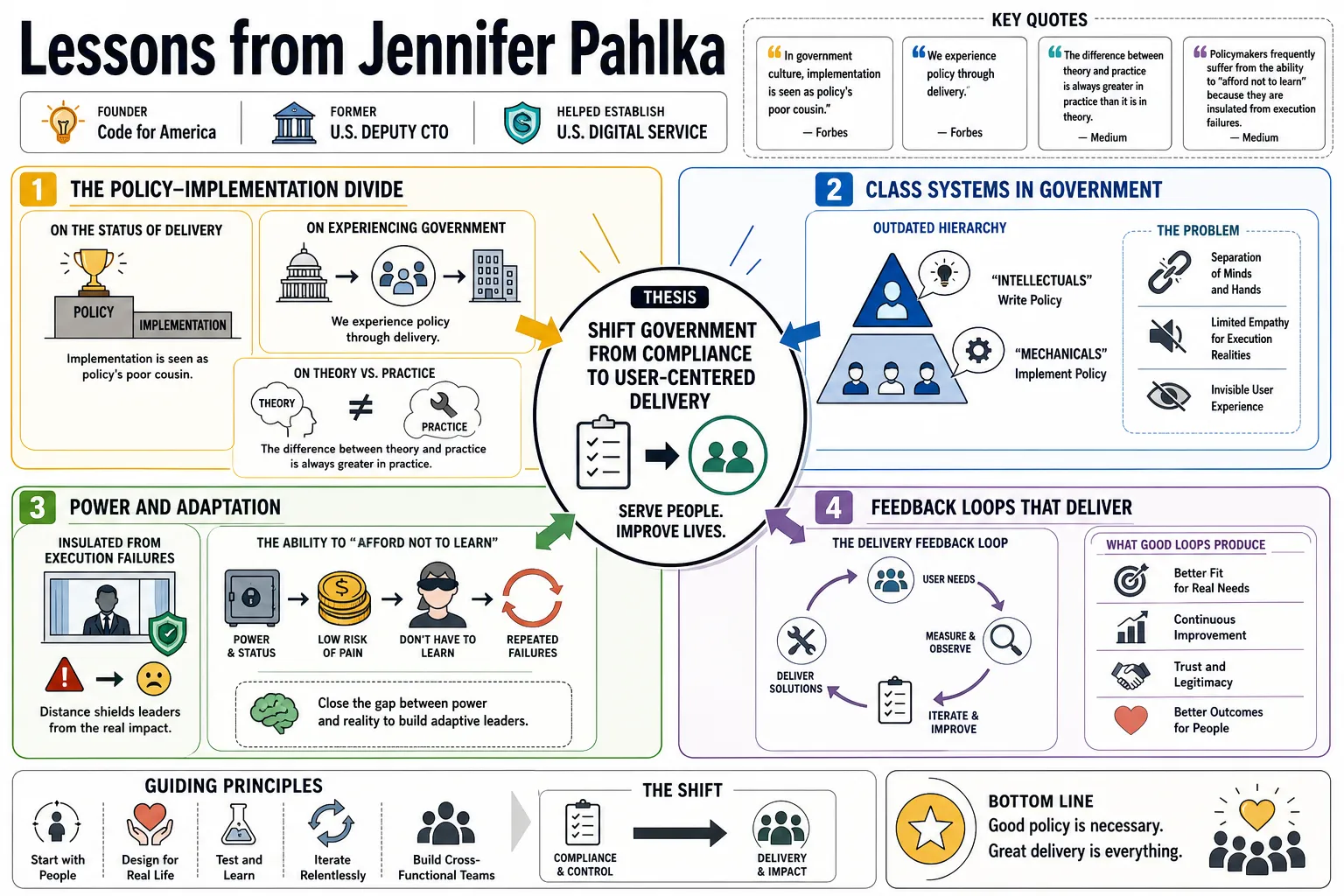
Lessons from Jennifer Pahlka
Jennifer Pahlka is the founder of Code for America and former U.S. Deputy Chief Technology Officer who helped establish the U.S. Digital Service. She is known for diagnosing how rigid internal processes and the separation of policy creation from technical execution cause public services to fail. This profile catalogs her arguments for shifting the government from a culture of compliance to one focused on user-centered delivery.
Part 1: The Policy-Implementation Divide
- On the Status of Delivery: "In government culture, implementation is seen as policy's poor cousin." — Source: Forbes
- On Experiencing Government: "We experience policy through delivery." — Source: Forbes
- On Class Systems: Government operates with an outdated hierarchy dividing the "intellectuals" who write policy from the "mechanicals" who implement it. — Source: McKinsey
- On Theory vs. Practice: "The difference between theory and practice is always greater in practice than it is in theory." — Source: Medium
- On Power and Adaptation: Policymakers frequently suffer from the ability to "afford not to learn" because they are insulated from execution failures. — Source: Medium
- On Feedback Loops: The traditional fire-and-forget approach to legislating prevents lawmakers from discovering how their policies actually function in reality. — Source: Conversations with Tyler
- On Rigid Interpretation: "Rigid, overly specific interpretations of law and policy are hard to avoid when those doing the interpretation can't evaluate the work for themselves." — Source: Goodreads
- On Policy-Delivery Fusion: Successful governance requires implementers to be at the table when major legislative ideas are first being developed. — Source: Eating Policy
- On Unintended Consequences: Lawmakers craft rules without understanding technical constraints, which routinely leads to wasted resources and unworkable public systems. — Source: Sobrief
- On Design as Expertise: "Vomiting intentions directly into policy without the benefit of thoughtful, user-centered design can be equally unhelpful." — Source: Eating Policy
Part 2: The Mechanics of Bureaucracy
- On Malice vs. Structure: "When systems or organizations don't work as you think they should, it is generally not because the people in them are stupid or evil. It is because they are operating according to structures and incentives that aren't obvious from the outside." — Source: Niskanen Center
- On Bureaucratic Sedimentation: Many rules civil servants follow are not actual laws, but layers of accumulated agency practices maintained out of institutional risk aversion. — Source: Good Science Project
- On Contempt for Government: "We say that word [bureaucracy] with such contempt. But it's that contempt that keeps this thing that we own and we pay for as something that's working against us." — Source: AZQuotes
- On Process Over Outcomes: Government culture heavily incentivizes following the correct procedural steps rather than ensuring a working product is delivered to the public. — Source: Reddit
- On Skunk Works Limitations: Creating an innovative side team is useless unless it has the power to disrupt existing bureaucratic infrastructures and procurement frameworks. — Source: Conversations with Tyler
- On Shifting Behaviors: "A revolution doesn't happen when society adopts new technologies—it happens when society adopts new behaviors. The same is true of government." — Source: Goodreads
- On Artificial Constraints: "The ultimate hidden truth of the world is that it is something that we make and could just as easily make differently." — Source: Conversations with Tyler
- On Dismantling the Old: Reforming bureaucracy is difficult because leadership is rarely disciplined enough to dismantle failing structures while building new ones. — Source: Conversations with Tyler
- On Policy Cruft: When the public blames bad technology for a clunky DMV site, they are actually experiencing decades of accumulated, unsimplified administrative burden. — Source: City Journal
- On Ideological Debates: "I think this notion of sort of big government or small government is less powerful than government that does what we intend it to do." — Source: EconTalk
Part 3: Agile and Iterative Government
- On Defining Agile: "The main concept of agile is that it's a cycle. You build, measure, learn, and you have all of the stakeholders in a cycle so they're able to talk to each other and learn from each other." — Source: Niskanen Center
- On Waterfall Pitfalls: Traditional government technology operates on a waterfall methodology, collecting thousands of requirements upfront and delaying user testing until the very end. — Source: McKinsey
- On Rituals vs. Culture: Adopting the trappings of agile fails instantly if the underlying policy structures demand strict compliance. — Source: Tech Policy Press
- On Theory and Action: When challenged about the theory of agile contracting, the Code for America team noted they had already been doing it for years and had actual results. — Source: US Digital Service Origins
- On the Requirements Religion: "I think requirements are sort of a religion... there is a fundamental belief, that is not supported by evidence, that requirements are the thing that make a tech project... succeed or fail." — Source: CSPS
- On Building Small: Good digital services require building small, testing with real users, observing failures, and iterating persistently until the system works. — Source: Long Now
- On Software Reality: "Treating software as just another commodity overlooks the fact that mission-critical software cannot simply be bought the way you buy a truck or even a building." — Source: Goodreads
- On Continuous Improvement: Transitioning away from waterfall means government must get comfortable changing direction based on what they learn during development. — Source: Conversations with Tyler
- On Applying Instinct: Long before learning the formal language of agile software development, civic tech leaders were applying its core principles instinctively out of necessity. — Source: CSPS
Part 4: User-Centered Design in Public Service
- On the Core Focus: "Our fundamental focus is improving services and making people's lives better. A report is useless unless it makes progress toward that goal." — Source: US Digital Service Origins
- On Organizational Blind Spots: "The barriers that matter here are not technical... Your organizational structure is not set up to understand what users experience when they are using your service." — Source: Dokumen
- On Internal Distractions: "When all your time is spent answering questions and writing reports for other people inside government, it's mighty hard to be focused on the people outside government you're supposed to serve." — Source: Goodreads
- On Visual Reminders: Digital service teams should keep literal signs that say "USERS" pointed at the street to remember their true constituents. — Source: US Digital Service Origins
- On Systemic Frustrations: "The maddening things that happen to people... when they interact with government services are the effects of a system We the People designed, so this is not a finger-pointing exercise." — Source: Medium
- On Expanding Design: User-centered methodologies apply equally to crafting laws and agency regulations, rather than being restricted to IT teams. — Source: Code for America
- On the Definition of Good Software: "Good software is user-centered, iterative, and data driven." — Source: Long Now
- On Equity Misinterpretations: True digital equity involves ensuring all channels work together to serve the public, rather than forcing every demographic to use a website in the exact same way. — Source: McKinsey
- On Complementary Channels: Paper forms, call centers, and in-person assistance are vital legacy channels that must complement digital tools to achieve complete service delivery. — Source: McKinsey
Part 5: Procurement and the Vendor Ecosystem
- On Talent Dependency: "The federal government has become completely dependent on contractors for technical talent... making procurement the whole ballgame." — Source: We The Builders
- On Hiring vs. Contracting: Because the federal hiring process is broken, agencies are forced to outsource core technical capabilities to external vendors. — Source: We The Builders
- On Monolithic Contracts: Government naturally gravitates toward massive, monolithic RFPs that lock in failure, instead of issuing smaller, focused contracts. — Source: Medium
- On Vendor Incentives: Pahlka argues that when digital delivery is fully outsourced, government loses the internal capacity to reshape waterfall procurement into user-centered iteration, and traditional contracts make every change to a specification expensive. — Reference: Pahlka essay on delivery-driven policy, vendor contracts, and internal digital capacity
- On Breaking Up RFPs: True reform requires breaking large contracts into smaller pieces that can be tested with users and developed iteratively. — Source: Medium
- On Managing Tech: When an agency outsources all its technical talent, it loses the internal competency required to manage the contractors it hired. — Source: McKinsey
- On Stopping Bad Habits: Leaders must stop pouring millions of dollars into massive technology procurements that everyone internally knows are destined to fail. — Source: StateScoop
- On Cost Savings: "Both sides need to understand that investing in digital competencies will save far more money than it costs." — Source: Goodreads
- On Reclaiming Ownership: Rebuilding government capacity requires bringing enough engineering and product expertise back in-house to make informed purchasing decisions. — Source: Recoding America
Part 6: The Healthcare.gov Wake-Up Call
- On the Concrete Boat: "When it's shipped, it's like a concrete boat, because it sinks the minute you put it on the water." — Source: McKinsey
- On the Crisis as Catalyst: The catastrophic launch of Healthcare.gov forced federal leadership to acknowledge that their approach to digital infrastructure was fundamentally broken. — Source: Tech Policy Press
- On Missing Vocabulary: Prior to the website's rescue effort, large swaths of federal leadership had never even heard of agile software development. — Source: Tech Policy Press
- On Rescue Teams: The rescue of Healthcare.gov proved that a small team of empowered technologists could fix what massive, traditional contractors could not. — Source: City Journal
- On the True Culprit: The failure was widely blamed on bad code, but the root cause was an impossibly complex web of policy and process constraints dictating the build. — Source: City Journal
- On the Illusion of Progress: The project demonstrated how a system can pass every internal bureaucratic checkpoint and green-light review, yet still fail completely upon public release. — Source: Niskanen Center
- On Changing the Paradigm: Healthcare.gov became the ultimate case study for why the government must shift from a compliance mindset to a product management mindset. — Source: Recoding America
- On Technical Debt: The launch revealed the immense technical debt and fragile legacy systems hiding behind the federal government's policy mandates. — Source: Gov.bc.ca
- On Shared Infrastructure: The crisis highlighted the urgent need for common, shared digital tools so each agency does not have to reinvent the wheel. — Source: Eating Policy
Part 7: Building State Capacity
- On the Definition of Capacity: State capacity is fundamentally about the government's practical ability to achieve its policy goals and deliver on its promises. — Source: Niskanen Center
- On the Product Model: Agencies must stop treating technology as temporary projects and start managing them as persistent products that require continuous improvement. — Source: Niskanen Center
- On Enablement: Instead of adding more mandates to fix broken agencies, lawmakers should adopt an enablement framework that asks what obstacles can be removed. — Source: Substack
- On Enriching the Soil: "If you're a gardener, you can't keep trying to grow plants in soil that has been depleted. We've got to enrich the soil of these capabilities of government." — Source: JHU
- On Elevating Champions: True capacity building involves identifying and supporting the internal public servants who already understand the systems and want to improve them. — Source: Medium
- On Administrative Burden: Simplifying policy frameworks and reducing the paperwork burden on citizens is a direct form of building state capacity. — Source: Harvard
- On Reports vs. Reality: Pahlka frames government failure as an implementation problem: policies and reports do not change outcomes unless teams alter the structures, incentives, and delivery practices that shape real services. — Reference: Niskanen interview with Pahlka on structures, incentives, implementation, and delivery
- On Elite Understanding: "You can no longer run a country properly if the elites don't understand technology in the same way they grasp economics or ideology." — Source: Long Now
- On Delivery as the Last Mile: A policy is nothing more than an unfulfilled promise until the delivery mechanism is successfully executed. — Source: Recoding America
Part 8: Civic Technology and the Future
- On the Origin of USDS: The U.S. Digital Service was created to provide top-down, institutional support for technologists trying to modernize federal agencies from within. — Source: Washington Post
- On the Value of USDS: The USDS generated a seventeenfold return on investment by saving the government billions through cost avoidance and system rescue. — Source: Goodreads
- On Organizational Goals: The ultimate purpose of a digital service unit is to get the government to a point where it can buy and build what it needs normally. — Source: Washington Post
- On It Being Hard: When the work of civic tech feels impossible, it helps to remember: "It’s not complicated, it’s just hard." — Source: US Digital Service Origins
- On the True Point of USDS: "The Digital Service Was Never the Point"—the real goal is a widespread shift toward an outcome-driven operating model across all of government. — Source: Eating Policy
- On Showing Up: In civic technology and political organizing, it remains fundamentally true that decisions are made by those who show up. — Source: Goodreads
- On Doing Important Work: "You're here because you're trying to do something really hard and really important. And that's make government work as it should." — Source: Code for America
- On Doing Things Together: "Government is supposed to be about how we do things together, and we can do that much more together if we use technology smartly right now." — Source: QuoteFancy
- On Grand Ambitions: Every grand political ambition eventually balances on the mundane reality of building good, usable technology for the public. — Source: US Digital Service Origins
- On the Future of Civic Tech: The civic technology movement must continuously push past temporary fixes to permanently change the underlying behaviors of public administration. — Source: Tech Policy Press