Jenny Harrington is the CEO and portfolio manager at Gilman Hill Asset Management, where she oversees equity income strategies. She is widely known for her focus on high-yield, dividend-paying stocks and her regular commentary on CNBC's Halftime Report. This profile compiles her core ideas on building sustainable income, avoiding dividend traps, and navigating market cycles.
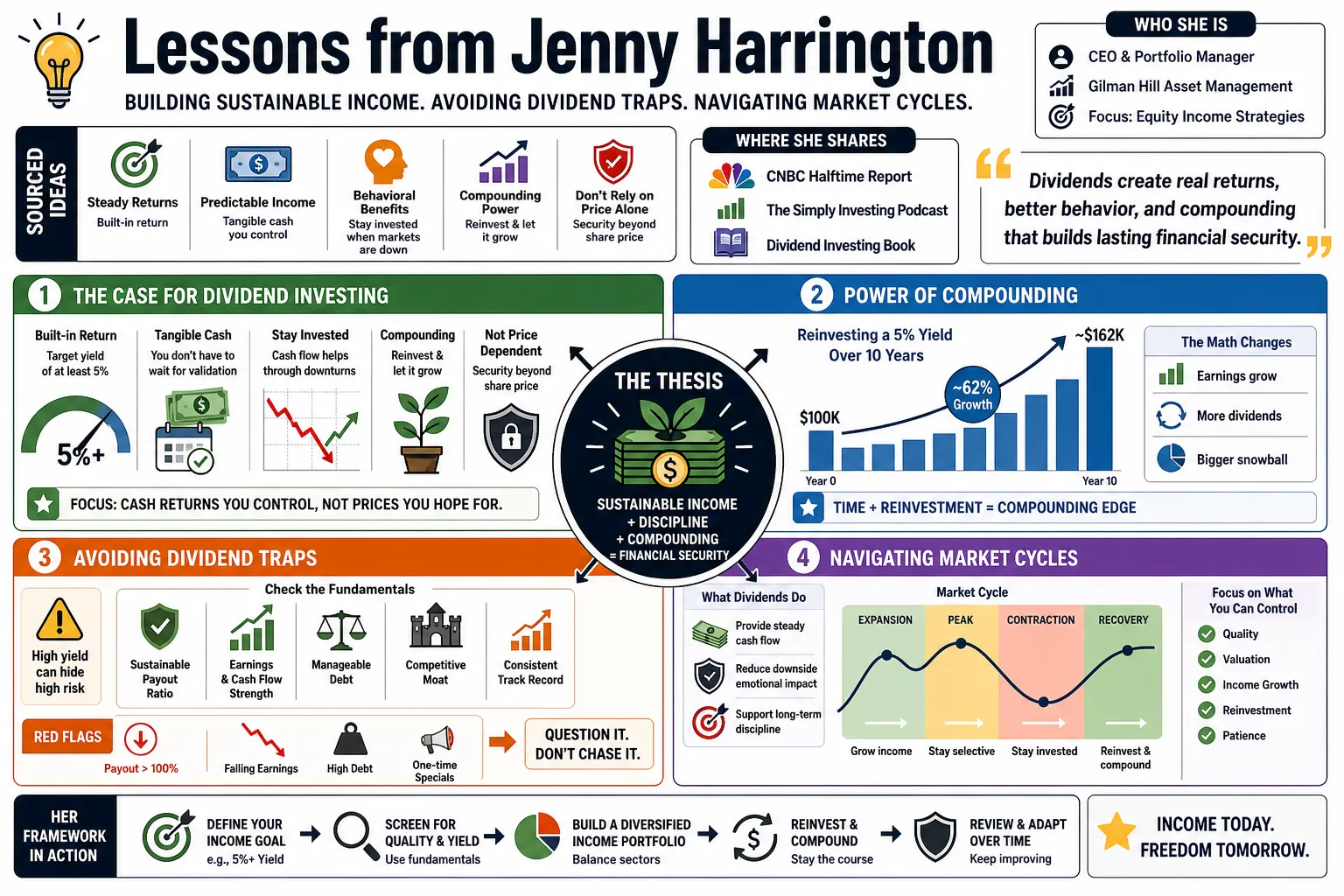
Part 1: The Case for Dividend Investing
- On steady returns: "We target an aggregate portfolio yield of at least 5%, which provides a built-in return regardless of broader market conditions." — Source: CNBC Halftime Report
- On predictable income: "Dividends offer a tangible cash return that you don't have to wait for the market to validate." — Source: Gilman Hill Asset Management
- On behavioral benefits: "Receiving regular cash payouts makes it much easier to stay invested when the index is down." — Source: The Simply Investing Podcast
- On compounding: "Reinvesting a 5% yield over a decade fundamentally changes the math of your retirement portfolio." — Source: Dividend Investing Book
- On market reliance: "You don't want your financial security tied entirely to the price someone else is willing to pay for your shares on any given day." — Source: HerMoney Podcast
- On income vs. growth: "Growth is exciting, but cash flow pays the bills. We build portfolios designed to fund real-life obligations." — Source: CNBC Worldwide Exchange
- On total return: "A high, sustainable dividend acts as a shock absorber during corrections and an accelerator during bull runs." — Source: Barron's
- On historical performance: "Historically, dividend payers have consistently outperformed non-payers over long durations with lower volatility." — Source: Money Life with Chuck Jaffe
- On realistic expectations: "We don't need our stocks to double. We just need them to pay us while maintaining their underlying business value." — Source: CoveredCalls Podcast
- On shifting demographics: "As more investors transition from the accumulation phase to the distribution phase, the structural demand for yield will only increase." — Source: The Wall Street Journal
Part 2: Identifying Sustainable Yield
- On payout ratios: "We look for companies paying out a reasonable percentage of their free cash flow, leaving room for both error and dividend growth." — Source: CNBC Halftime Report
- On balance sheet strength: "A high yield means nothing if the company has to borrow money to fund it." — Source: Gilman Hill Asset Management
- On business maturity: "We prefer mature businesses that no longer need to plow every cent back into growth." — Source: The Simply Investing Podcast
- On consistent cash flow: "Earnings can be manipulated by accounting, but cash generation is much harder to fake." — Source: Dividend Investing Book
- On dividend history: "A management team that has raised its dividend through multiple recessions has proven its commitment to shareholders." — Source: HerMoney Podcast
- On targeted yields: "A 5% to 6% yield is often the sweet spot—high enough to generate meaningful income, but not so high that it signals distress." — Source: CNBC Worldwide Exchange
- On capital allocation: "We want to see capital return as a core tenet of the executive team's strategy, not an afterthought." — Source: Barron's
- On inflationary environments: "Companies that can pass costs onto consumers are the ones most likely to sustain their payouts when inflation runs hot." — Source: Money Life with Chuck Jaffe
- On sector stability: "Utilities and consumer staples naturally lend themselves to our strategy because of their inelastic demand profiles." — Source: CoveredCalls Podcast
- On stress testing: "Before we buy, we model how the dividend would fare if the company's revenue dropped by 20%." — Source: The Wall Street Journal
Part 3: Avoiding Yield Traps
- On double-digit yields: "When you see a 10% or 12% yield, the market is usually pricing in a dividend cut. You have to assume the market is right until proven otherwise." — Source: CNBC Halftime Report
- On cyclical dangers: "A cyclical company paying out peak earnings at the top of an economic cycle is a classic yield trap." — Source: Gilman Hill Asset Management
- On debt burdens: "Rising interest rates will crush highly levered companies, forcing them to slash dividends to service their debt." — Source: The Simply Investing Podcast
- On stagnant businesses: "A company with a declining core business cannot sustain its dividend forever, no matter how clean the balance sheet looks today." — Source: Dividend Investing Book
- On chasing yield blindly: "Buying a stock solely for its yield without understanding the underlying business is the fastest way to lose your principal." — Source: HerMoney Podcast
- On payout ratio spikes: "If the payout ratio exceeds 100% of free cash flow, the clock is ticking on that dividend." — Source: CNBC Worldwide Exchange
- On management denial: "When executives insist a dividend is safe despite deteriorating fundamentals, that is often the exact moment to sell." — Source: Barron's
- On value traps: "A stock isn't cheap just because the price went down and the yield went up. Sometimes it's cheap because the business is broken." — Source: Money Life with Chuck Jaffe
- On asset sales: "Funding a dividend by selling off assets is a massive red flag. It is a liquidating trust, not a going concern." — Source: CoveredCalls Podcast
Part 4: Navigating Market Volatility
- On market sell-offs: "When the market drops 10%, our primary concern is whether our companies can still write us a check next quarter." — Source: CNBC Halftime Report
- On emotional investing: "Income strategies naturally reduce anxiety because your success metric shifts from daily stock prices to quarterly cash flows." — Source: Gilman Hill Asset Management
- On taking advantage of fear: "Broad market panics are the best times to lock in 6% or 7% yields on high-quality companies that are being sold indiscriminately." — Source: The Simply Investing Podcast
- On down-market protection: "High-yielding stocks typically have shorter durations, making them less sensitive to sudden spikes in interest rates." — Source: Dividend Investing Book
- On ignoring the noise: "We don't trade based on geopolitical headlines. We trade based on whether a company's cash flow supports its valuation." — Source: HerMoney Podcast
- On staying invested: "If you sell in a panic, you instantly cut off your income stream. You lose twice." — Source: CNBC Worldwide Exchange
- On portfolio anchors: "You need boring, defensive names in your portfolio precisely so you don't panic when the high-beta stocks roll over." — Source: Barron's
- On bear markets: "Bear markets are just sales events for income investors looking to compound their share counts." — Source: Money Life with Chuck Jaffe
- On interest rate cycles: "We focus on companies with pricing power, which allows them to out-earn the negative effects of rising rates." — Source: CoveredCalls Podcast
Part 5: Portfolio Construction and Allocation
- On target weighting: "We typically hold around 35 to 45 names to ensure adequate diversification without diluting our best ideas." — Source: CNBC Halftime Report
- On concentration risk: "Never let one sector dominate your income stream. If that sector faces regulatory changes, your entire portfolio suffers." — Source: Gilman Hill Asset Management
- On position sizing: "We size positions based on our conviction in the dividend's safety, not just the potential upside in the stock." — Source: The Simply Investing Podcast
- On blending yields: "You pair a steady 3% yielder that has high growth potential with a slower 7% yielder to achieve a 5% portfolio average." — Source: Dividend Investing Book
- On selling criteria: "We sell when the dividend is cut, when the valuation becomes stretched, or when the original investment thesis is broken." — Source: HerMoney Podcast
- On international exposure: "We generally prefer US equities because of greater transparency and more shareholder-friendly capital return policies." — Source: CNBC Worldwide Exchange
- On alternative income: "We look at REITs and MLPs for specialized yield, but we are very strict about understanding their specific tax and structural risks." — Source: Barron's
- On cash reserves: "Holding a small amount of cash allows you to act as a liquidity provider when everyone else is panic selling." — Source: Money Life with Chuck Jaffe
- On rebalancing: "Trimming winners to buy losers isn't just about risk management; it's a mechanical way to boost your aggregate yield." — Source: CoveredCalls Podcast
Part 6: Evaluating Company Fundamentals
- On competitive moats: "A sustainable dividend requires a business model that competitors cannot easily disrupt or replicate." — Source: CNBC Halftime Report
- On management alignment: "We want CEOs who own the stock alongside us, so they feel the pain of a dividend cut as acutely as we do." — Source: Gilman Hill Asset Management
- On free cash flow yield: "Free cash flow yield is the single most important metric. It tells you exactly how much cash the business is throwing off relative to its price." — Source: The Simply Investing Podcast
- On debt maturity schedules: "We scrutinize when a company's debt comes due. A wall of refinancing in a high-rate environment can destroy a dividend." — Source: Dividend Investing Book
- On margin stability: "Companies with volatile operating margins are poor candidates for consistent income generation." — Source: HerMoney Podcast
- On organic vs. acquired growth: "We heavily discount dividend growth that is entirely dependent on continuous M&A activity." — Source: CNBC Worldwide Exchange
- On recurring revenue: "Subscription models and long-term contracts provide the revenue visibility necessary to support high payout ratios." — Source: Barron's
- On capital expenditures: "Asset-light businesses are inherently better positioned to return cash to shareholders." — Source: Money Life with Chuck Jaffe
- On hidden liabilities: "We look closely at pension obligations and pending litigation, which can act as a silent drain on future cash flows." — Source: The Wall Street Journal
Part 7: Sector Perspectives and Stock Selection
- On consumer staples: "Companies like Kimberly-Clark are foundational for us because people buy their products regardless of the macroeconomic environment." — Source: CNBC Halftime Report
- On energy infrastructure: "Midstream pipeline companies offer incredible yields and operate essentially as toll roads, insulated from the day-to-day price of oil." — Source: Gilman Hill Asset Management
- On financials: "We prefer diversified financial institutions with strong balance sheets that can navigate yield curve fluctuations." — Source: The Simply Investing Podcast
- On healthcare REITs: "Demographic tailwinds make specialized healthcare real estate highly attractive for long-term, compounding income." — Source: Dividend Investing Book
- On legacy tech: "Mature technology companies have transitioned from high-growth cash burners to some of the most reliable dividend payers in the market." — Source: HerMoney Podcast
- On telecommunications: "Telecoms offer high yields but often struggle with massive debt loads and zero growth, requiring careful selection." — Source: CNBC Worldwide Exchange
- On utilities: "Regulated utilities are the closest thing to a bond proxy in the equity market, offering slow but nearly guaranteed dividend increases." — Source: Barron's
- On consumer discretionary: "We approach discretionary names with caution; they are the first to suffer when consumer wallets tighten." — Source: Money Life with Chuck Jaffe
- On industrial cyclicals: "We buy industrials at the bottom of the cycle when yields are high and sell when earnings peak and yields compress." — Source: CoveredCalls Podcast
- On avoiding fads: "We completely ignore hyper-growth sectors that don't generate cash. We leave that speculation to other managers." — Source: The Wall Street Journal
Part 8: Long-Term Income Strategy
- On time horizons: "Dividend investing is a get-rich-slowly scheme. It requires patience and a willingness to ignore short-term underperformance." — Source: CNBC Halftime Report
- On sequence of returns risk: "Generating a reliable 5% yield protects retirees from having to sell shares into a down market to fund their lifestyle." — Source: Gilman Hill Asset Management
- On fighting inflation: "A static bond coupon loses purchasing power every year. A growing equity dividend is the ultimate inflation hedge." — Source: The Simply Investing Podcast
- On the power of DRIP: "Automatically reinvesting dividends at lower prices during a bear market mathematically accelerates your future income growth." — Source: Dividend Investing Book
- On shifting mindsets: "Investors need to stop obsessing over their portfolio's principal value and start focusing on its cash generation capacity." — Source: HerMoney Podcast
- On disciplined execution: "The strategy only works if you stick to your yield requirements and refuse to chase expensive stocks." — Source: CNBC Worldwide Exchange
- On market predictions: "We don't try to time the market. We just buy strong cash flows at reasonable prices and wait." — Source: Barron's
- On generational wealth: "A well-constructed portfolio of dividend payers is an asset that can provide income not just for you, but for your heirs." — Source: Money Life with Chuck Jaffe
- On ultimate success: "True financial freedom is knowing your portfolio generates enough cash to cover your expenses, entirely independent of the stock market's daily mood." — Source: The Wall Street Journal