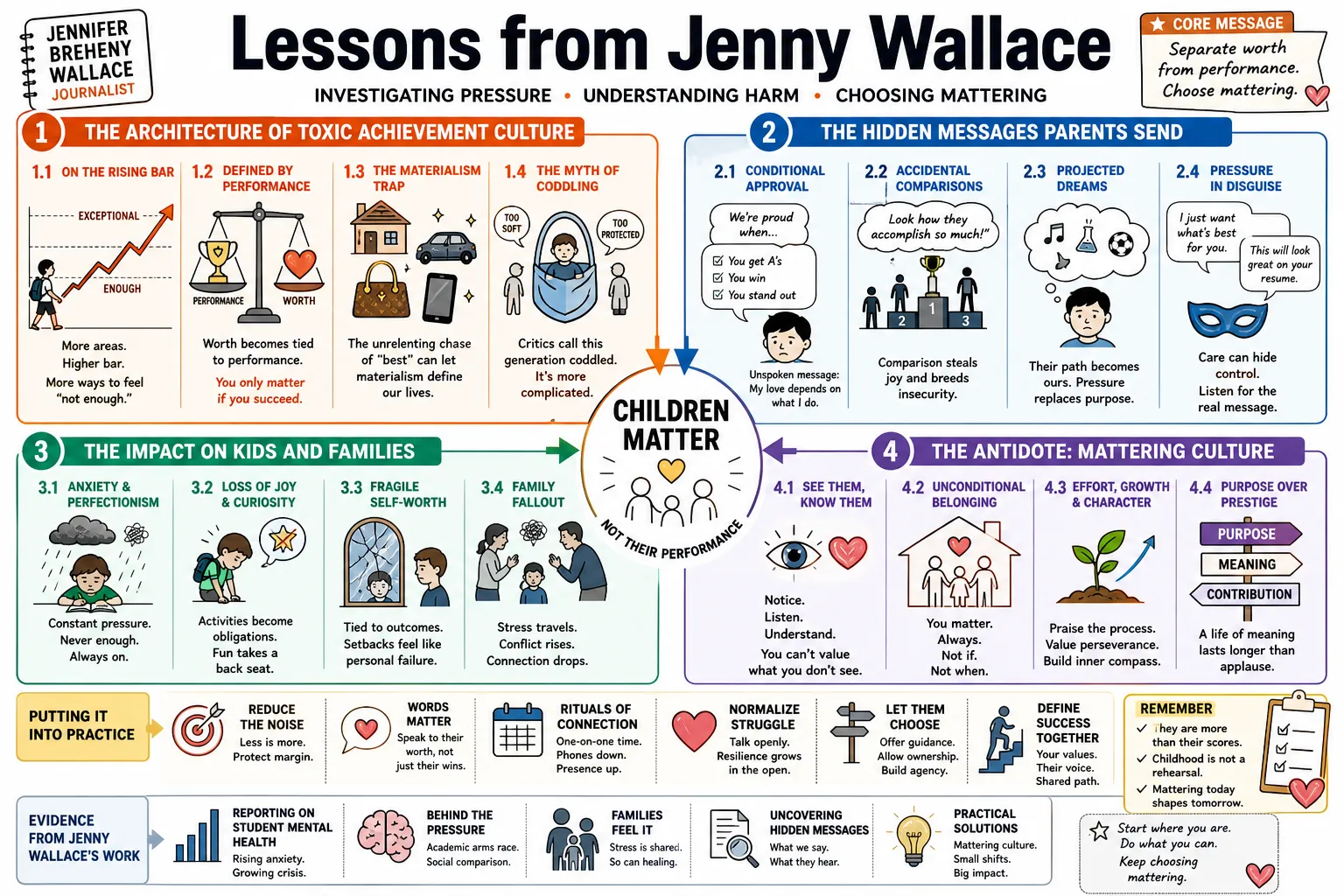
Lessons from Jenny Wallace
Journalist Jennifer Breheny Wallace investigates how modern academic and social pressures affect families. She documents the damage of toxic achievement culture and proposes "mattering" as a practical response for parents and educators. This compilation gathers her reporting on student mental health, the hidden messages parents send, and how to separate a child's worth from their performance.
Part 1: The Architecture of Toxic Achievement Culture
- On defining the crisis: Toxic achievement culture occurs when a child's worth becomes directly tied to their performance, leaving them feeling they only matter if they are successful. — Source: [Harvard Gazette]
- On the myth of coddling: "Critics of this generation say they are being coddled and overprotected, but I actually think it’s quite the opposite. They’re being crushed by expectations to accomplish more and more." — Source: [Thrive Street Advisors]
- On contingent self-worth: "Our kids are absorbing the idea that their worth is contingent on their performance—their GPA, the number of social media followers they have, their college brands—not for who they are deep at their core." — Source: [Thrive Street Advisors]
- On systemic pressures: The culture of relentless performance stems from a systemic issue driven by an increasingly precarious economy and hyper-competitive college admissions, rather than individual family failings. — Source: [ParentData with Emily Oster]
- On the narrowed childhood: Treating childhood as a resume-building exercise inadvertently strips away the unscheduled play and downtime necessary for healthy psychological development. — Source: [The Mel Robbins Podcast]
- On early specialization: Pushing kids to specialize in a single sport or academic track too early robs them of the chance to explore their identities without the pressure to be the best. — Source: [Talking to Teens Podcast]
- On the illusion of control: Parents often use a child's achievements as a proxy for safety, believing that a prestigious degree guarantees a secure future in an uncertain world. — Source: [Dr. Lisa Damour Podcast]
Part 2: The Psychology of Mattering
- On the root of the problem: "At the root of that ‘never enough’ feeling is what psychologists call an unmet need to matter." — Source: [Next Big Idea Club]
- On unconditional value: "Mattering is the personal belief that we are valued for who we are at our core, away from external achievements." — Source: [Next Big Idea Club]
- On the dual nature of mattering: "Mattering—the feeling that we are valued and add value to others—is key to positive mental health and to thriving in adolescence and beyond." — Source: [Thrive Street Advisors]
- On contributing to others: It is essential to play a role that is mission critical to others, realizing that life is greater than you alone and your role is instrumental to the group. — Source: [Curious Cardinals]
- On a fundamental human need: "Mattering is a basic, fundamental human need that researchers have been studying since the 1980s. It is the feeling of being valued and having an opportunity to add value to the world." — Source: [Thrive Global]
- On buffering stress: Feeling that you matter acts like a protective shield, buffering kids against stress and anxiety in their environment. — Source: [Goodreads]
- On moving beyond self-esteem: Unlike self-esteem, which often relies on feeling special or better than others, mattering is built on feeling connected to and needed by your community. — Source: [Katie Couric Media]
- On the antidote to burnout: Students who feel they matter to their teachers and peers are far more likely to stay engaged and resilient when facing academic setbacks. — Source: [Harvard Gazette]
- On adding value: Feeling valued is only half the equation, as children also need genuine responsibilities to see that their contributions are indispensable to their family. — Source: [Zen Parenting Radio]
Part 3: The Hidden Curriculum of Parenting
- On misaligned focus: The parents who concern psychologists most organize their entire relationship with their children around achievements, creating a hidden curriculum that dictates their parenting. — Source: [Thrive Street Advisors]
- On unintended messages: "When parents focus on their kids' achievement—usually defined narrowly as academics and sports—it can accidentally send the message to kids that their parents only value that in them." — Source: [Thrive Street Advisors]
- On parental anxiety: A parent's unmanaged anxiety about the future frequently spills over into their parenting style, translating into intense academic pressure on their children. — Source: [The Mel Robbins Podcast]
- On prioritizing tasks over connection: Asking about homework or test scores immediately upon walking in the door subtly communicates that a child's performance matters more than their well-being. — Source: [Raising Boys & Girls Podcast]
- On outsourcing childhood: Relying heavily on tutors, coaches, and college counselors can inadvertently communicate that a child is a project to be managed rather than a person to be loved. — Source: [ParentData with Emily Oster]
- On the car ride home: The drive home from a game or a test should function as a time for decompression and connection, rather than an unsolicited performance review. — Source: [Talking to Teens Podcast]
- On celebrating effort: If a parent only praises the final grade or the winning goal, kids learn to hide their struggles and avoid taking risks where they might fail. — Source: [Dr. Lisa Damour Podcast]
- On modeling balance: Parents who work constantly while telling their kids to relax teach a contradictory lesson, because children learn how to rest by watching their parents rest. — Source: [Zen Parenting Radio]
- On the scarcity of downtime: Scheduling every hour of the weekend with enrichment activities denies families the unstructured time where genuine parent-child bonding actually occurs. — Source: [Katie Couric Media]
Part 4: The Toll on Student Mental Health
- On at-risk environments: High-achieving schools have effectively become at-risk environments characterized by elevated rates of anxiety, depression, and self-harm among students. — Source: [Washington Parent]
- On sleep deprivation: The cultural normalization of teenagers sleeping only four or five hours a night to maintain their course load acts as a public health crisis masquerading as a work ethic. — Source: [Harvard Gazette]
- On the fear of falling behind: Students often report their primary source of stress is not the workload itself, but the constant fear that one bad grade will permanently derail their future. — Source: [Talking to Teens Podcast]
- On masking struggles: In competitive environments, appearing effortlessly perfect is valued as highly as the achievement itself, forcing teens to hide their exhaustion and internal struggles. — Source: [ParentData with Emily Oster]
- On the loss of joy: Pursuing extracurricular activities solely for college applications rather than personal interest drains the intrinsic joy of learning and playing. — Source: [The Mel Robbins Podcast]
- On physical symptoms of stress: Chronic academic pressure frequently manifests in adolescents as tangible physical ailments like migraines, stomach issues, and chronic fatigue. — Source: [Dr. Lisa Damour Podcast]
- On the isolation of competition: Grading curves and strict class rankings turn peers into competitors, which deprives teenagers of the supportive friendships they need during adolescence. — Source: [Zen Parenting Radio]
- On emotional regulation: Teens who are overwhelmed by the demand to constantly perform often lack the emotional bandwidth to develop healthy coping mechanisms for everyday frustrations. — Source: [Raising Boys & Girls Podcast]
Part 5: Escaping the Scarcity Mindset
- On economic anxiety: The intense pressure placed on students is largely driven by rational parental fears regarding a shrinking middle class and widening income inequality. — Source: [Harvard Gazette]
- On the prestige trap: Believing that only a small handful of elite colleges can guarantee a successful life operates as a modern myth that fuels the scarcity mindset. — Source: [The Mel Robbins Podcast]
- On shifting focus: Escaping the scarcity mindset requires families to redefine a good life by moving away from wealth and status and toward purpose and connection. — Source: [ParentData with Emily Oster]
- On artificial competition: Many of the metrics students fight over, such as a fraction of a point on a GPA, represent artificial scarcity with little bearing on their readiness for adulthood. — Source: [Talking to Teens Podcast]
- On the zero-sum illusion: Fostering the belief that another child's success diminishes your own child's opportunities creates a toxic and unsupportive community environment. — Source: [Dr. Lisa Damour Podcast]
- On letting go of brands: Parents need to do the difficult internal work of decoupling their own ego from the brand-name prestige of the colleges their children attend. — Source: [Katie Couric Media]
- On valuing character over credentials: A family culture that rejects scarcity visibly celebrates traits like kindness, resilience, and curiosity over awards and admissions letters. — Source: [Zen Parenting Radio]
- On redefining security: True security in adulthood comes from adaptability, problem-solving skills, and strong networks rather than a prestigious diploma. — Source: [Raising Boys & Girls Podcast]
Part 6: Broadening the Definition of Success
- On intrinsic motivation: Sustainable success develops when students are allowed to pursue what genuinely interests them rather than what looks impressive on a resume. — Source: [Harvard Gazette]
- On late bloomers: The current achievement timeline demands that children figure out their life's passion by age sixteen, completely ignoring the reality that most people develop later in life. — Source: [The Mel Robbins Podcast]
- On alternative pathways: Society must normalize and celebrate diverse paths to adulthood, including state universities, community colleges, trade schools, and gap years. — Source: [ParentData with Emily Oster]
- On defining values: Families should explicitly define their core values and regularly audit their calendars to ensure their time actually reflects those beliefs. — Source: [Talking to Teens Podcast]
- On the purpose of education: The ultimate goal of education should be to develop a capable and contributing adult rather than simply winning a spot at a selective institution. — Source: [Dr. Lisa Damour Podcast]
- On character development: A complete definition of success must include the development of a strong moral compass and the ability to maintain healthy interpersonal relationships. — Source: [Zen Parenting Radio]
- On embracing failure: A healthy approach to achievement treats failure as an inevitable step in the learning process rather than a permanent reflection of a child's worth. — Source: [Katie Couric Media]
- On recognizing non-academic talents: Societal praise needs to broaden to include children who are naturally empathetic, mechanically gifted, or deeply creative, even if those skills are not tested. — Source: [Raising Boys & Girls Podcast]
- On genuine well-being: A truly successful adolescent is one who sleeps enough, eats well, maintains friendships, and feels secure in their family's love. — Source: [Thrive Street Advisors]
Part 7: Community, Connection, and Support Systems
- On the limits of self-care: "You can't self-care your way out of deep overwhelm. The most powerful source of resilience is relationships." — Source: [Thrive Global]
- On building support networks: Parents need their own support systems to help them resist the cultural tide of hyper-competitive parenting because it is too difficult to swim upstream alone. — Source: [ParentData with Emily Oster]
- On interdependent families: A healthy family dynamic relies on interdependence, where everyone has responsibilities to each other, reinforcing the message that every member matters. — Source: [The Mel Robbins Podcast]
- On school environments: Schools that successfully combat toxic achievement foster a culture of belonging where every student feels known by at least one adult. — Source: [Harvard Gazette]
- On peer support: Encouraging adolescents to support their friends through academic stress builds empathy and reduces the isolation found in competitive high schools. — Source: [Talking to Teens Podcast]
- On the role of mentors: Non-parental adults like coaches, youth group leaders, and extended family play a significant role in validating a child's worth outside of their academic performance. — Source: [Dr. Lisa Damour Podcast]
- On community service: Meaningful community service helps teenagers step outside their own anxieties and realize they have the power to positively impact others. — Source: [Zen Parenting Radio]
- On dismantling parental judgment: When parents stop judging each other's choices, they create a safer community for all children to grow at their own pace. — Source: [Katie Couric Media]
- On intergenerational connections: Spending time with younger children or older adults helps high-achieving teens gain perspective on what holds value over the course of a lifetime. — Source: [Raising Boys & Girls Podcast]
- On shared vulnerability: When adults openly share their own past failures and struggles with teenagers, it demystifies success and builds deeper, more authentic connections. — Source: [Thrive Street Advisors]
Part 8: Practical Interventions for Homes and Schools
- On auditing parent-child conversations: Tracking the topics discussed with your child over a week can reveal if the majority of conversations revolve around logistics and academics, signaling a need to pivot. — Source: [Talking to Teens Podcast]
- On protecting family time: Families must guard dinners and weekends fiercely against the encroachment of homework and travel sports, treating downtime as a strict priority. — Source: [The Mel Robbins Podcast]
- On rethinking chores: Assigning household responsibilities is a critical way to show a child they are a needed, contributing member of the household, rather than a distraction from studying. — Source: [ParentData with Emily Oster]
- On school policies: Schools can reduce unnecessary stress by implementing structural policies like capping the number of AP classes a student can take or enforcing homework-free weekends. — Source: [Harvard Gazette]
- On mindful praise: Adults should intentionally shift praise away from outcomes like perfect scores and focus it toward processes like persistence, curiosity, or helping a classmate. — Source: [Dr. Lisa Damour Podcast]
- On managing parental anxiety: Parents must actively manage their own anxiety through therapy or support groups so they do not pass their economic fears down to their children. — Source: [Zen Parenting Radio]
- On questioning the culture: Encouraging teens to critically analyze the achievement culture they live in helps them recognize when societal expectations are unrealistic or harmful. — Source: [Katie Couric Media]
- On setting boundaries with technology: Limiting access to grade portals ensures that parents and students do not obsessively track every minor assignment, which heightens daily anxiety. — Source: [Raising Boys & Girls Podcast]
- On prioritizing sleep: Making adequate sleep a non-negotiable family rule is essential, even if it requires stepping back from an extracurricular activity or accepting a lower grade. — Source: [Thrive Street Advisors]