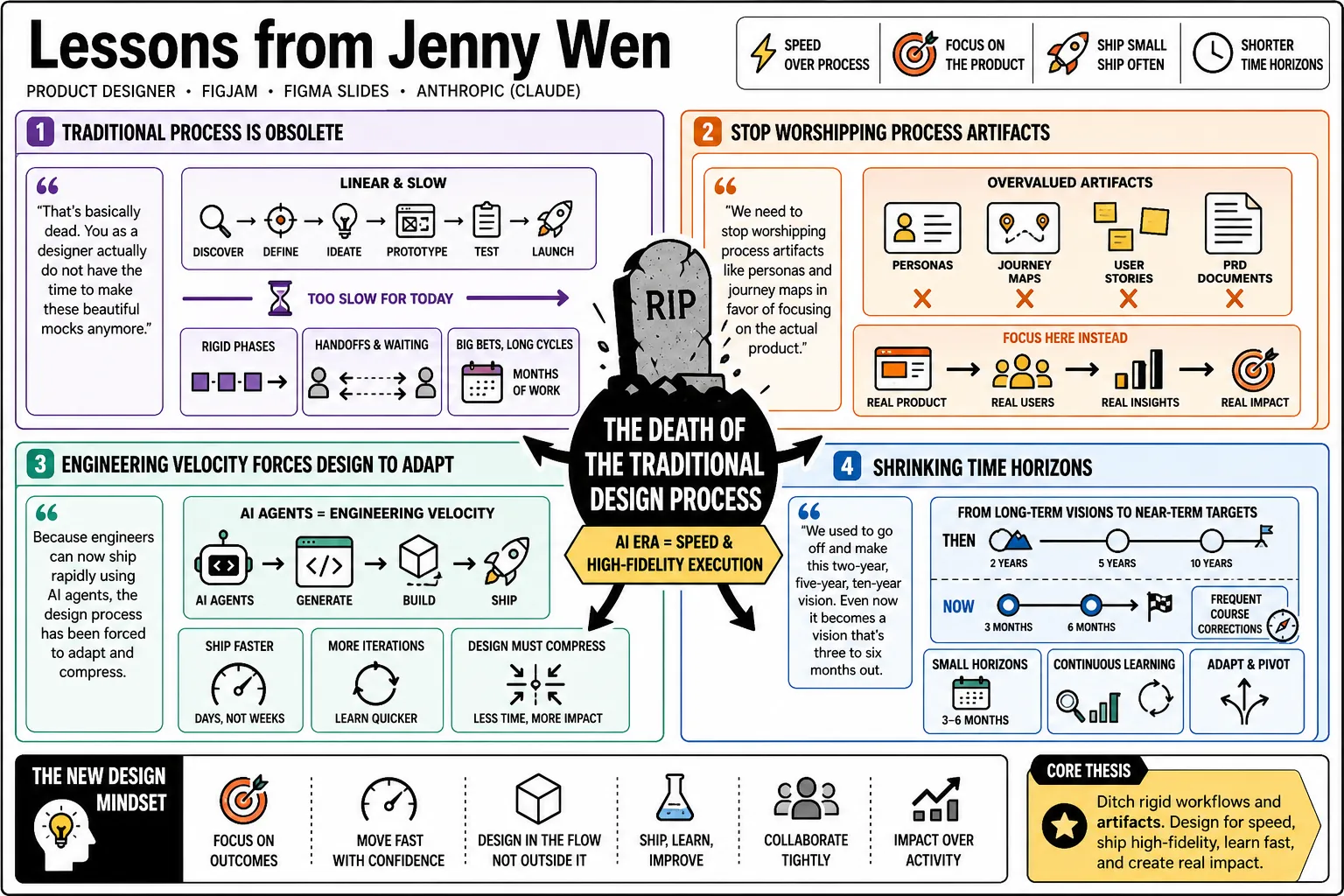
Lessons from Jenny Wen
Jenny Wen is a product designer who led the creation of FigJam and Figma Slides before moving to Anthropic to build interfaces for Claude. She recently argued that the traditional, linear design process is obsolete in the AI era. This profile examines her case for ditching rigid workflows in favor of speed and high-fidelity execution.
Part 1: The Death of the Traditional Design Process
- On the traditional design process: "That's basically dead. You as a designer actually do not have the time to make these beautiful mocks anymore." — Source: [Lenny's Podcast]
- On process artifacts: We need to stop worshipping process artifacts like personas and journey maps in favor of focusing on the actual product. — Source: [Hatch Conference]
- On the linear approach: The sequential method of discovery, define, ideate, prototype, test, and launch is too slow for the current era of product development. — Source: [The Faintest Idea]
- On engineering velocity: Because engineers can now ship rapidly using AI agents, the design process has been forced to adapt and compress. — Source: [Lenny's Podcast]
- On shrinking time horizons: "We used to go off and make this two-year, five-year, ten-year vision. Even now it becomes a vision that's three to six months out." — Source: [Lenny's Podcast]
- On rigid methodologies: Following a strict checklist often causes process-first thinking, where the documentation matters more than the output. — Source: [The Faintest Idea]
- On speed to market: The time from idea to working code has collapsed, meaning designers must abandon drawn-out discovery phases. — Source: [Lenny's Podcast]
- On the purpose of process: Process should serve the product, not the other way around. If the process is slowing down shipping without adding value, cut it. — Source: [Jenny Wen's Notes]
- On shifting focus: "A few years ago, 60 to 70% of it was mocking and prototyping, but now I feel the mocking up part of it is 30 to 40%." — Source: [Lenny's Podcast]
- On over-documentation: Creating massive decks to justify a design decision wastes time compared to simply building a prototype to test the hypothesis. — Source: [The Faintest Idea]
Part 2: Designing with AI and for AI
- On the AI workspace: Working on AI models like Claude means working on the most alive frontier in design today. — Source: [Lenny's Podcast]
- On AI as a partner: Designers should actively use AI in their day-to-day workflow to synthesize large datasets and user feedback. — Source: [Lenny's Podcast]
- On generating ideas with AI: Using AI to generate product ideas allows designers to move faster and work more ambitiously. — Source: [The Faintest Idea]
- On Claude Co-work: Tools like Claude Co-work are highly effective at stitching together patterns across vast amounts of product documentation. — Source: [Lenny's Podcast]
- On technical toil: As AI takes over technical execution and repetitive tasks, designers can focus on higher-level orchestration. — Source: [The Faintest Idea]
- On adapting to AI: The designers who will thrive are those who are comfortable integrating AI tools directly into their creative workflows. — Source: [Dive Club Podcast]
- On designing AI interactions: Building interfaces for AI requires moving away from static screens to designing conversational, fluid experiences. — Source: [Lenny's Podcast]
- On the speed of AI development: The pace at which AI models improve means designs must be flexible enough to accommodate capabilities that might not exist yet. — Source: [The Faintest Idea]
- On using AI for research: AI can quickly process user interviews and highlight patterns, compressing weeks of research into hours. — Source: [Lenny's Podcast]
- On the future of the interface: AI will fundamentally alter how users interact with software, shifting from clicks and menus to natural language and intent. — Source: [Jenny Wen's Notes]
Part 3: The Return to Craft and Intuition
- On the role of taste: "I think we might be holding on to taste as a differentiator a little bit too much." — Source: [Lenny's Podcast]
- On developing intuition: In the absence of lengthy research phases, designers must rely heavily on their developed intuition to make quick decisions. — Source: [The Faintest Idea]
- On high-fidelity details: Designers should focus on high-fidelity execution earlier in the process rather than getting stuck in low-fidelity wireframes. — Source: [Lenny's Podcast]
- On obsessive craft: The true value of a designer now lies in their obsessive dedication to craft and the subtle details that elevate a product. — Source: [Hatch Conference]
- On judgment as a skill: Exercising high-level judgment is becoming more critical than the ability to produce large volumes of design assets. — Source: [The Faintest Idea]
- On feeling the product: Great design requires a visceral sense of how the product feels to use, which can only be developed through hands-on building. — Source: [Dive Club Podcast]
- On moving past mechanics: With AI handling the mechanical aspects of design, human designers must double down on empathy, aesthetic sensibility, and taste. — Source: [Lenny's Podcast]
- On the value of polish: In a world where basic functionality is easy to build, the polish and care put into the final product differentiate it. — Source: [Jenny Wen's Notes]
- On trusting your gut: Sometimes the data isn't there, and designers need to trust their gut instinct to push a vision forward. — Source: [The Faintest Idea]
- On the definition of craft: Craft is no longer just about pushing pixels; it's about deeply understanding the medium and the constraints of the technology. — Source: [Lenny's Podcast]
Part 4: Building FigJam and Figma Slides
- On launching FigJam: Bringing FigJam to market required a fundamental shift in how the team viewed collaboration, moving from static files to active, real-time spaces. — Source: [Dive Club Podcast]
- On the value of riffing: FigJam was designed for alignment and riffing, encouraging teams to think together rather than just documenting decisions. — Source: [Lenny's Podcast]
- On playful design: The aesthetic of FigJam intentionally incorporates playfulness to lower the barrier to entry and encourage messy, early-stage thinking. — Source: [The Faintest Idea]
- On building for growth: Leading growth initiatives at Figma taught the importance of removing friction and making the core value of the product instantly apparent. — Source: [Lenny's Podcast]
- On Figma Slides: Developing Figma Slides meant rethinking presentation software to seamlessly integrate with the design workflows already happening in Figma. — Source: [Jenny Wen's Notes]
- On expanding the user base: FigJam successfully expanded Figma's reach beyond designers, making visual collaboration accessible to PMs, engineers, and marketers. — Source: [Dive Club Podcast]
- On cross-functional collaboration: The success of products like FigJam relies heavily on blurring the lines between design, engineering, and product management. — Source: [Lenny's Podcast]
- On iterative development: FigJam was built through rapid iteration and constant internal usage, refining the tool based on how the team naturally wanted to work. — Source: [The Faintest Idea]
- On the ecosystem: Both FigJam and Slides succeeded because they leveraged the existing power and familiarity of the Figma ecosystem. — Source: [Jenny Wen's Notes]
Part 5: Career Transitions and Returning to IC
- On leaving leadership: Stepping down from a Director role to become an Individual Contributor was driven by a desire to be closer to the actual work. — Source: [Lenny's Podcast]
- On the appeal of Anthropic: Joining Anthropic as an IC offered the chance to work directly on the frontier of AI model development, which felt incredibly alive. — Source: [The Faintest Idea]
- On the management track: Management is not the only path for career growth; highly impactful IC work is equally valuable, especially in fast-moving fields like AI. — Source: [Jenny Wen's Notes]
- On staying close to the code: To truly understand the constraints and possibilities of AI, designers need to be actively building and interacting with the models. — Source: [Lenny's Podcast]
- On the builder's mindset: The decision to return to IC work reflects a fundamental builder's mindset—the joy of creating something tangible rather than managing the creation process. — Source: [Dive Club Podcast]
- On career non-linearity: Career paths don't have to be a straight line up the corporate ladder; moving laterally or back to IC can provide immense personal and professional growth. — Source: [The Faintest Idea]
- On impact over title: True influence in a product organization comes from the quality of the work and the ability to solve hard problems, not just from a leadership title. — Source: [Lenny's Podcast]
- On relearning the craft: Returning to an IC role required unlearning some management habits and re-honing the tactical skills of product design. — Source: [Jenny Wen's Notes]
- On the changing nature of IC roles: In the AI era, senior ICs operate with a high degree of autonomy, acting as strategic partners as much as execution specialists. — Source: [Lenny's Podcast]
Part 6: Rapid Prototyping and Solution-First Thinking
- On solution-first design: Starting with a proposed solution or a working prototype can often clarify the problem much faster than abstract problem statements. — Source: [The Faintest Idea]
- On prototyping as discovery: The act of building a prototype is in itself a form of research and discovery, revealing constraints and opportunities early. — Source: [Lenny's Podcast]
- On directional prototyping: Short-term, directional prototyping is essential when engineering teams can ship production code in days rather than weeks. — Source: [Dive Club Podcast]
- On the limitations of discovery: Getting stuck in a protracted discovery phase paralyzes a team and prevents them from learning through actual execution. — Source: [The Faintest Idea]
- On tangible artifacts: A functional prototype is a much stronger tool for building alignment than a slide deck describing what the feature might be. — Source: [Jenny Wen's Notes]
- On iterating in code: Whenever possible, the iteration loop should happen as close to the final medium as possible, rather than endlessly tweaking design files. — Source: [Lenny's Podcast]
- On the dangerous generalist: Teams need dangerous generalists—designers who learn quickly, prototype in code, and aren't tethered to traditional rituals. — Source: [Lenny's Podcast]
- On hypothesis testing: Every prototype is a hypothesis; the goal is to build just enough to prove or disprove that hypothesis as quickly as possible. — Source: [The Faintest Idea]
- On overcoming perfectionism: Designers must learn to ship imperfect prototypes to gather real-world signal, rather than polishing mocks in isolation. — Source: [Jenny Wen's Notes]
Part 7: Process Literacy vs. Process Rituals
- On process literacy: Instead of blindly following a process, designers need process literacy—the ability to match the methodology to the specific problem at hand. — Source: [The Faintest Idea]
- On the danger of rituals: When design methodologies become rituals, they lose their utility and become a crutch that prevents critical thinking. — Source: [Lenny's Podcast]
- On contextual workflows: A heavy research process might be necessary for a new healthcare product, but it is overkill for iterating on a well-understood consumer feature. — Source: [Dive Club Podcast]
- On questioning the gospel: The Double Diamond and similar frameworks should be viewed as tools, not religious texts that must be strictly adhered to. — Source: [The Faintest Idea]
- On agility: True agility in design means having the confidence to skip steps when the path forward is already clear. — Source: [Lenny's Podcast]
- On the illusion of safety: Extensive process often provides an illusion of safety, but it does not guarantee a successful product outcome. — Source: [Jenny Wen's Notes]
- On outcome over output: The focus should always be on the final product outcome, not the volume of design output generated along the way. — Source: [The Faintest Idea]
- On lean methodologies: Process compression is not about skipping work; it is about finding the most direct and efficient path to learning. — Source: [Lenny's Podcast]
- On adaptability: The best designers are highly adaptable, able to invent a new workflow on the fly based on the constraints of the project. — Source: [Hatch Conference]
Part 8: The Future of the Design Profession
- On new archetypes: The future belongs to specific archetypes: the block-shaped generalist, the deep-T specialist, and the highly adaptable new grad. — Source: [Lenny's Podcast]
- On the block-shaped generalist: Designers who are strong across multiple disciplines—design, code, product strategy—will have a massive advantage. — Source: [Lenny's Podcast]
- On collaboration with engineering: The gap between design and engineering is closing rapidly; designers must become comfortable working in technical environments. — Source: [The Faintest Idea]
- On continuous learning: The pace of technological change requires designers to be perpetual students, constantly updating their toolkits and mental models. — Source: [Jenny Wen's Notes]
- On the evolving toolkit: Figma will remain central, but the modern designer's toolkit will increasingly include AI prompting, light coding, and complex system modeling. — Source: [Dive Club Podcast]
- On the value of fresh perspectives: Cracked new grads unburdened by legacy processes are often the ones pushing the boundaries of what is possible with new tools. — Source: [Lenny's Podcast]
- On shifting focus from UI to systems: As AI handles more UI generation, the designer's focus will shift towards defining the underlying systems and logic. — Source: [The Faintest Idea]
- On resilience: The ability to navigate ambiguity and rapid change will be the most important soft skill for designers in the next decade. — Source: [Jenny Wen's Notes]
- On the enduring need for humanity: Despite the rise of AI, the core of design will always be understanding human needs, desires, and psychology. — Source: [Lenny's Podcast]