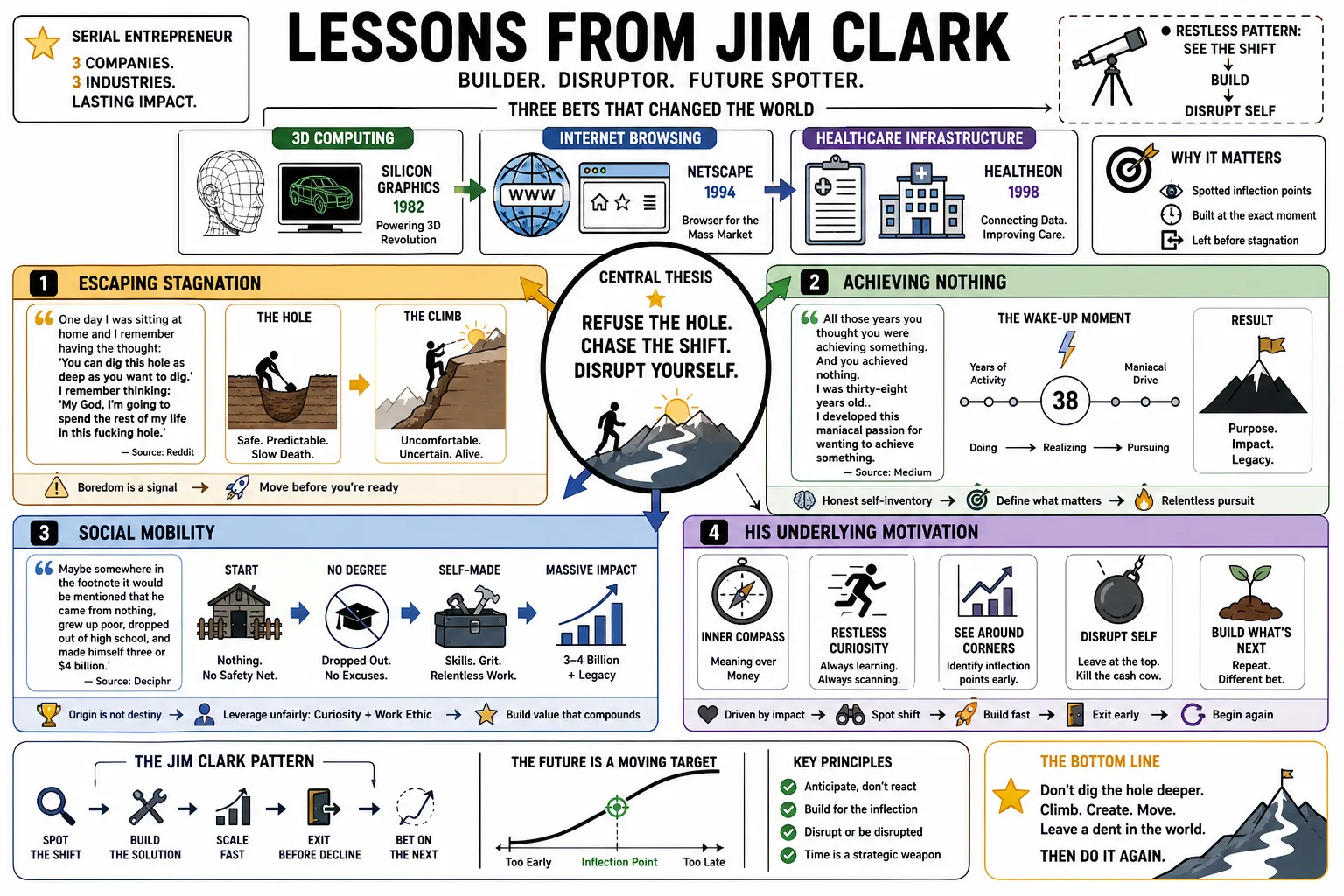
Jim Clark founded Silicon Graphics, Netscape, and Healtheon, launching three separate companies that fundamentally altered 3D computing, internet browsing, and healthcare infrastructure. He is known for his serial entrepreneurship and his restless ability to identify technological shifts just before they reached the mass market. This collection organizes his perspectives on building companies, anticipating the future, and disrupting his own successes.
Part 1: Early Life and Drive
- On Escaping Stagnation: "One day I was sitting at home and I remember having the thought: 'You can dig this hole as deep as you want to dig.' I remember thinking: 'My God, I'm going to spend the rest of my life in this fucking hole.'" — Source: Reddit
- On Achieving Nothing: "All those years you thought you were achieving something. And you achieved nothing. I was thirty-eight years old... I developed this maniacal passion for wanting to achieve something." — Source: Medium
- On Social Mobility: "Maybe somewhere in the footnote it would be mentioned that he came from nothing, grew up poor, dropped out of high school, and made himself three or $4 billion." — Source: Deciphr
- On His Underlying Motivation: He was driven by a constant need to disrupt industries and, by extension, his own life. — Source: Deciphr
- On Education: "I think the thing to do is to make sure that every single person have a college education." — Source: Computer History Museum
- On Restlessness: He was built to work on the frontier of economic life when the frontier was once again up for grabs. — Source: Agent Palmer
- On Personal Reinvention: "You can reach these points in life when you say, 'Fuck, I've reached some sort of dead-end here.' And you descend into chaos." — Source: Hey
- On Proving Doubters Wrong: Much of his drive was fueled by a deep-seated impatience and a desire to prove doubters wrong. — Source: Medium
- On the Catalyst for Change: He turned people's lives upside down and subjected them to the most vicious force a human being can be subjected to, change. — Source: Agent Palmer
Part 2: Innovation and The New New Thing
- On Defining Innovation: "The new new thing is a notion that is poised to be taken seriously in the marketplace. It's the idea that is a tiny push away from general acceptance and, when it gets that push, will change the world." — Source: Agent Palmer
- On What It Isn't: "It's easier to say what the new new thing is not than what it is. It is not necessarily a new invention. It is not even necessarily a new idea—most everything has been considered at some point." — Source: Agent Palmer
- On Technological Disruption: He focused on creating new categories rather than improving existing ones. — Source: Grokipedia
- On Anticipating the Future: He realized the world was three-dimensional and that computers would eventually need to be as well. — Source: Salon
- On Institutional Traps: Companies tend to define themselves by what they have been doing, not by what they can do, which can prevent them from innovating further. — Source: 25iq
- On the Role of the Engineer: "The power is shifting to the engineers who create the companies." — Source: HubSpot
- On Cultivating Ideas: The quirks of his character sent the most fantastic ripples through the world around him, often starting with the best intentions or no intentions at all. — Source: Deciphr
- On Counter-Culture Roots: Silicon Valley’s culture is deeply rooted in counter-culture, emphasizing the importance of thinking for yourself and ignoring conventional wisdom. — Source: Reddit
- On Continuous Curiosity: By looking for patterns in history and remaining open to the fluidity of outcomes, entrepreneurs can create better results than if they rigidly stick to a pre-defined plan. — Source: The Impossible Network
Part 3: Silicon Graphics and 3D Computing
- On the Logic of 3D: "The world was three-dimensional, and so the computer would have to be, too." — Source: Musixmatch
- On the Geometry Engine: The technology was viewed as a natural extension of how humans interact with the physical world. — Source: Stanford University
- On Moving to Market: The technology was obviously good, but industry players were many years away from adopting it, which compelled him to start Silicon Graphics to bring it to market. — Source: FreakTakes
- On Hard Work: "The thing that characterized that company was just a lot of hard work and drive and passion to make sure that the world could use it." — Source: Stanford University
- On Intellectual Property Friction: "Stanford did that to me in the form of the Geometry Engine... they gave a paid-up license to Microsoft, which ended up enabling Microsoft to get off the dime more quickly." — Source: Computer History Museum
- On compressed adoption cycles: In Stanford's 2013 interview, Clark described Netscape as something that was simply "happening" and recalled how the Internet had moved from a network for a few research labs and universities into a mass-market platform with extraordinary speed, supporting a clearer lesson that computing adoption cycles were compressing rapidly. — Reference: Stanford Engineering Hero interview with Jim Clark
- On Early Belief: He and his students felt the technology they were developing was inevitably the foundation for modern graphics. — Source: Stanford University
- On Transforming Industries: His hardware accelerators became the foundation for workstations that transformed fields ranging from engineering to Hollywood visual effects. — Source: Stanford University
- On Leaving SGI: He realized he did not thrive within the environment of a large, mature corporation. — Source: Deciphr
- On Starting Over: Upon exiting the company he founded, he immediately sought the next technological frontier to conquer. — Source: Computer History Museum
Part 4: Netscape and the Internet Revolution
- On Meeting the Moment: "With Netscape, I had been thinking for years about how networking was evolving. Somehow I had the insight and instinct and luck to meet people like Marc Andreessen and the people building Mosaic." — Source: Stanford University
- On Taking the Leap: He had the chutzpah to put in the money out of his own pocket to see it come to fruition. — Source: Stanford University
- On the Threat to Microsoft: "If the invention at the heart of my first start-up was an internal combustion engine, Mosaic was fire itself." — Source: Dokumen
- On the Concept of Netscape Time: He established the absolute necessity for companies to move with extreme agility to survive in a market where timing mattered more than technical perfection. — Source: David Sheff
- On Speed Over Polish: It described the telescoping of time required for technology to move from invention to prototype, commercial success, and maturity. — Source: Ethernet
- On the Freemium Blueprint: He helped pioneer a model of distributing software to consumers for free to build massive market share quickly, while selling more robust versions to enterprises. — Source: EBSCO
- On the First Internet IPO: "We started the machinery and we went public in August even though people said you can't go public in August because everyone's on vacation. And it was a hugely successful IPO." — Source: Computer History Museum
- On Partnering with Youth: His email to Andreessen read, "You may not know me, but I'm the founder and former chairman of Silicon Graphics... I plan to form a new company. I would like to discuss the possibility of your joining me." — Source: Time
- On Recognizing Shifts: He was able to position his companies at the exact moment of market readiness as computing transitioned from mainframes to PCs to the Internet. — Source: BeFreed
- On Shifting Paradigms: The browser served as the platform that would democratize information access across the globe. — Source: Internet History Podcast
Part 5: Healtheon, WebMD, and Market Disruption
- On Healthcare Inefficiency: He conceived the idea for Healtheon to create a digital link between doctors, patients, and healthcare payers to reduce inefficiencies and paperwork. — Source: Wikipedia
- On the Grand Vision: His goal was to shift the healthcare industry away from paper-based transactions toward a centralized, web-based system. — Source: Forbes
- On Commitment: He invested an additional $200 million of his own money into the company during market volatility to demonstrate his continued confidence in the vision. — Source: LA Times
- On Finding Pain Points: He showed a consistent pattern of finding friction in emerging industries and using his technical background to build scalable solutions. — Source: Grokipedia
- On Stepping Back: After establishing the technical direction, he often stepped back from day-to-day operations to let others lead. — Source: Encyclopedia
- On the Pigs and Chickens Metaphor: He emphasized the importance of true commitment over mere interest when launching a venture. — Source: Deciphr
- On Funding the Vision: His willingness to invest his own money into his ideas demonstrated a level of conviction that inspired confidence and encouraged others to invest. — Source: Stanford University
- On Knowing When to Leave: In 2000, he resigned from the board of directors to pursue other interests when his foundational work was complete. — Source: Funding Universe
- On Building Infrastructure: Healtheon provided the technological backbone that ultimately allowed WebMD to become a household name. — Source: CNET
- On serial entrepreneurship: The Computer History Museum's Jim Clark oral-history catalog describes the same pattern directly: after SGI and Netscape reached billion-dollar scale, he was still not done founding major companies and went on to start Healtheon, making serial entrepreneurship one of the clearest through-lines of his career. — Reference: Computer History Museum Jim Clark oral history
Part 6: Business Philosophy and Risk
- On Self-Cannibalization: "Don't be afraid to cannibalize your product. You must be willing to challenge your own product lines." — Source: 25iq
- On the Cost of Hesitation: "Barnes and Noble could have addressed the Internet, but didn't until Amazon forced them to. That is the worst way to do it." — Source: 25iq
- On Internal Disruption: "For a technology company to succeed, he argued, it needed always to be looking to destroy itself. If it didn't, someone else would." — Source: Hey
- On Disrupting Profits: "It's the hardest thing in business to do. Even creating a lower-cost product runs against the grain, because the low-cost products undercut the high-cost, more profitable products." — Source: Hey
- On the Value of Luck: "The old adage that luck favors the prepared mind." — Source: Stanford University
- On Product People: His philosophy emphasizes the necessity of product people who can constantly push the boundaries of what is possible rather than simply protecting a legacy business. — Source: 25iq
- On Market Timing: Technical skill is often secondary to timing. — Source: BeFreed
- On Scale Before Profit: He popularized a startup playbook that prioritized rapid market entry and scale over immediate profitability. — Source: BeFreed
- On the Adventure of Business: "His mere presence on a scene inspired the question that propels every adventure story forward. What will happen next?" — Source: Deciphr
Part 7: Management, Talent, and Team Building
- On Hiring the Best: "A small team of A-plus players can run circles around a giant team of B and C players." — Source: Musixmatch
- On His Own Weaknesses: He openly acknowledged his own deep-seated streak of impatience and his tendency to manage with a seat-of-the-pants attitude. — Source: CNET
- On Planning: He preferred building companies on the back of an envelope rather than through traditional corporate planning. — Source: CNET
- On Venture Capitalists: He famously referred to venture capitalists as velociraptors, though he recognized their utility in securing top-tier leadership. — Source: ResearchGate
- On Attracting Talent: He understood that the quality of the team was a primary differentiator in building a successful technology company. — Source: Computer History Museum
- On Executive Delegation: After founding companies, he often brought in experienced executives to lead the company through scaling and growth phases. — Source: Encyclopedia
- On Avoiding Bureaucracy: He grew impatient with the nuts and bolts of corporate operations and preferred the chaos of creation. — Source: CNET
- On Zero Salary: "And I never got a salary ever out of Netscape." — Source: Computer History Museum
- On Empowering Engineers: He believed in the power of engineers to shift industries, arguing that true power should lie with creators rather than managers. — Source: HubSpot
Part 8: Wealth, Yachts, and Perspective
- On Building Custom Yachts: "Boats of this type are sort of like building a Formula 1 car. They are expensive." — Source: Business Insider
- On Extreme Ambition in Sailing: "Let's face it, you have to be a little bit nuts." — Source: Boat International
- On Appreciating Design: "I love her proportions. To my eye, she's one of the most gorgeous large sailing yachts, maybe the most gorgeous large sailing yacht in the world." — Source: Boat International
- On Moving On from Passions: "Been around the world twice and really don't like the [Mediterranean-Caribbean] circuit. After 28 years of owning boats, I'm over it." — Source: Forbes
- On Classic Taste: "What I like is the historic quality of this boat; nothing is plastic... I'm a classic boat snob. I like the old wood look; big modern boats do nothing for me." — Source: Huisfit
- On Technologizing the Sea: His yacht Hyperion was built to replace conventional electronics with a custom system controlled by Silicon Graphics computers. — Source: AutoEvolution
- On the Metaphor of the Boat: His push to build ever-larger and more complex vessels was often viewed as a metaphor for his own driven and unconventional nature. — Source: Medium
- On Financial Independence: Creating immense wealth served primarily to buy the freedom to pursue his next obsession. — Source: Deciphr
- On Never Settling: Despite billions in wealth and unprecedented success, his core trait remained an intense, defining dissatisfaction with the present. — Source: Agent Palmer