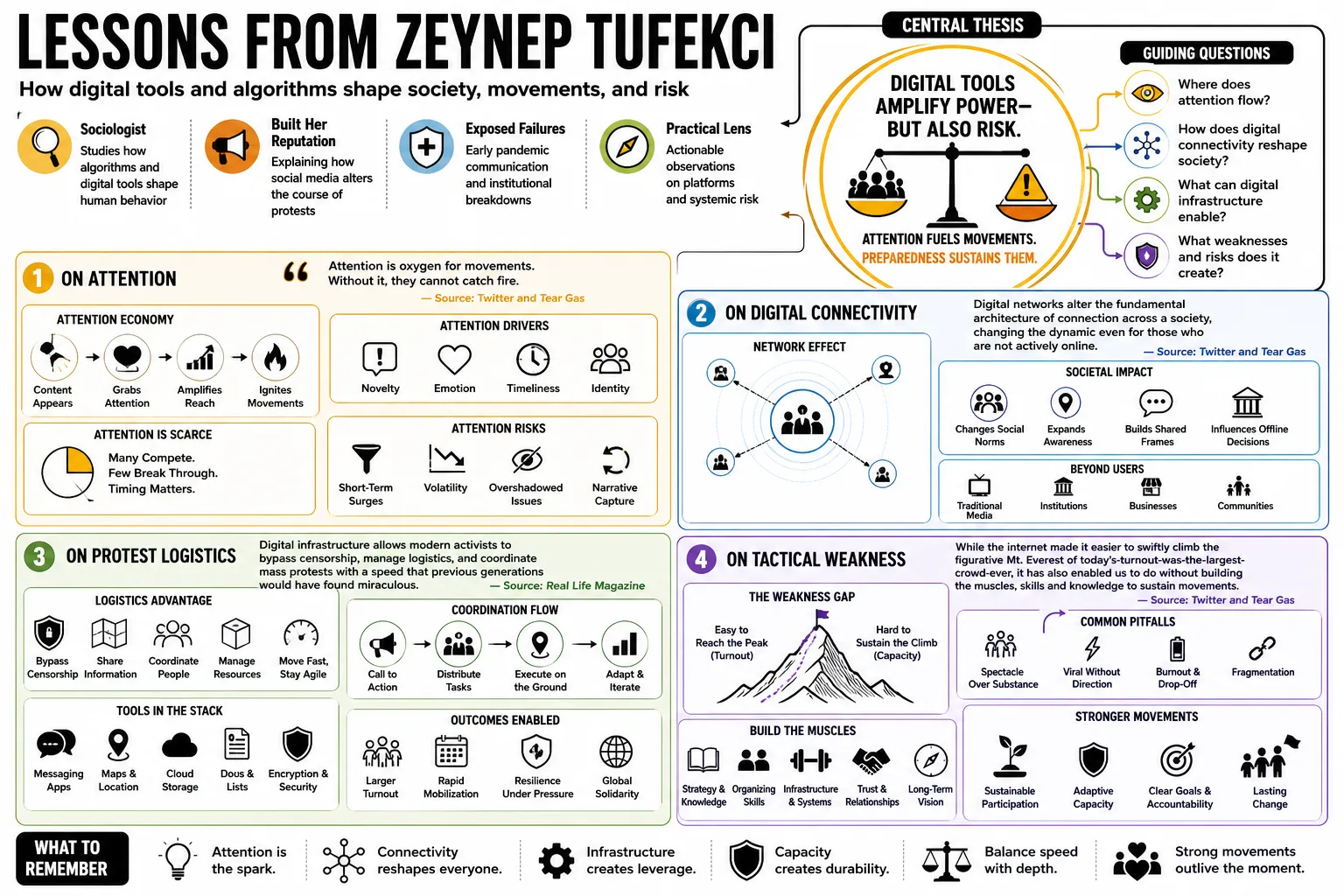
Lessons from Zeynep Tufekci
Sociologist Zeynep Tufekci studies how algorithms and digital tools shape human behavior. She built her reputation by explaining how social media alters the course of protests and exposing institutional failures in early pandemic communication. This profile gathers her practical observations on digital platforms and systemic risk.
Part 1: Social Movements and Digital Activism
- On Attention: "Attention is oxygen for movements. Without it, they cannot catch fire." — Source: Twitter and Tear Gas
- On Digital Connectivity: "Digital networks alter the fundamental architecture of connection across a society, changing the dynamic even for those who are not actively online." — Source: Twitter and Tear Gas
- On Protest Logistics: "Digital infrastructure allows modern activists to bypass censorship, manage logistics, and coordinate mass protests with a speed that previous generations would have found miraculous." — Source: Real Life Magazine
- On Tactical Weakness: "While the internet made it easier to swiftly climb the figurative Mt. Everest of today's-turnout-was-the-largest-crowd-ever, it has also enabled us to do without building the muscles, skills and knowledge to make a big crowd powerful enough to challenge the powers-that-be." — Source: The Insight
- On Tactical Freeze: "Movements organized primarily online often struggle to pivot strategies or negotiate because they lack traditional organizational hierarchies and decision-making bodies." — Source: Twitter and Tear Gas
- On Movement Fragility: "When movements substitute digital mobilization for long-term capacity building, they often become brittle in the face of inevitable pushback from authorities." — Source: The Insight
- On Networked Protestors: "During the 2011 Egyptian protests, veteran activists realized that the people showing up in Tahrir Square were not just long-time political allies, but essentially their Facebook networks." — Source: Twitter and Tear Gas
- On The Gezi Park Atmosphere: "The Gezi Park protests felt like a hybrid between the cultural festival of Woodstock and the communal governance of the 1871 Paris Commune." — Source: Twitter and Tear Gas
- On Ephemeral Power: "Rapid, viral growth allows movements to bypass the slow work of trust-building, meaning they often fail to survive their own initial success." — Source: The New York Times
- On "Preguntando Caminamos": "When studying or participating in social change, it is vital to adopt the Zapatista philosophy of walking while asking questions, maintaining ongoing inquiry rather than assuming all answers are known." — Source: Twitter and Tear Gas
Part 2: Algorithms, AI, and Machine Learning
- On Artificial Intelligence: "It may seem like artificial intelligence is just the next thing after online ads. It's not. It's a jump in category." — Source: TED Talk
- On Growing Intelligence: "We're not programming anymore; we're growing intelligence that we don't truly understand." — Source: TED Talk
- On Algorithmic Dystopia: "We're building this infrastructure of surveillance authoritarianism merely to get people to click on ads." — Source: TED Talk
- On Algorithmic Bias: "Introducing computation into messy human affairs does not magically yield objectivity; instead, the complexity and bias of human systems simply invade the algorithms." — Source: TED Talk
- On Outsourcing Morality: "We cannot outsource our responsibilities to machines. We must hold on ever tighter to human values and human ethics." — Source: TED Talk
- On The True AI Threat: "The primary risk of artificial intelligence is not a rogue supercomputer taking over the world, but rather powerful human actors using AI to manipulate public behavior and control information." — Source: The New York Times
- On Algorithmic Opacity: "Machine learning systems often operate as black boxes, making decisions based on correlations that even their creators cannot fully untangle or explain to the public." — Source: TED Talk
- On Optimization Metrics: "When algorithms are optimized solely for engagement, they inevitably prioritize content that provokes outrage and tribalism over nuance or truth." — Source: The Atlantic
- On The "Free" Internet: "Many of these ad-financed platforms, they boast that they're free. In this context, it means that we are the product that's being sold." — Source: TED Talk
- On Technological Shifts: "AI represents a societal transition on the scale of the printing press or the invention of writing, guaranteed to have widespread and destabilizing effects." — Source: Elon University Interviews
Part 3: The Public Sphere and Misinformation
- On Modern Censorship: "Bad actors and governments no longer censor primarily by blocking access to information, but by inundating audiences with information, producing distractions to dilute their attention and focus, and delegitimizing media that provide accurate information." — Source: Twitter and Tear Gas
- On Drowning in Nonsense: "In the digital age, authoritarian control is often achieved not by silencing dissent, but by confusing the population and drowning them in nonsense." — Source: Twitter and Tear Gas
- On Platform Incentives: "Internet businesses driven by advertising naturally incentivize groupthink and tribal conflict because those behaviors generate the most reliable engagement." — Source: The Insight
- On Information Overload: "True freedom of speech requires more than just the ability to speak; it requires a structural environment where citizens can find reliable signals amidst overwhelming noise." — Source: The New York Times
- On The Marketplace of Ideas: "The classical idea of the marketplace of ideas is functionally a myth in an environment where algorithmic distribution channels attention based on outrage rather than merit." — Source: The Atlantic
- On Trust Deficits: "Crises like pandemics unfold much worse when they take place in an ecosystem characterized by widespread public mistrust and well-oiled disinformation channels." — Source: The New York Times
- On The Truth as Commodity: "When factual information is treated merely as another commodity vying for attention, society loses its capacity to establish a shared reality." — Source: The Atlantic
- On Friction in Systems: "Removing all friction from the sharing of information does not create a more enlightened society; it often accelerates the spread of panic and falsehood." — Source: The Insight
- On Algorithmic Radicalization: "Recommendation algorithms often act as radicalization engines, slowly pushing users toward more extreme content to keep their attention on the platform." — Source: The New York Times
Part 4: Public Health and Pandemic Response
- On Top-Down Communication: "Providing contradictory health guidance or patronizing the public without explaining the underlying rationale severely damages trust and often backfires." — Source: The Atlantic
- On Academic Duty: "In a pandemic, what's the point of being a professor with tenure if you're not going to use that privilege to say we need to really think through this, we need to do better?" — Source: The New York Times
- On Harm Reduction: "Public health must focus on giving people sustainable tools for harm reduction rather than relying on endless, rigid mandates that ignore human psychology." — Source: The Atlantic
- On Preparing for Disruption: "Early preparation for a potential pandemic is one of the most pro-social, altruistic things you can do in response to potential disruptions of this kind." — Source: Scientific American
- On Institutional Blame: "Authorities frequently blame the public for bad outcomes rather than admitting that their own communication strategies or systemic failures set the stage for those outcomes." — Source: The Atlantic
- On The Mask Debate: "Early official guidance advising against mask-wearing, designed to preserve supplies for hospitals, was a fatal error in communication that severely eroded long-term public compliance." — Source: The New York Times
- On Repeated Mistakes: "Institutions failed repeatedly during the COVID-19 pandemic because they refused to learn from their initial errors, falling back on defensive posturing instead of adapting." — Source: The Atlantic
- On Navigating Uncertainty: "Experts must communicate uncertainty clearly and transparently, rather than projecting false confidence that will shatter when new data emerges." — Source: The Insight
- On Sociology of Health: "Managing a pandemic is not just an epidemiological challenge; it is fundamentally a sociological one, dependent on trust, behavior, and social infrastructure." — Source: The New York Times
- On Paternalism: "Paternalistic health messaging assumes the public is too fragile to handle the truth, which only encourages people to turn to conspiracy theorists for answers." — Source: The Atlantic
Part 5: Technology, Society, and Power
- On Technological Neutrality: "Technology is never neutral; it is an active force that reshapes the social environment, echoing the historical law that it is neither good nor bad, nor is it neutral." — Source: The New York Times
- On Asymmetric Power: "Digital tools often grant immense, asymmetric power to those who design the platforms, while users falsely feel empowered by their ability to participate." — Source: The Insight
- On The True Manipulation Question: "The meaningful question is not whether people are trying to manipulate your experience and behavior, but whether they're trying to manipulate you in a way that aligns with or contradicts your own best interests." — Source: Medium
- On The Profit Motive: "If you are not paying for something that's offered by a for-profit company, you are likely the product being sold." — Source: UNC Lectures
- On Digital Governance: "We desperately need to have a deliberate societal discussion on how to govern algorithmic decision-making, attention-channeling, and data collection, rather than leaving it to the market." — Source: The New York Times
- On Structural Upheaval: "Implementing new communication technologies is inherently painful and destabilizing, regardless of the intentions of the creators." — Source: Elon University Interviews
- On Designing Policy: "Breaking a flawed technological mechanism does not automatically produce a better one; transitioning to healthier systems requires intentional, difficult policy work." — Source: The Insight
- On The Surveillance Business: "The modern internet relies on a foundational infrastructure of surveillance, tracking every human action simply to maximize the efficiency of advertising." — Source: TED Talk
- On Corporate Nudges: "Large platforms constantly employ subtle nudges and dark patterns to shape human desires, steering users toward profitable behaviors under the illusion of choice." — Source: The Insight
Part 6: Media, Journalism, and Information Ecology
- On Journalism's Scale: "A traditional journalist can see what is in front of her nose and hear what she is told; a social media journalism curator can see hundreds of feeds that show an event from many points of view." — Source: Twitter and Tear Gas
- On Traditional Scarcity: "Traditional journalism tries to solve a problem of scarcity, essentially the lack of cameras at an event, whereas modern media must solve the problem of abundance." — Source: Twitter and Tear Gas
- On Understanding Methods: "The first question a reader must ask of any science journalism is whether the reporter actually read and understood the study's methods section." — Source: The Insight
- On The Role of Gatekeepers: "In an era of AI and deepfakes, journalists must serve as crucial gatekeepers, helping the public differentiate between reality and unsubstantiated claims." — Source: The New York Times
- On Manufactured Panic: "Media outlets routinely generate unnecessary panic by prioritizing alarming headlines over the nuanced, methodological realities of the underlying research." — Source: The Insight
- On Media Distribution: "The architecture of social media distribution forces journalists to compete on the terrain of emotional resonance rather than factual rigor." — Source: The Atlantic
- On The Illusion of Access: "Having access to infinite information does not guarantee a well-informed public if the institutions tasked with curating that information are fundamentally broken." — Source: The New York Times
- On Epistemological Trouble: "Without understanding the systems that govern an event, reporters risk generating epistemological trouble by focusing only on isolated, sensational details." — Source: The Insight
- On Cross-Disciplinary Literacy: "Effective modern journalism requires the ability to read primary sources across multiple disciplines, rather than relying on secondary interpretations that strip away context." — Source: The Insight
Part 7: Complex Systems and Systemic Thinking
- On Systems Thinking: "To truly understand a problem, one must prioritize looking at the whole and its interactions, rather than merely dissecting its individual parts." — Source: The Insight
- On The Big Picture: "The sociological lens demands focusing on institutional structures, historical context, and population-level outcomes, rather than becoming distracted by individual-level anecdotes." — Source: The New York Times
- On Costly Action: "To interpret true incentives, apply the principle of observing costly actions, paying attention to what institutions spend real resources doing, not what they say." — Source: The Insight
- On Interconnected Systems: "Modern crises are rarely contained to one domain; a public health crisis rapidly becomes a crisis of logistics, communication, and technological infrastructure." — Source: The Atlantic
- On Structural Fragility: "Systems optimized for maximum efficiency and speed often lack resilience, making them highly vulnerable to sudden, unexpected shocks." — Source: The Insight
- On Evaluating Root Causes: "Addressing the symptoms of a crisis without mapping the underlying systemic incentives guarantees that the problem will eventually replicate itself." — Source: The New York Times
- On Transcending Disciplines: "Solving modern systemic problems requires breaking out of academic silos; the answers rarely exist entirely within one field of study." — Source: The Insight
- On Societal Transitions: "Major technological changes function as phase transitions in complex systems, irrevocably altering the baseline rules by which society operates." — Source: Elon University Interviews
- On Getting Things Right: "Successfully predicting systemic failures requires trusting primary data and observing structural dynamics, even when it conflicts with the current expert consensus." — Source: The Atlantic
Part 8: Human Behavior and Social Dynamics
- On Offline Bonds: "The strongest political resilience still comes from the deep, offline bonds that are forged through slow, face-to-face organizing." — Source: Twitter and Tear Gas
- On The Need for Trust: "Without foundational trust between citizens and institutions, even the most technically brilliant interventions will fail in practice." — Source: The Atlantic
- On Collective Capacity: "True power stems from building the formal and informal collective capacities required to withstand inevitable pushback and negotiate for demands." — Source: The Insight
- On Human Consistency: "The desire of powerful entities to manipulate human behavior is a historical constant; what has changed is the scale and precision of the tools they use." — Source: Medium
- On Social Friction: "Friction in human interaction often serves as a necessary buffer, allowing people time for reflection rather than immediate, emotional reaction." — Source: The New York Times
- On Reactionary Outrage: "Social media platforms exploit the human instinct for social defense, turning natural communal responses into engines for continuous outrage." — Source: The Insight
- On Altruism: "Human beings are inherently capable of profound altruism during crises, provided they are given clear, honest information about what is required of them." — Source: Scientific American
- On Institutional Defensiveness: "In times of public failure, leaders often protect their own reputations at the expense of necessary course corrections, deeply alienating the public." — Source: The Atlantic
- On The Human Variable: "No matter how sophisticated a computational model is, it will always struggle to account for the unpredictable, messy reality of human emotion and choice." — Source: TED Talk