William Randolph Hearst inherited a fortune from his mining-tycoon father and used it to construct the largest newspaper chain and media company in American history. He understood before anyone else that media could be integrated across newspapers, magazines, radio, and film to command public attention and shape political outcomes. This profile catalogs his approach to audience building, the mechanics of sensationalism, and the consequences of wielding information as a blunt instrument of power.
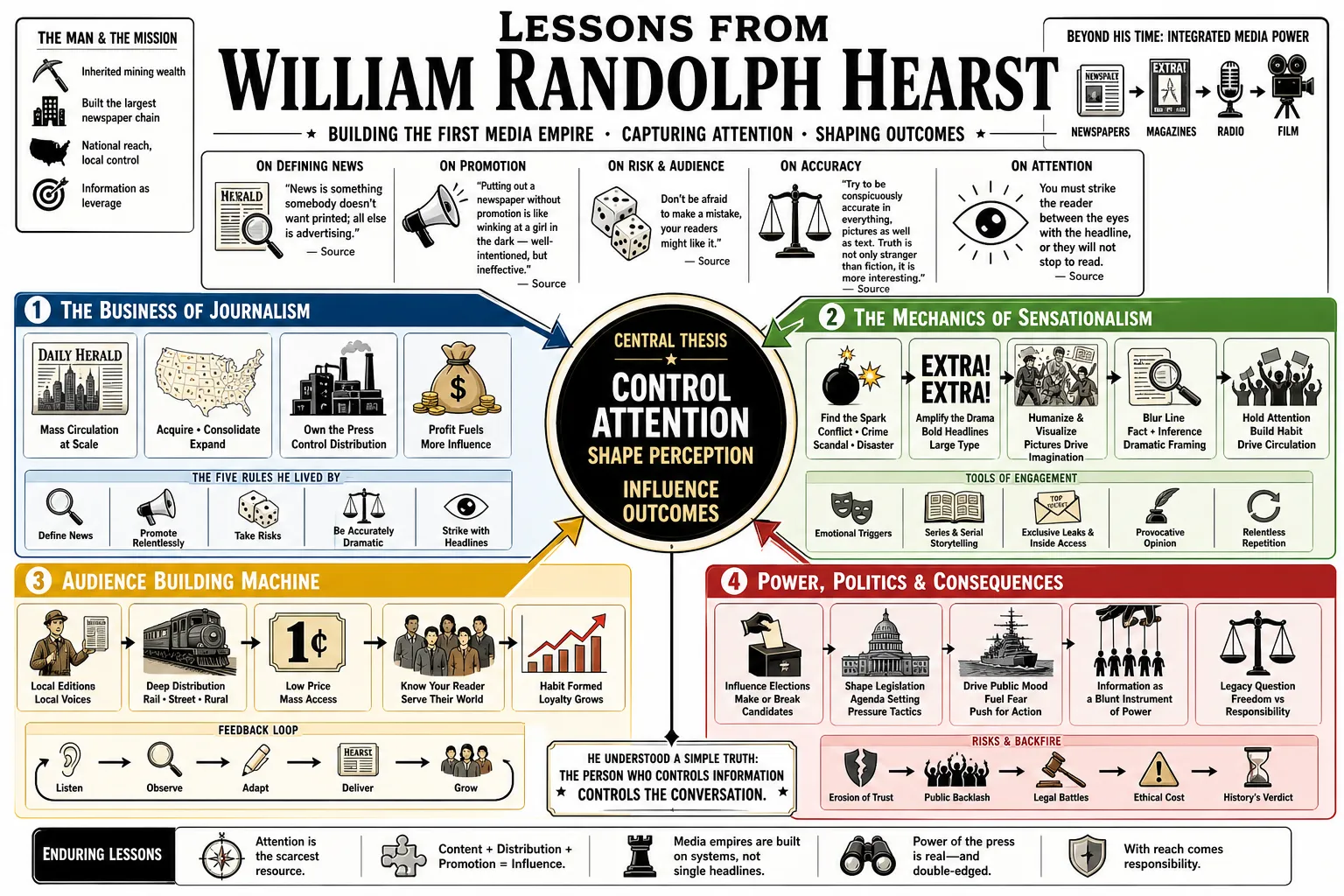
Part 1: The Business of Journalism
- On defining news: "News is something somebody doesn't want printed; all else is advertising." — Source: [William Randolph Hearst]
- On the necessity of promotion: "Putting out a newspaper without promotion is like winking at a girl in the dark — well-intentioned, but ineffective." — Source: [William Randolph Hearst]
- On taking risks with the audience: "Don't be afraid to make a mistake, your readers might like it." — Source: [William Randolph Hearst]
- On narrative accuracy: "Try to be conspicuously accurate in everything, pictures as well as text. Truth is not only stranger than fiction, it is more interesting." — Source: [William Randolph Hearst]
- On capturing attention: You must strike the reader between the eyes with the headline, or they will not stop to read the text. — Source: [Arthur Brisbane]
- On poaching talent: He did not simply compete with Joseph Pulitzer's New York World; he bought Pulitzer's entire Sunday staff outright by offering them double their salaries. — Source: [W.A. Swanberg]
- On the Sunday edition: He reinvented the Sunday paper as a standalone entertainment magazine filled with color comics, fashion, and serialized fiction. — Source: [David Nasaw]
- On visual hierarchy: He realized that massive, bold typography and dominant illustrations could sell a paper from across a crowded street before the buyer even read a word. — Source: [Ben Procter)]
- On editorial speed: He demanded that his editors be capable of tearing up the front page and resetting the entire layout within minutes of a major news flash. — Source: [David Nasaw]
- On the publisher's role: He viewed the publisher not merely as a chronicler of events, but as a primary actor who could initiate investigations, fund expeditions, and create the news itself. — Source: [W.A. Swanberg]
Part 2: Sensationalism and "Yellow Journalism"
- On provoking the elite: "The more a newspaper frightens the powerful, the more valuable it becomes." — Source: [William Randolph Hearst]
- On emotion over intellect: He understood that working-class readers at the end of a long day did not want dry political theory; they wanted melodrama, crime, and scandal delivered with maximum intensity. — Source: [David Nasaw]
- On true crime as theater: His papers covered local murders not as police blotter statistics, but as serialized detective novels, complete with villains, victims, and breathless daily updates. — Source: [W.A. Swanberg]
- On the comic strip war: The battle for circulation was fought with ink; the term "yellow journalism" itself was born from the fierce bidding war over the rights to print Richard F. Outcault's "Yellow Kid" cartoon. — Source: [Ben Procter)]
- On the immigrant audience: By relying heavily on pictures, bold layouts, and simple language, his papers were specifically designed to be accessible to recent immigrants who were still learning English. — Source: [David Nasaw]
- On crusading for the public: He branded his papers as the sole defenders of the common man against corrupt trusts, utility monopolies, and indifferent politicians. — Source: [W.A. Swanberg]
- On manufacturing outrage: When genuine news was slow, his editors were instructed to launch campaigns against minor municipal grievances, inflating them into full-blown civic crises. — Source: [David Nasaw]
- On the limits of decency: He frequently pushed the boundaries of taste, forcing competitors to either match his lurid coverage or lose readers to his more exciting pages. — Source: [Ben Procter)]
- On self-promotion: He ensured that his newspapers regularly congratulated themselves in their own headlines whenever a crusade resulted in a new law or an arrest. — Source: [W.A. Swanberg]
- On the feedback loop: He closely monitored daily circulation figures to see which headlines and scandals moved the needle, instantly abandoning failing narratives and doubling down on what sold. — Source: [David Nasaw]
Part 3: The Politics of Print
- On maintaining focus: "You must keep your mind on the objective, not on the obstacle." — Source: [William Randolph Hearst]
- On ideological fluidity: He began his career as an outspoken progressive and ally of labor unions, only to transform into a fierce conservative and opponent of the New Deal in his later decades. — Source: [David Nasaw]
- On political ambition: He actively sought the Democratic nomination for president in 1904, believing his national readership would translate directly into votes. — Source: [W.A. Swanberg]
- On punishing enemies: Politicians who crossed him were subjected to relentless, multi-year smear campaigns across his entire network of newspapers in different cities. — Source: [David Nasaw]
- On the megaphone of syndication: By writing front-page editorials that were simultaneously published in dozens of his papers nationwide, he possessed an unmatched ability to inject his personal opinions directly into the national bloodstream. — Source: [Ben Procter)]
- On the limits of press power: Despite his massive reach, his campaigns for Mayor and Governor of New York ultimately failed, proving that voters distinguish between buying a newspaper and casting a ballot. — Source: [W.A. Swanberg]
- On isolationism: In the years leading up to World War II, he used his platform to vehemently argue for "America First," opposing any entanglement in European conflicts. — Source: [David Nasaw]
- On Franklin D. Roosevelt: He initially supported FDR and was instrumental in securing him the 1932 nomination, but later turned on him completely, viewing the New Deal as creeping communism. — Source: [Ben Procter)]
- On the perception of power: Many politicians feared him not because they agreed with him, but because the sheer volume of his circulation meant they could not afford to be on his bad side. — Source: [W.A. Swanberg]
- On shifting alliances: He possessed no permanent party loyalty; he endorsed Democrats, Republicans, and third-party candidates based entirely on whether they aligned with his immediate personal and business interests. — Source: [David Nasaw]
Part 4: The Architecture of War
- On manufacturing conflict: "You furnish the pictures and I'll furnish the war." — Source: [Attributed to William Randolph Hearst]
- On the USS Maine: When the battleship Maine exploded in Havana harbor, he immediately blamed the Spanish without evidence, offering a $50,000 reward for information and boosting his daily circulation over a million copies. — Source: [W.A. Swanberg]
- On participatory journalism: During the Spanish-American War, he chartered a fleet of steamboats, outfitted them with printing presses and reporters, and personally sailed to Cuba to cover the conflict. — Source: [David Nasaw]
- On the Evangelina Cisneros rescue: To create a compelling narrative, he dispatched a reporter to Cuba to physically break a young female political prisoner out of a Spanish jail, bringing her to New York for a massive parade. — Source: [Ben Procter)]
- On war as a product: He viewed the Cuban rebellion not merely as a geopolitical crisis, but as the ultimate serialized drama to be packaged and sold to the American public. — Source: [David Nasaw]
- On forcing the government's hand: His relentless front-page coverage of alleged Spanish atrocities created an atmosphere of public jingoism that made it nearly impossible for President McKinley to avoid declaring war. — Source: [W.A. Swanberg]
- On the aftermath of jingoism: Following the assassination of President McKinley by an anarchist carrying a clipping of a Hearst editorial, he faced severe public backlash and accusations of incitement. — Source: [Ben Procter)]
- On treating reporters as soldiers: He commanded his correspondents in Cuba like military generals, ordering them to capture territory, interview rebels on the front lines, and prioritize the spectacle of combat over objective analysis. — Source: [David Nasaw]
- On the legacy of 1898: The Spanish-American War proved to him that a well-funded, coordinated press apparatus could act as an independent branch of government, capable of dictating foreign policy. — Source: [W.A. Swanberg]
Part 5: Empire and Synergy
- On the invention of media synergy: Long before modern conglomerates, he understood that a story broken in a Hearst newspaper could be serialized in a Hearst magazine, adapted by a Hearst film studio, and promoted on a Hearst radio station. — Source: [David Nasaw]
- On capital deployment: He used the vast profits from the family's Homestake mining operations to subsidize his newspapers for years, absorbing massive losses until they achieved dominant market share. — Source: [Ben Procter)]
- On the magazine expansion: He acquired and built massive lifestyle and fiction magazines like Cosmopolitan, Good Housekeeping, and Harper's Bazaar, recognizing that advertisers would pay a premium for specific demographics. — Source: [David Nasaw]
- On financial mismanagement: His primary flaw as an executive was a complete lack of fiscal restraint; he believed that rapid expansion and relentless spending would always outpace his debts. — Source: [W.A. Swanberg]
- On the creation of INS: To feed his growing network of papers and break his reliance on the Associated Press, he created the International News Service, an independent wire agency that further centralized his control over information. — Source: [David Nasaw]
- On entering radio: He quickly realized the threat and promise of radio broadcasting in the 1920s, purchasing stations in major markets to ensure his newspapers maintained their audio equivalent. — Source: [Ben Procter)]
- On the Great Depression: The 1930s nearly destroyed his empire; his massive personal debts and bloated corporate structure forced him to cede financial control of the company to a trust to avoid bankruptcy. — Source: [David Nasaw]
- On vertical integration: He owned the timberlands that produced the pulp, the mills that made the paper, the syndicates that drew the comics, and the presses that printed the final product. — Source: [W.A. Swanberg]
- On absolute authority: Despite the massive scale of his corporation, he refused to delegate editorial authority, reading his papers daily and sending streams of telegrams to editors micromanaging layouts and headlines. — Source: [David Nasaw]
Part 6: The Vision of San Simeon
- On architectural monuments: At San Simeon, he was not merely building a home; he was constructing a visual representation of his wealth, influence, and permanence. — Source: [David Nasaw]
- On collaborating with genius: He partnered closely with architect Julia Morgan for decades, engaging in a relentless, iterative design process where blueprints were constantly altered and rebuilt on a whim. — Source: [Victoria Kastner]
- On the continuous state of construction: The castle was never truly finished; he viewed the act of building as a perpetual creative project, halting construction only when his funds completely dried up. — Source: [W.A. Swanberg]
- On plundering antiquity: He operated on an unprecedented scale of acquisition, purchasing entire Spanish monasteries and European castles, dismantling them stone by stone, and shipping them to California warehouses. — Source: [Victoria Kastner]
- On controlling nature: He surrounded his hilltop estate with the world's largest private zoo, importing zebras, giraffes, and exotic predators to roam the coastal hills of California. — Source: [David Nasaw]
- On blending styles: Rather than adhering to a single historical period, he instructed Morgan to seamlessly weave together Gothic arches, Renaissance ceilings, and Roman pools into a cohesive theatrical backdrop. — Source: [Victoria Kastner]
- On the congregation of power: Invitations to San Simeon were highly coveted; he curated weekends where Hollywood stars, European royalty, and political power brokers were forced to mingle under his roof. — Source: [David Nasaw]
- On the psychology of the estate: The remote location and opulent scale of the property functioned as a physical moat, isolating him from his critics and allowing him to rule as an absolute monarch over his own domain. — Source: [W.A. Swanberg]
- On the illusion of permanence: Despite the millions spent embedding concrete and marble into the mountainside, he lived in the main house for barely twenty years before failing health forced him to leave it behind forever. — Source: [Victoria Kastner]
Part 7: Hollywood and Marion Davies
- On film production: Through Cosmopolitan Productions, he attempted to control the emerging medium of cinema the same way he controlled print, funding massive historical epics. — Source: [David Nasaw]
- On Marion Davies' talent: While he desperately wanted her to be a dramatic leading lady in prestige period pieces, her true, natural talent was in light, physical comedy. — Source: [Orson Welles]
- On weaponizing reviews: He explicitly ordered his nationwide network of film critics to give Davies glowing reviews, heavily punishing any editor who allowed a negative mention of her work to reach print. — Source: [W.A. Swanberg]
- On the power of the gossip column: By employing Louella Parsons and syndicating her column, he wielded the power to break Hollywood careers, forcing studio moguls to negotiate directly with him to protect their stars. — Source: [David Nasaw]
- On the genuine nature of their relationship: Despite the public scandal and his refusal to divorce his wife, his multi-decade partnership with Davies was built on deep, mutual affection rather than mere transaction. — Source: [David Nasaw]
- On her financial loyalty: During the depths of his financial crisis in the late 1930s, Davies liquidated her own jewelry and real estate to hand him a million-dollar check, saving the corporation from immediate ruin. — Source: [W.A. Swanberg]
- On blurring lines of reality: He used his media empire to create a parallel universe where Davies was the most popular actress in the world, regardless of actual box office returns. — Source: [David Nasaw]
- On negotiating with studios: He moved his production company between MGM and Warner Bros, using his massive advertising budget and newspaper backing as leverage to secure favorable distribution deals. — Source: [David Nasaw]
- On the tragedy of expectation: His relentless drive to make her a specific type of serious actress ultimately overshadowed her actual comedic abilities, leaving her historical reputation unfairly diminished. — Source: [Orson Welles]
Part 8: The Weight of Legacy
- On the fury over Citizen Kane: He viewed Orson Welles's film not just as an insult, but as an existential threat to his carefully curated public image, triggering a massive campaign to destroy the movie. — Source: [David Nasaw]
- On suppressing the film: He banned any mention of the movie in his newspapers and threatened to expose the private scandals of Hollywood studio heads if they allowed RKO to release the picture. — Source: [Orson Welles]
- On the inaccuracy of Charles Foster Kane: While Kane died alone and miserable in Xanadu, the real man spent his final years surrounded by Marion Davies and continued to exert influence until his health failed. — Source: [David Nasaw]
- On the loss of control: In his final decade, the financial reorganization of his company meant that, for the first time in his life, he had to ask a board of trustees for permission to spend money. — Source: [W.A. Swanberg]
- On his ultimate failure: Despite all the newspapers, the wealth, and the political machinery he built, he could never outright purchase the respect of the American political establishment. — Source: [W.A. Swanberg]
- On the transition of the corporation: After his death, his executives immediately pivoted away from his idiosyncratic editorial demands, focusing entirely on making the Hearst Corporation a quiet, profitable enterprise. — Source: [David Nasaw]
- On the paradox of the populist: He spent his life writing editorials demanding rights for the working class while simultaneously amassing one of the largest private art collections and real estate portfolios in the world. — Source: [David Nasaw]
- On the enduring template: Every modern media conglomerate that utilizes cross-promotion, television channels, and print magazines to dominate a news cycle is operating on the blueprint he established in the 1920s. — Source: [David Nasaw]
- On the irony of his legacy: He spent sixty years dictating the daily news narrative for tens of millions of Americans, yet his permanent place in the cultural memory is entirely defined by a movie he tried to destroy. — Source: [Orson Welles]