Lessons from William Rosenberg
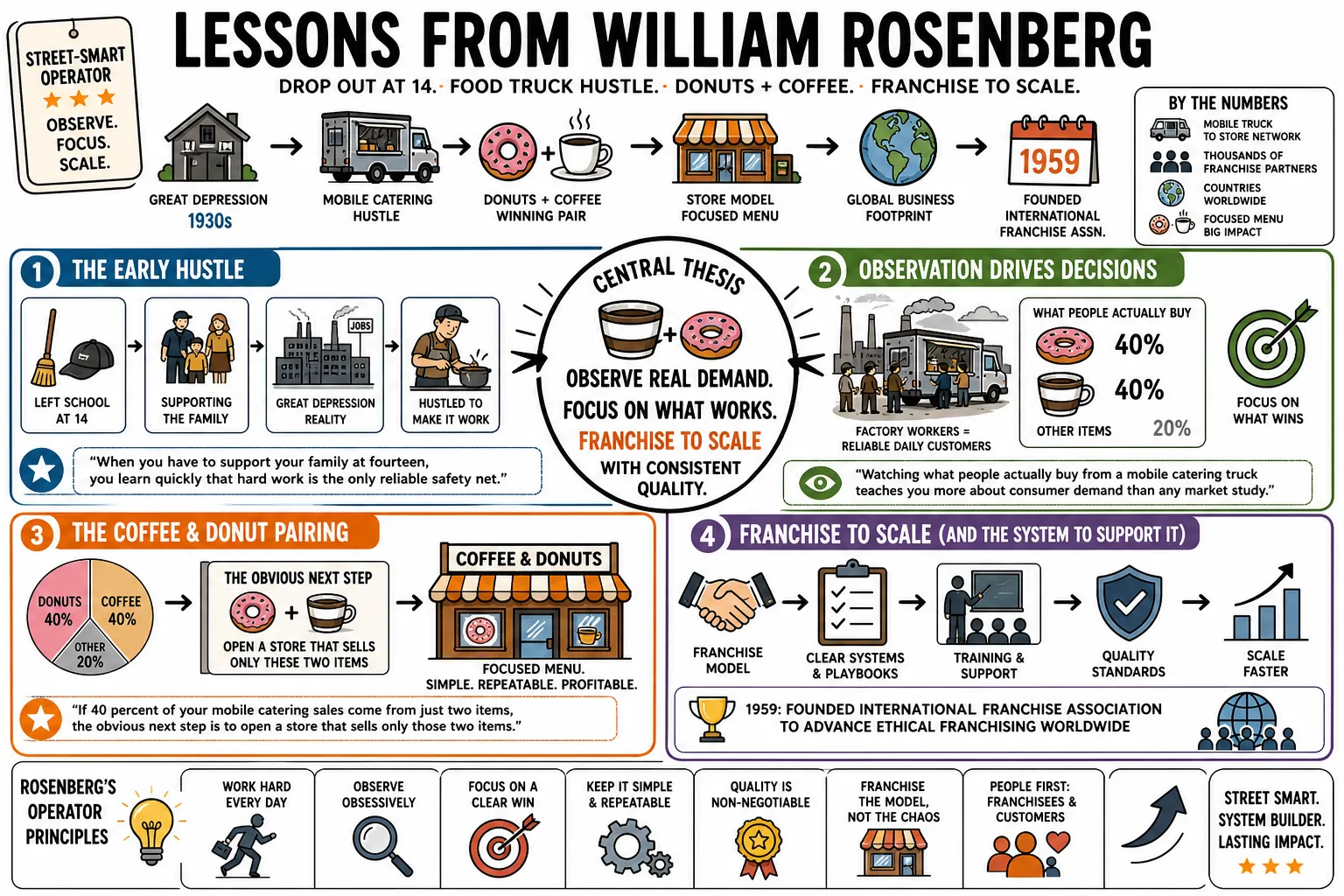
William Rosenberg dropped out of school at 14 during the Great Depression and built Dunkin' Donuts into a global business after noticing factory workers reliably bought coffee and pastries from his food trucks. He realized franchising was the fastest way to scale a retail footprint, leading him to found the International Franchise Association in 1959. This compilation breaks down his blunt, street-smart approach to operations, franchise management, and quality control.
Part 1: The Early Hustle
- On Formal Education: "Success isn't about theoretical knowledge; it's about relentless determination and learning from the obstacles in front of you." — Source: [Time to Make the Donuts]
- On The Depression Era: "When you have to support your family at fourteen, you learn quickly that hard work is the only reliable safety net." — Source: [LA Times]
- On Observation: "Watching what people actually buy from a mobile catering truck teaches you more about consumer demand than any market study." — Source: [UNH Rosenberg Center]
- On The Coffee and Donut Pairing: "If 40 percent of your mobile catering sales come from just two items, the obvious next step is to open a store that sells only those two items." — Source: [Entrepreneur Magazine]
- On Sweat Equity: "Most success is achieved by average people with above-average desire." — Source: [Time to Make the Donuts]
- On Starting Small: "Before you can build an empire, you have to prove you can run a single, profitable food truck." — Source: [Medium]
- On Street Smarts: "You don't need to be an intellectual to understand that people want a hot cup of coffee and a fresh pastry before work." — Source: [LA Times]
- On Grit: "You use every experience, especially the failures, as a building block for the next endeavor." — Source: [Time to Make the Donuts]
- On Self-Reliance: "If someone else can do it, I can do it, too." — Source: [Success Magazine]
- On Originality: "My philosophy is this: Don't reinvent the wheel. Just make sure your wheel turns smoother and faster." — Source: [Time to Make the Donuts]
Part 2: The Customer is Boss
- On Hierarchy: "The boss is the customer. They have the money, and they have the discretion to spend it wherever they want." — Source: [1851 Franchise]
- On Listening to Feedback: "If a customer complains about the coffee being burnt, you don't argue with them. You fix the coffee." — Source: [Time to Make the Donuts]
- On Menu Innovation: "We introduced Munchkins because customers wanted a bite-sized option they could share, and it reduced our dough waste." — Source: [UNH Rosenberg Center]
- On Meeting Needs: "Any idea that effectively meets a customer need is worth pursuing, regardless of how simple it seems." — Source: [LA Times]
- On Respect: "You treat every person walking through the door as if they are the sole reason your business exists, because they are." — Source: [Time to Make the Donuts]
- On Value: "Value isn't about being the cheapest; it's about providing a product so good the customer feels they underpaid." — Source: [Medium]
- On Consistency for the Consumer: "A customer expects the same cup of coffee in Boston as they do in Chicago. If you fail that expectation, you lose their trust." — Source: [Entrepreneur Magazine]
- On Speed of Service: "Working people have exactly ten minutes to get their breakfast. If you take eleven, they won't come back." — Source: [Time to Make the Donuts]
- On Marketing Fallacies: "Advertising and public relations alone will not create a successful business. Putting a spotlight on a pile of manure only makes it smell worse." — Source: [Success Magazine]
Part 3: Franchising as a Growth Engine
- On The Core Concept of Franchising: "Franchising is fundamentally built on the principle of sharing—sharing success, knowledge, and opportunity with others." — Source: [IFA History]
- On Scaling: "You can only open so many stores with your own capital. To grow rapidly across the country, you need operators who have skin in the game." — Source: [Time to Make the Donuts]
- On Industry Organization: "The franchising industry needed a unified body to protect legitimate businesses from the fly-by-nighters who were giving us all a bad name." — Source: [1851 Franchise]
- On Franchisee Selection: "You need more than someone with money; you want an operator willing to follow a proven system to the letter." — Source: [UNH Rosenberg Center]
- On Mutual Benefit: "If the franchisee doesn't make money, the franchisor won't survive. It has to be a reciprocal relationship." — Source: [Time to Make the Donuts]
- On Systemization: "A franchise only works if the operating manual is so clear that anyone with basic common sense can run a profitable shop." — Source: [Entrepreneur Magazine]
- On Legislative Threats: "When I slammed that $100 on the table in 1959, it was because we needed to fight unfair legislation together, or we'd be put out of business individually." — Source: [IFA History]
- On Local Ownership: "A local owner will always care more about the cleanliness of their parking lot than a corporate manager sitting five hundred miles away." — Source: [Time to Make the Donuts]
- On Brand Protection: "When you license your name, you are licensing your reputation. You must defend it aggressively." — Source: [LA Times]
- On Expansion Strategy: "Why open one store a year when you can teach ten people to open ten stores a year?" — Source: [Medium]
Part 4: Managing People and Leadership
- On Hiring Strategy: "Seek out the best people, compensate them the best, and share your profits and equity with them." — Source: [Rosenberg's Principles]
- On Autonomy: "Give your people the responsibility and the authority to achieve the goals you've set together." — Source: [Time to Make the Donuts]
- On Respecting Staff: "Treat your employees with respect. If you want them to treat the customer well, you have to treat them well first." — Source: [Rosenberg's Principles]
- On Company Culture: "Share your goals and strategies with them to create a family atmosphere and a sense of belonging." — Source: [UNH Rosenberg Center]
- On Leadership Credibility: "Make certain your credibility is unquestionable. A leader without trust is just a guy talking to himself." — Source: [Rosenberg's Principles]
- On Motivation: "Enthusiastically instill in your team your passion to achieve excellence in all your combined endeavors." — Source: [LA Times]
- On Accountability: "Periodically check and follow through to ensure that your standards and philosophies are actually being adhered to." — Source: [Rosenberg's Principles]
- On Delegation: "You can't bake every donut yourself. At a certain point, leadership means trusting the system you built." — Source: [Time to Make the Donuts]
- On Recognition: "Providing recognition for accomplishments is often just as important as the paycheck." — Source: [Medium]
Part 5: Action, Mistakes, and Resilience
- On Taking Action: "When you make your mind up that something is the right thing to do, for God's sake get out and do it." — Source: [Success Magazine]
- On The Value of Mistakes: "Show me a person who never made a mistake, and I will show you a person who never did anything." — Source: [Time to Make the Donuts]
- On Overcoming Doubt: "People will always tell you why an idea won't work. Focus on finding the one reason it will." — Source: [UNH Rosenberg Center]
- On Pivoting: "If a product isn't selling, don't force it. Cut it from the menu and replace it with something the customer actually wants." — Source: [Entrepreneur Magazine]
- On Speed of Execution: "In retail, the difference between winning and losing is often just who gets the doors open first in a new neighborhood." — Source: [Time to Make the Donuts]
- On Resilience in Downturns: "Economic depressions don't eliminate consumer demand; they just force you to offer better value for the pennies they do have." — Source: [LA Times]
- On Analysis Paralysis: "You can study a location for a year, but sometimes you just have to trust your gut, sign the lease, and start pouring coffee." — Source: [Medium]
- On Handling Competitors: "The best way to invite competition is to have a successful business with a substandard operation." — Source: [Time to Make the Donuts]
- On Learning Curves: "Your first store is where you make all the expensive mistakes. Your tenth store is where you start making real money." — Source: [1851 Franchise]
- On Persistence: "A door slammed in your face isn't an ending; it's a signal to try the window." — Source: [Time to Make the Donuts]
Part 6: Obsessive Quality Standards
- On Setting the Bar: "Set the highest possible standards for your product. If you compromise on quality once, you'll do it again." — Source: [Rosenberg's Principles]
- On Coffee Brewing Rules: "Coffee should only be held for eighteen minutes. After that, it degrades. Throw it out and brew a fresh pot." — Source: [Time to Make the Donuts]
- On The Four Pillars: "You must have a passion for providing the finest quality, service, cleanliness, and value." — Source: [LA Times]
- On Ingredient Sourcing: "You cannot make a premium pastry out of discount flour and cheap oil. The customer's palate always knows the difference." — Source: [UNH Rosenberg Center]
- On Store Cleanliness: "If the bathrooms are dirty, the customer will assume the kitchen is filthy. Everything must shine." — Source: [Time to Make the Donuts]
- On Product Freshness: "A donut is a baked good that is meant to be eaten the day it is made. Day-old product destroys the brand." — Source: [Entrepreneur Magazine]
- On Standardization: "Whether a shop is in Maine or California, a glazed donut should taste exactly the same." — Source: [1851 Franchise]
- On Quality Control Checks: "You have to inspect what you expect. Random visits are the only way to ensure the manual is actually being followed." — Source: [Medium]
- On Protecting the Core Product: "You can add new items, but never let the quality of your flagship product slip while you are distracted." — Source: [Time to Make the Donuts]
Part 7: Simplicity in Operations
- On Operational Complexity: "I was always too dumb to make things complicated. Success is usually about executing basic fundamentals perfectly." — Source: [LA Times]
- On Streamlined Menus: "If you offer fifty things, you will do them all poorly. Offer a few things and do them better than anyone else in the world." — Source: [Time to Make the Donuts]
- On Clear Instructions: "The operations manual shouldn't read like a textbook; it should read like a checklist." — Source: [UNH Rosenberg Center]
- On Focusing on the Main Thing: "We are in the business of getting people to work with a good breakfast. Everything else is secondary." — Source: [Medium]
- On Business Models: "Buy raw materials in bulk, process them efficiently, and sell them at a margin that sustains growth. That's the whole game." — Source: [Time to Make the Donuts]
- On Facility Design: "The layout of the store needs to facilitate speed. The distance from the coffee pot to the register should be as short as physically possible." — Source: [Entrepreneur Magazine]
- On Cost Control: "You track every penny of waste. A dropped donut is lost inventory and lost margin on the next three sales." — Source: [1851 Franchise]
- On Over-intellectualizing: "Business professors like to invent complex theories for why a store fails. Usually, the coffee was just cold." — Source: [Time to Make the Donuts]
- On Scalable Processes: "If an operational process requires a genius to execute it on a Tuesday morning at 5 AM, you have designed a flawed process." — Source: [UNH Rosenberg Center]
Part 8: Legacy and Long-term Perspective
- On Reputation: "My father taught me that reputation, not money, was the most important thing in the world." — Source: [Success Magazine]
- On Family Business Dynamics: "Bringing family into leadership is a double-edged sword; it provides trust, but the conflicts are deeply personal." — Source: [Time to Make the Donuts]
- On Industry Stewardship: "If you benefit from an industry, you have an obligation to organize and leave that industry better than you found it." — Source: [IFA History]
- On Wealth: "Money is simply a byproduct of doing everything else right. If you chase the money first, the product suffers." — Source: [LA Times]
- On Leadership Transition: "A true test of what you've built is whether the company continues to grow after you step out of the daily operations." — Source: [Medium]
- On Generational Vision: "You plant seeds today so that thirty years from now, a franchisee you never met can send their kids to college." — Source: [UNH Rosenberg Center]
- On Institutional Memory: "Record your mistakes so the next generation of leadership doesn't have to pay for the exact same lessons." — Source: [Time to Make the Donuts]
- On Corporate Evolution: "The brand will have to change eventually. The menu will change. But the core commitment to the customer must remain permanent." — Source: [Entrepreneur Magazine]
- On Looking Back: "If I had to do it all over again, I wouldn't change the hard times. The struggle is where the company's character was forged." — Source: [Time to Make the Donuts]