Winston Weinberg is the co-founder and CEO of Harvey, an AI platform built specifically for the legal industry. A former securities and antitrust litigator at O'Melveny & Myers, he recognized the capacity of generative AI to handle complex legal reasoning after testing early OpenAI models with his roommate, AI researcher Gabriel Pereyra. The following insights trace his journey from a first-year associate to leading an $11 billion legal tech company, documenting his practical approach to scaling, product design, and the evolving nature of professional services.
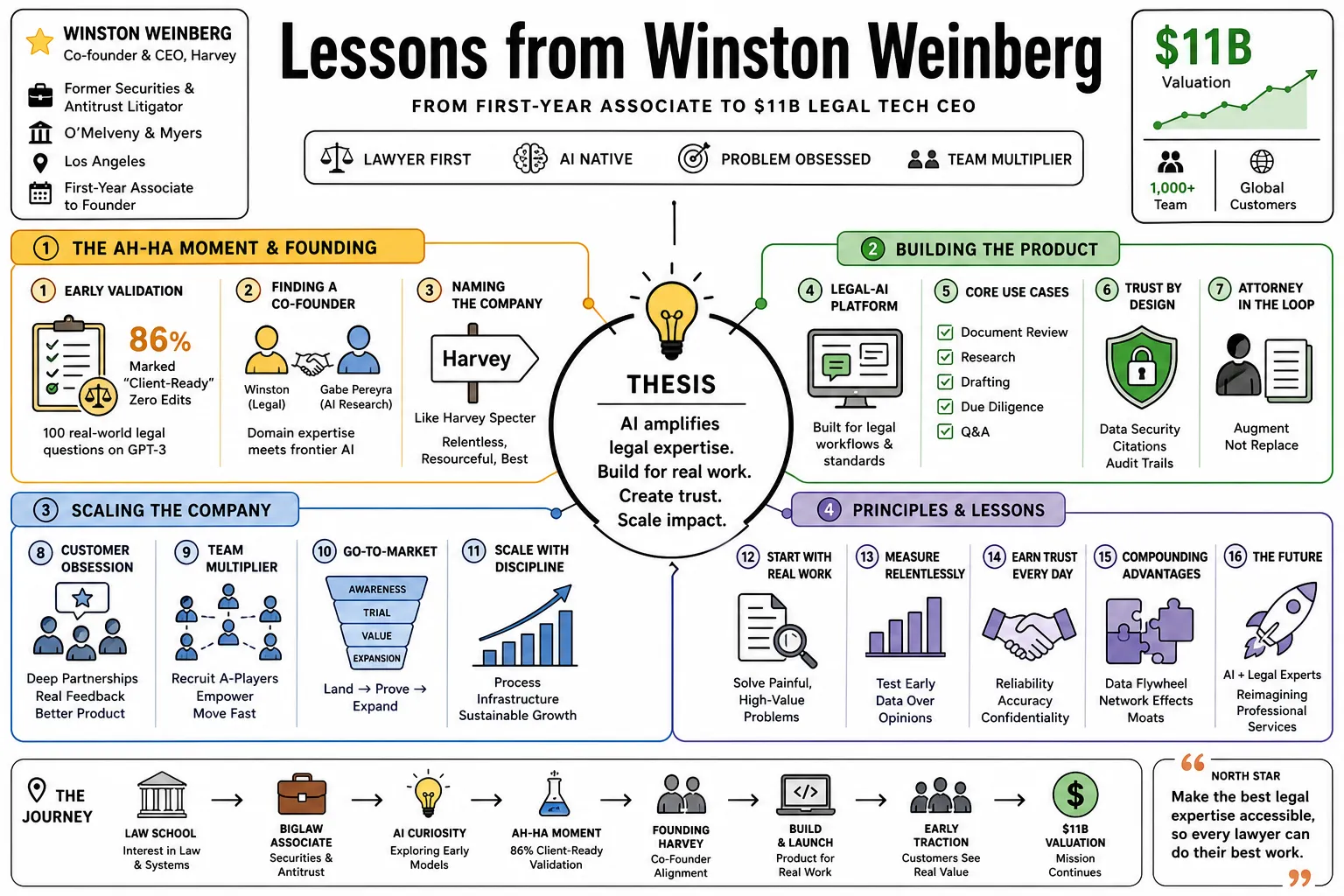
Part 1: The Ah-Ha Moment and Founding
- On early validation: "We ran 100 real-world legal questions through GPT-3 and gave the results to experienced attorneys without telling them they were AI-generated. When 86 of them were marked as 'client-ready' with zero edits, we knew the industry was about to change." — Source: Forbes
- On finding a co-founder: "I was living in Los Angeles with Gabe [Pereyra], who was a research scientist at DeepMind. He had access to these early language models, and I had the domain expertise to know exactly which tedious legal tasks they could automate." — Source: Observer
- On naming the company: "We picked the name Harvey because of Harvey Specter from Suits. We wanted something that sounded confident but familiar to lawyers, something that felt like a partner rather than just a software tool." — Source: Wikipedia
- On first impressions: "The first time I saw the model summarize a dense antitrust brief accurately in seconds, I realized that the billable hour model was going to face a massive structural shock." — Source: Harvey Blog
- On pitching OpenAI: "Our early blind tests were so successful that we just reached out to OpenAI directly. We showed them the data, and they ended up becoming one of our earliest investors." — Source: Forbes
- On the initial MVP: Weinberg describes Harvey starting with a narrow legal-AI wedge around citation accuracy, then using that wedge to build toward more complete professional-services workflows. — Reference: Sequoia Training Data transcript on Harvey beginning with citations
- On leaving Big Law: "I had only been at O'Melveny for about a year. It was a risk to leave a secure associate track, but the window to build the definitive legal AI platform was clearly opening right then." — Source: Observer
- On convincing the first law firms: Weinberg says trust is the core currency in professional services, so Harvey went after respected firms whose adoption would make the rest of the market more willing to listen. — Reference: Sequoia transcript on prestige and trust in professional services
- On finding the right problem: Harvey was built around messy professional work where process expertise matters, not around a generic model demo looking for a use case. — Reference: Sequoia summary on process expertise and legal workflows
- On early momentum: Harvey gained traction by proving usefulness to skeptical legal users at scale; Upstarts describes the company reaching about 100,000 lawyers and roughly $200 million in revenue. — Reference: Upstarts interview page on Harvey traction
Part 2: Legal AI and Domain-Specific Models
- On domain-specific models: Weinberg argues that legal AI needs workflow and process expertise layered on top of models, because complex legal work cannot be solved by public data alone. — Reference: Sequoia transcript on process expertise and specialized workflows
- On data security: "Law firms cannot use public models. They need guarantees that their client data won't train a broader model. We architected Harvey so it integrates directly with their existing document management systems without duplicating data." — Source: Reddit AMA
- On the wrapper criticism: Weinberg rejects the idea that Harvey is only a model wrapper: the defensible work is dealing with messy legal data, specialized workflows, and the gap between foundation models and customer reality. — Reference: Sequoia transcript on GPT-wrapper criticism
- On trust in legal tech: For Weinberg, legal AI adoption starts with trust: if Harvey earns credibility with demanding firms, that trust can travel through the rest of the market. — Reference: Sequoia transcript on trust and prestige
- On document management integration: "We don't want lawyers to leave their workflow to use Harvey. That's why deep integrations with iManage and NetDocs were our first engineering priorities." — Source: Reddit AMA
- On hallucination mitigation: Weinberg emphasizes making AI outputs checkable: the system should show the information it used and cite the literal sentence so legal reviewers can validate the answer. — Reference: No Priors transcript on inline citations and review
- On in-house vs. firm usage: Harvey serves different legal customer types, including law firms and in-house corporate teams, and Weinberg notes those categories adopt and grow at different speeds. — Reference: Sourcery transcript on law-firm and corporate customers
- On the complexity of legal reasoning: Weinberg keeps stressing that legal work is genuinely complex professional judgment, which is why Harvey targets workflows that require domain mastery rather than simple text generation. — Reference: Sequoia transcript on complex legal work
- On the future of legal tech: "The future isn't software that lawyers use; it's software that works alongside lawyers as a junior associate, handling the first 80% of the research." — Source: Legally Disrupted Podcast
- On bespoke firm models: "Eventually, every major law firm will want a customized model trained on their specific institutional knowledge and past deal precedents." — Source: Reddit AMA
Part 3: Scaling and Hypergrowth
- On organizational design: The hard lesson from Harvey scale-up was that there is no shortcut around building the team, execution rhythm, and culture needed for the next stage. — Reference: Upstarts transcript on team, execution, and culture compounding
- On the 2024 merger attempt: Harvey nearly pursued a one-shot merger to accelerate scale, but walking away taught Weinberg that shortcuts do not replace the compounding work of building the company. — Reference: Upstarts interview on Harvey near-merger lesson
- On hiring engineers: Weinberg wants engineers to appreciate the depth of legal problems; once they see the mastery involved, the work becomes a serious technical challenge rather than a boring back-office tool. — Reference: Upstarts transcript on legal complexity and engineering empathy
- On managing a high valuation: "Reaching an $11 billion valuation creates a lot of noise. The only way to handle it is to completely ignore the number and focus on the daily product usage metrics." — Source: Reddit AMA
- On capital efficiency: Harvey funding supports an expensive AI operating model, including token costs and scale, so capital is a tool for execution rather than a victory lap. — Reference: Upstarts interview on Harvey funding and token usage
- On scaling sales: "Selling to law firms is notoriously difficult because decisions are made by committee. We bypassed that by getting the tool directly into the hands of the associates who actually do the work." — Source: Legally Disrupted Podcast
- On maintaining speed: Weinberg sees speed as part of the product system: Harvey has to keep testing model capability, customer usage, and new workflows as the AI market changes. — Reference: Sequoia summary on moving at unprecedented speed
- On firing fast: Weinberg treats scaling talent as an active leadership job: people may need development, promotion, a different role, or a hard call when the company outgrows the current fit. — Reference: Sourcery transcript on development, promotion, and outscaling
- On focusing the product roadmap: Harvey builds specific high-value workflows, then collapses them into a broader product, which keeps the roadmap tied to repeatable professional work rather than one-off requests. — Reference: Sequoia transcript on expanding and collapsing product
- On reinventing yourself: Weinberg says Harvey has to reinvent itself every few months; the pressure is a signal that the company needs structural changes before it falls behind. — Reference: Sourcery transcript on reinventing the company every few months
Part 4: Leadership and Operating Principles
- On managing stress: The scaling pressure shows up as a recurring signal for Weinberg: when things start breaking, he looks for the few structural changes that will release the pressure. — Reference: Sourcery transcript on pressure and structural changes
- On decision-making speed: Weinberg links fast decisions to close observation: if a founder is paying attention to enough signals, quick judgment is not just instinct but accumulated context. — Reference: No Priors transcript on decisive decisions and context
- On co-founder dynamics: "Gabe and I work well because our skills don't overlap. He owns the model architecture, and I own the legal product translation and business execution." — Source: Observer
- On leading a technical team: As a non-research founder in a technical company, Weinberg focuses on learning from trusted experts until he understands enough to make better decisions. — Reference: No Priors transcript on imposter syndrome and trusted technical advisors
- On internal communication: Weinberg sees one founder challenge as moving from personal context-gathering to making sure the broader team can share, absorb, and act on that context. — Reference: No Priors transcript on sharing context with the team
- On handling failure: Weinberg treats hard failures as forcing functions: they reset the team around the slower, more durable work of consistency and execution at scale. — Reference: Upstarts transcript on failures and execution at scale
- On ignoring standard advice: Harvey does not fit a simple SaaS playbook: Weinberg frames the product around transforming professional work, not just selling another software seat. — Reference: Sequoia transcript on selling software versus selling work
- On setting company culture: For Weinberg, culture is built through hiring, development, promotion, and the willingness to move people into the roles the next stage requires. — Reference: Sourcery transcript on hiring, development, and promotion
- On extreme focus: "There are a hundred adjacent markets we could enter tomorrow. We stay out of them because winning the legal vertical requires complete, obsessive focus." — Source: Legally Disrupted Podcast
Part 5: The Future of Professional Services
- On the billable hour: "AI won't immediately kill the billable hour, but it will force firms to move toward flat fees for standard transactional work." — Source: Legally Disrupted Podcast
- On junior associates: "The role of the first-year associate is changing. They won't spend late nights doing document review; they will function more like editors and project managers overseeing AI outputs." — Source: Forbes
- On access to justice: "By drastically lowering the cost of legal research, AI has the potential to make high-quality legal representation accessible to smaller businesses and individuals." — Source: Reddit AMA
- On the definition of legal work: Weinberg breaks legal work into workflows that combine data, process, domain expertise, and many steps, which is why Harvey focuses on end-to-end professional tasks. — Reference: No Priors transcript on legal workflows and professional services
- On law firm economics: Weinberg sees AI letting firms convert specialized expertise into software-like offerings, creating new margin structures around work that used to be purely service labor. — Reference: No Priors transcript on law-firm domain expertise and software margins
- On the talent pipeline: "Law schools need to start teaching prompt engineering and AI tool evaluation. The attorneys of the future need to know how to direct machines." — Source: Legally Disrupted Podcast
- On human judgment: Weinberg does not frame Harvey as replacing lawyers; he argues AI can strip away routine work so lawyers spend more time as strategic advisors. — Reference: Sequoia summary on enhancing rather than replacing lawyers
- On changing client expectations: As firms turn expertise into software, clients can start expecting legal providers to deliver some work through products rather than only through hours. — Reference: No Priors transcript on law firms selling specialized systems
- On expanding outside law: Harvey is not only a law-firm tool in this account; the broader idea is domain-specific AI for professional services and other rule-heavy enterprise workflows. — Reference: No Priors episode framing on law, professional services, and the Fortune 500
Part 6: Market Strategy and Competition
- On staying ahead: "In a market this hot, any technical moat you build will evaporate in six months. The only real moat is distribution and deeply ingrained user habits." — Source: Legally Disrupted Podcast
- On competing with incumbents: Weinberg is skeptical of buying legacy technology just to gain surface area; he would rather acquire strong teams than bolt Harvey onto old legal-tech foundations. — Reference: Sourcery transcript on legacy technology and team value
- On pricing strategy: "We don't price per query. We price based on the enterprise value we create for the firm, which aligns our incentives with their overall adoption." — Source: Reddit AMA
- On the Big Tech threat: Weinberg takes the model-lab threat seriously: Harvey has to prove over time that a specialized legal-work product will not simply be eaten by OpenAI, Anthropic, or the labs. — Reference: Upstarts transcript on model-lab competition
- On early customer lock-in: "Winning a majority of the AmLaw 100 early was critical. Law firms talk to each other constantly. Once the top tier adopted us, it created a safety net for the rest of the market." — Source: Legally Disrupted Podcast
- On avoiding distraction: Harvey avoids becoming a pile of one-off tools by building high-value workflows and then collapsing them into a unified product experience. — Reference: Sequoia transcript on expanding and collapsing product
- On evaluating competitors: Weinberg worries less about ordinary legal-tech noise than about the frontier labs: the strategic question is whether Harvey can keep adding value as OpenAI and Anthropic improve. — Reference: Upstarts transcript on competition from model labs
- On international expansion: "Expanding globally means dealing with entirely different legal systems and languages. It requires retraining the model on local jurisprudence, not just translating the interface." — Source: Reddit AMA
- On the nature of venture capital: For Harvey, capital is fuel for expensive AI execution: tokens, post-training, infrastructure, and the product work needed to keep scaling. — Reference: Sourcery transcript on funding, tokens, and post-training
Part 7: Product Development and Engineering
- On UI simplicity: Weinberg wants the product to reduce blank-page friction, giving professional users guided entry points into workflows instead of expecting them to prompt from scratch. — Reference: Sequoia transcript on changing behavior and blank-page friction
- On continuous deployment: Harvey has to keep testing model capability, customer behavior, and new product pieces because AI capabilities change too quickly for a static roadmap. — Reference: Sequoia summary on rapid testing and integration
- On the limit of AI: Weinberg knows Harvey has to overcome skepticism on two fronts: legal users who doubt the tools and technologists who think the labs will replace the application layer. — Reference: Upstarts transcript on skepticism and overpromising concerns
- On product feedback loops: "The most valuable feedback doesn't come from the managing partners who bought the software. It comes from the paralegals who spend eight hours a day in it." — Source: Legally Disrupted Podcast
- On building for edge cases: "In law, the edge case is often the entire point of the lawsuit. The model has to be robust enough to handle the weird, anomalous data." — Source: Reddit AMA
- On latency vs. accuracy: In Harvey early product work, latency mattered enough to become a running internal joke, but it was always part of a broader push to make legal AI usable in real workflows. — Reference: Sourcery transcript on latency as an early product problem
- On cloud agents: Weinberg says Harvey rebuilt around cloud agents, and that infrastructure shift helped usage start doubling quarter over quarter. — Reference: Sourcery transcript on cloud agents and usage growth
- On evaluating new foundational models: Harvey cannot rely on generic benchmarks; Weinberg says senior domain experts have to evaluate whether a new model checkpoint is actually useful for legal work. — Reference: No Priors transcript on benchmarks and domain-expert evals
- On data pipelines: The data challenge is not just ingestion; Harvey has to combine internal context, external data, client material, and legal process into workflows the model can execute. — Reference: No Priors transcript on internal data, external data, and process
Part 8: Transitioning from Law to Tech
- On his legal background: "Practicing as a litigator taught me how to read extremely carefully and how to construct a bulletproof argument. Both skills translate directly to writing product requirements." — Source: Observer
- On the pace of tech: Weinberg describes AI company-building as a compressed timeline, where people need the appetite to keep up with unusually fast learning and impact cycles. — Reference: No Priors transcript on compressed AI timelines
- On risk tolerance: Weinberg chose demanding legal customers early because Harvey needed to partner with the industry it wanted to transform, not hide in easier low-stakes adoption. — Reference: No Priors transcript on partnering with demanding industry customers
- On returning to law: "I could never go back to billing in six-minute increments. Once you see how fast software can solve a problem at scale, doing it manually feels impossible." — Source: Forbes
- On the value of domain expertise: Weinberg sees domain expertise as the raw material for new legal-software products, because firms can turn specialized practice knowledge into systems clients can use. — Reference: No Priors transcript on domain expertise becoming software
- On imposter syndrome: Weinberg handles the gap between legal background and technical company-building by spending time with trusted experts until he can ask better questions and understand the architecture. — Reference: No Priors transcript on imposter syndrome
- On client empathy: "Because I used to be the person doing the grunt work at 2 AM, I have a deep, personal empathy for our end users that drives every product decision." — Source: Legally Disrupted Podcast
- On leaving a prestigious path: Weinberg left a strong legal path at O Melveny because the AI opportunity pulled him toward a less proven but more urgent problem. — Reference: Upstarts transcript on leaving O Melveny and the legal path
- On building a legacy: "I don't want to be remembered for building a successful company. I want Harvey to be remembered as the tool that permanently changed the practice of law for the better." — Source: Reddit AMA