Jim Donovan is a Vice Chairman of Global Client Coverage at Goldman Sachs and an adjunct professor at the University of Virginia School of Law. He is best known for his blunt lectures on career strategy and the daily realities of high-stakes finance. This profile distills his specific rules for earning client trust and executing advisory work.
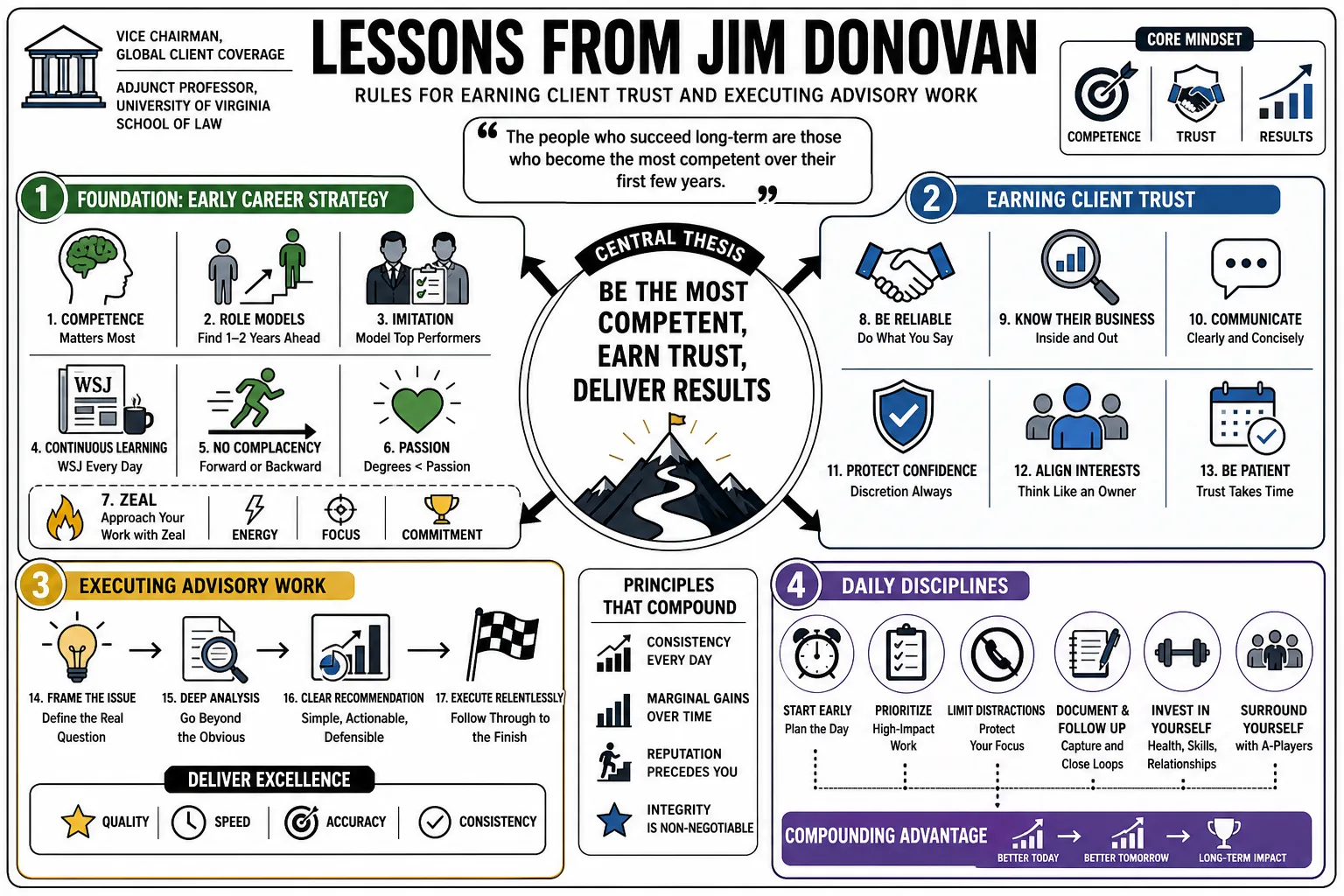
Part 1: Early Career Strategy
- On Competence: "Competence matters most. Charisma might help early on, but the people who succeed long-term are those who become the most competent over their first few years." — Source: [eFinancialCareers]
- On Role Models: "Find the person one or two years ahead of you who is the absolute best at the job, and study them." — Source: [UVA Law YouTube]
- On Imitation: "Model your behavior, your work ethic, and your substance after the top performers in your office." — Source: [Medium Interview]
- On Continuous Learning: "Read the Wall Street Journal every single day to ensure you know more about the industry than anyone else in the room." — Source: [UVA Law YouTube]
- On Complacency: "If you’re not moving forward, you’re going backwards." — Source: [Medium Interview]
- On Passion: "Degrees matter less than passion. The workplace will always welcome eager and committed individuals." — Source: [UVA Magazine]
- On Zeal: "Approach your second and third years on the job with the exact same zest and zeal as your first day." — Source: [UVA Law YouTube]
- On Ego: "Make it clear that you have no ego and that no task given to you is beneath you." — Source: [eFinancialCareers]
- On Being Indispensable: "Volunteer for menial tasks early on. It signals to the team that you are willing to do whatever is necessary for the group to succeed." — Source: [UVA Law YouTube]
Part 2: Interviewing and Networking
- On Interviewing Goals: "The goal of an interview is to shift the dynamic from an interrogation to a dialogue." — Source: [UVA Law YouTube]
- On Eliciting Authentic Responses: "In an interview, get the other person talking about themselves to draw out genuine answers." — Source: [eFinancialCareers]
- On Asking Questions: "Avoid yes or no questions. Ask open-ended questions that require full sentences as answers." — Source: [UVA Law YouTube]
- On Being Memorable: "Asking highly specific questions leaves a more lasting impression than trying to list your own achievements." — Source: [eFinancialCareers]
- On Curiosity: "Stop trying to impress the interviewer. Instead, get actively curious about their work." — Source: [UVA Law YouTube]
- On Specific Questions: "Ask things like, 'What was the most interesting transaction you worked on and why?'" — Source: [UVA Law YouTube]
- On Human Nature: "People enjoy talking about themselves more than anything else." — Source: [eFinancialCareers]
- On Preparation: "Know more about the interviewer's business and recent deals than they expect you to know." — Source: [James Donovan Website]
- On Listening: "By listening far more than you speak, you gather intelligence that others miss entirely." — Source: [UVA Law YouTube]
- On Nerves: "Pause when you speak. It controls your nerves and ensures your message lands with weight." — Source: [UVA Law YouTube]
Part 3: Professionalism and Execution
- On Note-Taking: "Always take notes in meetings, even if you have a perfect memory." — Source: [eFinancialCareers]
- On Signalling Seriousness: "Bringing a notebook and writing things down conveys immediately that you are a serious professional." — Source: [UVA Law YouTube]
- On Implicit Flattery: "Taking notes flatters the speaker by sending a clear signal that their words are important enough to record." — Source: [eFinancialCareers]
- On Work Ethic: "The most successful analysts and associates are the hardest workers. Period. Full stop." — Source: [UVA Law YouTube]
- On Excelling: "Excel on the merits, and no one will question how you manage your schedule." — Source: [UVA Law YouTube]
- On Effort vs. Smoozing: "Dismiss the idea that outside hobbies or networking matter as much as pure, undeniable effort." — Source: [UVA Law YouTube]
- On Adding Value: "Look for ways to add value completely outside your specific engagement scope." — Source: [James Donovan Website]
- On Excellence in Small Things: "Execute menial administrative tasks with the exact same level of excellence as complex financial models." — Source: [UVA Law YouTube]
- On Positivity: "Be positively contagious. Never show your personal difficulties or a bad mood to a client." — Source: [UVA Law YouTube]
- On Happiness: "Happiness is contagious, and people naturally want to hire individuals who make them feel good." — Source: [UVA Law YouTube]
Part 4: The Psychology of Client Service
- On Building Credibility: "There is no better way to establish credibility with a client than to give them advice that is explicitly not in your interest." — Source: [UVA Law YouTube]
- On Radical Honesty: "If a deal isn't right for the client, tell them straight away, even if it means losing a massive fee." — Source: [eFinancialCareers]
- On Taking a Position: "Clients hire you to tell them what to do. Don’t equivocate or present five options without a recommendation." — Source: [UVA Law YouTube]
- On Empathy: "Develop the ability to put yourself completely in the client's shoes before offering any guidance." — Source: [UVA Law YouTube]
- On Extreme Responsiveness: "Tell your client upfront that they are your priority and respond to them immediately whenever they reach out." — Source: [Medium Interview]
- On Alleviating Anxiety: "Even if you don't have the answer yet, respond quickly to say you are working on it. This eliminates client anxiety." — Source: [Medium Interview]
- On Availability: "Tell clients they can leave a voicemail anytime unless you are dead or asleep." — Source: [UVA Law YouTube]
- On Competence over Faking: "If you don't know the answer, don't fake it. An uninformed answer permanently destroys trust." — Source: [UVA Law YouTube]
- On Learning the Client's Mind: "Open-ended questions reveal the client’s underlying biases, fears, and passions." — Source: [Medium Interview]
- On Viewing Clients as Partners: "Clients are drawn to advisors who operate as true partners, rendering traditional salespeople obsolete." — Source: [James Donovan Website]
Part 5: Communication and Meeting Dynamics
- On Meeting Agendas: "Always have an agenda and get the client to buy into it at the very start of the meeting." — Source: [UVA Law YouTube]
- On Subconscious Buy-in: "Once a client agrees to an agenda, they have subconsciously bought into the content of the meeting itself." — Source: [UVA Law YouTube]
- On Eliminating Jargon: "Using technical jargon can make a client feel foolish or confused. Speak clearly and simply." — Source: [UVA Law YouTube]
- On Empowering Clients: "Structure your explanations to ensure the client feels smart and entirely in control of the decision." — Source: [UVA Law YouTube]
- On Controlling the Room: "If the client wants to add or remove something from the agenda, do it immediately to maintain flow and authority." — Source: [UVA Law YouTube]
- On Business Relationships: "Business is ultimately about people and managing relationships directly rather than focusing strictly on transactions." — Source: [UVA Magazine]
- On Confidence: "The absolute best way to convey a sense of confidence to the client is to be visibly competent." — Source: [UVA Law YouTube]
- On Presentation Cadence: "Speak with a deliberate cadence. Pausing ensures the weight of your message registers with the audience." — Source: [UVA Law YouTube]
- On Asking About History: "Ask founders what it was like in the early days of building their company. It builds immediate rapport." — Source: [Medium Interview]
Part 6: Conflict, Ego, and Adversity
- On Persistence: "Never, ever, ever give up. Don't take 'no' for an answer." — Source: [eFinancialCareers]
- On Ambition: "Don't be ordinary. Nothing extraordinary ever comes from being ordinary." — Source: [Medium Interview]
- On Conflict Resolution: "You do not get to avoid conflict by becoming a corporate lawyer or an investment banker." — Source: [eFinancialCareers]
- On Embracing Adversity: "Relish in difficult situations. Adversity is what builds the muscle required for elite performance." — Source: [UVA Law YouTube]
- On Differentiating Talent: "What separates good bankers from great ones is a strict refusal to accept failure when faced with roadblocks." — Source: [UVA Law YouTube]
- On Entitlement: "Banish any sense of entitlement early in your career." — Source: [eFinancialCareers]
- On Earning the Right to Work: "Executing the menial work flawlessly is how you eventually earn the right to do the real work." — Source: [UVA Law YouTube]
- On Team Mentality: "Volunteering for the worst tasks builds immediate trust with senior team members." — Source: [UVA Law YouTube]
- On Ego Restraint: "Be the volume leader in effort while remaining a strict follower in ego." — Source: [UVA Law YouTube]
Part 7: Managing Time and Balance
- On Regulating Time: "Compartmentalize your time. When you commit to an activity, do not let anything else bleed into it." — Source: [UVA Magazine]
- On the Reality of Balance: "Don't measure work-life balance in days or weeks; measure it in months and years." — Source: [eFinancialCareers]
- On The 'One Thing' Rule: "Pick one personal routine during your most intense years and protect it at all costs, sacrificing everything else to keep it." — Source: [eFinancialCareers]
- On Merit-Based Leverage: "If you are the best at what you do, you gain leverage. No one will question how you spend your time off." — Source: [UVA Law YouTube]
- On the 100/90 Rule: "Work at 100 percent of your potential for 90 percent of your time, and be totally off for the other 10 percent." — Source: [UVA Magazine]
- On the Competitive Reality: "If you’re not there for the client at 2 AM, there are plenty of competitors willing to pick up the phone." — Source: [UVA Law YouTube]
- On Boundaries: "You earn the right to set your own boundaries by being undeniably competent first." — Source: [UVA Law YouTube]
- On Professional Stamina: "The people who survived in the industry were the ones who actively and sustainably improved their skills over time." — Source: [eFinancialCareers]
- On Intense Focus: "Once I've committed to doing a task, I shut out the noise and do not let other things intrude." — Source: [UVA Magazine]
Part 8: The Path to Trusted Advisor
- On the 'Everything Advisor': "Look for ways to become an everything banker. If a client hurts their knee, they should feel comfortable asking you for a doctor recommendation." — Source: [UVA Law YouTube]
- On Being a Generalist: "By practicing as a generalist, you build a steady stream of revenue and box out competitors from your client's inner circle." — Source: [James Donovan Website]
- On Cross-Disciplinary Knowledge: "If you are a lawyer, understand the business. If you are a banker, understand the law." — Source: [UVA Law YouTube]
- On Long-Term Strategy: "Giving advice against your own short-term interest yields a lifetime of business that easily outweighs one lost commission." — Source: [UVA Law YouTube]
- On Moving Beyond Transactions: "Service providers execute tasks piecemeal. Trusted advisors are the first call for any problem." — Source: [UVA Law YouTube]
- On Job Security: "If you become the person the client calls for any business problem, you have achieved ultimate job security." — Source: [eFinancialCareers]
- On Managing Cyclicality: "A generalist approach smooths out the cyclicality of specific financial markets and product trends." — Source: [James Donovan Website]
- On Foundational Trust: "A client's trust is built entirely when they see you working harder for their money than they do." — Source: [UVA Law YouTube]
- On Ultimate Success: "Becoming a genuine strategic advisor to your client is the absolute pinnacle of the service business." — Source: [UVA Law YouTube]