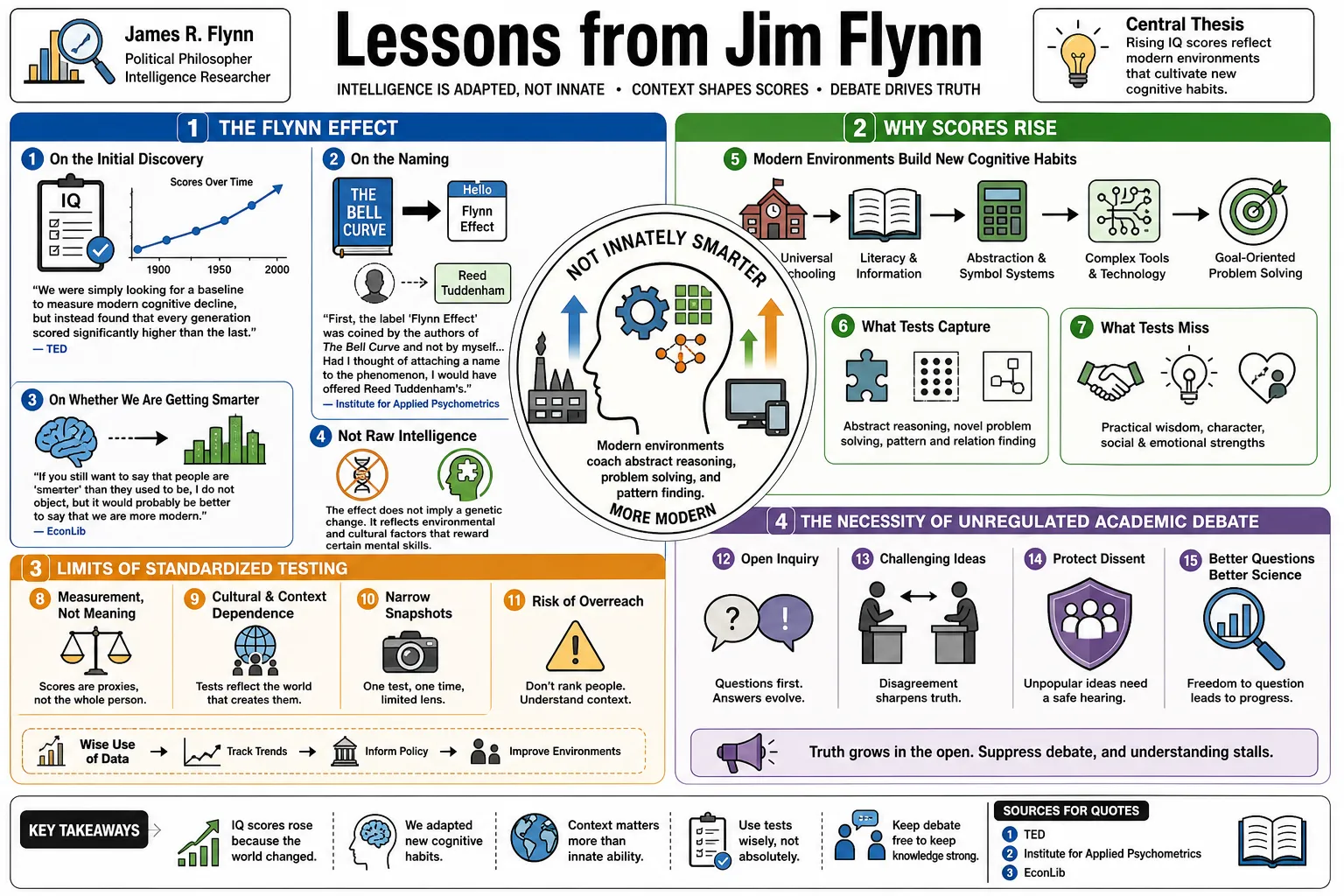
James R. Flynn was a political philosopher and intelligence researcher who documented the "Flynn effect"—the consistent rise in global IQ scores over the twentieth century. Rather than concluding humanity was growing innately smarter, he argued that modern environments forced us to develop new cognitive habits based on abstract logic. This collection gathers his observations on cognitive history, the limitations of standardized testing, and the necessity of unregulated academic debate.
Part 1: The Flynn Effect
- On the initial discovery: "We were simply looking for a baseline to measure modern cognitive decline, but instead found that every generation scored significantly higher than the last." — Source: TED
- On the naming of the effect: "First, the label 'Flynn Effect' was coined by the authors of The Bell Curve and not by myself... Had I thought of attaching a name to the phenomenon, I would have offered Reed Tuddenham’s." — Source: Institute for Applied Psychometrics
- On whether we are getting smarter: "If you still want to say that people are 'smarter' than they used to be, I do not object, but it would probably be better to say that we are more modern." — Source: EconLib
- On raw intelligence versus testing: Higher IQ scores do not mean our ancestors were unintelligent; they simply were not trained to take abstract tests. — Source: American Psychological Association
- On the role of education: The expansion of formal schooling over the twentieth century forced students to adopt test-taking frameworks as a default mode of thinking. — Source: The Guardian
- On generational progress: Our grandparents were intimately familiar with the concrete world, while our world requires us to navigate complex classifications and hypothetical logic. — Source: TED
- On interpreting test gains: We should view rising scores as a cultural artifact documenting how the demands of the workplace and education have shifted over time. — Source: Psychology Today
- On cognitive history: The Flynn Effect is a historical phenomenon, not a biological one, capturing a specific era of industrial and technological transition. — Source: Mensa Foundation
- On the limits of the effect: The massive gains observed in the twentieth century cannot continue forever and have already begun to plateau in some developed nations. — Source: BBC
- On the nature of IQ tests: An IQ test measures how well a person understands the cognitive tools valued by their specific society at a specific moment in time. — Source: In-Sight Publishing
Part 2: Cognitive Evolution and Modernity
- On scientific spectacles: "Modern humans see the world through what I call 'scientific spectacles.' We are comfortable with abstract classification, logic, and hypotheticals." — Source: EconLib
- On concrete thinking: "At the beginning of the century, people were confronted with a concrete world... In today's world we confront a complex world with new habits of mind." — Source: TED
- On the shift in logic: A person from 1900 would refuse to answer a hypothetical question about snow in a place they had never visited, demanding practical relevance instead of logical play. — Source: TED
- On categorization: We now group objects by their abstract functions—like putting dogs and rabbits under 'mammals'—rather than their practical utility, such as using a dog to hunt a rabbit. — Source: Learning and the Brain
- On the cognitive demands of work: The transition from agricultural labor to professional roles meant that everyday survival suddenly required manipulating symbols and abstract concepts. — Source: Cambridge University Press
- On changing leisure: Even our leisure activities, from complex video games to intricate television narratives, demand more working memory and active tracking than pastimes of the past. — Source: The Guardian
- On hypothetical morality: Taking moral principles and applying them to hypothetical scenarios is a modern cognitive habit that enables broader empathy. — Source: TED
- On technological impact: Technology fundamentally alters the cognitive categories we use to organize reality, demanding constant analytical updating. — Source: Psychology Today
- On modern abstraction: "We clothe the concrete world, trying to make it logical and consistent." — Source: TED
- On the flexibility of mind: Human cognition is highly elastic, capable of stretching to meet the specific analytical demands of an industrialized environment. — Source: Mensa Foundation
Part 3: The Social Multiplier
- On environmental feedback: "To distinguish these society-driven feedback loops from those gene-driven feedback loops that favor one individual over another, Dickens and Flynn call them 'the social multiplier'." — Source: Cambridge University Press
- On collective performance: "Its essence is that rising average performance becomes a potent causal factor in its own right." — Source: Cambridge University Press
- On the basketball analogy: "TV is invented and hugely expands interest in basketball. There is an initial rise in average performance that becomes self-fueling." — Source: Scribd
- On peer influence: "We believe that it is not only people's phenotypic IQ that influences their environment, but also the IQs of others with whom they come into contact." — Source: Medium
- On the spread of ideas: "Then someone steals an idea from a player in another city, and it spreads rapidly through the culture." — Source: Scribd
- On rising standards: As society’s average intellectual engagement increases, individuals are forced to adapt to a higher baseline, which pushes the population average even higher. — Source: Milky Eggs
- On environmental triggers: A very small environmental advantage can trigger a feedback loop that results in a massive shift in a group's cognitive performance over time. — Source: Riot IQ
- On group dynamics: The social multiplier explains how entire generations can experience cognitive gains that outpace any plausible genetic timeline. — Source: Psychology Today
- On shared environments: If external factors cause some individuals to improve cognitively, this upgrades the intellectual environment for everyone around them. — Source: Medium
Part 4: The Nature of Intelligence
- On the mind as a muscle: "The mind is more like a muscle than we once believed. It is something that must be constantly exercised to attain and maintain peak fitness." — Source: Goodreads
- On human potential: In What Is Intelligence?, Flynn argues that lasting cognitive gains depend on people continuing to seek cognitively demanding experiences after formal programs end, making intelligence development an ongoing interaction between ability and environment rather than a fixed inheritance. — Reference: Flynn, What Is Intelligence?, on sustaining gains through cognitively demanding experiences
- On the limitations of IQ: General intelligence tests measure a specific set of analytical skills but fail to capture the entirety of human intellect. — Source: University of Otago
- On the definition of intelligence: Intelligence is a complex interaction between brain function and environmental demands, rather than a single biological entity. — Source: In-Sight Publishing
- On working memory: While we have improved dramatically in solving logical puzzles, our baseline working memory capacity has remained relatively unchanged. — Source: Learning and the Brain
- On intellectual autonomy: True intelligence requires the ability to detach from immediate stimuli and direct one's own cognitive focus. — Source: The Psychology Podcast
- On testing bias: IQ tests are biased toward the cognitive habits of modern, industrialized societies, rendering cross-cultural comparisons highly complicated. — Source: The Guardian
- On the fallacy of g-factor: The idea of a general intelligence factor is useful for statistical modeling, but it does not map neatly onto the biological reality of how the brain learns. — Source: In-Sight Publishing
- On skill specialization: Human beings have developed highly specialized cognitive tools tailored to the modern economy, instead of becoming uniformly smarter. — Source: Cambridge University Press
Part 5: Nature Versus Nurture
- On genetic determinism: It is a mistake to assume that because an individual's IQ is highly heritable within a group, group differences themselves must be genetic. — Source: The Guardian
- On the illusion of fixed traits: Genetic advantages operate by pushing individuals toward environments that multiply those advantages, rather than acting as a fixed ceiling. — Source: Medium
- On overcoming genetics: Massive generational shifts in IQ prove that environmental changes can completely overwhelm genetic inheritance over a short period. — Source: Psychology Today
- On family influence: Dickens and Flynn’s IQ-paradox model treats family background as only part of the story: people’s IQs are shaped by both genes and environments, and those environments tend to become matched to ability in ways that can amplify cognitive development over time. — Reference: PubMed abstract for Dickens and Flynn on genes, environments, and matched IQ environments
- On race and IQ: Persistent gaps in test scores among different populations are better explained by systemic environmental differences and cultural histories than by genetic disparity. — Source: University of Cambridge
- On individual multipliers: A slight genetic advantage for reading can lead a child to seek out books, creating an environmental multiplier effect that exaggerates the initial genetic difference. — Source: Cambridge University Press
- On the complexity of causation: Untangling genes from environment is nearly impossible because our genetics actively shape the environments we select. — Source: The Psychology Podcast
- On the plasticity of age: Cognitive ability remains malleable throughout adulthood, entirely dependent on how aggressively an individual challenges their own mind. — Source: Mensa Foundation
- On the ultimate balance: Genes determine the size of the muscle, but the environment determines whether that muscle is ever flexed or developed. — Source: Goodreads
Part 6: Morality, Philosophy, and Wisdom
- On philosophical discipline: "I am too much in love with philosophy to collect data or do field studies." — Source: Goodreads
- On wisdom vs. intelligence: "Our obsession with IQ is one indication that rising wisdom has not characterized our time." — Source: University of Cambridge
- On moral philosophy: His primary academic identity was always that of a moral philosopher; the data on intelligence was merely a tool to understand human flourishing. — Source: In-Sight Publishing
- On practical reasoning: A high IQ does not guarantee that a person will make ethical choices or possess the practical reasoning required to lead a good life. — Source: Scribd
- On the purpose of knowledge: Raw analytical ability is useless unless it is directed by a strong philosophical framework and a commitment to humanistic values. — Source: Goodreads
- On critical acumen: Modern society produces many people capable of complex technical feats, but very few who possess the historical context to critique society itself. — Source: University of Cambridge
- On the danger of technical minds: A society that optimizes for abstract logic without equal emphasis on ethical reasoning risks producing highly capable architects of disaster. — Source: TED
- On human autonomy: The ultimate goal of cognitive development should not be higher test scores, but the achievement of true intellectual and moral autonomy. — Source: The Psychology Podcast
- On philosophical debate: The truest test of intellect is the willingness to submit one's core moral beliefs to rigorous philosophical scrutiny. — Source: Goodreads
Part 7: Free Speech and the Right to Offend
- On the necessity of debate: "There is no substitute for someone of great intellectual caliber who disagrees with you." — Source: Wikiquote
- On the nature of liberty: "If liberty means anything at all, it means the right to tell people what they do not want to hear." — Source: Why Evolution Is True
- On the right to be offended: "Anyone has the right to be offended. But, particularly at university, they have not got the right to use that as a criterion for what can be discussed." — Source: Heretica
- On censorship on campus: "Freedom to debate is essential to the development of critical thought, but on university campuses today free speech is restricted for fear of causing offence." — Source: Quillette
- On patronizing assumptions: Censoring hateful words relies on the patronizing assumption that adults lack the agency to hear bad ideas without automatically adopting them. — Source: Why Evolution Is True
- On political hypocrisy: Neither the extreme left nor the extreme right possesses a principled commitment to free speech; they both censor aggressively the moment they secure institutional power. — Source: Trouble Magazine
- On intellectual resilience: Shielding students from offensive concepts guarantees they will graduate without the intellectual resilience required to navigate a pluralistic society. — Source: Goodreads
- On the danger of self-censorship: When society punishes unpopular opinions, the greatest casualty is the public, who is deprived of the opportunity to test their own beliefs. — Source: Kiwiblog
- On publishing risks: The refusal of publishers to print controversial arguments is a betrayal of the public square and a capitulation to social panic. — Source: The Critic
Part 8: Academic Freedom and Debate
- On the role of universities: "Any university unwilling to stand up for free and open debate is, ultimately, unworthy of the name." — Source: WordPress
- On the pursuit of truth: "It is, without doubt, one of the most important intellectual lessons... that truth is the product of free and open debate." — Source: Blogspot
- On controversial topics: "There are almost no courses on intelligence in Psychology departments in America. When I ask staff why, they give the same answer: what if a student raised a hand and said, what do you think about the race and IQ debate?" — Source: Wikiquote
- On engaging with opponents: Isolating controversial figures only hardens their resolve and protects their errors from scrutiny. — Source: In-Sight Publishing
- On ideological conformity: Academic institutions have increasingly prioritized ideological comfort over the disruptive and difficult process of finding the truth. — Source: Quillette
- On the scientific method: You cannot claim a scientific consensus if the institutions conducting the research actively penalize scholars who attempt to falsify the prevailing theory. — Source: Cambridge University Press
- On the duty of scholars: A scholar's primary obligation is to follow the data wherever it leads, regardless of the political inconvenience of the destination. — Source: Learning and the Brain
- On institutional fear: When universities cancel speakers, they teach students that force and administrative power are legitimate substitutes for evidence and logic. — Source: Goodreads
- On evaluating evidence: To properly evaluate an argument, one must read the best defense written by its most capable proponent. — Source: The Psychology Podcast
- On intellectual legacy: The highest compliment an academic can receive is not agreement, but the acknowledgment that their work demanded a serious and rigorous response. — Source: University of Otago