Jim Loehr (d. 2026) was a performance psychologist whose mental-toughness and energy-management training reached athletes, business leaders, military teams and medical professionals. — USTA Coaching Remembrance.
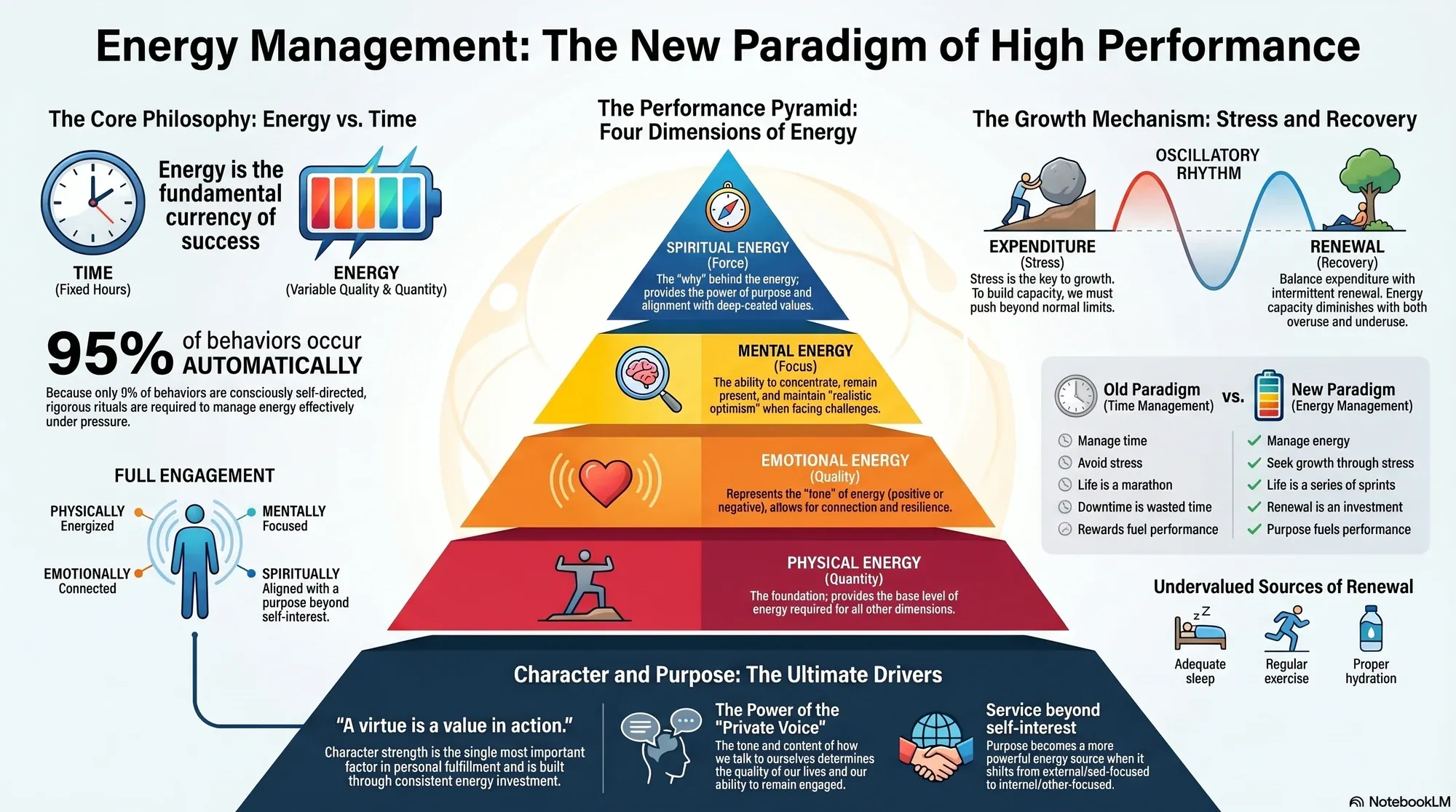
On Energy Management: The Core of High Performance
Managing energy rather than only allocating hours is the central premise of Loehr and Schwartz’s full-engagement framework. — The Power of Full Engagement — Book Excerpt.
- Energy is the performance currency: Loehr and Schwartz place the energy brought to an activity ahead of the number of hours allotted to it. — The Power of Full Engagement — Book Excerpt.
- Time is fixed; energy varies: A day has a fixed duration, while the quantity and quality of available energy can change. — The Power of Full Engagement — Book Excerpt.
- Full engagement spans four dimensions: Their ideal of full engagement combines physical vitality, emotional connection, mental focus and purpose beyond immediate self-interest. — The Power of Full Engagement — Book Excerpt.
- Own the energy you bring: Loehr and Schwartz urge people to take responsibility for the energy they contribute to work and relationships. — The Power of Full Engagement — Book Excerpt.
- Manage energy for life, not just output: Their framework presents energy management as relevant to performance, health and happiness, not merely productivity. — The Power of Full Engagement — Book Excerpt.
- Recovery belongs in performance: The authors argue that relentless activity without renewal is at odds with sustained engagement. — The Power of Full Engagement — Book Excerpt.
- Value the energy within the hour: For a client or project, Loehr emphasizes focus and quality of energy over the sheer hours spent. — CBS MoneyWatch Interview.
- Presence is more than attendance: A scheduled meeting or family dinner adds little if attention and energy are elsewhere. — CBS MoneyWatch Interview.
The Four Dimensions of Energy
Their model distinguishes four related dimensions of energy: physical, emotional, mental and spiritual. — The Power of Full Engagement — Book Excerpt.
- Draw on all four energy sources: The authors describe physical, emotional, mental and spiritual energies as related sources that must be managed together. — The Power of Full Engagement — Book Excerpt.
- Physical energy supplies quantity: In the authors’ framework, physical capacity is the quantity of energy available for action. — The Power of Full Engagement — Book Excerpt.
- Emotional energy shapes quality: Their framework treats emotional energy as positive or negative in quality. — The Power of Full Engagement — Book Excerpt.
- Mental energy directs focus: Their full-engagement model asks people to direct attention to the task rather than merely remain busy. — The Power of Full Engagement — Book Excerpt.
- Purpose gives energy direction: The authors connect the spiritual dimension to meaning and a purpose beyond immediate self-interest. — The Power of Full Engagement — Book Excerpt.
Stress, Recovery, and Building Capacity
Their training model pairs deliberate stress or expenditure with recovery; neither constant exertion nor constant rest builds sustainable capacity. — The Power of Full Engagement — Book Excerpt.
- Alternate expenditure and renewal: Capacity can decline with overuse or underuse; Loehr and Schwartz therefore pair effort with intermittent recovery. — The Power of Full Engagement — Book Excerpt.
- Stress can serve growth when followed by recovery: The authors treat appropriately bounded stress as a training stimulus, not a reason to eliminate all demands. — The Power of Full Engagement — Book Excerpt.
- Apply the rhythm across dimensions: They extend cycles of effort and recovery beyond the physical to emotional, mental and purpose-driven activity. — The Power of Full Engagement — Book Excerpt.
- Build capacity through systematic challenge: The authors compare capacity-building to athletic training: gradually push beyond familiar limits, then recover. — The Power of Full Engagement — Book Excerpt.
- Accept short-term discomfort for capacity: Their model asks for tolerable challenge in service of longer-term growth, provided recovery follows. — The Power of Full Engagement — Book Excerpt.
- Train nonphysical capacities too: Loehr and Schwartz describe empathy, patience, focus, creativity and integrity as capacities that can be practiced, using a muscle metaphor. — The Power of Full Engagement — Book Excerpt.
- Recovery protects judgment: In their coauthored Wise Decisions, Loehr and Sheila Ohlsson Walker warn that stress without recovery can undermine wiser choices. — Wise Decisions — Chapter 13.
The Power of Rituals
Loehr and Schwartz use specific positive rituals to make energy-management choices repeatable. — The Power of Full Engagement — Book Excerpt.
- Use positive energy rituals: Highly specific routines are a central means of managing energy in the authors’ full-engagement framework. — The Power of Full Engagement — Book Excerpt.
- Give recovery a structure: Regular routines can make deliberate rest and renewal more dependable than ad hoc willpower. — The Power of Full Engagement — Book Excerpt.
- Make rituals precise: The authors recommend defining concrete behaviors and times rather than relying on a vague intention to change. — The Power of Full Engagement — Book Excerpt.
- Make helpful habits automatic: The source supports their claim that repeated rituals can reduce the conscious effort needed for helpful behavior; it does not establish the captured 5%/95% statistic. — The Power of Full Engagement — Book Excerpt.
On Mental and Emotional Toughness
Loehr’s mental-toughness work addresses attention, self-talk and emotional response alongside physical preparation. — CBS MoneyWatch Interview.
- Train attention as well as the body: Loehr includes mental presence alongside sleep, exercise and other physical foundations in his performance training. — CBS MoneyWatch Interview.
- Coach the private voice: Loehr asks athletes to notice the tone and content of their self-talk and make it as constructive as advice to someone they care about. — Tim Ferriss Interview.
- Write down unhelpful self-talk: Loehr suggests recording moments of harsh self-talk so people can recognize and change the pattern. — Tim Ferriss Interview.
- Look for learning under pressure: In a stressful situation, Loehr encourages a constructive response that asks what can be learned rather than dwelling only on threat. — CBS MoneyWatch Interview.
- Prepare the next response: Loehr’s approach includes deliberate mental preparation, focus and a positive self-response between performance demands. — USTA Coaching Remembrance.
- Model constructive energy as a leader: Loehr and Schwartz argue that leaders affect others first through their own energy and then through how they mobilize the group’s energy. — The Power of Full Engagement — Book Excerpt.
- Face the truth before changing habits: Their Purpose–Truth–Action process asks people to examine how they currently invest energy before building new rituals. — The Power of Full Engagement — Book Excerpt.
- Pair honesty with empathy: In his account of character, Loehr includes honesty and empathy together in how people connect with and treat others. — Loehr on Character and Success.
Purpose, Values, and Character
In Loehr’s later work, character and purpose matter alongside achievement, especially in how people treat others. — Loehr on Character and Success.
- Let purpose reach beyond self-interest: The authors describe service to others or a larger cause as part of full engagement. — The Power of Full Engagement — Book Excerpt.
- Let values guide energy investment: Loehr asks people to connect daily energy expenditure with deeply held values and a purpose that matters beyond achievement alone. — Tim Ferriss Interview.
- Put values into action: Loehr treats the way a person pursues success—not just the result—as a measure of character. — Loehr on Character and Success.
- Practice gratitude deliberately: Loehr describes a daily gratefulness reflection as one way to cultivate empathy and compassion under pressure. — CBS MoneyWatch Interview.
- Character matters to sustained success: Loehr’s later work argues that strong character is important to long-term achievement, fulfillment and relationships. — Loehr on Character and Success.
- Train character through repeated investment: Loehr distinguishes performance strengths from moral and ethical strengths and proposes deliberate practice of the latter. — Tim Ferriss Interview.
- Protect identity beyond the scoreboard: Loehr’s former collaborator Carlos Salum recalls that their work prioritized the whole athlete over records, money or fame. — Carlos Salum’s Firsthand Remembrance.
Practical Learnings and Insights
- Guard attention against task-switching: Loehr discourages trying to do many attention-demanding tasks at once and suggests boundaries around email and devices. — CBS MoneyWatch Interview.
- Include hydration in physical renewal: Loehr lists hydration with sleep, exercise, nutrition and rest as basic elements of his physical-energy training. — CBS MoneyWatch Interview.
- Do not sacrifice basic recovery under pressure: When demands rise, Loehr’s framework still makes sleep, exercise and intermittent rest part of the training plan. — CBS MoneyWatch Interview.
- Invest in relationship rituals: The authors include predictable time and attention for family relationships among positive energy rituals. — The Power of Full Engagement — Book Excerpt.
- What you repeatedly invest in grows: Loehr’s energy-investment metaphor applies to helpful and unhelpful habits alike. — Tim Ferriss Interview.
- Do not postpone fulfillment until another win: Loehr argues that an additional accolade or financial milestone does not by itself supply lasting fulfillment. — Loehr on Character and Success.
- Find a pursuit worth risking for: Loehr encourages choosing an area that invites meaningful risk and genuinely engages your interest. — Elite Performance Psychology Interview.
- Listen before diagnosing: Carlos Salum recalls Loehr building athletes’ trust through deep listening and tactful questions before proposing solutions. — Carlos Salum’s Firsthand Remembrance.
Learn more:
- Jim Loehr and Tony Schwartz — The Power of Full Engagement, chapter-one excerpt
- CBS MoneyWatch — Jim Loehr: Train for Success Like a Pro Athlete
- Jim Loehr — About the Author
- Jim Loehr — 40 Years of Training the Biggest Names in Business and Sports Taught Me This
- USTA Coaching — Jim Loehr’s Lasting Lessons for Tennis Coaches
- Carlos Salum — Dr. James Loehr: In Memoriam
- Jim Loehr and Sheila Ohlsson Walker — Wise Decisions, Chapter 13: The Inner Voice and Managing Stress
- Jim Loehr — Elite Performance Psychology for Sports, Business and Life (Interview)
- The Tim Ferriss Show #490 — Jim Loehr Interview Transcript
- Jim Loehr — Books